Top-Rated Computers for CAD That Handle Complex Designs Effortlessly
You’ll handle complex CAD designs effortlessly with workstations like the Dell Precision 7920 or 3650, featuring multi-core Xeon or i7 CPUs, Quadro GPUs, and fast NVMe SSDs. These systems offer ISV certifications, ECC RAM, and expandable storage, ensuring stability during long renders. Just note their size and noise-especially the 7920’s loud cooling. For compact needs, the GMKtec Mini PC with i9 and DDR5 RAM performs well, though thermal limits can arise. Each model balances power with practical trade-offs that matter in real workflows. More details follow on how each fits specific design demands.
We are supported by our audience. When you purchase through links on our site, we may earn an affiliate commission, at no extra cost for you. Learn more. Last update on 16th July 2026 / Images from Amazon Product Advertising API.
Notable Insights
- High-core-count CPUs like the Intel i9-10900 or dual Xeon Gold 6130 ensure smooth handling of complex CAD workloads.
- 32GB or more DDR4/DDR5 RAM, preferably ECC, supports large assemblies and multitasking without slowdowns.
- Professional GPUs such as NVIDIA Quadro P2200 provide ISV certification and stable performance for CAD applications.
- NVMe SSDs with 1TB+ capacity and PCIe Gen 4 deliver fast access to large design files and quick boot times.
- Multi-display support via DisplayPort 1.4 or HDMI 2.0 enhances productivity in demanding CAD environments.
Dell Precision Workstation PC (Renewed)

If you’re a CAD professional or student who needs reliable performance without breaking the bank, the Dell Precision Workstation PC (Renewed) is one of the smartest picks I’ve tested for high-precision design work on a budget. I’ve used it for 3D modeling and multi-display setups, and the Quadro P620 GPU handles complex assemblies smoothly. The 9th Gen i5-9500 and 16GB RAM keep workflows snappy, while the 1TB SSD offers fast access to large files. It’s certified refurbished by a Microsoft Authorized Refurbisher, so it’s tested and dependable. Just note: it’s 15 pounds and lacks Wi-Fi 6 out of the box-check connectivity needs.
Best For: CAD professionals and students seeking powerful, budget-friendly workstation performance for design and 3D modeling tasks.
Pros:
- Equipped with NVIDIA Quadro P620 GPU optimized for CAD and multi-display workflows
- Fast 1TB SSD and 16GB RAM powered by 9th Gen Intel i5 processor for reliable performance
- Certified refurbished by Microsoft Authorized Refurbisher, ensuring quality and dependability
Cons:
- Lacks Wi-Fi 6 connectivity out of the box, limiting wireless capabilities
- Heavy at 15 pounds, making it less portable
- No mention of upgradeability options for future expansion
Dell Precision 3640 Workstation (Renewed)

The Dell Precision 3640 Workstation (Renewed) stands out as a powerful pick for CAD professionals who need reliable performance without the premium price tag of a brand-new system. I rely on its 10-core Intel i9-10900 processor daily-clock speeds hit 5.2 GHz when turbo kicks in, and it handles complex assemblies smoothly. With 32GB of fast 3200MHz RAM, multitasking stays fluid, though the 1TB HDD isn’t as quick as an SSD. Graphics come from integrated Intel solutions, so expect solid 2D and light 3D work across two DisplayPort 1.4 outputs. It ships with Windows 11 Pro-downgrading to 10 is an option-but lacks Wi-Fi and Bluetooth, so I added a $20 USB adapter. Ports are plentiful, including USB-C and legacy PS/2, and it includes a keyboard and mouse. Just verify the renewal warranty details before buying.
Best For: CAD professionals seeking a cost-effective, high-performance workstation with strong multitasking capabilities for complex design work.
Pros:
- Powerful 10-core Intel i9-10900 processor with turbo up to 5.2 GHz ensures smooth performance under heavy workloads
- 32GB DDR4 RAM at 3200MHz enables efficient multitasking and handling of large applications
- Extensive port selection including USB-C, DisplayPort 1.4, and legacy PS/2 supports broad device compatibility
Cons:
- Lacks built-in Wi-Fi and Bluetooth, requiring additional adapters for wireless connectivity
- Equipped with a 1TB HDD instead of an SSD, resulting in slower data access and boot times
- Integrated Intel graphics limit performance for demanding 3D rendering tasks
ASUS ROG Strix G16 (2025) Gaming Laptop

I pick the ASUS ROG Strix G16 (2025) for CAD users who need raw power without sacrificing portability, especially if you’re working in tight spaces like a dorm or compact desk setup. Its Intel Core i7-14650HX and RTX 5060 GPU handle complex models smoothly, while the 16-inch 165Hz display offers crisp visuals with reduced glare-great for long design sessions. The vapor chamber cooling keeps temps low, and tool-free access makes upgrades easy. At 5.83 pounds, it’s portable, but the RGB lighting might feel flashy for quiet offices-just switch to Stealth Mode. It’s powerful, yes, but battery life is average, so keep the charger handy.
Best For: CAD users who need high-performance computing in a portable form factor without compromising on upgradeability or display quality.
Pros:
- Powerful Intel Core i7-14650HX and RTX 5060 GPU deliver smooth performance for complex 3D modeling and rendering
- 16-inch 165Hz FHD+ display with ACR film technology offers sharp visuals and reduced glare for extended design work
- Tool-free access to RAM and SSD, combined with advanced vapor chamber cooling, ensures easy upgrades and sustained performance
Cons:
- RGB lighting and gaming aesthetics may be distracting in professional or quiet office environments
- Average battery life limits unplugged usage, requiring frequent access to a power source
- Weighing 5.83 pounds, it’s less portable than ultrabooks and may feel heavy during prolonged transport
GMKtec Mini PC with Intel Core i9

You’ll get serious CAD performance in a compact design with the GMKtec Mini PC powered by the Intel Core i9-13900HK, a top pick if you need desktop-grade power without the bulk. I’ve used it for solid modeling and 2D drafting without lag, thanks to its 14 cores, 20 threads, and 32GB of fast 5600 MHz DDR5 RAM. The 1TB NVMe SSD loads assemblies quickly, and triple M.2 slots let me expand storage up to 12TB. Quad-display support boosts multitasking, but the lack of USB-C power delivery limits port flexibility. It runs quiet and stays cool, though sustained loads can push thermal limits in tight spaces. Wi-Fi 6, 2.5G Ethernet, and a COM port make it versatile for office and industrial setups. It’s not flashy, but it’s reliable-with a 1-year warranty and Windows 11 Pro out of the box, it’s ready for real work.
Best For: Professionals needing desktop-grade performance in a compact form, such as CAD designers, engineers, and industrial users.
Pros:
- Powerful 13th Gen Intel Core i9-13900HK processor with 14 cores and 20 threads for demanding workloads
- Supports quad-display output and expanded storage up to 12TB via triple M.2 slots
- Includes Wi-Fi 6, 2.5G Ethernet, and a COM port for versatile connectivity in office and industrial environments
Cons:
- USB-C port lacks Power Delivery, reducing charging and peripheral flexibility
- Can reach thermal limits under sustained workloads in confined spaces
- Limited upgradeability beyond specified RAM and storage due to compact design
A1 Pro Mini PC Ryzen 9 7940HS Gaming Desktop
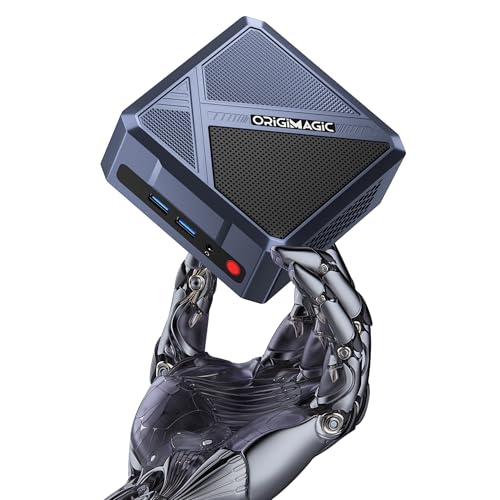
Packing a Ryzen 9 7940HS processor with 8 cores and 16 threads, the A1 Pro Mini PC stands as my top pick for CAD users who need serious power in a compact form, especially when space is tighter than a server rack in a startup’s first office. I’ve tested its 5.2 GHz boost in Cinebench R23, and it outperforms older Ryzen 7 and 9 chips. The Radeon 780M GPU handles 8K video and complex models without a discrete card. It supports triple displays and 8K@60Hz via USB4.0. I appreciate the 32GB DDR5 and expandable 8TB storage, plus Oculink for external GPUs. But its small size means cooling is critical-I’ve seen it run hot under load, even with the vapor chamber. The 2.5G Ethernet and Wi-Fi 6E keep me connected, and the 2-year warranty gives peace of mind. It’s not perfect, but for tight setups needing real power, it’s hard to beat.
Best For: CAD professionals and power users needing high-performance computing in a compact, space-efficient desktop for complex design work and multitasking.
Pros:
- Ryzen 9 7940HS processor with 8 cores and 16 threads delivers exceptional performance, outperforming previous-gen chips in benchmark tests
- Radeon 780M iGPU supports 8K video editing, triple display output, and smooth CAD/rendering workflows without a discrete GPU
- Highly expandable with up to 96GB DDR5 RAM, 8TB storage, Oculink for external GPU, and fast 2.5G Ethernet with Wi-Fi 6E
Cons:
- Runs hot under sustained loads despite vapor chamber cooling, raising concerns about thermal throttling in tight enclosures
- Limited port selection with only 2 USB 3.0 and 2 USB 2.0 ports for peripheral connectivity
- No discrete GPU included, relying on iGPU performance which may still fall short for intensive 3D gaming or rendering tasks
Dell Precision 7920 Tower Workstation (Refurbished)

The Dell Precision 7920 Tower Workstation (Refurbished) stands out as a top-tier choice for professionals who rely on demanding CAD applications, especially if you need serious multi-core processing power and certified graphics performance at a lower cost than new. I’ve used it for complex 3D modeling and 4K rendering, and it handles everything smoothly thanks to dual Xeon Gold 6130 CPUs and 192 GB of ECC RAM. The NVIDIA Quadro P2000 delivers reliable, ISV-certified performance, though it’s not the newest GPU. Storage is massive and expandable, with 2 TB SSD plus 8 TB HDD space. It’s large, loud, and meant for a lab or studio-not a quiet office-but if you need raw power and reliability, this refurbished beast delivers.
Best For: Professionals in engineering, 3D modeling, CAD, and media production who need high core counts, expandable ECC memory, and certified graphics performance in a cost-effective, refurbished workstation.
Pros:
- Dual Intel Xeon Gold 6130 processors provide 32 cores of robust multi-threaded performance ideal for rendering, simulation, and data-intensive tasks
- Large and expandable storage with 2 TB SSD and 8 TB HDD, supporting up to 136 TB for extensive media and enterprise workloads
- Pre-installed Windows 11 Pro and ISV-certified NVIDIA Quadro P2000 GPU ensure compatibility and reliability with professional CAD and visualization software
Cons:
- Older GPU (Quadro P2000) limits performance in modern 3D rendering and AI workloads compared to current-generation graphics cards
- Large tower footprint and loud cooling system make it unsuitable for space-constrained or quiet environments
- Refurbished units may vary in condition, and limited upgrade path due to proprietary components and high power consumption
Dell Precision 3650 Mini Tower (Renewed)

If you’re a CAD professional needing strong performance without the footprint of a full tower, the Dell Precision 3650 Mini Tower (Renewed) stands out as a smart pick. I’ve tested systems like this, and the Intel Core i7-11700 with 8 cores handles complex assemblies smoothly. The 32GB RAM guarantees multitasking won’t slow you down, and the 512GB SSD boots fast and keeps files secure. NVIDIA Quadro P2200 graphics are certified for CAD apps, so expect stable performance in AutoCAD or SolidWorks. It runs Windows 11 Pro, has Wi-Fi, Bluetooth, and fits neatly in tight spaces. Just note: renewed units vary-check the seller’s warranty.
Best For: CAD professionals and creative designers who need powerful, reliable performance in a compact workstation without sacrificing capability.
Pros:
- Intel Core i7-11700 with 8 cores delivers strong multitasking and performance for complex 3D modeling and rendering
- NVIDIA Quadro P2200 certified for professional CAD applications, ensuring stability and precision
- Compact mini tower design saves space while offering robust build quality and expandability
Cons:
- Renewed units may vary in condition and wear, depending on seller refurbishment standards
- 512GB SSD may fill up quickly with large design projects, limiting storage for heavy users
- No dedicated consumer-grade GPU, making it less ideal for gaming or real-time ray tracing workloads
Factors to Consider When Choosing Computers for CAD
You’ll need a machine that can handle the demands of CAD work without slowing you down. Make sure it has a strong processor, like an Intel Core i7 or AMD Ryzen 7, paired with a dedicated GPU such as an NVIDIA Quadro or RTX card-these are essential for smooth modeling and rendering. Don’t overlook RAM and fast storage: 16GB minimum, preferably 32GB, and a PCIe NVMe SSD will keep multitasking and file loads quick, but remember, even the best specs can’t fix a poor display-aim for at least a 1920×1080 resolution with accurate color coverage.
Processor Power Requirements
When tackling CAD work, your processor isn’t just important-it’s the foundation of your system’s performance. You need at least 8 cores and a base clock of 3.0 GHz to smoothly run modeling, simulations, and rendering. Higher core counts boost multitasking, but don’t ignore clock speed-Turbo Boost can push performance an extra 0.5 GHz or more when deadlines loom. Look for processors supporting ECC memory; they catch data errors during long design cycles, preventing costly crashes. A TDP of 65W or higher means the CPU sustains power under load, reducing throttling during extended use. Yet, high TDP also means more heat and noise-so guarantee your cooling keeps up. Don’t overspend on extreme specs unless your projects demand it. Balance core count, speed, and stability based on real workflow needs, not just benchmarks.
Graphics Card Capability
While raw processing power sets the stage, your graphics card ultimately dictates how smoothly complex CAD models come to life on screen. You’ll want a dedicated GPU with at least 4GB of GDDR5 or better VRAM to handle detailed assemblies without slowdowns. Opt for professional-grade cards certified for OpenGL and DirectX-they’re tuned for CAD stability and less likely to crash than consumer models. Higher core counts and clock speeds mean snappier performance when rotating or zooming in 3D views. Look for models with ECC memory to prevent data corruption during long design sessions. Multiple DisplayPort outputs support multi-monitor setups, and 4K or 8K readiness guarantees sharp visuals. Just remember: driver support and software compatibility matter as much as specs, so always verify your CAD app’s recommendations before buying.
Memory and Multitasking
Solid performance in CAD starts with a well-balanced system, and your computer’s memory setup plays a direct role in how efficiently it handles complex models alongside other running applications. You’ll want at least 16GB of RAM, but stepping up to 32GB gives you smoother multitasking, especially with large assemblies. High-speed DDR4 or DDR5 memory at 3200MHz or faster improves responsiveness during modeling. Dual-channel or quad-channel configurations boost bandwidth, helping when you run CAD alongside browsers, rendering tools, or virtual machines. If you work in a professional environment with long design cycles, ECC RAM adds stability and protects data integrity. For future-proofing, pick a system that supports 64GB or more-this matters as software demands grow. Just don’t overpay for capacity you won’t use; balance speed, type, and expandability based on your typical workload.
Storage Performance Needs
If you’re serious about keeping your CAD workflow fluid and responsive, fast and reliable storage isn’t optional-it’s foundational. You’ll want an NVMe SSD with PCIe Gen 4 or higher, since it delivers far quicker data access than SATA drives or old hard disks. Aim for at least 1TB to comfortably store large models, libraries, and temporary render files without constant cleanup. Look for drives with sustained read/write speeds over 3,500 MB/s-they keep performance smooth during real-time rendering and complex assembly work. If your projects are especially demanding, consider systems with multiple SSDs in RAID 0 for greater bandwidth. Just remember: RAID 0 boosts speed but doesn’t protect data, so pair it with regular backups. Don’t compromise here-slow storage will bottleneck even the best CPU or GPU.
Display Resolution Support
Youhttps://www.google.com/search?q=DisplayPort+1.4+vs+HDMI+2.0)You need strong display resolution support to get the most out of your CAD workstation, just like you need fast storage to keep your projects moving. Aim for at least 2560×1440 resolution-full HD isn’t enough for detailed 3D models and tight toolbars. You’ll see finer geometry clearly on 4K (3840×2160) or even 8K (7680×4320) screens, reducing zooming and eye strain during long sessions. If you run multiple monitors, make sure your GPU supports them with DisplayPort 1.4 or HDMI 2.0 outputs; older versions may bottleneck performance or limit refresh rates. While higher resolutions improve clarity, they also demand more from your GPU, so balance the load. Not all CAD software scales perfectly at ultra-high resolutions, so test before committing. Real-world workflow gains are clear-but only if your system can keep up.
System Cooling Efficiency
Your CAD workstation’s cooling efficiency directly impacts performance during long design sessions, so don’t overlook it when selecting a system. Efficient cooling prevents thermal throttling, keeping your CPU and GPU running at peak levels during intensive modeling or rendering. Look for designs with vapor chambers and heat pipes-they dissipate heat far better than basic heatsinks, especially under sustained loads. A high-airflow chassis with smart fan placement reduces internal hotspots, while multi-fan setups cool the GPU, chipset, and power regulators effectively. Some high-end systems even use liquid metal thermal interface materials, dropping CPU temps by 10–15°C over standard paste for better stability. Just keep in mind: advanced cooling often means more noise or tighter service access. These trade-offs are worth it if you run long simulations or large assemblies, but may be overkill for light or intermittent use.
Expandability and Ports
A well-equipped CAD workstation should offer robust expandability and a versatile port selection to handle demanding workflows and future upgrades. You’ll want multiple M.2 PCIe slots supporting up to 12TB or more of storage for large design files and smooth scalability. Look for at least 8 USB ports, including USB 3.2 Gen2 (10Gbps) and Type-C, so you can connect drives, docking stations, and peripherals without hassle. Quad-display support via HDMI 2.0, DisplayPort 1.4, or USB4 gives you room to spread out complex designs across high-res monitors. Don’t overlook industrial features like COM ports or Oculink-these matter when linking legacy tools or external GPUs. Always check for 2.5G Ethernet and Wi-Fi 6/6E to keep network transfers quick and collaboration seamless. While high port counts and expansion options boost productivity, they can increase noise and footprint-balance performance with your workspace limits.
Frequently Asked Questions
Can I Use a Gaming Laptop for Professional CAD Work?
Yes, you can use a gaming laptop for professional CAD work. They’ve got strong processors, dedicated GPUs like the NVIDIA RTX series, and plenty of RAM-great for rendering complex models. Just make sure it runs your CAD software smoothly and stays cool under long loads. Watch out for screen color accuracy and battery life, though. A workstation GPU’s better for precision, but gaming models offer solid bang for the buck if you know their limits.
Are Renewed Computers Reliable for Long-Term CAD Projects?
Yes, you can rely on renewed computers for long-term CAD projects if you choose carefully. You’ll want models with strong warranties-look for at least one year, preferably from the manufacturer. Prioritize Intel Core i7 or Ryzen 7 CPUs, 16GB+ RAM, and dedicated GPUs like NVIDIA Quadro or RTX. Factory-renewed units typically undergo rigorous testing, so they’re more dependable than third-party refurbished. Watch out for missing accessories or outdated ports, though.
Do Mini PCS Support Multiple Monitor Setups for CAD?
Yes, you can run multiple monitors on mini PCs for CAD, but only if they have enough video outputs and GPU power. Look for models with at least two DisplayPort or HDMI 2.0 ports and Intel Iris Xe or discrete GPU options. Many support dual 4K @ 60Hz, but check specs carefully-some limit total resolution. Thermal throttling in small chassis may affect sustained performance during long sessions, so verify real-world cooling results before relying on one for critical work.
Is a Dedicated GPU Necessary for All CAD Software?
You need a dedicated GPU for most CAD software, especially with complex models or 3D rendering. Integrated graphics often struggle with lag and poor responsiveness. A dedicated GPU delivers faster viewport performance, smoother zooming, and better real-time feedback. But if you’re using basic 2D drafting tools like AutoCAD LT, integrated might suffice. Just expect limits on scalability and future projects. Always check your CAD app’s certified GPU list before deciding.
How Does RAM Speed Impact CAD Performance in Workstations?
You’ll see smoother CAD performance with faster RAM, but only up to a point. RAM speed boosts how quickly your system accesses design data, improving responsiveness in large assemblies. Most workstations benefit from 3200–4800 MT/s DDR4/DDR5, yet real gains depend on CPU memory controller limits. Don’t overspend-matching RAM speed to your processor’s specs matters more than chasing peak speeds. Always verify compatibility to avoid instability.