Choosing the Right Surge Protection Devices for Office Equipment Reliability
You need a surge protector with at least 1000 joules and clamping voltage under 400V to effectively shield your office equipment from voltage spikes. Look for UL 1449 certification-don’t confuse power strips without joule ratings for real protection. While SPDs can’t stop direct lightning strikes, they reduce damage from grid surges. Avoid daisy-chaining units to prevent overheating. Models with warranties covering connected gear offer added peace of mind-if their specs hold up over time, you’ll see fewer costly failures.
Notable Insights
- Select surge protectors with at least 1000 joules of energy absorption for reliable office equipment protection.
- Ensure clamping voltage is under 400V to enable fast response to voltage spikes and minimize damage risk.
- Verify UL 1449 certification to confirm the device meets safety and performance standards for surge protection.
- Use layered protection by installing whole-building suppressors and point-of-use surge protectors at workstations.
- Avoid daisy-chaining; connect sensitive equipment directly to UL-certified surge protectors to prevent overheating and failure.
Why Office Equipment Needs Surge Protection
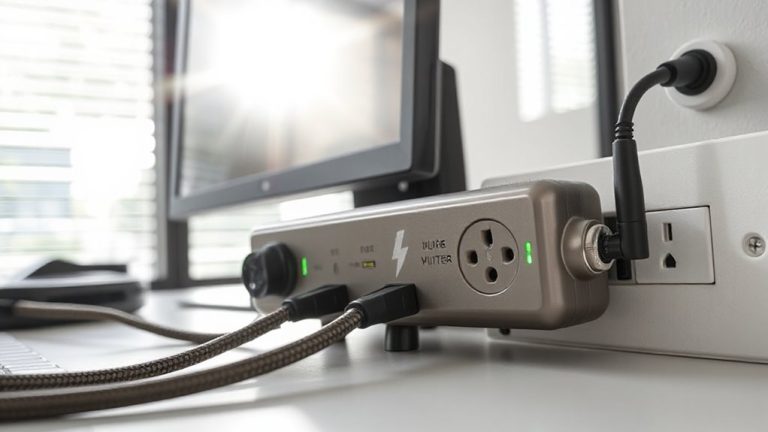
Ever wonder why your office gear keeps failing after a storm? Electrical storms generate voltage spikes that easily overwhelm sensitive electronics. Your router, printer, or workstation isn’t just inconvenient to replace-most modern equipment has high equipment sensitivity, meaning even minor surges degrade performance over time. Without protection, you’re risking data loss and shortened lifespans across devices. Surge protection devices (SPDs) act as essential shields, diverting excess voltage before it reaches your gear. Look for models with clear indication lights and durable housing-plastic enclosures crack, leaving circuits exposed. Note: not all power strips offer surge protection. Check for a listed joule rating and UL 1449 certification. While SPDs aren’t foolproof during direct lightning strikes, they drastically reduce risk from typical grid fluctuations. Pair them with regular backups for best results. For reliable performance, choose surge protectors with a high joule rating from reputable brands.
Understanding Joule Ratings and Clamping Voltage
You need to pay close attention to two key specs when picking a surge protector: joule rating and clamping voltage. These determine how well your office gear is shielded from spikes. A higher joule rating means greater total energy absorption over time, boosting joule efficiency. Clamping voltage is the voltage threshold at which the protector starts diverting excess power. Lower clamping voltage means faster, more responsive protection. For optimal performance in office environments, consider best office power strips that meet these technical specifications.
| Joule Rating | Clamping Voltage | Response Time |
|---|---|---|
| 600–1000 | 400V | <1 nanosecond |
| 1000–1500 | 330V | <1 nanosecond |
| 1500–2000 | 300V | <1 nanosecond |
| 2000–2500 | 275V | <1 nanosecond |
| 2500+ | 250V | <1 nanosecond |
Choose models with at least 1000 joules and a clamping voltage under 400V for reliable defense. Watch warranty terms-some manufacturers tie coverage to joule efficiency and voltage threshold performance.
Power Strip vs. Surge Protector: What’s the Difference?
How do you know if that extra-long power strip your coworker recommended actually protects your laptop and monitors-or just adds more outlets? A real surge protector does more than multiply plugs-it blocks voltage spikes using internal circuitry rated in joules, unlike basic power strips. Don’t be fooled by design aesthetics; a sleek look doesn’t guarantee protection. Always check for a listed joule rating and clamping voltage. Brand reputation matters here: trusted brands often provide longer warranties, better testing transparency, and consistent performance under stress. That said, not all high-end models are right for your setup-some sacrifices in outlet spacing or cord length come with compact designs. While a power strip simply offers convenience, a true surge protector safeguards your gear. Confirm UL 1449 certification and avoid daisy-chaining. Your office electronics deserve more than extra sockets-they need real defense. Top picks in surge protectors often feature joule ratings over 1000, ensuring enhanced protection for sensitive office equipment.
Key Features of Office Surge Protectors
While not every office setup demands the highest-tier surge protection, investing in a model with verified joule ratings, low clamping voltage, and proper certification is essential for safeguarding sensitive electronics like computers, monitors, and networking gear. You’ll want at least 600–1000 joules for decent protection and a clamping voltage under 400V to respond quickly to spikes. Look for UL 1449 certification-it means the specs are legit. Device compatibility matters too; guarantee your surge protector supports the plug types and power needs of your equipment. Some models offer USB ports or spaced outlets, which help with bulky adapters. Energy efficiency isn’t always highlighted, but units with auto-shutoff or individual outlet control can reduce phantom load. Keep in mind: higher ratings and better build often mean higher cost, and no protector lasts forever. Check warranty terms-some include connected equipment coverage, but read the fine print.
Where to Install Surge Protectors for Full Coverage
Where should you actually place surge protectors to get the coverage you need? Effective placement strategies start at the source-your electrical panel-by installing a whole-building surge suppressor. This creates the first line of defense for all circuits. Then, layer in secondary protection at individual coverage zones, like workstations and server racks. You’ll want UL 1449-certified devices with clamping voltages under 400V and high joule ratings (over 1,000). Plug sensitive office gear-computers, printers, network switches-into point-of-use surge protectors, not power strips without surge suppression. Avoid daisy-chaining, which can overheat circuits. While this layered approach boosts reliability, it’s not foolproof. Direct lightning strikes may still overwhelm even the best setup. Still, combining service entrance and endpoint protection gives the best real-world results.
On a final note
You need surge protectors, not power strips, to shield office gear from voltage spikes. Look for at least 1,000 joules and a clamping voltage under 400V for solid protection. Units with indicator lights show when protection fails. Install them at every critical device-computers, routers, printers-but remember, even the best models wear out after big surges or years of use. Replace them every 3–5 years or after a known strike.