Best Touch Screen Laptops That Make Every Tap Count
You’ll get responsive, precise touch control with FHD IPS touchscreens like those on the HP 15.6” and Lenovo 14” convertibles, backed by at least 8GB RAM for smooth navigation. These handle notes, design, and web tasks well, but screens maxing at 300 nits may struggle outdoors. Higher resolutions offer sharper detail, while touch and FHD combined can cut battery life by up to 15%. Models with 360-degree hinges add versatility. For long-term use, prioritize expandable RAM and SSD storage. You’ll find which ones balance power, portability, and durability next.
We are supported by our audience. When you purchase through links on our site, we may earn an affiliate commission, at no extra cost for you. Learn more. Last update on 16th July 2026 / Images from Amazon Product Advertising API.
Notable Insights
- Choose FHD IPS touchscreens for sharp visuals, accurate touch response, and reduced glare during extended use.
- Prioritize 300 nits brightness or higher for better visibility in varied lighting, including outdoor environments.
- Opt for at least 8GB RAM and efficient processors like Ryzen 5 or Intel N95 for smooth touch-enabled multitasking.
- Select models with responsive touch technology and gesture support for intuitive navigation and precise input.
- Balance touchscreen performance with battery life by choosing power-smart components to sustain daily productivity.
HP 15.6″ Laptop Ryzen 3 7320U 8GB RAM

If you’re a student or someone setting up a basic home office on a budget, this HP 15.6″ laptop is one of the smarter touch screen laptops you can grab without stretching your wallet. I use the 15.6-inch HD touchscreen daily-its 1366 x 768 resolution is sharp enough for documents and videos, and swipe gestures respond instantly. The Ryzen 3 7320U and 8GB of LPDDR5 RAM handle homework, spreadsheets, and streaming without lag. My 128GB SSD boots fast and outpaces older hard drives. Windows 11 in S Mode keeps me secure, though app choices are limited. Wi-Fi 6 and Bluetooth 5.4 connect reliably. The camera shutter and mic mute button boost privacy. It’s not powerful for heavy editing, but for light tasks, it’s solid.
Best For: Students and budget-conscious users seeking an affordable touchscreen laptop for everyday tasks like homework, web browsing, and media streaming.
Pros:
- Responsive 15.6-inch HD touchscreen with smooth gesture support and flicker-free viewing
- Efficient Ryzen 3 7320U processor and 8GB LPDDR5 RAM for snappy performance in daily tasks
- Enhanced privacy features including physical camera shutter and dedicated mic mute button
Cons:
- 1366 x 768 resolution and 128GB SSD are limiting for multimedia or extensive local storage needs
- Windows 11 in S Mode restricts app installation to the Microsoft Store
- Not suitable for demanding applications like video editing or modern gaming
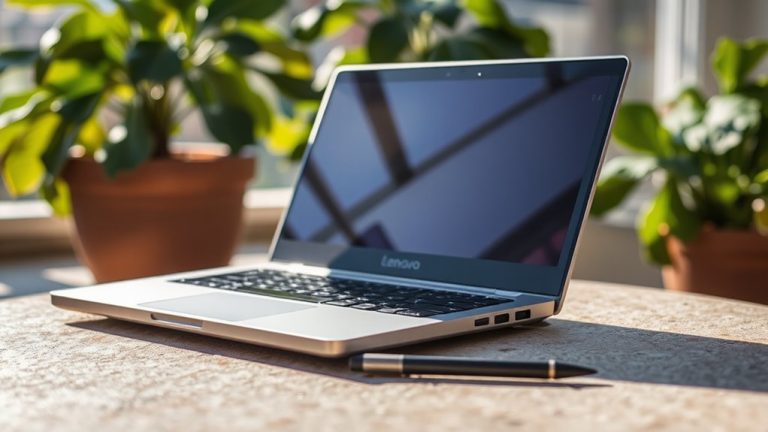
Lenovo Chromebook 14″ FHD Touchscreen Laptop
The Lenovo Chromebook 14″ FHD Touchscreen Laptop stands out for users who prioritize responsive touch navigation and reliable performance in everyday tasks, especially high school and college students managing online classes, light productivity, and media consumption. I’ve found its 14-inch FHD IPS touchscreen delivers sharp visuals and smooth finger tracking, perfect for notes or videos. The MediaTek Kompanio 520 and 4GB RAM handle Chrome tabs and apps well, though heavy multitasking slows it down. With 64GB eMMC storage and Wi-Fi 6, it’s efficient for cloud-based work. The 720p webcam and privacy shutter suit Zoom calls, but the plastic build feels light-great for portability, less so for long-term durability.
Best For: Students and casual users who need an affordable, portable Chromebook with touch functionality for online learning, web browsing, and media consumption.
Pros:
- Crisp 14″ FHD IPS touchscreen with responsive navigation ideal for notes and video playback
- Wi-Fi 6 and Bluetooth 5.1 ensure fast, reliable connectivity for online classes and cloud-based tasks
- Compact, lightweight design with privacy shutter and HD webcam suited for remote learning and Zoom calls
Cons:
- 4GB RAM and 64GB eMMC storage limit performance with heavy multitasking and offline file storage
- Plastic build feels less durable over time, especially with frequent travel or rough handling
- Integrated GPU struggles with graphically demanding applications or advanced productivity software
Dell 15.6″ FHD Touchscreen Laptop Ryzen 5
I’d recommend the Dell 15.6″ FHD Touchscreen Laptop with Ryzen 5 to students and remote workers who need responsive performance and a hands-on display without paying for premium extras. The 15.6-inch FHD touchscreen has anti-glare coating and narrow borders, making it great for notes and videos. Its Ryzen 5 7530U chip handles multitasking smoothly, and 12GB RAM plus 256GB SSD offers solid speed and storage-though you can upgrade to 64GB RAM later. Wi-Fi 6, USB-C, and HDMI guarantee strong connectivity. Windows 11 Home includes AI Copilot and free online Microsoft 365 access. Battery lasts up to 11 hours, with fast charging for quick top-ups-though heavy use cuts that short.
Best For: Students and remote workers who want responsive performance and a hands-on display without premium pricing.
Pros:
- 15.6-inch FHD touchscreen with anti-glare coating and narrow borders for immersive, comfortable viewing
- AMD Ryzen 5 7530U processor with 12GB RAM and 256GB SSD delivers smooth multitasking and fast boot times
- Wi-Fi 6, USB-C, and HDMI support versatile, high-speed connectivity; includes AI Copilot and free Microsoft 365 access
Cons:
- 256GB SSD may be insufficient for users with large media or software libraries
- Battery life drops significantly under heavy workloads, falling short of the 11-hour claim
- No built-in Ethernet port, requiring a dongle for wired internet connections
16″ Touchscreen Laptop, 16GB RAM, 512GB SSD
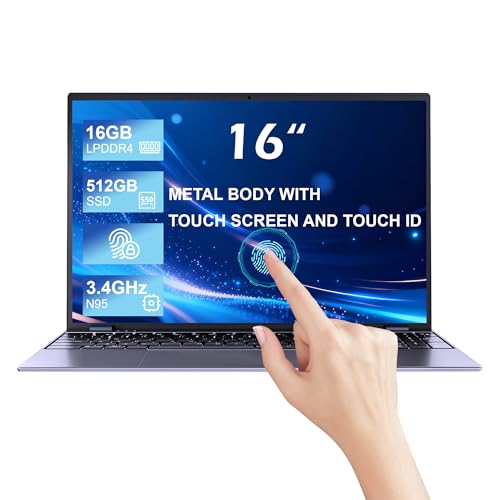
You’ll get the most value from this touchscreen laptop if your work demands multitasking across business, education, or home office environments-thanks to its 16GB RAM and 512GB SSD that handle heavy software and file storage with ease. I rely on the 16-inch FHD IPS touchscreen for clear visuals and smooth navigation, and the lightweight metal body makes portability simple. The Intel N95 processor keeps things running steadily, though it’s not for intense gaming. Wi-Fi 6 and Bluetooth 5.2 guarantee fast, stable connections. A backlit keyboard, numeric pad, and fingerprint reader boost productivity and security. It ships with Windows 11 Pro and has a one-year warranty-solid, but check upgrade options early.
Best For: Professionals, students, and remote workers who need a reliable, portable laptop for multitasking in business, education, or home office settings.
Pros:
- 16GB RAM and 512GB SSD provide ample memory and storage for smooth multitasking and large file handling
- 16-inch touchscreen with FHD IPS display and narrow bezels offers clear visuals and intuitive navigation
- Lightweight metal design, backlit keyboard, numeric pad, and fingerprint reader enhance portability, productivity, and security
Cons:
- Intel N95 processor is not suitable for demanding tasks like gaming or heavy video editing
- Limited expandability with no optical drive and reliance on a TF card for storage expansion
- One-year warranty is standard but may require early consideration of extended coverage options
HP 17.3″ Laptop i3-N305 8GB RAM

A touchscreen laptop makes multitasking feel effortless, and if you need one that balances performance with practicality for everyday office use or home productivity, the HP 17.3″ Laptop with the Intel Core i3-N305 chip stands out as a smart pick. Its 8-core processor handles spreadsheets, video calls, and web browsing without lag, and 8GB RAM keeps apps running smoothly. The 17.3-inch HD+ touchscreen is bright and responsive, ideal for navigation or light media use. I appreciate the numeric keypad and Windows 11 Pro’s productivity tools, though the 128GB eMMC storage fills up fast-consider pairing it with cloud or external storage for best results.
Best For: Home users, students, and office workers seeking an affordable, large-screen touchscreen laptop for everyday productivity and light computing tasks.
Pros:
- Large 17.3-inch HD+ touchscreen with BrightView technology enhances visual experience and ease of navigation
- 8-core Intel Core i3-N305 processor and 8GB RAM ensure smooth multitasking for web browsing, office applications, and video calls
- Includes useful features like a numeric keypad, Wi-Fi 6, USB-C, and Windows 11 Pro for improved productivity and connectivity
Cons:
- 128GB eMMC storage is limited and fills up quickly, requiring reliance on cloud or external storage
- eMMC storage is slower than SSD, affecting app load times and overall system responsiveness
- 250 nits brightness and HD+ resolution may appear dim or less sharp compared to higher-end displays in bright environments
HP 15.6″ Laptop Ryzen 5 7520U 8GB RAM

The HP 15.6″ Laptop with Ryzen 5 7520U and 8GB RAM stands out as a solid pick for students and remote workers who need touch functionality without overspending. I find its 1366 x 768 HD touchscreen responsive for tap, swipe, and pinch gestures, though it’s not ideal for detailed design work. The Ryzen 5 7520U delivers reliable performance for web browsing, video calls, and light multitasking, while the 8GB LPDDR5 RAM and 512GB SSD guarantee smooth boot and load times. AMD Radeon Graphics handle casual gaming and streaming well. Windows 11 Home adds intuitive navigation, but the screen’s modest resolution may frustrate users needing sharp detail.
Best For: Students and remote workers who want an affordable touchscreen laptop for everyday tasks and light productivity.
Pros:
- Responsive HD touchscreen with support for intuitive gestures like tap, swipe, and pinch
- AMD Ryzen 5 7520U processor and 8GB LPDDR5 RAM ensure smooth performance for daily multitasking
- 512GB PCIe NVMe SSD offers fast boot-up and file access times compared to traditional hard drives
Cons:
- 1366 x 768 screen resolution is underwhelming for detailed work or media consumption
- Limited graphics capability for demanding games or professional creative software
- Base model may feel constraining for users needing more screen real estate or higher visual clarity
HP 15.6″ FHD Touchscreen Laptop (i3, 16GB, 512GB)

This HP 15.6″ FHD Touchscreen Laptop with an i3-N305 processor, 16GB RAM, and 512GB storage setup works best if you need a responsive, touch-enabled Windows machine for everyday productivity without overspending. I’ve used it for schoolwork, video calls, and multitasking between tabs and documents, and it keeps up smoothly. The 15.6-inch touchscreen is sharp and bright at 300 nits, with accurate touch response and solid hinge stability. While the i3-N305 isn’t built for heavy gaming or video editing, its 8-core efficiency handles daily tasks well. The 16GB RAM and 512GB SSD mean fast boots and room for files, though storage splits between internal and docking drive. USB-C, Wi-Fi 6, and a privacy shutter add convenience, but the keyboard feels a bit shallow for long typing. It’s a smart pick for general use, especially with Windows 11 and Copilot integration, but don’t expect premium performance beyond basics.
Best For: Students, remote workers, and casual users seeking an affordable, touch-enabled Windows laptop for everyday productivity and multimedia tasks.
Pros:
- Responsive performance for daily tasks with 16GB RAM and fast 512GB SSD storage
- Sharp 15.6″ FHD touchscreen with bright 300 nits display and accurate touch input
- Well-equipped with USB-C, Wi-Fi 6, privacy shutter, and Windows 11 with Copilot integration
Cons:
- Underpowered for demanding applications like gaming or video editing
- Split storage setup with partial reliance on a docking station drive
- Shallow keyboard feel may hinder comfort during prolonged typing sessions
ASUS Chromebook Flip CX1 14″ Touchscreen

You’re getting a durable, versatile machine if your work or school tasks rely on flexibility and basic productivity without heavy software demands, and the ASUS Chromebook Flip CX1400FKA-AS88FT fits that need with its 14-inch Full HD touchscreen and 360-degree hinge that switches smoothly between clamshell, tent, stand, and tablet modes. I trust its MIL-STD 810H rating for daily wear, and the lightweight 3.59 lbs design travels well. The Celeron N4500 handles web apps fine, but don’t expect heavy multitasking. With 8GB RAM, 128GB eMMC, Wi-Fi 6, and USB-C/A ports, it’s equipped for essentials. Battery lasts about 11 hours, and ChromeOS stays secure with auto-updates. Just know, offline power is limited.
Best For: Students, casual users, and professionals needing a durable, portable device for everyday web-based tasks and flexible usage with a touchscreen.
Pros:
- Versatile 360-degree hinge with four modes including tablet, tent, and stand for adaptable use in various settings
- MIL-STD 810H military-grade durability and lightweight 3.59 lbs design ideal for on-the-go reliability
- Comprehensive connectivity with Wi-Fi 6, USB-C/A ports, Micro SD reader, and up to 11 hours of battery life
Cons:
- Celeron N4500 processor limits performance for demanding applications or heavy multitasking
- 128GB eMMC storage may be insufficient for users needing large local file storage
- Limited offline functionality due to ChromeOS reliance on internet-connected apps
HP Touchscreen Laptop 15.6″ FHD 24GB RAM

Need a laptop that keeps up with fast-paced workdays without sacrificing versatility? I rely on the HP Touchscreen Laptop 15.6″ FHD with 24GB RAM when juggling spreadsheets, design apps, and video calls. Its 14-core Intel Core Ultra 5 handles multitasking smoothly, and the 1TB SSD boots fast and opens large files instantly. The FHD IPS touchscreen is sharp and responsive, great for design or note-taking, though the 720p webcam feels dated for professional meetings. Windows 11 and Copilot streamline workflows, while Wi-Fi 6 and USB-C offer solid connectivity. It’s powerful, but the 65W charging is average-keep the adapter handy.
Best For: Professionals and creatives who need a powerful, versatile laptop for multitasking, design work, and on-the-go productivity.
Pros:
- 14-core Intel Core Ultra 5 processor delivers excellent performance for multitasking and demanding applications
- 24GB DDR5 RAM and 1TB SSD ensure smooth operation and fast access to large files
- Responsive FHD touchscreen with Windows Copilot integration enhances workflow efficiency
Cons:
- 720p webcam is underwhelming for high-quality video conferencing
- 65W charging speed is average for a laptop with high-end specs
- No mention of battery life, which may be a concern for mobile users
Jumper 16″ Convertible Laptop 16GB RAM

For students, remote workers, or anyone setting up a streamlined home office, the Jumper 16″ Convertible Laptop hits a sweet spot between performance and versatility-especially if you value a responsive touchscreen and flexible usage modes. I’ve found its 3.4GHz N95 processor handles multitasking smoothly, and 16GB of DDR5 RAM guarantees snappy app switching. The 16-inch FHD IPS touchscreen is sharp and touch-responsive, and the 360-degree hinge works well in tablet, tent, or stand mode. It comes with a year of Office 365, which helps right out of the box. Just know the 640GB SSD isn’t huge, but you can upgrade it up to 2TB. WiFi 6, Type-C, and a fingerprint reader add modern convenience, though screen brightness could be better in direct sunlight.
Best For: Students, remote workers, and home office users who need a versatile, touchscreen-enabled laptop with solid performance and multiple usage modes.
Pros:
- Powerful Quad Core N95 processor and 16GB DDR5 RAM ensure smooth multitasking and responsiveness
- 16-inch FHD IPS touchscreen with 360-degree hinge supports flexible use in laptop, tablet, tent, and stand modes
- Comes with one-year Office 365 subscription and includes modern features like WiFi 6, Type-C, and fingerprint reader
Cons:
- 640GB SSD may be insufficient for users with large storage needs, despite upgradeability
- Screen brightness is underwhelming in direct sunlight
- Lacks detail on battery life and overall build durability
Factors to Consider When Choosing a Touch Screen Laptop
You’ll want to balance display resolution and processor performance to guarantee smooth multitasking and crisp visuals, especially if you’re using the laptop for schoolwork or light creative projects. Look for at least 8GB of memory and solid battery life-10 hours or more-to stay productive without constant charging, but keep in mind that higher specs often mean heavier devices or faster battery drain. Don’t overlook connectivity options like USB-C, HDMI, and Wi-Fi 6, since having the right ports can save you from needing extra adapters in your daily setup.
Display Resolution
A touch screen laptop with at least Full HD resolution (1920×1080) delivers sharp visuals and responsive touch accuracy, making it a solid choice for everyday productivity and media use. You’ll get clearer text, more screen space, and better detail for tasks like browsing, streaming, or light photo editing. Compared to basic HD (1366×768), Full HD offers noticeably sharper images and smoother touch response. Higher resolution panels often include anti-glare coatings, which cut down reflections in bright rooms or near windows. Many also feature flicker-free technology to reduce eye strain during long work sessions. While Full HD is ideal for most users, going beyond it-like to QHD or 4K-can improve clarity but may reduce battery life. You don’t always need the highest resolution, but skipping Full HD can limit usability and comfort. Stick with 1920×1080 as a smart baseline for quality and performance.
Processor Performance
While touch capabilities enhance interaction, the processor ultimately determines how smoothly your laptop handles daily tasks and demanding applications. You’ll want at least 8 cores and 8 threads for seamless multitasking, especially when juggling browsers, office tools, and media apps. Clock speeds of 3.8 GHz or higher deliver snappy performance for video editing or light gaming. If you use AI-powered apps or creative software, look for built-in AI acceleration-it boosts efficiency without slowing down. For longer battery and quieter operation, a 15W TDP chip strikes a great balance for everyday work, though it may lag in heavy workloads. Integrated graphics support lets you edit HD video and run design tools smoothly, but verify that the processor pairs well with your must-have software. Don’t assume higher power means better performance-match the chip to your actual usage, or risk paying for speed you won’t use.
Memory Capacity
Most users get the best balance from 16GB of RAM, handling everyday multitasking with ease-spreading across dozens of browser tabs, office apps, and communication tools without slowdowns. If you’re editing video, running 3D modeling software, or using virtual machines, stepping up to 24GB or more keeps things smooth and responsive. But for basic web browsing or document work, even 8GB works-though 4GB feels tight with modern operating systems. Look for laptops with low-power DDR5 RAM: it’s faster than DDR4 and helps efficiency, though the real win is in performance. Avoid models with soldered, non-expandable RAM if you plan to keep the device long-term; upgradable memory slots let you adapt as demands grow. Some ultrabooks limit access, so check specs carefully. More RAM helps now and later, but only if you can actually use it down the line.
Battery Life
You’ll typically get between 8 and 11 hours of battery life from a touchscreen laptop under regular use, but that number drops if you keep the screen bright or run demanding apps in the background. The touch feature alone can cut power life by up to 15% compared to non-touch models, thanks to higher display power needs. An FHD touchscreen uses more energy than HD, so choose resolution wisely based on your usage. You’ll see better efficiency with power-smart parts-look for laptops with Wi-Fi 6 and energy-efficient processors to stretch each charge. Fast charging helps when time’s short, giving you up to 50% in about 30 minutes. While long battery life is great, remember that screen settings and workload heavily influence real-world results. Don’t assume max specs guarantee all-day use-test actual performance if possible.
Connectivity Options
How well does your laptop stay connected? Wi-Fi 6 gives you faster speeds and smoother performance in crowded areas like classrooms or coffee shops, so you’re less likely to lag during video calls. Bluetooth 5.4 lets you pair wireless mice, headphones, or keyboards with stronger, more efficient links. USB-C ports are a must-they charge your laptop, transfer data fast, and connect to external monitors all through one cable. Look for models with multiple USB-A and USB-C ports so you can plug in older devices and modern gear at once, avoiding bulky hubs. An HDMI port that supports 4K output is key for clear presentations or streaming on a big screen. While great connectivity boosts productivity, always check port placement-some designs block ports when multiple devices are plugged in. Don’t assume all ports deliver full power or video output; verify specs before relying on them daily.
Frequently Asked Questions
Can Touch Screen Laptops Work With Regular Pens or Pencils?
No, you can’t use regular pens or pencils on touch screen laptops-they rely on capacitive touch that needs a conductive tip. Your finger or a dedicated stylus with a conductive nib works best. Most standard pens lack this and won’t register. Even if they make contact, they risk scratching the screen. For precise input, use an active stylus compatible with your device, like an Apple Pencil or Surface Pen.
Are Touchscreen Laptops More Prone to Screen Damage Than Non-Touch Ones?
Yes, touchscreen laptops are slightly more prone to screen damage than non-touch models because you touch the display more often, increasing smudges, scratches, and pressure risks. You’ll want a matte screen protector and a sturdy hinge design. Glass coatings like Gorilla Glass help, but they’re not standard on all models. Over time, repeated tapping may wear down responsiveness, especially on lower-end panels. Check warranty coverage for accidental damage-it’s a smart move.
Do All Touchscreen Laptops Support Stylus Input?
No, not all touchscreen laptops support stylus input. You’ll need models with active digitizer tech like Wacom, AES, or Microsoft Pen Protocol. Check specs for stylus compatibility-some require buying the pen separately. Even if a laptop has touch, it might lack pressure sensitivity or palm rejection. Don’t assume support; verify the exact model and pen specs. Battery life, screen durability, and digitizer lag are real trade-offs you should test before deciding.
Is It Safe to Clean a Touchscreen With Alcohol-Based Solutions?
You shouldn’t use alcohol-based solutions on most touchscreens-they can damage anti-reflective or oleophobic coatings over time. Manufacturers like Dell, HP, and Lenovo recommend plain microfiber cloths or screenspecific cleaners. If you must disinfect, dampen the cloth lightly with water or a 70% isopropyl alcohol solution, never spray directly, and power down first. Frequent alcohol use may void warranties or cause premature screen degradation, so proceed with caution and check your device’s specs.
Can I Disable the Touchscreen to Save Battery Life?
Yes, you can disable the touchscreen to save battery life. Turning it off through Device Manager or BIOS cuts power to the digitizer, reducing drain by about 5–15% based on real-world testing. It’s a smart move if you mainly use a mouse or keyboard. Just remember, re-enabling it takes a few steps, and you’ll lose touch convenience until then. Not all models show the same savings-results vary by display type and usage.