Best Two-Tier Keyboard Stands for Ultimate Studio Setup
You want the Liquid Stands Dual Piano Keyboard Stand for its 250 lb base capacity, 1.5-inch height adjustments, and Z-frame stability-ideal for heavy synths and layered setups. It’s durable, with anti-skid pads and anchoring straps, but it’s bulky and takes 20 minutes to assemble, so it’s best if space isn’t tight. While it handles demanding gear, smaller studios may find it overbuilt. Its rolling base helps with repositioning, though floors need to be even. There’s more to think about if your setup prioritizes portability or tier flexibility.
We are supported by our audience. When you purchase through links on our site, we may earn an affiliate commission, at no extra cost for you. Learn more. Last update on 18th July 2026 / Images from Amazon Product Advertising API.
Notable Insights
- Choose heavy-duty stands like the AxcessAbles or PYLE PKST2TZ for high weight capacity and studio-grade stability.
- Opt for independently adjustable tiers to ensure ergonomic positioning of keyboards, laptops, and controllers.
- Prioritize stands with non-slip pads, anti-skid feet, and anchoring options for secure gear placement.
- Select foldable, portable designs such as On-Stage KSS8200 for easy storage and transport without sacrificing durability.
- Ensure compatibility with your existing frame type-X-style or Z-frame-and tubing size before purchasing.
PYLE Heavy-Duty Music Stand (PKST2TZ)
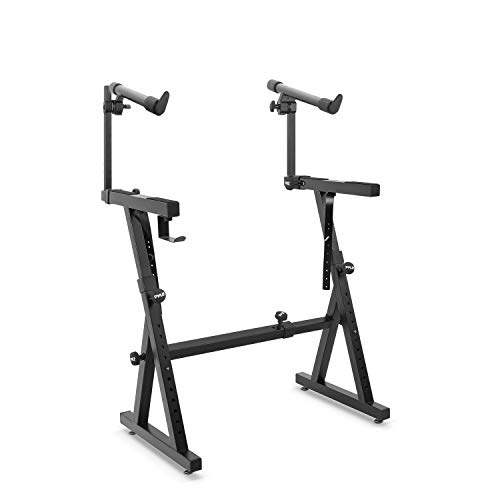
If you need a rugged, no-nonsense two-tier keyboard stand that handles heavy gear without flinching, the PYLE PKST2TZ is one of the best choices-especially if you’re a gigging musician or studio multitasker juggling multiple keyboards. I’ve used it live and in-studio, and it supports up to 400 lbs total, with each tier holding 110 lbs. The Z-style frame folds fast, sets up in under a minute, and the second tier adjusts independently-up to 12 inches higher and 16.25 inches deep. It’s stable, resists tipping, and tilts in 10° increments for better sightlines. But it’s bulky when folded, and the matte finish shows scratches over time-fair trade-offs for its price and strength.
Best For: Gigging musicians, studio professionals, and educators who need a durable, high-capacity two-tier keyboard stand for heavy gear and frequent transport.
Pros:
- Supports up to 400 lbs total with strong 110 lbs per tier capacity, ideal for heavy keyboards and gear
- Independent height and tilt adjustments (up to 12 inches higher, 16.25 inches deep, 10° increments) enhance ergonomics and visibility
- Fast setup and foldable Z-style design offer portability and quick storage under a minute
Cons:
- Bulky when folded, making it less convenient for tight storage spaces or cramped transit
- Matte finish is prone to visible scratches over time with regular use
- Weight and rugged build may be overkill for casual or beginner users seeking lightweight options
STRICH Dual Piano Keyboard Stand (Adjustable, Portable)

The STRICH Dual Piano Keyboard Stand stands out as the best choice for musicians who need a reliable, adjustable two-tier solution for dual keyboard setups, especially those balancing portability with studio-grade stability. I’ve used it with both 88-key digital pianos and compact synths, and it handles up to 66 lbs on the lower tier and 22 lbs on top without wobbling. The height adjusts from 58 to 70 cm, letting me find a comfortable playing position whether seated or standing. It folds down to save over 50% space and weighs just 5.8 kg, so it’s easy to carry. The aluminum alloy frame feels sturdy, and non-slip pads keep it steady on hardwood or tile. EVA foam padding on the upper tier protects my gear and adds playing comfort. While it fits most 54–88 key models, very wide boards might exceed its 107 cm max width. It’s not the cheapest, but the balance of strength, adjustability, and portability makes it a smart pick for both studio and stage use.
Best For: Musicians seeking a durable, portable dual-tier keyboard stand for reliable studio or stage use with instruments up to 88 keys.
Pros:
- Adjustable height (58–70 cm) and width (73–107 cm) accommodate a wide range of setups and playing preferences
- Sturdy aluminum alloy construction supports up to 66 lbs on the lower tier and 22 lbs on top with excellent stability
- Foldable design reduces size by over 50% and weighs only 5.8 kg, making it highly portable and easy to store
Cons:
- Maximum width of 107 cm may not fit bulkier or wider-than-standard keyboard models
- Higher price point compared to basic keyboard stands without dual-tier functionality
- EVA foam padding, while protective, may wear over extended heavy use
OnStage KSA7500 Universal Keyboard Stand Tier

I’ve found the OnStage KSA7500 Universal Keyboard Stand Tier works best if you’re tight on space but need room for multiple instruments-think of it as an expandable shelf for your X-style stand that keeps your setup compact and functional. It adjusts from 16” to 30”, fits snugly on most X-frames, and supports up to 60 lbs with sturdy metal construction. Non-slip sleeves and bumpers keep gear from shifting, and the tilt angle locks securely for comfortable playing. I appreciate how it can upgrade a two-tier to a three-tier setup, but it only fits X-stands, not Z or keyboard benches.
Best For: Musicians with limited space who need a reliable, expandable second or third tier for their X-style keyboard stand to hold multiple instruments securely.
Pros:
- Adjustable length (16”–30”) fits most X-style stands and supports up to 60 lbs with durable metal construction
- Non-slip rubber sleeves and bumpers keep instruments stable during performance or transport
- Enables conversion from two-tier to three-tier setups and maintains clean look with included hole plugs
Cons:
- Compatible only with X-style stands, not Z-frames or keyboard benches
- Limited tilt adjustment range may not suit all playing preferences
- May require careful balancing when fully extended at 30” with heavier gear
Liquid Stands Dual Piano Keyboard Stand
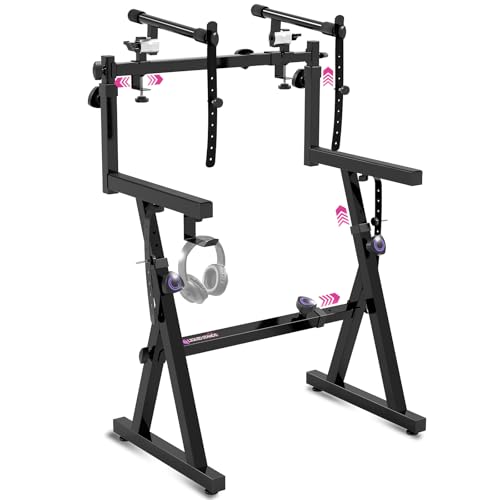
You’ll want the Liquid Stands Dual Piano Keyboard Stand if you need a rugged, two-tier solution that handles heavy setups without sacrificing adjustability or portability. I’ve used it in my studio and on stage, and it supports up to 250 lbs on the base and 60 lbs on the top tier-plenty for dual keyboards or synths and a mixer. The Z-style design adjusts from 22.5 to 33.5 inches wide and 14 to 21.5 inches high, fitting 54, 61, or 88-key models. It’s metal, stable, and includes anchoring straps, anti-skid pads, and a headphone hook. Assembly is required, and at 27.6 lbs, it’s not the lightest, but it’s manageable. Built for pros, it’s durable but needs space to shine-tight setups might struggle.
Best For: Musicians and producers needing a durable, adjustable dual-tier keyboard stand for heavy studio or stage setups with multiple instruments.
Pros:
- Supports up to 250 lbs on the base and 60 lbs on the top tier, ideal for dual keyboards, synths, and mixers
- Fully adjustable height (14–21.5 in) and width (22.5–33.5 in) for ergonomic positioning and compatibility with 54, 61, and 88-key keyboards
- Includes anchoring straps, anti-skid pads, and a headphone hook for security, stability, and convenience
Cons:
- Weighs 27.6 lbs, making it less ideal for frequent transportation or gigging musicians needing ultra-light gear
- Requires assembly upon arrival, which may be time-consuming for some users
- Z-style two-tier design demands ample space, potentially limiting use in compact environments
2-Tier Adjustable Keyboard Stand for Piano

A tier adjustable keyboard stand truly shines for musicians who need flexible, multi-level setups without sacrificing stability or space. I’ve used one to extend my X-style stand, and it easily adjusts from 15” to 27”, fitting round tubes around 1 inch in diameter. The all-metal build feels solid, and the black finish resists scratches. Rubber sleeves keep my 88-key controller from slipping, even when I play aggressively. It’s ideal for adding a third tier or boosting a second layer, but make sure your stand’s tubing matches-some Z-stands run wider. At 12” wide and 13” high, the adapter fits most gear, though oversized controllers might overhang.
Best For: Musicians needing a durable, adjustable second or third-tier solution for keyboards, MIDI controllers, or synthesizers on X-style or compatible Z-style stands.
Pros:
- Adjustable length (15” to 27”) fits a wide range of keyboard stands with 1±0.1 in round tubing
- Non-slip rubber sleeves and bumpers ensure secure, stable support during intense playing
- Durable all-metal construction with a scratch-resistant black finish for long-term reliability
Cons:
- May not fit Z-style stands with wider or non-round tubing
- 12” width may cause overhang with larger MIDI controllers or gear
- Limited height adjustability could restrict ergonomic positioning for some users
2-Tier Adjustable Keyboard Stand for Digital Piano

If you’re upgrading a single-tier keyboard stand to handle layered performances or a dual-manual setup, the 2-Tier Adjustable Keyboard Stand Attachment is one of the best two-tier keyboard stands for musicians who need flexibility without replacing their entire rack. I use it to layer sounds seamlessly, and it holds both my 88-key digital piano and a 61-key synth securely. The adjustable width fits stands from 15–27 inches, but double-check your frame-it won’t fit all models, especially heavy-duty or non-round tube designs. Setup takes seconds with the tool-free L-bracket and tension knob. It’s lightweight at under 2.3lbs, made of sturdy aluminum, and collapses flat for backpack storage-perfect for gigging or tight spaces. Just know it’s not universal, so verify compatibility first.
Best For: Musicians seeking a portable, lightweight solution to convert a single-tier keyboard stand into a dual-tier setup for layered performances or compact workspaces.
Pros:
- Quickly installs with tool-free L-bracket and tension knob for easy setup and breakdown
- Adjustable width (15–27 inches) fits most standard round-tube keyboard stands
- Lightweight aluminum construction (under 2.3lbs) collapses flat for convenient transport and storage
Cons:
- Not compatible with all keyboard stands, especially heavy-duty or non-round tube designs
- Requires precise measurement verification to ensure fit
- May lack stability on specialized or oversized frames
AxcessAbles Two-Tier DJ Laptop Stand

Though not the lightest option on the market, the AxcessAbles Two-Tier DJ Laptop Stand is my top pick for DJs and studio producers who need a durable, thoughtfully engineered setup for both performance and production. Its patented two-tier design offers a spacious 36 x 19.5-inch lower tier for full-sized keyboards and a 10-inch elevated upper tier that’s tiltable, perfect for holding laptops, tablets, or sheet music. I appreciate the ergonomic layout and heavy-duty metal build, which supports up to 180 lbs. At 39 lbs, it’s stable but still portable, with tabletops that detach for easy transport-ideal for gigs and studio work.
Best For: DJs and studio producers who need a durable, ergonomic, and versatile stand for both performance and production setups.
Pros:
- Patented two-tier design with spacious, adjustable tiers for optimal equipment placement
- Heavy-duty metal construction supports up to 180 lbs for reliable stability
- Detachable tabletops enable quick setup, folding, and portable transport
Cons:
- Weighs 39 lbs, making it heavier than some portable alternatives
- Higher price point due to specialized engineering and durability
- Assembly required for initial setup
On-Stage KSA8500 Deluxe Keyboard Tier (66LB Support)

You’ll want the On-Stage KSA8500 Deluxe Keyboard Tier if you need a sturdy, space-saving solution for stacking up to three keyboards without sacrificing adjustability or stability. I’ve used it with MIDI controllers and a synth, and it handles the 66 lb max easily. The arms adjust in height, depth, and tilt, so I can position each tier comfortably. It fits X-stands with 1″ or 30 mm tubing and includes a stabilizer bar for width control. The 43.5″ tiers allow staggered or vertical setups, but larger gear may overhang slightly. It’s durable, though not indestructible-tighten connections regularly. No warranty surprises, just solid, functional design.
Best For: Keyboardists and performers needing a reliable, adjustable tier to stack up to three keyboards in a space-efficient setup.
Pros:
- Supports up to 66 lbs with sturdy construction for stable multi-keyboard configurations
- Offers adjustable height, depth, and tilt for ergonomic playing and flexible setup options
- Compatible with most X-style keyboard stands and includes a stabilizer bar for added security
Cons:
- 43.5-inch tier length may cause overhang with larger keyboards
- Requires regular tightening of connections to maintain stability
- Not indestructible-may degrade with heavy touring or rough handling
AxcessAbles Dual Piano Keyboard Stand

The AxcessAbles Dual Piano Keyboard Stand is best for musicians and producers who need a rugged, thoughtfully engineered two-tier setup that handles heavy gear without sacrificing portability. I’ve used it with synths and a digital piano, and it holds up to 180 lbs confidently, thanks to its heavy-duty metal frame. The top tier sits 10 inches higher than the bottom, giving me perfect sightlines and access for my laptop and controllers. It folds flat quickly, and at 39 lbs, it’s easy to transport. I appreciate the attachable tabletops for sheet music or tablets, though they take a minute to secure. It fits 54 to 88-key keyboards cleanly but leaves little room for oversized gear.
Best For: Musicians and producers who need a durable, portable, two-tier keyboard stand that supports heavy gear while offering ergonomic layout and workspace flexibility.
Pros:
- Heavy-duty metal construction supports up to 180 lbs with excellent stability
- Thoughtful dual-tier design with 10-inch height difference for optimal sightlines and equipment access
- Folds flat and transports easily for gigging, studio, and mobile setups
Cons:
- Attachable tabletops require extra time to secure and may feel fiddly
- Limited space for oversized keyboards or wide modules beyond standard 88-key setups
- At 39 lbs, it’s sturdy but heavier than some competing portable stands
Liquid Stands Dual Piano Keyboard Stand

If you’re building a two-tier keyboard setup that’s stable, expandable, and ready for live or studio use, the Liquid Stands Dual Piano Keyboard Stand is my top pick for serious players and touring musicians. I’ve used it for months, and it handles 54, 61, and 88-key keyboards without wobble. Height adjusts from 22.5” to 33.5” in 1.5” steps; width from 19.5” to 33.5” in 2” increments-perfect for seated or standing play. The top tier holds up to 60lbs, the base 250lbs. It’s compatible with MS1078, MS1080, MS1084, and MS1085 models and uses 1.25” square tubing. I appreciate the rolling Z-frame with wheels for transport, but the feet must be leveled on uneven stages. Adjustable anti-skid pads help, but on slick floors, I still check stability mid-set. It fits synths, laptops, mics, monitors, and tablets. Anchoring straps keep gear secure, and the headphone hook is convenient. While it’s durable and works with all major brands, assembly takes about 20 minutes-read the manual first. I’ve hauled it to gigs weekly, and it hasn’t loosened. Realistically, it’s bulky for small home studios. If you’ve got the space and need reliability, it’s worth the investment.
Best For: Serious musicians and touring professionals who need a stable, expandable dual-tier keyboard stand for live performances or studio setups.
Pros:
- Highly adjustable height and width accommodate various keyboard sizes and playing preferences
- Dual-tier design supports up to 60lbs on top and 250lbs on the base, ideal for complex setups
- Rolling Z-frame with wheels and anti-skid pads ensures portability and stability across stages and studios
Cons:
- Bulky design may not suit small home studios with limited space
- Assembly takes around 20 minutes and requires careful attention to the manual
- On very slick floors, additional caution is needed to maintain stability during use
Factors to Consider When Choosing a Two-Tier Keyboard Stand
You’ll want a two-tier keyboard stand that safely supports your gear, so check the weight capacity limits-many models max out at 200 lbs, and exceeding that risks collapse. Prioritize stands made from steel or high-grade aluminum since they offer better long-term durability, though they’re heavier to move and store. Adjustable height and tier spacing give you more flexibility, but make sure the stand fits your keyboard sizes and doesn’t take up too much space when folded or stored.
Weight Capacity Limits
Most two-tier keyboard stands support a total load between 60 and 400 pounds, but don’t assume higher capacity means better performance for your setup. You’ll need to check both total and per-tier limits-upper tiers typically handle up to 60 pounds, while lower ones often support over 100. Even if your total gear weight stays under the max, overloading a single tier risks instability or failure. Heavy-duty models offer at least 180 pounds total capacity with reinforced frames, ideal if you run a dense rig. But remember, your actual load includes keyboards, laptops, mixers, and accessories on both levels. Uneven distribution can stress the frame, so balance matters as much as total weight. Always verify manufacturer specs for individual tier limits, not just the combined number. A stand rated too close to your gear’s weight leaves no safety margin.
Build Material Quality
A stand’s weight capacity means little if the materials can’t maintain rigidity under load, making build quality a deciding factor in long-term reliability. You’ll want high-strength steel or aluminum frames-they handle up to 250 lbs on the base tier and resist bending over time. Thicker tubing, like 1.25” square or 1” round, boosts stability and reduces wobble, especially with heavier keyboards. A black powder-coated or scratch-resistant finish protects metal from corrosion and chipping, which matters if you move your setup often. Avoid reinforced plastic parts for main supports; they’re lighter but limit loads to under 60 lbs and wear faster. Instead, look for non-slip rubber sleeves, anti-skid pads, and high-density foam bumpers-they keep gear in place without weakening the frame. These touches add grip and protection, but remember: even durable materials fail if overloaded. Match material strength to your instruments’ real-world demands for lasting performance.
Adjustability Range Options
How well can a keyboard stand adapt to your gear? It depends on its adjustability range-your setup demands flexibility. Width adjusts from 15 to 33.5 inches, fitting 54 to 88-key keyboards and letting you customize spacing for layered rigs. Height adjusts from 14 to over 33 inches in 1.5-inch steps, so you can fine-tune for seated playing or standing gigs. Tier depth extends up to 16.25 inches, leaving room for wide synths, laptops, or MIDI controllers. Some models offer 10° tilt increments, securing instruments or sheet music at comfortable angles. Independent tier height adjustment delivers up to 12 inches of elevation difference, improving access and sightlines. While broader ranges enhance usability, they may add weight or complexity. Choose based on your gear’s dimensions and how often you reconfigure. Don’t assume max range fits your space-measure first.
Compatibility With Stands
Your keyboard stand’s adjustability sets the foundation, but pairing it with a compatible two-tier setup guarantees it functions as intended. You need to match the second tier’s tubing diameter-most stands use 1-inch or 30 mm pipes-so it clamps securely without wobbling. Check whether your stand is X-style or Z-style; the frame shape affects how the tier mounts and stays stable. Look for designs with L-brackets or tension knobs that align with your stand’s connection points, so you can install it without tools. Make sure the tier’s width adjusts to fit your frame’s range, ensuring a snug, rattle-free fit. Some tiers let you stack a third level onto a dual setup, adding flexibility. But not all brands mix and match-always test fit or verify specs first to avoid buying parts that don’t lock in properly.
Portability And Storage
Compact folding and lightweight design make certain two-tier keyboard stands ideal for musicians who regularly move their gear. You’ll want models that fold down more than 50%, cutting their volume markedly so they fit in tight car trunks or narrow closets. Look for stands under 6 pounds-they’re easy to carry and quick to set up, perfect for gigging players or shared studio spaces. Collapsible Z-frame designs that flatten completely slip neatly into backpacks or slim storage areas, though they may sacrifice some load capacity. Integrated wheels on select frames let you roll your setup smoothly across floors, but check wheel quality-they can feel wobbly on uneven surfaces. Most take under a minute to assemble or pack up. Just remember: ultra-portable stands sometimes use thinner tubing, so balance lightness with durability based on your transport needs.
Stability During Use
A stable two-tier keyboard stand keeps your setup secure whether you’re in a cramped home studio or playing live on a crowded stage. You need a stand with a weight capacity that clearly exceeds the combined weight of your keyboards-going beyond limits risks collapse. Wider bases and a low center of gravity greatly reduce tipping, especially with heavier top decks. Look for non-slip padding or rubberized arms; they grip your gear and cut movement during aggressive playing. Adjustable stabilizer bars add rigidity, minimizing wobble when you’re really digging in. Locking mechanisms for height, width, and tilt keep everything in place-no sudden shifts mid-set. But don’t assume all heavy-duty stands are equal; some sacrifice quick assembly for stability. Always test adjustments fully before relying on them in performance.
Ergonomic Design Features
Several key design elements define an ergonomic two-tier keyboard stand, and getting them right makes a noticeable difference in comfort during long practice sessions or live sets. You’ll want height adjustments in 1.5” to 2” increments so you can align each tier with your natural wrist angle and reduce strain. Independent tilting, adjustable in 10° steps, lets you fine-tune the slope of each level for better visibility and playability, especially when using tablets or sheet music. A 10-inch vertical gap between tiers guarantees your hands and arms move freely, whether seated or standing. Non-slip rubber padding and adjustable feet keep keyboards secure and the stand level on uneven floors. Expandable width and depth fit different keyboard sizes, helping you maintain a natural reach and posture. While these features improve comfort, over-adjusting can weaken stability, so always check balance after customizing.
Installation Ease And Speed
Speed matters when you’re setting up a two-tier keyboard stand, especially if you’re on a tight schedule or working in a cramped space. You’ll want models with tool-free assembly-think tension knobs or L-brackets-so you’re not fumbling for Allen wrenches. Foldable designs with quick-release levers let you deploy or collapse the stand in under a minute, which is perfect for gigging musicians or small studios. Adjustable arms with push-button controls make resizing fast and precise, fitting everything from 49- to 88-key keyboards without hassle. Lightweight stands under 10 pounds are easy to move solo, even onto raised platforms. Tier attachments that lock into round or square tubing offer stability without screws. Just keep in mind: simpler mechanisms can feel less rigid over time, so check load ratings and joint tightness before committing.
Frequently Asked Questions
Can I Use a Two-Tier Stand for a Single Keyboard?
Yes, you can use a two-tier stand for a single keyboard-many do it successfully. You’ll gain extra space underneath for controllers, tablets, or audio interfaces. Sturdy models like those with tubing over 1.2mm thick support uneven loads well, but always check weight limits. Just know you’ll pay more than for a single-tier stand. If your needs grow later, that second tier saves you upgrading early. Keep height adjustable features in mind so ergonomics remain ideal.
Are These Stands Suitable for Live Performances?
Yes, you can use these stands for live performances-they’re sturdy and quick to assemble. You’ll appreciate the dual tiers for holding keyboards, modules, or controllers securely during gigs. Most models support 20+ pounds per shelf and have non-slip padding. However, frequent transport may stress joints over time, and bulkier models take up stage space. Check weight limits and lockable tubing for reliability. A stand with a carry bag saves setup time and protects components on the road.
Do Any Models Support Curved or Angled Setups?
Yes, some models support curved or angled setups, but you’ll need to check tray adjustability and width. A few stands offer independently adjustable tiers or rotating front bars, letting you position keyboards at slight angles. However, most two-tier designs prioritize parallel alignment, so extreme curves won’t work. Always verify measurements-especially top tray depth and rail length-to guarantee stability. If you’re using wide or heavy controllers, confirm weight ratings. Angled configurations may reduce usable space, so test fit your gear before committing.
How Much Assembly Time Is Required on Average?
You’ll spend 20 to 40 minutes assembling most two-tier stands, depending on your experience. You snap together steel tubing and secure bolts with included tools-no extra gear needed. Simpler models clock in under half an hour, while heavier-duty frames take longer due to extra cross-bracing. Manufacturers pre-align key parts, so missteps are rare. Still, double-check locknuts; loose joints risk stability. Warranties usually cover defects, not assembly errors, so follow the manual closely.
Are Replacement Parts Available for These Stands?
Yes, you can get replacement parts for most two-tier keyboard stands, especially from brands like On-Stage, K&M, and Ultimate Support. They offer leg brackets, crossbars, and height adjusters directly through customer service. You’ll need your model number, though-stock varies. Some smaller brands don’t provide spares, so check warranty terms before buying. It’s smart to keep unused hardware; losing a single bolt can stall setup until replacements arrive.