Best Daisy Chain Case Fans for Seamless Cooling Setup
You’ll get the best results with daisy-chained 4-pin PWM fans like the CORSAIR RS120 or Thermalright TL-M12Q X3, which offer strong airflow (up to 72.8 CFM), quiet operation under 36 dBA, and reliable synchronized control. Make sure your motherboard supports 5V ARGB and doesn’t exceed 1A current draw-use a powered hub if chaining more than five fans to avoid signal loss or flickering. Watch for clearance and connector compatibility; keep wiring tight for stable performance. There’s more to optimizing your setup based on noise, space, and power needs.
We are supported by our audience. When you purchase through links on our site, we may earn an affiliate commission, at no extra cost for you. Learn more. Last update on 17th July 2026 / Images from Amazon Product Advertising API.
Notable Insights
- Choose 4-pin PWM fans like CORSAIR RS120 for consistent speed control and seamless daisy-chaining to one motherboard header.
- Prioritize fans with ARGB daisy-chaining support, such as Thermalright TL-M12Q X3, for synchronized lighting with minimal cabling.
- Ensure static pressure exceeds 1.5 mmH₂O for efficient cooling on radiators and heatsinks in daisy-chained setups.
- Use splitters like Cables Matters 3-Way or ARCTIC models to connect multiple fans neatly while maintaining signal integrity.
- Opt for fluid dynamic bearing fans to keep noise under 30 dBA, ensuring quiet operation even with multiple units running.
Cable Matters 3-Way Fan Splitter (2-Pack)

If you’re managing airflow in a cluttered build and need a reliable way to daisy chain case fans, the Cable Matters 3-Way Fan Splitter (2-Pack) is one of the better choices-especially if you’re syncing three 4-pin PWM fans under one motherboard header. I’ve used both splitters to control six fans across two zones, and they deliver stable power and accurate speed syncing. The master 4-pin connector sends PWM signals and RPM feedback, so my motherboard adjusted speeds smoothly. Sleeved 12-inch cables help with clean routing, though tight bends can stress the housing. It works with 3-pin and 4-pin fans, but 3-pin units won’t report RPM. I noticed minor variance in older fans, but overall cooling stayed balanced.
Best For: Enthusiasts and builders seeking a reliable, cost-effective way to sync and manage multiple PWM or DC case fans from a single motherboard header.
Pros:
- Enables synchronized fan speed control across three fans using a single 4-pin PWM header
- Supports both 3-pin and 4-pin fans with stable power delivery and RPM feedback (for 4-pin)
- Includes two sleeved 12-inch cables for cleaner cable management and improved build aesthetics
Cons:
- 3-pin fans do not provide tachometer (RPM) feedback to the motherboard
- Minor speed variance may occur, especially with older fan models
- Sleeving can stress at sharp bends, potentially affecting durability in tight spaces
CORSAIR RS120 120mm PWM Fans (Triple Pack)

The CORSAIR RS120 120mm PWM Fans (Triple Pack) are my top pick for anyone building a high-performance cooling setup that values clean cable management and precise fan control. I use these on my radiator, and they deliver strong airflow-72.8 CFM at 2,100 RPM-while staying focused thanks to AirGuide Technology. They’re loud at full blast (36 dBA), but Zero RPM mode keeps things silent when temps are low. The daisy-chain design means I only need one motherboard header, which cuts clutter. Magnetic bearings help durability and reduce noise over time. Just know they’re built for radiators or dense heatsinks, not open-air case ventilation. Model CO-9050189-WW, available since June 2024.
Best For: Enthusiasts and builders seeking high-static-pressure fans for radiators or heatsinks with daisy-chaining and Zero RPM mode for silent low-load operation.
Pros:
- High airflow (72.8 CFM) and static pressure (4.15mm-H2O) ideal for radiators and heatsinks
- Daisy-chain capable via PWM headers for clean cable management and single-header control
- Zero RPM mode and Magnetic Dome Bearing ensure quiet operation and long lifespan
Cons:
- Noise level of 36 dBA at max speed may be noticeable in quiet environments
- Optimized for radiators, not ideal for open-air case ventilation
- Only available in black, limiting aesthetic options for custom builds
CORSAIR RS120 ARGB 120mm PWM Fans (3-Pack)
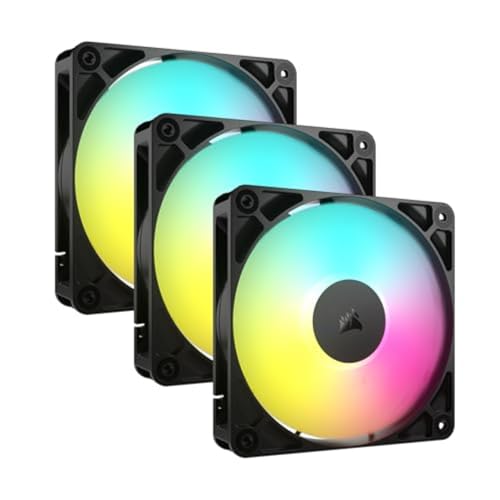
You’ll get the most out of daisy-chained case fans like the CORSAIR RS120 ARGB 120mm PWM Fans (3-Pack) if you’re building a high-performance PC where clean cable management and synchronized lighting matter-though only when your motherboard supports both PWM and ARGB headers. I rely on these fans for strong, directed airflow up to 72.8 CFM and 2,100 RPM, thanks to their PWM control and AirGuide tech that boosts static pressure to 2.8mm-H2O-perfect for radiators. The eight ARGB LEDs per fan deliver vibrant, tunable lighting, but they demand a 5V ARGB header. Magnetic dome bearings promise long life, yet noise can rise at full speed, so I use them where cooling justifies the sound.
Best For: Enthusiasts building high-performance, aesthetically focused PCs with ARGB-compatible motherboards who need strong, directed airflow for radiators or heatsinks.
Pros:
- Daisy-chained connectivity simplifies cable management and enables unified PWM speed and ARGB lighting control
- High 72.8 CFM airflow and 2.8mm-H2O static pressure optimize cooling performance on radiators and dense heatsinks
- Vibrant, customizable 8 ARGB LEDs per fan sync with motherboard software for immersive lighting effects
Cons:
- ARGB and PWM functionality require compatible motherboard headers, limiting usability on older or budget boards
- Noise levels increase noticeably at maximum 2,100 RPM speeds
- Lighting customization depends on third-party software, which may vary in user experience across brands
Thermalright TL-M12Q X3 120mm ARGB Fans (3-Pack)
For anyone building or upgrading a desktop PC with a focus on clean cable management and vibrant lighting, the Thermalright TL-M12Q X3 120mm ARGB Fans stand out as a strong choice-especially if I prioritize daisy-chaining capability to reduce clutter. These 2000 RPM fans deliver 68.9 CFM of airflow with just 28.2 dBA noise, thanks to their 4-pin PWM and S-FDB bearing, which guarantees smooth, long-lasting operation. I appreciate the dual-sided ARGB infinity lighting-it’s vivid and syncs well via serial headers. While the plastic build feels standard, the daisy-chain design genuinely simplifies wiring. Just know each fan weighs 6.3 oz, so check your case’s fan cutout support.
Best For: PC builders seeking high airflow, low-noise performance, and vibrant daisy-chainable ARGB lighting with clean cable management.
Pros:
- Delivers strong 68.9 CFM airflow with quiet 28.2 dBA operation thanks to 2000 RPM speed and S-FDB bearing
- Features dual-sided ARGB infinity-mirror lighting with serial daisy-chaining for seamless, vibrant illumination
- Simplified cable management with integrated 4-pin PWM and ARGB connectors for a clean build
Cons:
- Plastic construction feels less premium compared to metal-framed alternatives
- Each fan weighs 6.3 oz, which may require reinforced mounting in some cases
- ARGB compatibility limited to serial headers, not universal RGB
AsiaHorse COSMIQ 120mm RGB PC Fans

A solid pick for builders who want clean cable management without sacrificing lighting control, the AsiaHorse COSMIQ 120mm RGB PC Fans let me daisy-chain up to 10 units using the 5V 3-pin connector, cutting down clutter while maintaining synchronized RGB effects. I get strong airflow-68.5 CFM at up to 2000 RPM-with low noise at 29.2 dB(A), thanks to PWM control and durable HDB bearings rated for 50,000+ hours. The reverse blade design works best when paired with standard fans for balanced pressure. I love the wireless RGB controller’s 12 effects and music sync, but for six or more fans on white light, you’ll need a separate hub (B097GQ8CQP) to avoid power issues.
Best For: PC builders seeking customizable RGB lighting, clean cable management, and efficient cooling with support for daisy-chaining and music-synced effects.
Pros:
- Daisy-chains up to 10 fans with synchronized RGB via 5V 3-pin connector for minimal cable clutter
- Delivers strong airflow (68.5 CFM) and pressure (2.05 mmH₂O) with quiet operation at 29.2 dB(A) thanks to PWM and HDB bearings
- Includes wireless RGB controller with 12 dynamic effects and music synchronization for immersive lighting
Cons:
- Reverse blade design requires pairing with standard fans for optimal airflow, limiting standalone use
- White light mode supports only up to 6 daisy-chained fans; more require a separate hub (B097GQ8CQP)
- Limited to 50,000+ hour lifespan-shorter than some high-end competitors with 70,000–100,000 hour ratings
Thermalright TL-M12QR X3 120mm ARGB Fans (3-Pack)

Though I prioritize both performance and clean cable management in my setup, the Thermalright TL-M12QR X3 120mm ARGB Fans stand out as a strong choice for anyone seeking reliable airflow with minimal noise and seamless RGB integration. I get 47.6 CFM of airflow at only 23.2 dB, thanks to S-FDB bearing that cuts vibration and boosts longevity. The 1500 RPM PWM control adapts to heat, while daisy-chained ARGB cables cut clutter. I love the infinite-mirror lighting, but remember-you’ll need a 5V ARGB header. The plastic build feels solid, though not rugged. At 6.3 oz, they’re light but secure. A clean pick, if your board supports the lighting standard.
Best For: PC builders seeking a balance of quiet operation, efficient airflow, and vibrant ARGB lighting with clean cable management.
Pros:
- Delivers strong 47.6 CFM airflow with low 23.2 dB noise thanks to S-FDB bearing and 1500 RPM PWM control
- Features daisy-chained ARGB connectivity for easy setup and reduced cable clutter
- Offers visually striking infinite-mirror lighting effects compatible with 5V ARGB headers
Cons:
- Requires a motherboard with a 5V ARGB header, limiting compatibility with older boards
- Plastic construction, while lightweight, may feel less durable compared to metal-framed fans
- Additional connecting cables needed for expanding fan clusters sold separately
ARCTIC 4-Pin PWM Fan Splitter Cable

You get clean cable management and reliable fan synchronization with the ARCTIC 4-Pin PWM Fan Splitter Cable, making it a solid pick for builders who need to daisy-chain up to four fans without cluttering their motherboard’s header zone. I use it to link my 4-pin and 3-pin PWM fans, and they all spin in sync, thanks to the shared PWM signal. Just know that only the first fan sends RPM feedback to the motherboard. The 700 mm cable-400 mm to the first socket, then 100 mm between each-gives me room to route neatly through my case. It’s ideal for setups with limited headers, but if you’re running more than four fans or drawing over 1 A, you’re better off with ARCTIC’s fan hub and SATA power.
Best For: PC builders who need to connect up to four 3-pin or 4-pin PWM fans to a single motherboard header while maintaining clean cable management and synchronized fan speeds.
Pros:
- Supports daisy-chaining up to four 3-pin or 4-pin PWM fans from one motherboard header
- Delivers synchronized PWM signals for consistent fan speed control across all connected fans
- 700 mm cable with thoughtful spacing (400 mm to first socket, 100 mm between sockets) aids in neat cable routing
Cons:
- RPM feedback is only relayed to the motherboard from the first connected fan
- Limited to 1 A total current, making it unsuitable for high-power fan setups
- Not expandable beyond four fans; requires a fan hub for larger configurations
Thermalright TL-C12C-S ARGB CPU Fan (3-Pack)

If you’re building a custom PC with a focus on clean cable management and synchronized RGB lighting, the Thermalright TL-C12C-S ARGB CPU Fan (3-Pack) makes a strong choice-especially when daisy-chaining multiple fans directly to a single motherboard header. I’ve used them as both case and CPU cooling, and they move 66.17 CFM with minimal noise-under 26 dBA-thanks to their sealed FDB bearing. The 4-pin PWM support lets my motherboard adjust speeds automatically, while the daisy-chain cables (up to 55cm) reduce clutter. Their ARGB lighting diffuses evenly through the blades and syncs well, though brightness isn’t extreme. Just note: these are 25mm thick, so check case clearance. They’re efficient, durable, and ideal if you want balanced airflow, quiet operation, and clean RGB-all without extra splitters.
Best For: PC builders seeking a balance of quiet, efficient cooling and clean, synchronized ARGB lighting with minimal cable clutter.
Pros:
- High airflow of 66.17 CFM with very low noise output (≤25.6 dBA) for effective and quiet cooling
- Daisy-chainable 4-pin PWM and ARGB connectors reduce cable clutter and simplify setup
- Customizable ARGB lighting with diffused blades and motherboard sync compatibility for a clean, modern look
Cons:
- 25mm thickness may pose clearance issues in slim or compact PC cases
- ARGB brightness is moderate, not ideal for setups requiring intense lighting
- Sold as a 3-pack, offering less flexibility for users needing only a single fan
3-Way PWM Fan Splitter Cable (2-Pack)

The 3-Way PWM Fan Splitter Cable (2-Pack) is ideal for PC builders who want clean cable management and precise fan control without sacrificing performance, especially when setting up multiple case fans in ATX builds. I use these splitters to sync three PWM fans to one motherboard header, and they reliably transmit 4-pin PWM signals, keeping speeds regulated through BIOS or software. Each 12-inch braided cable is durable, flexible, and helps position fans neatly. They work with both 4-pin and 3-pin fans, but all connected fans run at the same speed. While that limits individual control, the trade-off is cleaner wiring. I’ve had no signal loss or overheating. If issues arise, support responds within 24 hours via email, and replacements are offered for damaged units.
Best For: PC builders seeking clean cable management and synchronized fan control in ATX builds using PWM motherboards.
Pros:
- Enables connection of three 4-pin or 3-pin PWM fans to a single motherboard header with reliable signal transmission
- 12-inch braided cables offer durability, flexibility, and improved airflow routing
- Supports software and BIOS fan speed control with quick email support and replacement policy for damaged units
Cons:
- All connected fans run at the same speed, limiting individual fan control
- Potential for slight cable clutter due to multiple fan leads branching from one header
- Limited to three fans per splitter, requiring multiple units for larger setups
ID-COOLING AF-125-K Trio 120mm Fan 3-Pack
A solid pick for builders aiming to streamline cable management without sacrificing performance, the ID-COOLING AF-125-K Trio 120mm Fan 3-Pack delivers consistent airflow and quiet operation across various cooling setups. I’ve used them on radiators and cases, and they push up to 78.25 CFM while staying under 29.85 dB(A), even at 2,000 rpm. The daisy chain connector cuts cable clutter, letting me link all three to one header. They’re PWM-controlled, so speeds adjust dynamically based on temps. Their black finish blends well in dark builds, and FDB bearings promise durability. Just note: at full blast, they’re noticeable, though never disruptive. Ideal for balanced airflow and clean routing.
Best For: PC builders seeking a balance of performance, low noise, and clean cable management in black-themed cooling setups.
Pros:
- Delivers strong airflow up to 78.25 CFM with PWM control for dynamic speed adjustment
- Daisy chain connector simplifies cable management and reduces clutter
- Durable FDB bearings and black aesthetic enhance longevity and visual appeal in dark builds
Cons:
- Audible at maximum speed, though not overly disruptive
- Maximum pressure of 2.68 mmH₂O may limit effectiveness in high-resistance scenarios
- Not RGB-equipped, limiting appeal for users seeking illuminated fans
Factors to Consider When Choosing Daisy Chaining Case Fans
You can save time and clean up cable clutter by daisy chaining case fans, but you’ve got to check that all your fans support it and won’t overload the header. Make sure your motherboard can handle the total amperage draw, especially if you’re linking more than three fans, since exceeding limits hurts performance or trips protection. Consider noise and airflow too-synchronized fans often run at the same speed, which might mean louder operation or less cooling in certain spots, and if you care about RGB, confirm the lighting sync works with your board’s software.
Fan Compatibility
Several key factors determine whether your case fans can work reliably in a daisy chain, and getting them right guarantees stable performance without risking hardware issues. You need to match control protocols-use 4-pin PWM fans across the chain so speed syncs properly. Check that all fans support daisy-chaining via compatible connectors like 3-pin ARGB or 4-pin PWM; mismatched types won’t pass signals correctly. Make sure your motherboard header handles the load-most cap at 1 A, so too many high-draw fans can overload it. Also, confirm tachometer support: some chains only send RPM data from the first fan, limiting monitoring. Even if fans share the same specs, poor daisy-chain design can cause flickering or speed instability. Always verify manufacturer specs and real-world testing feedback to avoid guesswork. Compatibility isn’t just about plugging in-it’s about seamless signal and power continuity.
Power Requirements
Matching fan specs guarantees signal compatibility, but power delivery determines whether the chain stays stable under load. You’re plugging multiple fans into a single motherboard header, which usually maxes out at 1 amp. Each fan draws power-say 0.20A at full speed-so four high-RPM fans already hit 0.8A, leaving little headroom. Chain five or more, and you risk tripping the board’s safety limits, causing shutdowns or erratic performance. High-output fans add up fast, stressing onboard circuitry not built for sustained peak loads. To avoid that, use an external fan hub with its own power supply. It takes the load off your motherboard while letting you daisy chain freely. This setup works especially well if you’re running more than four fans or need consistent speeds under system stress. Skip the hub, and you’re playing with thermal reliability.
Noise Levels
Often, noise becomes a key concern when daisy chaining case fans, especially in shared or quiet spaces like home offices. You’ll want fans with fluid dynamic or sealed bearings, as they typically run under 30 decibels, staying nearly silent even at full speed. Models with RPMs below 1500 are quieter, making them ideal for low-noise setups, though they may trade off some airflow. Look for optimized blade designs-they reduce turbulence and cut sound under load. When multiple fans run high without individual speed control, noise adds up fast, so make certain your daisy chain uses a hub or motherboard header that supports PWM regulation. Many quality fans include low-noise modes or zero RPM settings, going completely silent during light use. These features help maintain peace when you’re working or relaxing, but verify real-world performance, as advertised noise levels don’t always reflect actual operation.
Cooling Performance
While noise matters in quiet environments, cooling performance ultimately determines how well your system handles sustained workloads when daisy chaining case fans. You need fans with high CFM ratings-ideally 60 or more-to move enough air through your case, especially when stacking multiple fans on a single connector. Look for models with strong static pressure (1.5 mmH₂O or higher) if you’re cooling restrictive areas like radiators or CPU heatsinks. Fans spinning at 2000 RPM or more boost heat dissipation, but check the dBA rating-anything above 30 can get loud fast. Go for 4-pin PWM fans so your motherboard can adjust speeds based on temps, balancing cooling and noise. Just remember, daisy chaining limits individual fan control, so uniform specs across all fans are critical for consistent airflow and avoiding bottlenecks.
Lighting Integration
How do you guarantee your case’s lighting looks cohesive without turning your build into a wiring mess? You use daisy-chained fans with integrated ARGB connectors that sync lighting through a single 5V header, cutting cable clutter and keeping colors uniform. These fans pass data serially, so effects like color waves or music sync run smoothly across all units. Just make sure you don’t exceed your header’s power-most support only 5–8 fans before risking signal drops or flickering. For best results, pair them with compatible software that gives you full control over patterns and brightness. If you want more depth, pick fans with dual-sided or reverse airflow lighting to illuminate both intake and exhaust sides. It looks great, but remember: more lights draw more current, so always check your motherboard’s ARGB limits first to avoid overloading.
Bearing Type
Your fan’s bearing type directly shapes its long-term performance and reliability-choose wisely. Opt for fluid dynamic or sealed fluid dynamic bearings; they typically last 50,000 hours or more, handle continuous use well, and resist wear better than sleeve or ball bearings. These high-quality bearings reduce friction, keeping noise under 25 dBA even at high RPMs, so your system stays quiet during heavy workloads. They also minimize blade vibration, maintaining steady airflow and preventing early mechanical failure, especially when temps fluctuate. Sealed designs add protection against dust and moisture, reducing maintenance and preserving cooling efficiency over time. Just note: while better bearings boost lifespan and smoothness, they can raise cost slightly. Still, the investment pays off in durability and quieter operation. Always check manufacturer specs and warranty terms-longer coverage often signals confidence in bearing quality.
Cable Management
When setting up multiple case fans, daisy-chaining simplifies wiring by letting you connect several fans to a single PWM and ARGB header, cutting down clutter and streamlining both installation and system aesthetics. You’ll run fewer cables overall, which means cleaner routing and better airflow. Most daisy-chained fans link directly through built-in 4-pin PWM and 3-pin ARGB connectors, so you’re not juggling multiple splitters. Just make sure your motherboard can power all fans on one line-some setups support up to 10, but voltage drops or signal loss can happen over long chains. Always check manufacturer specs for power draw and chain limits. Poorly powered ARGB lines may cause flickering, while overloaded PWM headers can lead to erratic fan behavior. Keep connections tight and avoid sharp bends in the cables to maintain signal integrity.
Speed Control
Synchronized speed control is the standout benefit of daisy-chaining case fans through a PWM splitter-every fan receives the same signal, so they ramp up and down in unison based on temperature. You’ll get smooth, uniform cooling since the PWM splitter delivers an identical duty cycle to all fans. Just keep in mind that only the first fan relays RPM feedback to the motherboard, so you’re not seeing real-time data from the others. Most PWM headers max out around 1A, meaning you risk overloading the circuit if you chain too many fans-stick to 3–4 depending on fan draw. Maximum speeds typically cap at 2,000–2,100 RPM, assuming your motherboard supports full PWM range. Go beyond the current limit, and you might face erratic speeds or a dead header. Always verify your fan specs and fan count to avoid instability.
Frequently Asked Questions
Can Daisy-Chained Fans Be Controlled Individually?
No, you can’t control daisy-chained fans individually through a single input. When wired in series or parallel via daisy-chaining, they all receive the same voltage and spin at the same speed. You’ll need separate fan hubs or controllers if you want per-fan adjustments. While daisy-chaining simplifies cable management and setup, it sacrifices granular control. Consider a PWM fan hub if independent speed adjustments, noise tuning, and thermal responsiveness matter in your build.
Do Splitter Cables Reduce Fan Performance or Speed?
No, splitter cables don’t inherently reduce fan speed or performance if your motherboard header supplies enough current. You’re safe plugging in two 0.3A fans into a single 1A header, for example. But overload risks voltage drops, causing slower spins or shutdowns. Always check your header’s amperage and total fan draw. Passive splitters work fine for basic setups, but powered hubs offer cleaner power distribution. Real-world tests show no speed loss with quality 4-pin PWM splitters under proper load.
Are ARGB Splitters Compatible With All Motherboards?
No, ARGB splitters aren’t compatible with all motherboards. You need a 5V ARGB header on your board-without it, they won’t work at all. Even if you’ve got the right header, check the splitter’s amperage rating and total LED count; overloaded circuits cause flickering or damage. Always verify your motherboard’s max current per pin and stay under 80% capacity. Use a separate controller if in doubt.
How Many Fans Can Safely Share One Header?
You can safely daisy-chain up to four case fans per PWM header, provided their combined current draw stays under 1A. Most 120mm fans pull 0.1A to 0.3A each, so four is usually safe. Always check the fan’s label for amperage specs. Overloading risks erratic speeds or header damage. Use a splitter with built-in resistors for stability, and monitor temps under load to confirm cooling stays effective.
Do PWM Splitters Support Automatic Speed Adjustment?
Yes, PWM splitters do support automatic speed adjustment if your motherboard header supplies PWM signals. You connect one fan to the motherboard, and it controls all daisy-chained fans at the same PWM duty cycle. Just make certain your header can handle the total fan current-usually up to 1A max. Passive splitters work fine, but avoid mixing fan brands with mismatched power draws to prevent uneven speeds or stalling.