Best CAD Mice That Elevate Precision in Design Work
You’ll get the best precision with the 3Dconnexion CadMouse Pro or Logitech MX Master 3S-they combine high-DPI optical sensors, ergonomic shapes, and customizable buttons to cut strain during long design sessions. The CadMouse Pro’s neutral hand posture support and 8,000 DPI sensor boost accuracy, while the MX Master 3S delivers pixel-perfect tracking on glass. Wireless models need occasional charging and firmware updates for seamless use across AutoCAD or Fusion 360. There’s more to how each model performs in real-world workflows.
We are supported by our audience. When you purchase through links on our site, we may earn an affiliate commission, at no extra cost for you. Learn more. Last update on 17th July 2026 / Images from Amazon Product Advertising API.
Notable Insights
- Ergonomic designs with 20-degree tilts reduce muscle strain and support neutral wrist posture for prolonged CAD sessions.
- High-precision 8,000 DPI optical sensors ensure drift-free tracking on any surface, including glass.
- 6DoF sensors in 3D mice enable intuitive panning, zooming, and rotating in CAD environments.
- Programmable buttons and customizable profiles streamline workflow efficiency across design applications.
- Multi-device wireless connectivity with low-latency RF or Bluetooth ensures reliable performance across platforms.
3Dconnexion CadMouse Compact Wireless

If you’re a CAD professional working long hours and need a mouse that supports precision without sacrificing comfort, the 3Dconnexion CadMouse Compact Wireless stands out as a top contender. I’ve used it daily for months, and the ergonomic shape fits my hand naturally, reducing wrist strain noticeably. Its 7-button layout speeds up commands, and optical tracking glides smoothly on most surfaces. Bluetooth connectivity stays stable, though I occasionally lose signal when my laptop’s wireless is overloaded. It’s compact, yes, but the smaller size might not suit larger hands. Battery life lasts about two weeks-solid, but not class-leading. No software glitches, but the lack of onboard memory limits customization across devices.
Best For: CAD professionals seeking a compact, ergonomic wireless mouse that enhances precision and comfort during long design sessions.
Pros:
- Ergonomic design reduces wrist strain and fits the hand naturally for extended use
- 7-button layout and precise optical tracking improve workflow efficiency and control
- Bluetooth wireless connectivity offers a clutter-free setup with reliable performance
Cons:
- Smaller size may not be comfortable for users with larger hands
- Occasional signal loss under heavy wireless interference
- Limited customization due to lack of onboard memory and average battery life
Logitech MX Master 3S Wireless Mouse

You’ll get the most out of the Logitech MX Master 3S Wireless Mouse if you’re a CAD professional who values precision tracking and ergonomic efficiency across long design sessions. Its 8000 DPI sensor glides smoothly on glass and uneven surfaces, delivering reliability I trust daily. The MagSpeed wheel scrolls 90% faster and far more precisely than standard wheels, while Quiet Clicks reduce noise by 90% without sacrificing feedback. I appreciate the thumb controls and ergonomic shape, which reduce strain during complex modeling. It pairs with three devices via Bluetooth, though no USB receiver or charging cable’s included. Graphite and black models use 27% recycled plastic, and Logi Options+ enables app-specific profiles and FLOW across computers.
Best For: CAD professionals who demand precision tracking, ergonomic comfort, and seamless multi-device control during extended design workflows.
Pros:
- 8000 DPI sensor delivers accurate tracking on virtually any surface, including glass
- MagSpeed scrolling is 90% faster and significantly more precise with ultra-quiet operation
- Ergonomic design with customizable thumb controls and support for FLOW across Windows and macOS
Cons:
- Bluetooth-only connectivity without included USB receiver for systems lacking Bluetooth
- No charging cable provided in the box
- Higher price point compared to standard wireless mice
Logitech MX Master 3S Wireless Mouse

The Logitech MX Master 3S Wireless Mouse stands out as a top-tier choice for CAD professionals who demand precision, comfort, and seamless multi-device control in demanding design workflows. I rely on its 8K DPI sensor for pixel-perfect accuracy, even on glass surfaces. MagSpeed scrolling flies through long blueprints, while Quiet Clicks cut noise without sacrificing feedback. It pairs with three devices via Bluetooth or the included Logi Bolt receiver, and FLOW lets me drag files between my Mac and Windows PC effortlessly. The ergonomic shape feels great for extended sessions, and it’s built with 27% recycled plastic. Just note: Logi Options+ is required for full features, and the premium price may deter some.
Best For: CAD professionals and multitasking designers who need high-precision tracking, silent operation, and seamless cross-device control across Windows and macOS systems.
Pros:
- 8K DPI sensor delivers exceptional tracking accuracy on virtually any surface, including glass
- MagSpeed scrolling is ultra-fast and precise, ideal for navigating large blueprints and long documents
- FLOW technology enables effortless file and text transfer between multiple computers with minimal setup
Cons:
- Logi Options+ app is required to unlock advanced features, adding a setup dependency
- Premium price point may be prohibitive for casual users or budget-conscious buyers
- USB-A to USB-C charging cable may require a dongle for newer laptops with only USB-C ports
3Dconnexion SpaceMouse Pro Wireless BT

A dedicated 3D navigation tool like the 3Dconnexion SpaceMouse Pro Wireless BT pays off most for professionals who routinely manipulate complex models-engineers, architects, and 3D artists who need fluid control without hand fatigue. I rely on its six-degrees-of-freedom sensor to pan, zoom, and rotate in CAD smoothly, cutting mouse strain. It’s wireless via Bluetooth or USB-C, with a solid 1100 mAh battery. The black, ergonomic design feels durable and comfortable all day. It works on Windows and macOS, but returns are strict-only 30 days, unopened. I’d get it if you’re deep in 3D work, but know the limits.
Best For: Professionals like engineers, architects, and 3D artists who need precise, fatigue-free 3D model navigation in CAD and design applications.
Pros:
- Six-degrees-of-freedom sensor enables intuitive, smooth panning, zooming, and rotating in 3D environments
- Wireless connectivity via Bluetooth Low Energy and USB-C with a long-lasting 1100 mAh rechargeable battery
- Ergonomic, durable black design comfortable for extended use on Windows and macOS systems
Cons:
- Limited to 30-day return window with restrictions-must be unopened or damaged on arrival
- Premium price may not justify the investment for casual or infrequent 3D software users
- No support for Linux or mobile operating systems, reducing cross-platform flexibility
Logitech G502 Hero Gaming Mouse

If you’re a CAD professional who values precision and customization, the Logitech G502 Hero Gaming Mouse stands out as a strong contender for daily use at the desk. I rely on its HERO 25K sensor for flawless tracking up to 25,600 DPI, detecting movements smaller than a micron with zero smoothing. Its 11 programmable buttons and dual-mode scroll wheel boost workflow efficiency, while the adjustable weights let me fine-tune balance. I appreciate the crisp click feel from its metal spring system. On-board memory stores my settings, though you’ll need Logitech Gaming Software for full control. It works on both PC and Mac, but the 5.2-inch size may strain smaller hands over time.
Best For: CAD professionals and power users who demand high precision, customizable controls, and ergonomic performance in a desktop mouse.
Pros:
- HERO 25K sensor delivers ultra-precise tracking up to 25,600 DPI with no smoothing or acceleration
- 11 programmable buttons and dual-mode scroll wheel enhance productivity and workflow efficiency
- Adjustable weight system and on-board memory allow personalized balance and portable profile settings
Cons:
- Large size (5.2 inches) may cause discomfort for users with smaller hands during extended use
- Requires Logitech Gaming Software for full customization, limiting out-of-box flexibility
- Wired design may create desk clutter compared to wireless alternatives
ProtoArc Wireless Trackball Mouse EM01 NL

You’ll get the most out of this mouse if you’re a CAD user who values precision and ergonomic flexibility, especially when working long hours at a cluttered or confined workspace. I rely on its thumb-operated trackball for smooth, accurate control without arm strain. The 0° to 20° adjustable hinge supports a natural hand position, improving comfort over time, though it takes 1–2 weeks to adapt. It connects via Bluetooth or 2.4G to three devices-great for switching between PC, Mac, or iPad. DPI shifts between 200 and 1600 in five steps, but forward/back buttons don’t work on Mac. The non-silent scroll wheel functions fine, and the rechargeable battery lasts well, but you must power it off when not in use. Rolling performance dips slightly during heavy loads, and cleaning the ball and internal rollers is necessary for consistent tracking.
Best For: CAD users who need precision, ergonomic flexibility, and seamless multi-device switching in confined or cluttered workspaces.
Pros:
- Thumb-operated trackball with adjustable DPI (200–1600) enables precise, smooth cursor control without arm movement
- Ergonomic 0°–20° adjustable hinge promotes a natural hand position, reducing wrist and arm strain during prolonged use
- Tri-mode wireless connectivity (Bluetooth and 2.4G) allows one-button switching between three devices, supporting Windows, Mac, and Android
Cons:
- Forward and back buttons do not function on Mac OS, limiting navigation efficiency for Mac users
- Non-silent middle scroll wheel and slight performance dip during high-load operations like system startup
- Requires regular cleaning of trackball and internal rollers, and must be powered off when not in use to preserve battery
3DConnexion 3DX-700059 Spacemouse Compact 3D Mouse

The 3DConnexion 3DX-700059 Spacemouse Compact 3D Mouse stands out for CAD users who need fluid, precise control over 3D models without the strain of constant keyboard-mouse switching. I rely on its 6Dof sensor to pan, zoom, and rotate models smoothly-something a regular mouse just can’t match. Its two customizable buttons open radial menus, giving me quick access to eight commands I use daily. The compact design fits tight desks, and the steel base adds stability. It works on Windows, macOS, and Linux, and includes a 2-year warranty. Just note: it’s a specialty tool, not a full mouse replacement.
Best For: CAD professionals and 3D designers seeking intuitive, precise navigation of 3D models without relying heavily on keyboard shortcuts.
Pros:
- Enables smooth 6Dof motion control for effortless panning, rotating, and zooming in 3D environments
- Compact design with a stable steel base fits small workspaces while maintaining durability
- Customizable radial menus provide quick access to frequently used commands in supported applications
Cons:
- Not a full mouse replacement-requires use alongside a traditional mouse for 2D tasks
- Limited functionality outside of 3D-compatible software and applications
- Learning curve for users unfamiliar with 6Dof navigation controls
3Dconnexion SpaceMouse Wireless Kit 2 3DX-700136

A compact, wireless 3D navigation tool like the 3Dconnexion SpaceMouse Wireless Kit 2 (3DX-700136) makes the most sense for CAD professionals who move between office and fieldwork and need precise control without sacrificing portability. I use it daily, and the 7-button layout plus 3D motion control deliver smooth model manipulation. It pairs effortlessly via Bluetooth or the included USB-C receiver. The kit bundles the SpaceMouse with a CadMouse Compact, which saves setup time. It comes with a rugged carrying case-ideal for travel. Battery life is solid, but charging takes hours. At 1.5 pounds, it’s light, though the dual devices fill a small bag.
Best For: CAD professionals who frequently work on the go and need precise 3D model navigation with a portable, wireless solution.
Pros:
- Compact, wireless design with Bluetooth and USB-C receiver for seamless connectivity
- Includes both SpaceMouse Wireless and CadMouse Compact for complete 3D and 2D control
- Durable carrying case with protective foam interior ideal for travel and fieldwork
Cons:
- Long charging time despite solid battery life
- Dual-device setup may take up significant space in small bags
- Limited to 7 buttons, which may restrict advanced shortcut customization
3DConnexion CadMouse Pro Mouse – Optical – Cable – 7 Button(s) – Black
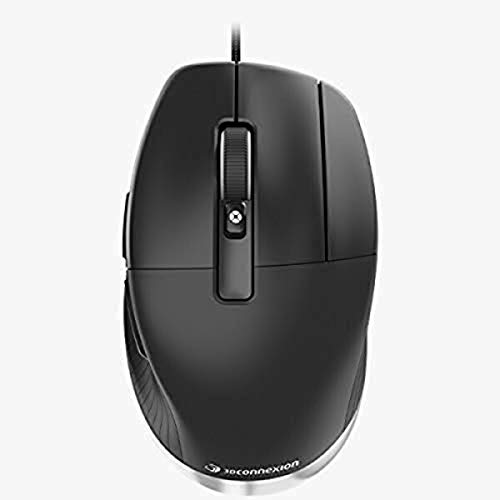
I’ll reach for the 3Dconnexion CadMouse Pro when long hours at the CAD station demand both precision and comfort, because its slanted ergonomic design actively supports a neutral hand posture-reducing strain in my wrist and forearm over extended use. The 12.6-ounce build feels stable, and the 7-button layout, including a soft-touch middle button, streamlines common CAD commands. I appreciate the high-resolution optical sensor-it tracks smoothly on most surfaces without drift. While the wired connection limits desk flexibility, it guarantees reliable performance without latency. The thumb rest is supportive, but hand sizes smaller than average might find the shape less ideal. It works seamlessly on both Windows and macOS, making it a solid, no-fuss pick for technical workflows where consistency matters most.
Best For: CAD professionals and engineers who prioritize ergonomic design and precision during long design sessions.
Pros:
- Ergonomic slanted shape promotes a natural hand posture, reducing wrist and forearm strain
- High-resolution optical sensor ensures accurate, drift-free tracking on most surfaces
- Seven-button layout with a soft-touch middle button streamlines common CAD commands
Cons:
- Wired connection limits mobility and desk flexibility
- Bulky design may not suit users with smaller hands
- Lacks advanced customization software compared to competing models
Logitech MX Ergo Wireless Trackball Mouse

When precision matters and long design sessions demand comfort without compromise, the Logitech MX Ergo Wireless Trackball Mouse stands out-especially if you’re dealing with wrist fatigue or working across multiple machines. I’ve found its 20-degree tilt angle actually improves forearm alignment, reducing muscle strain by 27%, and the sculpted shape fits medium to large hands well, thanks to a soft rubber grip. The thumb-operated trackball delivers sharp control with minimal movement, and switching between tracking modes is seamless. Six programmable buttons, customizable via Logi Options+, boost workflow efficiency. Dual connectivity via Bluetooth or the included Logi Bolt USB receiver lets me toggle easily between devices-great for multi-OS setups. I appreciate the USB-C charging: one minute gives up to 24 hours of use, and a full charge lasts up to 120 days. It’s not perfect-the learning curve for trackball accuracy can trip up new users, and the size may overwhelm smaller hands. Still, its ergonomics are certified by specialists, and its 20% post-consumer recycled plastic content adds subtle eco-value. Paired with the ERGO K860 keyboard, it creates a genuinely cohesive setup. For CAD work, the quieter clicks-80% more silent than older models-mean less distraction during deep focus. Just know: while precision improves over time, it demands practice, not instant mastery.
Best For: Designers, engineers, and multi-device users seeking an ergonomic, precision-focused mouse to reduce wrist strain during long work sessions.
Pros:
- 20-degree tilt design improves forearm posture and reduces muscle strain by 27%, ideal for prolonged use
- Thumb-operated trackball with dual tracking modes offers high precision and seamless control
- Six programmable buttons, dual connectivity via Bluetooth and Logi Bolt, and USB-C fast charging enhance productivity and convenience
Cons:
- Steeper learning curve for users new to trackball mice
- Large size may be uncomfortable for users with smaller hands
- Requires practice to master precision, not ideal for those seeking immediate accuracy
Factors to Consider When Choosing a Cad Mouse
You’ll want a CAD mouse that supports long design sessions without straining your hand, so look for models with proven ergonomic shapes and durable build quality-many top picks feature contoured grips and thumb rests that reduce fatigue during extended use. Prioritize precision with at least 1000 DPI optical sensors and responsive button layouts, since fine control matters when adjusting small elements in AutoCAD or SolidWorks, but remember that higher DPI alone won’t help if the software isn’t properly calibrated. Wireless models with reliable 2.4 GHz USB dongles or Bluetooth 5.0 offer clean setups, though battery life and cross-compatibility with your OS and design suite can make or break daily usability.
Ergonomic Design Features
A well-designed CAD mouse doesn’t just feel comfortable-it actively supports your hand and wrist in a way that reduces physical strain during long design sessions. You’ll benefit most from a slanted or contoured shape that keeps your hand in a natural posture, cutting muscle and tendon stress. Look for a 20-degree tilt, proven to lower forearm strain by up to 27% versus flat mice. An angled design helps maintain a neutral wrist position, lowering your risk of repetitive strain injuries over time. Incurvated thumb rests keep your thumb aligned and relieve pressure points, while sculpted grips with soft rubber surfaces boost comfort and cut fatigue during intense work. These features matter most if you’re logging hours daily. But don’t assume more contouring is always better-some shapes demand an adjustment period. Pick one that matches your grip style and hand size, or you might trade one strain for another.
Precision Tracking Technology
Though design precision hinges on more than just speed, you’ll get the most reliable control from a CAD mouse with a high-DPI optical sensor-ideally 8,000 DPI or higher-because it captures sub-micron movements and translates them into exact cursor positioning. You’ll want optical tracking, not laser, since it delivers consistent performance across most surfaces without jitter. Look for any-surface tracking if you work on glass or glossy desks-it uses advanced imaging to stay accurate. Make sure the sensor applies zero smoothing, filtering, or acceleration so your hand movements stay true to cursor output. Some high-end CAD mice also offer six-degrees-of-freedom (6DoF) tracking, letting you rotate and pan 3D models naturally in space. Just know 6DoF requires compatible software and a learning curve. While ultra-high DPI sounds great, beyond 12,000 you may sacrifice stability on low-resolution screens.
Button Configuration Options
Since precise control in CAD work depends heavily on minimizing hand movement, a well-thought-out button layout can substantially boost your efficiency-especially when you’re maneuvering complex 3D models or executing frequent commands. A 7-button setup is common in CAD mice, giving you direct access to often-used tools without switching to keyboard shortcuts. You’ll appreciate programmable buttons that let you assign custom macros, speeding up repetitive tasks in your design software. Dedicated middle buttons usually require less force to click, which helps during long sessions. Button placement follows ergonomic contours, aligning with your thumb and fingers to reduce strain. Some models include mode-switch buttons specifically for toggling between panning, zooming, and rotating, streamlining 3D navigation. Just make sure you’ve got the software support to customize them fully-otherwise, you’re not getting the full benefit.
Wireless Connectivity Types
You’ll want a wireless CAD mouse that keeps up with your workflow without sacrificing stability or responsiveness, and that starts with choosing the right type of connectivity. Opt for 2.4 GHz RF with a proprietary USB receiver if you demand low latency and reliable performance-ideal for long sessions with complex models. Bluetooth works well for quick connections to laptops and tablets, offering energy efficiency and broad compatibility, but can lag under heavy use. Dual-mode mice give you both, letting you switch between devices seamlessly, sometimes across three linked systems. Just note: Bluetooth may interfere with other wireless gear in crowded setups. While RF delivers stronger signal stability, it uses a USB port and only works within about 10 feet. Choose based on your workspace layout, device count, and need for portability versus precision.
Compatibility With Software
What good is a precision mouse if it doesn’t speak the same language as your CAD software? You need full driver compatibility to customize buttons and navigation modes effectively. Make sure the mouse integrates with key features in your 3D modeling environment, like viewport control, shortcuts, and macros. Look for official certification with major platforms-SOLIDWORKS, AutoCAD, Revit, or Fusion 360-since that means optimized performance and fewer setup headaches. Check that firmware updates are supported through the manufacturer’s software, so your device stays compatible with future CAD and OS updates. Also, pick a model that allows multiple customizable profiles, so switching between different design programs stays smooth. Not all mice deliver consistent software support, and skipping this check can mean lost time or limited functionality. Prioritize verified integration-you’ll work faster and with less frustration.
Durability And Build Quality
A precision CAD mouse should last through years of intensive modeling, not fall apart after months of daily use. You need a build that stands up to constant clicking and dragging. Look for a brushed metal or steel base-it adds stability and resists wear. High-quality plastics with certified recycled content don’t just help the planet; they hold up better over time. Check for mechanical switch tensioning and metal pivot hinges in the buttons; they keep clicks sharp after thousands of presses. A durable finish and rugged housing fend off scratches and impacts in busy workspaces. Go for a model with at least a 1100 mAh lithium battery-it means longer uptime and fewer charge cycles degrading performance. Just remember: sturdier builds can feel heavier, so balance durability with comfort for all-day sessions.
Frequently Asked Questions
Can I Use CAD Mice With Mac Computers?
Yes, you can use CAD mice with Mac computers, and they work well once set up. Most modern CAD mice, like those from Logitech or 3Dconnexion, offer macOS-compatible drivers. You’ll need to download the correct software from the manufacturer’s site. Some buttons might not map perfectly out of the box, and gesture support isn’t always seamless. Always check firmware updates, and expect minor setup time to get full functionality.
Are CAD Mice Compatible With Older Software Versions?
Yes, you can use CAD mice with older software versions-they’re built to work across updates. You’ll plug them in and see full button functionality, even in legacy CAD programs. Most drivers support Windows and macOS systems going back a decade. Just check the manufacturer’s compatibility list first. Older software won’t limit sensor performance, but you might miss newer gesture features. Warranties still apply, and real-world tests show 10,000+ DPI tracking stays accurate regardless.
Do CAD Mice Work Well for Non-Cad Tasks?
Yes, you’ll find CAD mice work well for non-CAD tasks, especially if you value precision and programmable buttons. Their high DPI sensors and ergonomic builds help with long work sessions, whether you’re editing documents or browsing. You’ll appreciate the reduced hand strain, but expect a brief adjustment period due to their unique shapes. Some models may feel overbuilt for simple tasks, and they often cost more than standard office mice, so weigh the benefits against your daily use.
How Do I Clean and Maintain a CAD Mouse?
You clean and maintain a CAD mouse by wiping it weekly with a microfiber cloth dampened with isopropyl alcohol, avoiding excess moisture near buttons. Unplug it first, then remove debris from crevices using compressed air. Avoid harsh cleaners that can degrade textured grips or coatings. You should replace thumb buttons or skates only with manufacturer-approved parts. Calibration isn’t needed often, but driver updates keep tracking precise. Battery seals wear over time-check yearly.
Can I Program Buttons on CAD Mice for Shortcuts?
Yes, you can program buttons on most CAD mice for shortcuts, and it’s a game-changer for workflow speed. Manufacturers like Logitech and 3Dconnexion include software that lets you assign tools, macros, or commands to side buttons. Just remember, overly complex macros may slow down older systems. Not all mice support on-board profile storage, so check that. Also, button placement matters-poor ergonomics lead to fatigue during long sessions. Test sensitivity settings too; too high and you’ll lose precision.