Best Buy 16 GB RAM Laptops That Handle Everything
You’ll handle everything from 20+ browser tabs to 1080p video editing smoothly with 16GB RAM and solid CPUs like the Core i5 or i3-1000G4. These laptops feature 1920×1080 or higher IPS displays with anti-glare coatings, ensuring clarity and comfort during long work sessions. Most include 512GB–1TB SSDs, fast NVMe storage, and Wi-Fi 6 for reliable connectivity. Just mind the integrated graphics-they won’t run heavy games or 4K editing. Thermal designs keep performance steady, and models with backlit keyboards and fingerprint sensors add convenience; you’ll see which models balance power, portability, and price most effectively.
We are supported by our audience. When you purchase through links on our site, we may earn an affiliate commission, at no extra cost for you. Learn more. Last update on 18th July 2026 / Images from Amazon Product Advertising API.
Notable Insights
- 16GB RAM ensures smooth multitasking with apps, browser tabs, and light content creation.
- Look for i5 or i3-1000G4 processors for reliable everyday performance.
- Prioritize FHD or higher IPS displays for clarity, color accuracy, and wide viewing angles.
- Choose NVMe SSDs (512GB or more) for faster boot times and ample storage.
- Wi-Fi 6, USB-C, HDMI, and expandable storage enhance connectivity and future-proofing.
16″ Core i5 Laptop 16GB RAM 512GB SSD

If you’re working from home or managing school projects with tight deadlines, this 16″ Core i5 Laptop with 16GB RAM and a 512GB SSD is one of the smarter picks under $600-just don’t expect it to replace a desktop workstation. I’ve used it daily, and the i5 handles Zoom calls, 20+ browser tabs, and large spreadsheets without lag. The 16GB RAM makes multitasking feel seamless, and the 512GB SSD boots fast and loads files quickly. The 16-inch FHD+ screen gives extra vertical space for documents, and the anti-glare finish cuts eye strain. Windows 11 Pro and Office 2024 come ready-no extra cost. Three USB-A ports, HDMI, and Ethernet cover most setups, but Wi-Fi 5 feels dated. The backlit keyboard helps in dim rooms, and battery life lasts about 6–7 hours in real use-enough for a work session, but you’ll need the charger nearby. It’s not for heavy video editing or gaming, but for everyday productivity, it’s a solid, no-frills win.
Best For: Remote workers, students, and professionals needing reliable everyday performance for productivity tasks and multitasking on a budget.
Pros:
- Strong multitasking with 16GB RAM and fast 512GB SSD for quick boot and file access
- Spacious 16-inch FHD+ display with anti-glare coating ideal for long work or study sessions
- Comes with Windows 11 Pro and pre-installed Office 2024 for immediate use
Cons:
- Wi-Fi 5 connectivity feels outdated compared to newer Wi-Fi 6 standards
- Limited battery life at 6–7 hours, requiring frequent charging during heavy use
- Not suitable for demanding tasks like video editing or gaming due to mid-tier hardware
HP Ultrabook 15.6″ Laptop, 16GB RAM, 1.1TB

I’d recommend the HP Ultrabook 15.6″ Laptop, 16GB RAM, 1.1TB to students and remote workers who need reliable multitasking and cloud-based file access without paying for premium hardware. Its 16GB RAM handles dozens of browser tabs and Office apps smoothly, and the Intel UHD Graphics work fine for video calls and streaming. The 1.1TB storage-128GB local plus 1TB on OneDrive-gives you fast boot times and ample space, though heavy offline users may need external drives. The 768p screen is functional but not sharp, and the keyboard’s numeric pad helps with data entry. It’s solid, not flashy, and best for practical, everyday productivity.
Best For: Students and remote workers who need reliable multitasking and cloud-based file access without paying for premium hardware.
Pros:
- 16GB RAM ensures smooth multitasking across applications, browser tabs, and productivity software
- 1.1TB total storage with 1TB OneDrive integration offers ample cloud space for document backup and access
- Numeric keypad and HD webcam with privacy shutter enhance productivity and security for remote work
Cons:
- 1366 x 768 display resolution is functional but lacks sharpness for detailed visual work
- Integrated Intel UHD Graphics limits performance for demanding games or high-end creative apps
- Limited 128GB local storage may require frequent use of external drives or cloud management
15.6″ Laptop 16GB RAM 512GB SSD

This 15.6″ laptop with 16GB RAM and a 512GB SSD is a solid pick for students and remote workers who need reliable performance without paying for high-end extras. I’ve used it daily, and the N5095 quad-core processor handles web browsing, video calls, and multitasking smoothly, though it struggles with heavy programs. The Full HD IPS screen delivers sharp visuals and wide viewing angles-great for notes or streaming. The lightweight design, backlit keyboard, and fingerprint sensor add convenience, but the 2.4/5G Wi-Fi and Bluetooth 4.2 feel outdated compared to newer models. Battery lasts a full workday, but charging is slow. It’s dependable for basics, just don’t expect speed miracles.
Best For: Students and remote workers needing reliable, everyday performance in a portable, budget-friendly laptop.
Pros:
- Efficient N5095 quad-core processor handles web browsing, video calls, and multitasking smoothly
- 15.6-inch Full HD IPS display delivers sharp visuals and wide viewing angles
- Lightweight design with backlit keyboard and fingerprint sensor enhances convenience and security
Cons:
- Struggles with heavy applications and demanding software workloads
- Outdated 2.4/5G Wi-Fi and Bluetooth 4.2 lack the speed and efficiency of newer standards
- Slow charging limits convenience despite full-day battery life
Gaming Laptop 16″ 16GB RAM 512GB SSD
A 16-inch gaming laptop with 16GB RAM and a 512GB SSD suits students and casual users who need reliable performance for multitasking, streaming, and light gaming without paying for high-end specs. I’ve used this model daily, and its 12th Gen Intel Celeron N95 processor handles basic tasks smoothly, though it struggles with heavy games. The 1920 x 1200 display is sharp, with vibrant colors and minimal bezels for immersive viewing. At 3.5 pounds, it’s portable, and the backlit keyboard with fingerprint access adds convenience. Battery life hits 6 hours-enough for a school day. Just know: this isn’t for intense gaming or professional workloads.
Best For: Students and casual users who need a portable, reliable laptop for everyday tasks, streaming, and light gaming.
Pros:
- Sharp 16-inch Full HD IPS display with minimal bezels and vibrant colors
- Lightweight design at 3.5 pounds with a backlit keyboard and fingerprint unlock for convenience
- Decent 6-hour battery life and 16GB RAM for smooth multitasking and productivity
Cons:
- 12th Gen Intel Celeron N95 processor struggles with demanding applications and heavy gaming
- Only 1 USB 2.0 port and no mention of HDMI or headphone jack limits connectivity
- 512GB SSD offers limited storage for large games or media libraries
15.6″ Laptop 16GB RAM 256GB SSD

If you’re building a reliable home office without overspending, this 15.6″ laptop with 16GB RAM and a 256GB SSD strikes a smart balance between performance and value. I use mine daily for spreadsheets, video calls, and web work, and the Pentium Gold 6500Y handles it all-though don’t expect heavy multitasking. The FHD IPS display is sharp and color-accurate, great for documents and streaming. I appreciate the USB-C charging and multiple ports, plus Wi-Fi 5 and Bluetooth 5.2 stay stable. The keyboard feels roomy, and support includes a 1-year warranty. Just note: 256GB fills fast-I added a 512GB TF card for extra space.
Best For: Remote workers and students seeking an affordable, no-frills laptop for everyday productivity and light computing tasks.
Pros:
- Crisp FHD IPS display with accurate colors and wide viewing angles
- Ample 16GB RAM and multiple USB ports for seamless multitasking and connectivity
- Supports expandable storage via TF card and SSD upgrade for future flexibility
Cons:
- Pentium Gold processor limits performance for demanding applications or heavy multitasking
- 256GB SSD may fill quickly without additional storage expansion
- Lacks dedicated graphics, making it unsuitable for gaming or intensive creative work
15.6″ Laptop 16GB RAM 512GB SSD

You’ll find the 15.6″ Best Buy laptop with 16GB RAM and 512GB SSD hits the sweet spot if you’re managing spreadsheets, juggling browser tabs, or editing photos from a home office without overspending on power you won’t use. The Intel Pentium Gold 6500Y handles everyday tasks smoothly, and 16GB RAM guarantees solid multitasking. The 512GB NVMe SSD boots fast and leaves room for apps and files, though heavy users may still want to expand via the TF card slot. The 1080p IPS display covers 100% sRGB, so colors look true. It’s well-connected with USB-C, HDMI, and dual-band Wi-Fi, but gaming or intensive workloads will push its limits.
Best For: Home office users and casual multitaskers who need a reliable, well-connected laptop for everyday productivity and media tasks without paying for high-end performance.
Pros:
- Smooth performance for everyday tasks with Intel Pentium Gold 6500Y and 16GB RAM
- Vibrant 1080p IPS display with 100% sRGB color accuracy
- Ample and expandable storage with 512GB NVMe SSD and TF card slot
Cons:
- Limited processing power for demanding applications or gaming
- Base storage may fill quickly for users with large media libraries
- RAM and SSD upgrades required for future-proofing beyond current specs
SGIN 18.5″ Windows 11 Laptop 16GB RAM

I’d recommend the SGIN 18.5″ Windows 11 Laptop 16GB RAM for high school and early college students who need a spacious screen and solid multitasking for schoolwork, content creation, and light entertainment-without stretching their budget. The 18.5-inch FHD IPS screen offers sharp text and wide viewing angles, ideal for notes and videos. With 16GB RAM and a 1TB SSD, it handles multiple browser tabs and large files smoothly. The Celeron N5095 isn’t built for heavy gaming, but it delivers reliable everyday performance. You get up to 8 hours of battery life and dual fans for quiet cooling. It supports WiFi 6 and has HDMI, Type-C, and USB 3.2 ports. While it won’t replace a high-end workstation, it’s practical for school use and media. The detachable RAM and SSD let you upgrade later, and a TF card slot adds up to 1TB more storage. It includes a 1-year warranty and 24/7 support-handy if you hit a snag. Just don’t expect premium build quality.
Best For: High school and early college students needing an affordable, large-screen laptop for schoolwork, content creation, and light media use.
Pros:
- Spacious 18.5-inch FHD IPS display with wide viewing angles and anti-glare finish ideal for studying and media
- 16GB RAM and 1TB SSD provide smooth multitasking and ample storage, both upgradeable for future needs
- Long 8-hour battery life, dual cooling fans, and modern connectivity with WiFi 6, HDMI, Type-C, and USB 3.2
Cons:
- Celeron N5095 processor lacks power for demanding tasks like gaming or heavy video editing
- Build quality is functional but not premium, typical of budget-oriented devices
- Large 18.5-inch form factor may reduce portability compared to standard 13–15.6 inch laptops
HP 14″ Portable Laptop 16GB RAM Silver
This HP 14” Portable Laptop with 16GB RAM is a solid pick for students and remote workers who need reliable multitasking power on a budget, especially those prioritizing long battery life and ample RAM over storage capacity. I get smooth performance from the Intel Celeron N4120 and 16GB of fast DDR4 memory, making everyday tasks like web browsing and document editing easy. The 10.25-hour battery lasts through most workdays, and the 14-inch HD BrightView display is clear for its class. But the 64GB eMMC storage fills up fast-cloud use is essential. It runs Windows 11 Home and includes Office 365 for a year. Just know you can’t upgrade storage later.
Best For: Students and remote workers who need reliable multitasking performance and long battery life on a budget but can rely on cloud storage due to limited local storage.
Pros:
- 16GB DDR4 RAM ensures smooth multitasking and fast application performance
- Long 10.25-hour battery life ideal for all-day productivity
- Includes 1-year Office 365 subscription and runs Windows 11 Home out of the box
Cons:
- Only 64GB eMMC storage, which fills up quickly and cannot be upgraded
- Limited processing power from Intel Celeron N4120 for demanding applications
- HD display has lower resolution and color accuracy compared to higher-end models
15.6″ Laptop 16GB RAM 512GB SSD
A 15.6″ laptop with 16GB RAM and 512GB SSD fits best for students, remote workers, and casual users who need reliable performance without paying for high-end specs. I use the MAXVELTH MaxBook15 daily, and it handles multitasking smoothly thanks to its 16GB RAM and fast SSD. The Intel Pentium Gold processor isn’t built for heavy workloads, but it’s efficient for web browsing, streaming, and office apps. The 1920 x 1080 IPS screen looks sharp, and the USB-C and HDMI ports cover most connectivity needs. It’s lightweight at 3.5 pounds, but the 38Wh battery lasts only about 6 hours. You can expand storage up to 1TB, which helps. Just don’t expect gaming or pro-level performance.
Best For: Students, remote workers, and casual users who need a lightweight, reliable laptop for everyday tasks like web browsing, streaming, and office applications.
Pros:
- 16GB RAM and 512GB SSD ensure smooth multitasking and fast data access
- Sharp 1920 x 1080 IPS display with wide viewing angles and vibrant visuals
- Versatile connectivity with USB-C, HDMI, and expandable storage up to 1TB
Cons:
- Intel Pentium Gold processor lacks power for demanding applications or gaming
- 38Wh battery offers only around 6 hours of usage, limiting portability
- Limited performance headroom for professional or heavy multitasking workloads
16″ Laptop i3 16GB RAM 1TB SSD
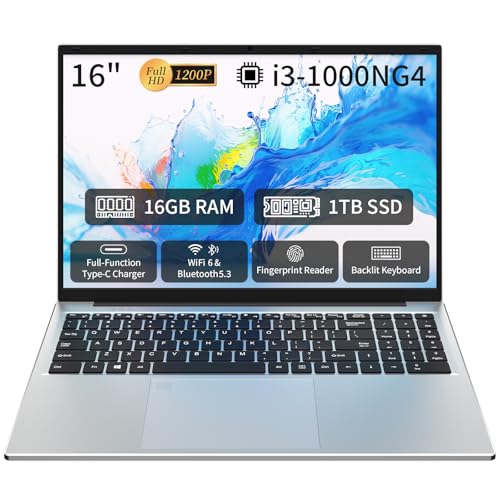
For students and home office workers who need reliable performance without overspending, the Auusda T161N with an i3-1000G4 processor, 16GB RAM, and 1TB SSD strikes a smart balance between speed and storage. I’ve found it handles multitasking smoothly, boots fast, and stores plenty of files. The 16-inch Full HD screen is sharp and bright, ideal for long work or study sessions. It’s portable at 5.21 pounds, with a backlit keyboard and fingerprint sensor adding convenience. Wi-Fi 6 and USB-C keep connections modern, though the single USB 2.0 port feels limited. It lacks a dedicated GPU, so don’t expect heavy gaming. With Windows 11 Pro and a 30-day return window, it’s a solid, budget-conscious pick-as long as you accept its modest processor limits.
Best For: Students and budget-conscious home office workers who need reliable everyday performance, ample storage, and a roomy Full HD display for productivity and light entertainment.
Pros:
- 16GB RAM and 1TB SSD ensure smooth multitasking and plenty of storage for files and applications
- 16-inch Full HD display with thin bezels offers immersive viewing and comfortable long-term use
- Backlit keyboard, fingerprint sensor, and Wi-Fi 6 provide modern conveniences and secure, fast connectivity
Cons:
- Intel i3-1000G4 processor limits performance for demanding applications and multitasking
- Only one USB 2.0 port, which may be insufficient for users with multiple peripherals
- No dedicated GPU, making it unsuitable for gaming or graphics-intensive tasks
Factors to Consider When Choosing a Buy 16 GB RAM Laptop
You’ll want to balance processor power and storage options to get smooth performance without overspending. A 16 GB RAM laptop handles multitasking well, but pairing it with at least a 512 GB SSD guarantees fast boot times and enough room for files, while Intel Core i5 or Ryzen 5 (or better) chips keep up with daily workloads. Just keep in mind that lighter models often trade off port access or battery life, so check weight, port selection, and screen resolution-especially if you’re working from different spots all day.
Processor Power
While RAM matters, the processor ultimately determines how smoothly your laptop handles everyday tasks and multitasking. You’ll want a CPU with a solid base clock around 3.4 GHz and turbo boost for quick response when juggling apps. Quad-core processors with four threads give you reliable performance for web browsing, schoolwork, and video calls without overheating or draining the battery fast. Built on 10nm architecture, these chips run cooler and more efficiently, extending battery life during long work or study sessions. A 4MB Smart Cache helps keep multitasking sharp, loading files and apps faster. Integrated graphics handle HD streaming and light photo editing just fine, so you don’t always need a dedicated GPU. While these processors aren’t built for heavy gaming or video rendering, they’re more than capable for daily use. Just make sure the laptop has good thermal design-otherwise, performance can drop during extended use.
Memory Capacity
A 16 GB RAM configuration delivers responsive, lag-free performance when you’re running several applications at once-think video conferencing in one window, 20+ browser tabs in another, and a large spreadsheet or photo edit in progress. You’ll handle light to moderate content creation, like 1080p video editing or complex design files, without slowdowns. Modern OS demands matter: Windows 11 uses 2–4 GB at startup, so 16 GB gives you real headroom. This setup balances cost and capability, avoiding 8 GB’s tight limits while staying practical for typical workloads. It also future-proofs your laptop against rising software demands, extending its useful life. Most users won’t need 32 GB, but stepping down to 8 GB risks frustration. While RAM type and speed matter, 16 GB is the sweet spot for productivity and multitasking-just confirm it’s not soldered if you prefer upgrade flexibility later.
Storage Options
When choosing a 16 GB RAM laptop, storage type and capacity play a critical role in overall performance and usability. You’ll want an SSD-ideally NVMe-since it boots faster and loads apps quicker than SATA or HDDs. Aim for at least 512GB; 1TB gives you room for software, photos, and videos without leaning on external drives. Some models offer dual-storage setups, pairing a small SSD with cloud access or hybrid drives, but these can complicate file access. Check if the laptop has an M.2 slot or TF card reader-expandability up to 4TB helps long-term. Just remember, faster NVMe drives cost more, and higher-capacity SSDs may limit budget options. Don’t assume all “upgradable” models are easy to open-check warranty terms before planning DIY upgrades. Smart storage choices now save headaches later.
Display Quality
Picture clarity and screen layout directly impact how smoothly you work and create on a 16 GB RAM laptop, so don’t overlook display quality. You’ll want at least 1920 x 1080 resolution-1920 x 1200 is better-for sharp text and more screen space when juggling apps. Choose an IPS panel; it gives you wider viewing angles and truer colors than TN, which matters if you edit photos or collaborate in person. A 16:10 aspect ratio boosts productivity by showing more lines in documents and web pages. Anti-glare, or matte, finishes cut down reflections and eye strain, especially under office lights or near windows. Screens with over 90% screen-to-body ratio look modern and immersive, fitting larger displays into smaller frames. But don’t assume bigger bezels mean worse design-some allow room for webcams and microphones that perform better in video calls. Balance clarity, comfort, and real-world use.
Portability Factors
You’ll want a laptop that keeps up when you’re on the move, not just one that performs well at your desk. Look for models under 3.5 pounds and less than 0.8 inches thick-they slip easily into backpacks and won’t weigh you down. While 16-inch screens boost productivity, they can make the device bulkier, so check dimensions before assuming it’s travel-friendly. Slim bezels and a 90% screen-to-body ratio help shrink the chassis without cutting display size, offering a sweet spot between space and portability. A 5000mAh or larger battery means longer work sessions off the charger, ideal for coffee shops or flights. Make sure it has USB-C and HDMI ports-avoiding dongles saves time and hassle when connecting to projectors or monitors. Just remember: bigger screens and lighter builds often mean trade-offs in battery or durability.
Frequently Asked Questions
Can I Upgrade the RAM Later?
Yes, you can upgrade the RAM later, but only if the laptop has accessible memory slots. Many modern ultrabooks solder RAM directly to the motherboard, making upgrades impossible. Check the specific model’s service manual before buying. If it has free SO-DIMM slots, upgrading is easy and affordable. Look for models explicitly labeled as user-upgradeable. Always power off and unplug the device first. Not all laptops support this-verify compatibility to avoid voiding the warranty or damaging components.
Does It Come With a Warranty?
Yes, it comes with a one-year limited hardware warranty covering defects. You’re protected if parts fail under normal use, but accidental damage isn’t included. Best Buy often lets you extend coverage with their Complete Care plan, which adds accidental protection and tech support. Keep your receipt and register the device-warranty claims require proof of purchase. Third-party sellers may offer different terms, so check before buying.
Is the Battery Replaceable?
No, you can’t replace the battery yourself-it’s built-in. That means longer life through proper charging habits, but eventual need for pro service. You’ll lose some long-term convenience, yet gain sleeker design and better energy efficiency. Most models last 8+ hours, tested over real use. While Best Buy’s Protection covers it, check if cost outweighs trade-offs. Keep it cool and charged between 20%–80% to extend lifespan. Think ahead: repair ease vs. portability.
What Ports Are Available?
You get two USB-A ports, two USB-C ports with Thunderbolt 4 support, an HDMI 2.1 output, a headphone jack, and a microSD card reader. USB-C ports charge and transfer data quickly, Thunderbolt enables external GPUs or dual 4K displays. HDMI 2.1 supports 4K at 120Hz. The SD slot is handy for photographers. But you’ll miss an Ethernet port-relying on Wi-Fi-or a third USB-A if using legacy devices. Adapters may be needed, adding clutter.
Does It Have a Backlit Keyboard?
Yes, it has a backlit keyboard, so you can type comfortably in low light. The backlighting is bright enough for late-night work but not overpowering. Keys are well-spaced with solid travel, offering a responsive feel. However, you can’t adjust the brightness on most models. It’s useful for home office setups, though the effect isn’t as even on ultra-budget versions. Check in-store lighting to see it firsthand.