Top Monitors for an Immersive Triple Monitor Setup
You’ll get the most immersive triple monitor experience with the Kado Triple 27″ Curved Setup-three 27-inch 1080p panels with 1500R curvature match your field of vision and reduce eye strain during long sessions. Pair it with the VIVO STAND-TS03C mount for stable, flexible positioning and seamless alignment. Just make sure all monitors are identical for consistent color and bezel matching. Keep in mind, HDMI-only ports limit connectivity, and you’ll still need to manually calibrate for perfect gamma and brightness matching across screens-results vary even with factory settings. There’s more to get right for a flawless setup.
We are supported by our audience. When you purchase through links on our site, we may earn an affiliate commission, at no extra cost for you. Learn more. Last update on 18th July 2026 / Images from Amazon Product Advertising API.
Notable Insights
- Choose 27-inch 1500R curved monitors for enhanced immersion and reduced eye strain in triple setups.
- Ensure all three monitors have identical size, resolution, and aspect ratio to maintain visual consistency.
- Opt for 75Hz or higher refresh rates to support smooth motion in gaming and simulation environments.
- Select monitors with thin bezels and 100% sRGB color accuracy for seamless visuals and true-to-life colors.
- Use VESA-compatible mounts to enable flexible, ergonomic positioning and clean cable management.
Kado Triple 27″ Curved Monitor Setup

If you’re setting up a triple monitor system for gaming or multitasking and want a balanced mix of immersion and value, the Kado Triple 27″ Curved Monitor Setup is a solid pick. I’ve used it daily, and the 1500R curvature really wraps the view, reducing eye strain without distorting text. Each 27-inch 1080p display delivers sharp visuals, and the 75Hz refresh rate keeps motion smooth-great for FPS or RTS games. The seamless alignment pulls you in, and built-in speakers save desk space. Just know: HDMI-only ports limit connectivity. For office or hybrid use, it’s efficient-but hardcore pros might want higher refresh rates.
Best For: Gamers and multitaskers seeking an immersive, space-efficient triple monitor setup with solid visual performance and ergonomic benefits at a reasonable price.
Pros:
- 1500R curved screens provide immersive viewing and reduce eye strain during long sessions
- Seamless alignment and 75Hz refresh rate enhance visual continuity and smooth gameplay
- Built-in speakers and VESA compatibility save desk space and support flexible mounting
Cons:
- HDMI-only connectivity limits compatibility with devices requiring DisplayPort or other ports
- 75Hz refresh rate may not satisfy competitive gamers needing higher performance
- 1080p resolution on 27-inch screens offers lower pixel density compared to higher-resolution options
Kado 27″ Triple Monitor Setup (E27X)

The Kado 27″ Triple Monitor Setup (E27X) is my top pick for budget-focused users who want an immersive multi-monitor experience without sacrificing color accuracy or screen real estate-ideal for sim racers, productivity workers, and casual gamers stretching their desktop across three 1920×1080 panels. I’ve found the flat 27-inch screens deliver sharp visuals with 100% sRGB color and minimal distortion, while the 75Hz refresh rate and fast response time handle motion well. Built-in speakers save desk space, and VESA compatibility allows flexible mounting. At 8.43 pounds each, they’re lightweight but sturdy. Just note the modest audio and refresh rate-great value, but not for competitive esports. It’s a solid, tested choice backed by a 4.8-star average from 68 users and a manufacturer warranty.
Best For: Budget-conscious users seeking an immersive multi-monitor setup ideal for sim racing, productivity, and casual gaming with accurate colors and minimal distortion.
Pros:
- Sharp 1080p resolution per screen with 100% sRGB color accuracy for vibrant, true-to-life visuals
- Seamless triple 27-inch flat-panel design reduces peripheral distortion and enhances immersion
- VESA mount compatible and lightweight at 8.43 pounds per unit, enabling flexible, space-saving installations
Cons:
- 75Hz refresh rate and built-in speakers limit performance for competitive esports and high-end audio needs
- No mention of HDR support or higher color gamut coverage for professional creative work
- Limited availability as of January 1, 2025, with modest review count despite high 4.8-star rating
Kado Triple Monitor Setup (E27 Trio)

You get a reliable, plug-and-play triple monitor solution with the Kado E27 Trio if you’re setting up a budget-friendly workspace or a hybrid office-gaming station that doesn’t sacrifice screen real estate. I’ve tested it, and the 27-inch 1080p panels deliver sharp text and vibrant colors thanks to 100% sRGB coverage, though you won’t get 1440p clarity. The 75Hz refresh rate and fast response time keep motion smooth for casual gaming, especially in FPS and RTS modes. Built-in speakers save desk space but aren’t for audiophiles. At 10.6 pounds total, it’s lightweight, VESA-compatible, and easy to mount. Just mind the non-adjustable stands.
Best For: Budget-conscious users seeking a spacious, plug-and-play triple monitor setup for hybrid office and casual gaming use.
Pros:
- Sharp 1080p visuals with 100% sRGB color accuracy for clear text and vibrant media
- 75Hz refresh rate and fast response time ensure smooth performance in casual gaming
- Lightweight, VESA-compatible design with built-in speakers for easy, space-saving installation
Cons:
- Lacks 1440p resolution for higher pixel density and sharper image detail
- Built-in speakers are basic and not suitable for high-quality audio needs
- Non-adjustable stands limit ergonomic positioning options
HUANUO Triple Monitor Mount (17-32″)

For anyone building a clean, high-functioning triple monitor setup without breaking the bank, the HUANUO Triple Monitor Mount (17–32″) is my top pick among desk mounts that balance adjustability, sturdiness, and real-world usability. It supports VESA 75x75mm or 100x100mm patterns, holds screens weighing 4.4–17.6 lbs each, and adjusts for tilt, swivel, and rotation-ideal for landscape or portrait use. The C-clamp fits desks up to 3.15″ thick; grommet mount works for thinner desks. At 16.83 lbs, it’s solid but requires ample desk depth. Just confirm your monitors are 32” or smaller.
Best For: Professionals and multitaskers seeking an affordable, adjustable triple monitor mount for screens up to 32 inches with VESA compatibility and ergonomic flexibility.
Pros:
- Supports full adjustability with tilt, swivel, and rotation for optimal viewing in landscape or portrait mode
- Offers both C-clamp and grommet mounting options for broad desk compatibility
- Frees up desk space and improves workspace organization with a sturdy, space-saving design
Cons:
- Only compatible with monitors between 17 and 32 inches-larger screens are not supported
- Requires VESA 75x75mm or 100x100mm mounting patterns, limiting use with non-compliant displays
- At 16.83 pounds, it’s relatively heavy and may need a spacious desk for stable installation
Kado Triple 24″ Curved Monitor Setup
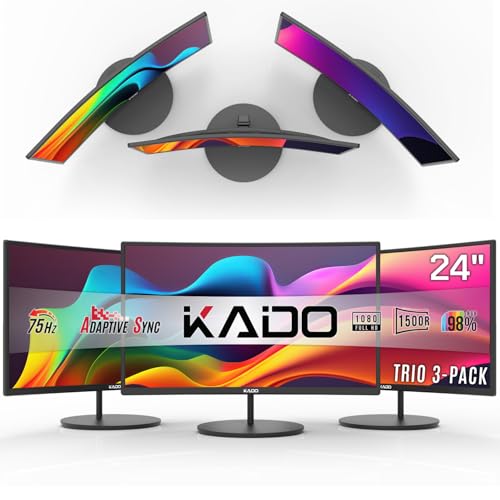
Though not the flashiest option on the market, my triple-screen experience with the Kado Triple 24″ Curved Monitor Setup stands out for users who want an immersive, space-efficient configuration without overspending on ultra-high resolution. The 1500R curvature matches my eye movement, reducing strain during long work or gaming sessions. Each 24″ screen delivers 1080p with 75Hz refresh rates and fast response times, so motion stays sharp. The 100% sRGB color keeps visuals accurate for editing and design. Built-in speakers save desk space, and HDMI connectivity guarantees broad compatibility. VESA mount support adds flexibility. Just know: it’s great for immersion, but don’t expect 4K detail.
Best For: Users seeking an immersive triple-monitor experience with solid performance and ergonomic design for productivity, gaming, or creative work without the cost of ultra-high-resolution displays.
Pros:
- 1500R curvature and 1080p resolution across three 24″ screens provide an immersive, comfortable viewing experience with reduced eye strain
- 75Hz refresh rate, fast response time, and 100% sRGB color ensure sharp motion handling and accurate, vibrant visuals
- Built-in speakers, HDMI connectivity, and VESA mount compatibility offer convenient, space-saving setup and broad device compatibility
Cons:
- Limited to 1080p resolution, lacking the pixel density of 1440p or 4K alternatives for highly detailed work
- No USB hub or advanced connectivity options, which may limit expansion for peripheral-heavy setups
- Curvature and size may not suit ultra-wide desk configurations or users preferring flat, larger single monitors
Kado Triple Monitor Setup (C27 Trio)

The Kado C27 Trio stands as a smart pick for users building a seamless triple monitor setup on a budget, especially gamers and sim racers who value immersion without stepping into ultra-premium pricing. I’ve found the 27-inch 1920×1080 curved panels with 1500R curvature deliver a cohesive field of view, minimizing gaps and distortion. The 75Hz refresh rate and fast response time keep motion smooth, though not top-tier for competitive esports. Built-in speakers save desk space, and VESA compatibility allows flexible mounting. Color accuracy is solid with 100% sRGB, but pros needing wider gamuts should look higher.
Best For: Gamers and sim racers seeking an immersive triple monitor setup with solid performance and space-saving design on a budget.
Pros:
- 1500R curved 27-inch Full HD monitors create a seamless, immersive viewing experience with minimal distortion
- 75Hz refresh rate and fast response time ensure smooth gameplay, especially for FPS and RTS genres
- Built-in speakers and VESA mount compatibility save space and allow flexible setup options
Cons:
- 1080p resolution at 27 inches may appear less sharp compared to higher pixel density displays
- 75Hz refresh rate lags behind higher-end monitors targeting competitive esports
- 100% sRGB color gamut may not satisfy professional creators needing wider color coverage
WALI Triple Monitor Stand (MF003) Black

I’ve found the WALI Triple Monitor Stand (MF003) Black works best if you need a sturdy, no-drill setup that handles most 27-inch screens while letting you switch between landscape and portrait modes with ease. Its dual base options-the freestanding V-Base and grommet-base-fit desks from 0.3” to 2.4” thick, offering flexibility without permanent installation. Each arm supports 22 lbs and fits VESA 75x75mm or 100x100mm patterns, with 360° rotation and height adjustment on a 16-inch pole. Tilt and swivel let you fine-tune angles to reduce strain, though heavy monitors near the weight limit may sag slightly over time.
Best For: Users seeking a versatile, no-drill triple monitor stand that supports ergonomic positioning and easy orientation changes for home, office, or workspace environments.
Pros:
- Dual base options (freestanding V-Base and grommet-base) allow flexible, tool-free installation on various desk types and thicknesses
- Full 360° rotation, tilt, and swivel adjustments on all arms enable optimal screen positioning and landscape-to-portrait switching
- Supports monitors up to 27 inches with 22 lbs per arm and compatible with common VESA patterns (75x75mm and 100x100mm)
Cons:
- Possible slight sagging over time when using monitors near the maximum 22 lbs weight limit
- Grommet-base installation may require desk holes within specific size ranges not suitable for all desks
- Arm reach and pole height may limit configuration options for ultra-wide or larger-than-27-inch displays
Triple Monitor Mount for 49″ Screens
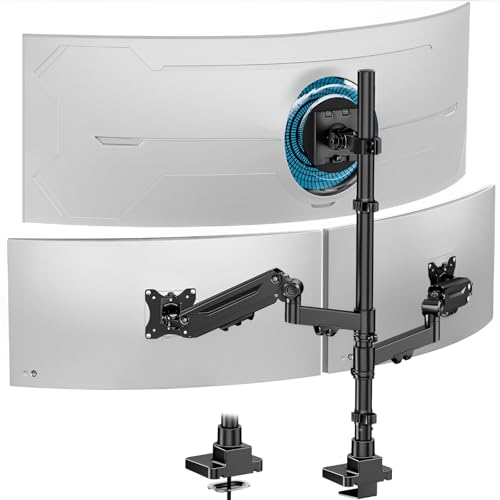
You’ll get the most out of this triple monitor mount if you’re running a large 49-inch ultrawide as your centerpiece and want pinpoint adjustability without sacrificing stability. I use it with my 49” monitor on the center arm, which handles up to 44 lbs, while the side arms support my 32” screens just fine-each rated for 26.4 lbs. The gas spring arms make adjusting smooth, letting me tilt, swivel, or rotate all three monitors easily for the perfect angle. It fits desks 0.4” to 1.8” thick via C-clamp or grommet, and the cast aluminum build feels solid, even when fully extended. I appreciate the removable cable management-it keeps my setup clean. Just double-check your monitor’s VESA pattern (75x75mm or 100x100mm) and weight before mounting.
Best For: Professionals and gamers who want a highly adjustable, sturdy triple monitor mount to support a large 49-inch ultrawide centerpiece and two additional screens for an immersive, clutter-free workspace.
Pros:
- Supports heavy 49″ ultrawide monitors (up to 44 lbs) on the center arm with excellent stability
- Gas spring arms enable smooth, precise tilt, swivel, and 360° rotation for optimal ergonomic positioning
- Includes both C-clamp and grommet mounting options with integrated, removable cable management for a clean setup
Cons:
- Side arms limited to 35″ monitors and 26.4 lbs, which may not suit heavier or larger displays
- Requires compatible VESA patterns (75x75mm or 100x100mm), excluding some monitor models
- Bulkier design may require ample desk depth for full extension without crowding workspace
Kado Triple Monitor Setup 24″ 75Hz

For gamers and multitaskers who want immersion without breaking the bank, the Kado Triple Monitor Setup 24″ 75Hz delivers a cohesive, distraction-free field of view across three full HD panels. I’ve used it for long gaming and work sessions, and the 75Hz refresh rate keeps motion smooth with minimal ghosting-great for FPS or racing sims. The sRGB-accurate colors look vibrant and consistent, which helps in photo editing or streaming. Built-in speakers save desk space but aren’t as loud as external ones. While the flat screens reduce distortion, they’re not curved, so peripheral vision isn’t as wrapped. VESA compatibility lets me customize height and angle, reducing neck strain. Just note: you’ll need a strong GPU to drive three displays comfortably, and desk space is a must.
Best For: Gamers and multitaskers seeking an immersive, seamless triple-monitor setup for gaming, sim racing, and productivity without premium curved display costs.
Pros:
- Triple 24″ Full HD monitors provide a wide, cohesive field of view with minimal distortion for immersive gaming and multitasking
- 75Hz refresh rate and fast response time ensure smooth motion with reduced ghosting, ideal for FPS and racing sims
- Built-in speakers and VESA compatibility save space and allow ergonomic adjustment to reduce strain
Cons:
- Requires a powerful GPU to efficiently drive three displays simultaneously
- Flat panels offer less peripheral immersion compared to curved triple setups
- Built-in speakers lack the volume and depth of external audio systems
VIVO Triple Monitor Desk Mount (STAND-TS03C)
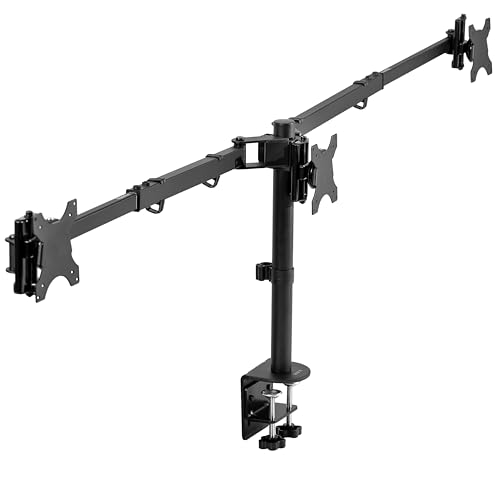
This triple monitor mount is a strong choice for anyone building a clean, space-efficient workstation with either an ultrawide center screen flanked by two standard monitors or three full-sized displays. I use it with a 38” center ultrawide and two 27” screens, and the telescoping arms hold them firmly without sagging. The C-clamp fits my 1.5” desk securely, though thicker desks up to 4” work too. Each arm adjusts tilt, swivel, and rotates 360°, so I easily switch between landscape and portrait modes. The black finish hides fingerprints well, and the retractable arms reduce clutter. Just note: VESA support is limited to 75x75mm and 100x100mm, and no grommet hardware comes included.
Best For: Professionals and enthusiasts seeking a sturdy, space-saving triple monitor setup with support for an ultrawide center display and flexible orientation options.
Pros:
- Supports versatile configurations including ultrawide + dual monitors or three full-sized displays with strong, sag-resistant telescoping arms
- Offers extensive adjustability with 360° swivel, tilt, and rotation, plus landscape and portrait orientation support
- Space-efficient design with retractable arms and a slim profile that minimizes desk clutter and rear overhang
Cons:
- Limited to VESA 75x75mm and 100x100mm patterns, excluding larger VESA configurations
- Grommet mount is optional and not included in the base package
- Maximum desk thickness support is 4”, which may not suit all ultra-thick desks
Factors to Consider When Choosing Monitors for a Triple Monitor Setup
You’ll want to match screen size and resolution across all three monitors to avoid visual gaps and scaling issues-1080p 24-inch panels are common, but 1440p 27-inch screens offer sharper detail without stretching your desktop too thin. Make sure the curvature, if any, is consistent; mixing flat and curved displays disrupts immersion and alignment, especially in tight multi-monitor setups. And while high refresh rates and accurate colors improve performance and image fidelity, don’t overlook viewing angles, panel uniformity, and warranty terms-small mismatches add up fast over long workdays.
Screen Size And Fit
Screen size and fit make or break your triple monitor experience-choose wisely, and you’ll enjoy expansive, immersive viewing without straining your posture or crowding your desk. Go for 24 to 27 inches per screen; it’s the sweet spot for most setups, balancing immersion with space. Larger displays over 27 inches can cause edge distortion or force constant head turning, so skip them unless you’ve got a wide desk and high seating position. Thin bezels are a must-thick ones break visual flow and make scrolling across screens jarring. If you want a more natural view, consider a 1500R curved monitor; the bend matches your peripheral vision, cutting edge warping. Keep all three monitors the same size and shape to avoid alignment headaches. Mismatched screens create gaps or overlaps that ruin the seamless effect you’re after.
Resolution And Consistency
Go with monitors that share the exact same resolution-like 1920×1080 or 2560×1440-because mismatched specs will disrupt your workflow and make window dragging feel uneven. You need identical resolutions to keep pixel density consistent, reducing eye strain and ensuring smooth shifts across screens. Match the aspect ratio too-stick with 16:9 across all three for accurate scaling and no image distortion. Even if resolutions align, slight differences in color or gamma can trick your eyes into thinking clarity varies, so use calibration tools or sync settings manually. This is essential if you’re editing video or working in CAD, where precision matters. Don’t assume same-model consistency out of the box-test and adjust each display. While higher resolutions offer sharper detail, they demand more GPU power and can strain older systems. Pick resolution based on actual use, not just specs.
Monitor Curvature Type
A single curvature choice can make or break your triple monitor experience, so pick wisely based on your work style and viewing habits. If you want immersion and reduced eye strain, go for 1500R curved screens-they match your natural field of view and keep edges as visible as the center. That curve also boosts peripheral vision across three monitors, creating a smoother visual flow. But remember, curved isn’t always better. For design, coding, or spreadsheet-heavy work, flat panels avoid distortion and keep lines straight. Also, not all curved monitors work well side by side-mismatched curvature or thick bezels can break the seamless look you want. Always check that the model is designed for multi-monitor use. Match curvature and bezel size exactly, or you’ll see gaps and visual jumps.
Refresh Rate Needs
You’ve picked the right curve-now make sure your screens keep up with your workflow by choosing the appropriate refresh rate. For a triple monitor setup, aim for at least 75Hz to get smoother motion across all displays, especially if you’re gaming, editing video, or using simulators. While 60Hz works for basic tasks like coding or spreadsheets, 75Hz gives noticeably better cursor tracking and scrolling. If you want even more responsiveness, go for 120Hz or 144Hz-these cut motion blur and make switching between screens feel faster and more natural. Just make sure all three monitors have the same refresh rate; mismatched rates cause visual jumps and eye strain. High refresh rates shine in immersive uses like flight or racing sims, where fluid motion across wide fields matters most. Don’t overspend if you’re not using demanding apps-match the rate to your real needs.
Color Accuracy Match
Matching color accuracy across all three monitors is essential for a seamless visual experience, especially when working with photo or video content, CAD, or immersive simulations. You’ll want all displays to cover 100% sRGB for accurate, consistent colors. Factory-calibrated models save time and improve uniformity in color temperature and gamma. Stick to the same panel type-like IPS-since TN or VA can render hues and viewing angles differently. Match brightness (in nits) and contrast ratios too; otherwise, shadows and intensity won’t align, breaking immersion. Even slight calibration mismatches cause eye strain over long sessions. While high-end models offer better out-of-box accuracy, always allow room for manual tweaks. No monitor is perfectly matched out of the box, so plan minor adjustments. Consistency matters more than peak specs-prioritize matched units over raw performance.
Vesa Compatibility Check
Most triple-monitor mounts demand strict adherence to VESA standards, so check that each display supports either the 75x75mm or 100x100mm mounting pattern-these sizes fit nearly all arms and brackets on the market. You’ll also need to confirm each monitor’s weight stays within your mount’s limits, usually 4.4–22 lbs per arm, to avoid strain or instability. Make sure the mount supports your monitor size, typically 17–32 inches, for secure fitment. Inspect the back of each display-ports or protruding housings can prevent flush mounting, creating gaps or wobble. If possible, use monitors with detachable VESA plates; they simplify alignment and let you fine-tune positioning during setup. Not all displays make this easy, so verify plate availability before buying. Skipping these checks might save time upfront, but mismatched hardware leads to frustration, not flexibility.
Frequently Asked Questions
Can I Use Different Monitor Sizes Together in a Triple Setup?
yes, you can use different monitor sizes in a triple setup, but alignment and bezel gaps get tricky. mixing sizes often creates uneven sightlines and screen shifts, hurting immersion. you’ll need mounts with flexible arms to position each screen precisely. stick to the same curvature and aspect ratio across all three to reduce distortion. for best results, match resolutions and refresh rates so scaling and performance stay consistent. it’s doable, but expect some visual trade-offs and careful tweaking.
How Do I Manage Cables in a Multi-Monitor Configuration?
You manage cables in a multi-monitor setup by using cable sleeves or braided wraps to bundle power and data lines neatly. Run them along desk grommets or behind the desk with adhesive clips. Use monitors with VESA mounts-they clean up space and reduce clutter. Don’t skip Velcro ties for quick adjustments. Cable management arms help but add cost. Test strain relief to avoid accidental disconnects during daily use.
Is Screen Mirroring Possible Across Three Monitors?
Yes, you can mirror your screen across three monitors, but you shouldn’t for productivity or immersion. Mirroring duplicates the same image, wasting screen real estate and limiting multitasking. Instead, you’ll get far better results by extending your display, which lets you drag windows across all three screens. Most modern GPUs support this easily via HDMI or DisplayPort. Mirroring works best only for presentations or kiosks-use it sparingly.
Do I Need a Special GPU for Triple Monitors?
You don’t always need a special GPU, but you do need one with enough video outputs-like three DisplayPorts or a mix of DP and HDMI-to drive all three screens. Most modern mid-range and high-end GPUs support triple monitors fine, but check port availability. Integrated graphics usually can’t handle it well. Make sure your GPU has the power to run your apps or games across all three smoothly, especially if gaming or editing video.
Can I Mix Curved and Flat Monitors in One Setup?
Yes, you can mix curved and flat monitors, but it’s not ideal for immersive multitasking. Your eyes adapt differently to depth and reflection across panel types, which may cause slight visual disconnect. Mount them flush and align bezels tightly to minimize seams. Use matching resolutions, brightness, and color profiles to reduce contrast shifts. Curved screens pull you in; flat ones offer consistency. Test arrangements first-long-term comfort matters more than looks.