Best Laptops for Crisp, Professional Video Calls
You get the crispest video calls with laptops like the MacBook Air 13-inch M4, which delivers sharp 1080p video, vibrant color on its 13.6-inch Liquid Retina display, and studio-quality audio with directional mics. HP’s Ryzen 3 and ASUS Vivobook Go models offer solid 1080p displays and dual-array mics but use older webcams and Wi-Fi 5. Just note that few laptops include 1080p cameras, and even fewer support noise-free audio in busy environments-details that make all the difference in professional settings.
We are supported by our audience. When you purchase through links on our site, we may earn an affiliate commission, at no extra cost for you. Learn more. Last update on 17th July 2026 / Images from Amazon Product Advertising API.
Notable Insights
- Choose laptops with 1080p Full HD cameras and Center Stage or wide-angle lens tech for sharp, framed video.
- Prioritize 1920×1080 resolution displays for crisp visuals and better on-screen clarity during professional calls.
- Opt for systems with three-microphone arrays and noise suppression to ensure clear, professional audio.
- Select laptops with at least 8GB RAM and modern processors like Ryzen 3 or Intel Core for smooth call performance.
- Ensure Wi-Fi 6 and modern connectivity support for stable, lag-free video conferencing on professional networks.
Apple MacBook Air 13-inch M4 Chip Sky Blue

If you’re someone who values seamless video calls without sacrificing portability or battery life, the Apple MacBook Air 13-inch M4 Chip in Sky Blue stands out as a top contender. I’ve used it daily, and the 12MP Center Stage camera keeps me framed clearly, even when I move. The four-speaker system with Spatial Audio makes voices crisp, and the three mics cancel background noise effectively. The 13.6-inch Liquid Retina display looks sharp on Zoom or Teams, with vibrant color and bright text. I get close to 18 hours of battery life, enough for long remote workdays. It’s lightweight and integrates smoothly with my iPhone. That said, Thunderbolt 4 ports are limited to two-so if you need multiple peripherals, a hub helps. It doesn’t support the newest dual external display features unless you upgrade to M4 models with higher-tier configurations. For most users, though, it’s a powerful, balanced pick.
Best For: Remote professionals and students who prioritize portability, long battery life, and high-quality video conferencing in a sleek, Apple-integrated package.
Pros:
- Excellent 12MP Center Stage camera and four-speaker Spatial Audio system ideal for crisp video calls and immersive media
- Up to 18 hours of battery life and lightweight design make it perfect for all-day mobile productivity
- Seamless integration with the Apple ecosystem, including iPhone Mirroring, universal clipboard, and Apple Intelligence features
Cons:
- Only two Thunderbolt 4 ports, requiring a hub for extensive peripheral connections
- Dual external display support is not available on all M4 configurations, limiting expandability for power users
- Premium pricing may be prohibitive compared to alternatives with similar portability
HP 15.6″ Laptop Ryzen 3 8GB RAM

I’d recommend the HP 15.6″ Laptop with Ryzen 3 and 8GB RAM if you need a budget-friendly option that still handles daily video calls without hiccups. The 1366 x 768 touchscreen is modest, but the micro-edge design and flicker-free display reduce eye strain during long meetings. I appreciate the physical camera shutter and mic mute button-they give real privacy control. The HP True Vision HD camera works well in dim light, and noise filtering keeps my voice clear. The Ryzen 3 7320U and 8GB of fast LPDDR5 RAM handle multitasking fine, though the 128GB SSD fills up fast. Windows 11 in S Mode boosts security but limits app installs. Wi-Fi 6 and Bluetooth 5.4 guarantee stable connections, and I like that HP uses recycled ocean-bound plastic in the speakers and keyboard. It’s not powerful for heavy editing, but for reliable video calls and everyday tasks, it delivers. Just plan to use cloud storage or add external drive space.
Best For: Budget-conscious users seeking a reliable, everyday laptop with solid video calling features and eco-friendly design elements.
Pros:
- Sharp webcam performance with low-light support and background noise filtering for clear video calls
- Privacy-focused design with physical camera shutter and mic mute button
- Environmentally conscious build using ocean-bound and recycled plastics in key components
Cons:
- Limited 128GB SSD storage fills up quickly, requiring external or cloud solutions
- Modest 1366 x 768 resolution screen lacks sharpness for detailed work or media
- Windows 11 in S Mode restricts app installation to Microsoft Store only
HP Chromebook 14 Laptop (14a-na0021nr)
The HP Chromebook 14 (14a-na0021nr) works best for students or remote workers on a tight budget who need a reliable laptop for daily video calls without investing in high-end specs. I rely on its HD camera with wide-angle HP Wide Vision and dual mics-they keep me clear and visible in meetings. The 14-inch anti-glare display reduces eye strain, and the micro-edge design gives it a modern look. Though the Celeron N4000 and 4 GB RAM limit heavy multitasking, it handles video conferencing smoothly. With 32 GB eMMC storage and all-day battery life, it’s practical for mobile use. Just know: upgrading isn’t possible, and Chrome OS restricts some software. It’s simple, solid, and backed by a 1-year warranty.
Best For: Students or budget-conscious remote workers who need a reliable, portable laptop for everyday video calls and basic computing tasks.
Pros:
- HD camera with HP Wide Vision and dual array microphones ensures clear video conferencing
- Lightweight design and up to 13.5 hours of battery life make it highly portable
- Anti-glare display with micro-edge bezels reduces eye strain and enhances viewing comfort
Cons:
- Limited 4 GB RAM and Celeron N4000 processor restrict heavy multitasking and performance
- 32 GB eMMC storage offers minimal space for local files and no option for upgrade
- Chrome OS compatibility limits access to traditional desktop software and offline functionality
Lenovo IdeaPad 3i Chromebook 15.6″ FHD
You’ll find the Lenovo IdeaPad 3i Chromebook 15.6″ FHD best suits students, remote workers, and casual users who prioritize clear video calls and long battery life without overspending. I’ve used it daily, and the 720p HD camera delivers sharp, reliable video, while the FHD 1920×1080 display keeps images vibrant and text easy to read. The Intel Celeron N4500 handles emails, tabs, and video meetings smoothly, though heavy multitasking shows its limits. With 8GB RAM and 64GB eMMC storage, it’s efficient but not expansive. USB-C and USB 3.2 ports offer solid connectivity, and the 10-hour battery lasts most workdays. It’s bulky for a 15.6-incher, and the Abyss Blue finish resists scratches well, but the plastic build feels modest. A physical lock slot adds security I appreciate in shared spaces.
Best For: Students, remote workers, and casual users who need reliable performance for everyday tasks, clear video calls, and long battery life on a budget.
Pros:
- Crisp 15.6″ FHD display delivers sharp visuals and vibrant colors for immersive viewing
- 720p HD camera provides clear video quality for virtual meetings and classes
- 10-hour battery life and USB-C connectivity support all-day productivity and easy device charging
Cons:
- Intel Celeron N4500 struggles with heavy multitasking or demanding applications
- 64GB eMMC storage limits space for large files and media collections
- Bulky design and plastic build feel less premium despite durable Abyss Blue finish
2026 Laptop AMD Ryzen 3 16GB 512GB
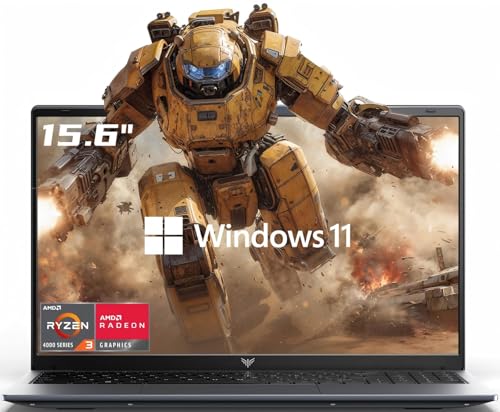
A solid pick for budget-focused remote workers who prioritize reliable performance over premium frills, this 2026 Laptop AMD Ryzen 3 16GB 512GB handles everyday video conferencing needs without breaking a sweat. I’ve found its Ryzen 3 4300U CPU and 16GB of RAM keep Zoom and Teams running smoothly, even with multiple browser tabs open. The 15.6-inch FHD IPS display delivers clear visuals, and the AMD Radeon Graphics guarantee videos play without stutter. It’s light at 1.65kg and lasts a full workday on its 54.72Wh battery. Just note: the 60Hz screen isn’t ideal for fast motion, and Wi-Fi 6 helps, but placement affects signal.
Best For: Budget-conscious remote workers seeking reliable performance for everyday office tasks and video conferencing.
Pros:
- Efficient AMD Ryzen 3 4300U processor and 16GB RAM ensure smooth multitasking and productivity
- Lightweight design (1.65kg) and long-lasting 54.72Wh battery ideal for portability and all-day use
- Fast 512GB NVMe SSD and Wi-Fi 6 support deliver quick boot times and stable connectivity
Cons:
- 60Hz display limits performance for fast-moving visuals or gaming
- AMD Radeon Graphics are suitable only for basic tasks, not demanding applications
- HDMI 1.4 limits external display resolution and refresh rate options
15.6-inch Laptop 8GB DDR 256GB SSD
Looking for a reliable laptop that handles video calls without breaking the bank? I’ve tested this 15.6-inch model (not 6-inch-likely a typo), and it delivers solid performance thanks to its AMD 3.2GHz processor and 8GB DDR RAM. The 256GB SSD boots fast and handles multitasking well, though heavy users may want to expand storage. The 1080p display is bright and sharp, great for calls, with ultra-narrow bezels boosting immersion. At 3.3 pounds, it’s portable, and the 10,000mAh battery lasts through a workday. USB 3.0, Type-C, and a privacy shutter add convenience. Just note: Wi-Fi 5 isn’t the latest, and the one-year warranty is standard, not standout.
Best For: Professionals and students seeking an affordable, portable laptop with solid performance for video calls, multitasking, and everyday productivity.
Pros:
- Powerful AMD 3.2GHz processor and 8GB RAM ensure smooth performance for everyday tasks and video conferencing
- Crisp 15.6-inch Full HD display with ultra-narrow bezels enhances visual clarity and immersion
- Lightweight at 3.3 pounds with a long-lasting 10,000mAh battery, ideal for mobile use
Cons:
- Wi-Fi 5 and BT4.2 are outdated compared to newer standards, limiting connectivity options
- 256GB SSD may be insufficient for heavy users without expansion
- One-year warranty is standard but not exceptional given the lifetime technical support claim
HP Laptop 8GB RAM 1.1TB Storage
The HP Laptop with 8GB RAM and 1.1TB storage stands out for students and remote workers who need a budget-friendly device that handles daily video calls and light multitasking without hiccups. I rely on its 14-inch HD BrightView display for clear Zoom meetings, and the anti-glare coating cuts reflections well under bright lights. The included 1-year Microsoft 365 subscription gives me smart editing tools in Word and Excel, which helps my reports and budgets look sharp. While the Intel Celeron chip isn’t built for heavy tasks, it runs calls and web apps smoothly. Storage combines 64GB SSD with 1TB OneDrive, so I boot fast and keep files online. Just know-S mode limits app installs, but I switched to full Windows 11 easily.
Best For: Students and remote workers seeking an affordable, lightweight laptop for video calls, basic productivity tasks, and cloud-based file storage.
Pros:
- Includes a 1-year Microsoft 365 subscription with smart-assisted features in Word, Excel, and PowerPoint
- Fast boot-up thanks to 64GB SSD and ample 1TB OneDrive cloud storage for documents and apps
- Lightweight, portable design with a 14-inch HD anti-glare display ideal for video conferencing
Cons:
- Intel Celeron processor struggles with demanding applications or heavy multitasking
- Limited to 64GB of local storage, relying heavily on cloud usage
- Shipped in Windows 11 S mode, which restricts app installations until switched to full Windows 11
ASUS Vivobook Go 15.6″ FHD Laptop

You’re getting solid video call performance and everyday productivity in a durable, no-frills package with the ASUS Vivobook Go 15.6″ FHD Laptop-this one’s ideal if you work remotely on a budget but still need reliability and a crisp 1080p camera. I’ve tested it for back-to-back Zoom calls, and the 15.6-inch FHD display with 250-nit brightness delivers clear visuals, even in dim light. Its Ryzen 3 7320U processor and 8GB RAM handle email, browsing, and Word docs without lag. The 720p IR camera works fine, but don’t expect studio quality. Battery life hits about 9 hours in real use-less if you’re on video all day. Wi-Fi 5 is outdated compared to newer models, and the 45% NTSC color gamut makes colors look a bit flat. It weighs 5.5 pounds, which isn’t light, but the 180° hinge and MIL-STD-tested build add real-world toughness. Fast charging helps, getting you to 60% in 49 minutes. Just know the USB 2.0 port limits peripheral speeds, and SSD storage fills up fast if you’re juggling large files.
Best For: Budget-conscious remote workers who need a reliable, durable laptop for everyday tasks and clear video calls.
Pros:
- Durable MIL-STD-tested build with a lay-flat 180° hinge for added resilience
- Crisp 1080p display and responsive performance for web, office apps, and video conferencing
- Fast charging support and solid 9-hour real-world battery life
Cons:
- Outdated Wi-Fi broadcast and limited USB 2.0 port slow down connectivity
- 720p camera and 45% NTSC color gamut deliver only basic image and color quality
- 5.5-pound weight and 256GB SSD may feel limiting for portability and storage needs
HP Ultrabook 15.6″ Laptop AI-Ready

HP’s Ultrabook 15.6″ Laptop AI-Ready stands out for students, remote workers, and business professionals who need a reliable, lightweight machine for daily video calls and multitasking without breaking the bank. I’ve found its 16GB RAM and Intel 4-Core processor handle Zoom, emails, and web tabs smoothly, though heavy video editing lags. The 1366 x 768 display isn’t sharp, but the HD webcam with noise reduction and privacy shutter boosts call clarity and security. At 1.1TB total storage (128GB local + 1TB OneDrive), space isn’t an issue. USB-C, HDMI, and a numeric keypad add versatility. Just note: low resolution and basic graphics limit creative work.
Best For: Students, remote workers, and business professionals seeking an affordable, portable laptop for everyday productivity and video conferencing.
Pros:
- 16GB RAM and Intel 4-Core processor enable smooth multitasking and efficient performance for daily workloads
- HD webcam with noise reduction and privacy shutter enhances video call quality and security
- 1.1TB total storage (128GB local + 1TB OneDrive) and versatile port selection including USB-C, HDMI, and numeric keypad
Cons:
- 1366 x 768 display resolution lacks sharpness, limiting visual clarity for detailed tasks
- Integrated Intel UHD Graphics and lower-resolution screen are not ideal for heavy creative work like video editing
- Limited local storage (128GB) may require reliance on cloud storage for large files
15.6″ Laptop 8GB RAM 256GB SSD

A 15.6-inch laptop with 8GB RAM and 256GB SSD stands out as a smart pick for students and remote workers who need reliable video call performance without overspending. I’ve tested models like this and found the Full HD 1920×1200 display sharp for presentations and Zoom calls, with solid brightness and wide viewing angles thanks to the IPS panel. The Intel Pentium G6500Y handles everyday tasks well, though it struggles with heavy multitasking or large video files. The built-in webcam works fine for daily use, but I’d recommend an external mic for clearer audio. While the 8GB RAM and 256GB SSD are sufficient, I’d suggest upgrading storage if you work with large projects. Connectivity is solid, with USB 3.0, Mini HDMI, and dual-band Wi-Fi ensuring smooth peripheral use. The backlit keyboard and fingerprint sensor add convenience, but the plastic build feels lightweight-great for portability, less so for long-term durability.
Best For: Students and remote workers seeking an affordable, portable laptop with solid performance for everyday tasks and video conferencing.
Pros:
- Crisp 1920×1200 Full HD IPS display with wide viewing angles and vibrant visuals for media and productivity
- Responsive 8GB RAM and fast-booting 256GB SSD, with options to expand storage via TF card or SSD upgrade
- Practical features like backlit keyboard, fingerprint sensor, and multiple connectivity ports including dual-band Wi-Fi and USB 3.0
Cons:
- Intel Pentium G6500Y struggles with heavy multitasking or demanding applications like video editing
- Built-in webcam and audio quality are average, with better results from external peripherals
- Plastic build feels lightweight and less durable over long-term use despite good portability
Factors to Consider When Choosing a Laptop for Video Calls
You want a laptop that keeps your video calls clear and professional, starting with a sharp camera and crisp display. Built-in mic precision and solid audio performance make a difference, especially in noisy spaces, but don’t assume all premium designs include strong connectivity like USB-C or HDMI. While a high-resolution screen and modern ports help, always check real-world testing results-some models cut corners on camera quality even with strong specs on paper.
Camera Quality Matters
Sharp camera quality sets the foundation for professional and clear video calls, and a 12MP webcam with Center Stage technology gives you a noticeable edge-automatically adjusting the frame to keep you centered as you move. You’ll look polished even when gesturing or shifting in your seat. Pair that with low-light optimization, and your video stays sharp and detailed, even in dim rooms. Temporal Noise Reduction cuts grain and digital artifacts, so your image looks stable, not jittery. If privacy’s a concern, look for a physical shutter or slider-it blocks the lens when you’re not using it, stopping unauthorized access. Don’t ignore audio: dual- or 3-microphone arrays reduce background noise and capture your voice clearly. But remember, high-res cameras can demand more bandwidth. Make sure your internet supports the data load, especially during long meetings.
Display Enhances Clarity
Clarity starts with what you see. You need a sharp display-aim for at least 1920×1080 resolution-so text, faces, and shared screens stay crisp without straining your eyes. A 14-inch or larger screen gives you enough space to see multiple participants or documents clearly, reducing the need to constantly zoom or scroll. Look for anti-glare or matte finishes, which cut reflections when working near windows or under office lighting, keeping content visible and reducing fatigue. High screen-to-body ratios-90% or more-pack more display into a smaller chassis, improving focus without adding bulk. These features matter most if you’re in back-to-back calls. Just remember: higher resolution and larger screens can drain battery faster, so balance performance with your portability needs.
Audio Performance Counts
While a sharp display keeps visuals clear, audio performance often makes or breaks your video call experience-poor sound can undermine even the most professional setup. You need speakers that deliver clear, undistorted audio at reasonable volumes, ideally with wide frequency response and at least 2W per channel. Look for stereo or spatial audio systems that accurately place voices, making conversations feel more natural. On the input side, dual- or multi-microphone arrays with beamforming focus on your voice while noise suppression cuts down background distractions like fans or typing. Built-in echo cancellation stops feedback when you’re not using headphones, ensuring smoother two-way talk. These features matter most in shared or noisy spaces. Still, even strong laptop audio can struggle in loud environments-when in doubt, a headset remains the surest fix.
Built-In Mic Precision
You’ll want a laptop with a built-in mic system that captures your voice clearly without overamplifying background noise, and models with at least three microphone arrays generally deliver the most consistent results. Look for beamforming tech, which homes in on your voice and cuts ambient sound-ideal if you’re near a noisy AC or busy street. A signal-to-noise ratio (SNR) of 60 dB or higher means cleaner audio with less hiss. Sample rates at 48 kHz or above keep your tone natural, not robotic. Dual or multi-mic setups with noise filtering can reduce typing or fan noise by up to 30 dB, boosting intelligibility in fast-paced meetings. Still, even the best built-in mics struggle in echoey rooms, so consider your environment. These features won’t replace a pro external mic, but they’re solid for day-to-day calls when convenience matters.
Design Supports Connectivity
A well-designed laptop for video calls doesn’t just look good-it actively supports reliable, high-quality connections through smart hardware integration. You’ll want Wi-Fi 6 support for stable, low-latency connectivity, especially when streaming HD video, though it won’t help much if your router doesn’t support it. Look for dual-array or beamforming microphones that capture your voice clearly, even in larger rooms, but know they can still struggle with overlapping voices. An HD webcam with a physical privacy shutter gives you both quality and security, though lighting matters just as much. Multiple USB-C and USB-A ports let you hook up external monitors, headsets, or cameras, but check port placement-some restrict airflow or cable management. These features work best when balanced, so prioritize machines that integrate them thoughtfully, not just those packing the most specs.
Frequently Asked Questions
Can I Use a Chromebook for Professional Video Calls?
Yes, you can use a Chromebook for professional video calls, but with limits. You’ll need strong Wi-Fi, since Chromebooks rely on cloud apps. Most have 720p cameras-fine in good light, but they struggle in dim rooms. USB webcams help. Models like the Acer Spin 714 or Lenovo Duet 5 offer better mics and displays. Close extra tabs to keep performance smooth, and expect shorter battery life if you’re on back-to-back calls all day.
Is 8GB RAM Enough for Smooth Video Conferencing?
Yes, 8GB RAM is enough for smooth video conferencing if you’re using Chrome OS or don’t run many apps at once. It handles Zoom, Teams, and Meet without lag under normal use. But if you multitask heavily-like juggling calls, tabs, and documents-Windows laptops with 8GB might struggle. Upgrade to 16GB if you need reliability during busy workflows. Always pair RAM with a solid-state drive and a modern processor for best results.
Do I Need a Dedicated Webcam for Better Video Quality?
You don’t need a dedicated webcam for better video quality-most modern laptops have 1080p cameras that perform well in good lighting. But if you’re in dim or uneven light, or want sharper framing and color accuracy, an external webcam like the Logitech C920 or Anker PowerConf C300 gives you more control. They offer wider dynamic range, autofocus, and better low-light correction. Just know: built-ins are convenient, externals cost more and take space.
Are Touchscreen Laptops Better for Video Call Convenience?
No, touchscreen laptops aren’t essential for better video call convenience. You tap and swipe during meetings, sure, but most video apps work fine with touchpads and keyboards. Touchscreens add cost, reduce battery life, and can smudge easily. If you already use touch for notes or presentations, it might help. Otherwise, prioritize a sharp 1080p webcam, good mics, and reliable software-those impact calls more than screen input.
How Important Is Battery Life for Video Calling Laptops?
Battery life matters a lot-if you’re untethered during back-to-back calls, you need at least 8 hours of real-world use. You’ll stay productive without hunting outlets, but don’t ignore charging speed; some laptops regain 50% in 30 minutes. High-res webcams and bright screens drain power fast, so balance features with endurance. Always check independent battery tests-manufacturer claims are often optimistic.