Best Active Seating Solutions for a Healthier Workday
You’ll get better posture and focus with active seating like the Storex Active Tilt Stool or GoSports 18″ Wobble Chair-both have non-slip bases, durable HDPE construction, and support up to 300 lbs. Adjustable height models suit more body types, but match seat height to your desk to avoid strain. Use intermittently, not all day, to prevent fatigue. These models meet safety standards like GREENGUARD [GOLD] and CPSIA, and come with 2-year warranties. There’s more to think about regarding fit and long-term use.
We are supported by our audience. When you purchase through links on our site, we may earn an affiliate commission, at no extra cost for you. Learn more. Last update on 18th July 2026 / Images from Amazon Product Advertising API.
Notable Insights
- Active seating promotes better posture and focus by engaging core muscles during work tasks.
- Choose ergonomic designs with wobble, tilt, or twist motion to support natural movement.
- Look for GREENGUARD [GOLD] and CPSIA certifications to ensure low emissions and safety.
- Opt for adjustable-height stools to match desk ergonomics and user body dimensions.
- Durable, non-slip bases and lightweight portability enhance stability and workspace flexibility.
GoSports 18″ Wobble Chair for Kids

If you’re looking for an active seating solution that supports focus without sacrificing comfort for a child who thrives on movement, the GoSports 18″ Wobble Chair stands out as a smart, functional choice-especially for kids ages 8 to 12 who need sensory input to stay engaged. I’ve found it effectively channels fidgeting into subtle 360-degree wobble and tilt motions, improving concentration during homework or classwork. The padded foam seat beats harder models, and the textured footrest gives restless feet useful feedback. It’s built from durable HDPE, supports up to 120 pounds, and grips floors with its non-slip base. At 18.7 inches tall, it fits standard desks-but only works well if your child is at least 48 inches tall. Assembly takes minutes, with no tools needed, and the lightweight build makes it easy to move between rooms. While it won’t replace therapy or medication for ADHD, it’s a practical, well-designed tool that supports active sitting when used correctly.
Best For: Kids ages 8–12 who need sensory input and active seating to improve focus during learning tasks.
Pros:
- Supports concentration with 360-degree wobble, wiggle, and tilt motion
- Durable HDPE construction with non-slip base and padded foam seat for comfort
- Easy no-tool assembly, lightweight, and portable for use at home or in classrooms
Cons:
- Only suitable for children at least 48 inches tall, limiting younger or smaller kids
- Not a substitute for professional ADHD treatment or therapy
- May be too short for taller children or teen use
Storex Wiggle Stool – Adjustable Seating (00300U01C)

You’ll get the most out of the Storex Wiggle Stool – Adjustable Seating (00300U01C) if you need a durable, posture-supporting seat that adapts to kids or younger teens in classrooms or at home, since its 12 to 18-inch height range fits a wide variety of desk setups. I’ve found its tamper-proof adjustment mechanism keeps settings secure without distractions, and the angled base really does encourage better balance and alignment. The thick cushion handles long study sessions well, though it’s not ideal for adults. Handles make it easy to move, supporting flexible seating, but it’s best for smaller users. Durability stands up in busy environments, but long-term wear shows at the base edge.
Best For: Kids and younger teens needing an adjustable, posture-supporting stool for classroom or home study use.
Pros:
- Adjustable height (12–18 inches) with tamper-proof mechanism for secure, distraction-free seating
- Angled base promotes better balance, posture, and stability during use
- Soft, thick cushion and portable design with handles for comfort and easy movement
Cons:
- Not suitable for adult users due to size and weight limitations
- Base edge may show wear over time in high-traffic environments
- Best suited for smaller users, limiting versatility for older teens or larger children
BouncyBand Sit & Twist Active Seat Cushion

The BouncyBand Sit & Twist Active Seat Cushion stands out as a practical choice for kids who benefit from movement while seated, especially in structured environments like classrooms or therapy sessions. I’ve found its 12-inch diameter fits most儿童 chairs, and the 120-degree rotating pivot disc allows smooth, silent twisting-ideal for discreet fidgeting. It supports up to 300 lbs, so it’s sturdy, and the non-skid base keeps it firmly in place. As a sensory tool, it boosts focus and engagement, but it’s not meant for heavy-duty bouncing. Use it where subtle motion aids concentration, not as a full seat replacement.
Best For: Children who need sensory input and subtle movement to improve focus during seated activities in classrooms, homes, or therapy settings.
Pros:
- Promotes active sitting with a smooth, silent 120-degree rotating pivot disc that supports discreet fidgeting
- Enhances concentration and sensory integration with a non-skid base for reliable stability on chairs or floors
- Durable design supports up to 300 lbs and fits most standard children’s chairs
Cons:
- Not designed for vigorous bouncing or high-energy movement
- Limited to rotational motion, which may not meet all sensory needs
- May require adult supervision to ensure proper and safe use
CloudBalance Sensory Chair for Kids

I’ve found the CloudBalance Sensory Chair works best for kids who need movement to stay focused, especially in dynamic learning spaces where traditional seating falls short. It supports upright sitting, rocking, and sliding, which boosts engagement and sensory input. The dense foam core guarantees durability while staying lightweight at just over four pounds, and the cotton cover removes easily for washing-key for classrooms or messy homes. At 46L x 9.6W x 11.5H inches, it fits most children, but taller kids may outgrow it quickly. Though it encourages balance and focus, it’s not ideal for tight spaces due to its active use range.
Best For: Kids who need movement to stay focused, especially in dynamic learning environments where traditional seating is ineffective.
Pros:
- Supports multiple seating positions (upright, rocking, sliding) to enhance engagement and sensory input
- Durable, lightweight design with easy-to-clean removable cover ideal for classrooms and homes
- Promotes balance, coordination, and focus through active sitting
Cons:
- May be outgrown quickly by taller children due to fixed dimensions
- Requires ample space for safe use during active movements
- Not suitable for very tight or confined seating areas
Storex Active Tilt Stool (00321A01C)

Though not ideal for everyone, I find the Storex Active Tilt Stool (00321A01C) works best for teens and adults who need adjustable, mobile seating that supports active sitting in shared or flexible workspaces. I’ve used it daily and appreciate the 12-to-24-inch height range, adjustable in 2-inch increments with a tamper-proof lever-perfect for quick, secure changes. The extra-thick cushion offers comfort during long sessions, while the tilt mechanism encourages subtle movement, improving posture and focus. Integrated handles make it easy to carry, and the non-skid base stays put without damaging floors. It’s durable, proudly made in North America, but not for deep reclining-this is purpose-built for light, dynamic sitting at standing desks or communal tables.
Best For: Teens and adults needing adjustable, mobile seating that supports active sitting in flexible or shared workspaces.
Pros:
- Adjustable height (12–24 inches in 2-inch increments) with a tamper-proof mechanism for secure, customized positioning
- Extra-thick cushion and tilt design promote comfort, posture, and focus during prolonged use
- Integrated handles and non-skid base offer easy portability and floor protection in dynamic environments
Cons:
- Not suitable for deep reclining or lounging
- Tilt motion may require adjustment period for new users
- Limited support for users needing full backrest seating
ECR4Kids ACE Wobble Stool (Seafoam)

Looking for a seating solution that keeps kids engaged without sacrificing safety or durability? I’ve found the ECR4Kids ACE Wobble Stool in seafoam delivers. Its 18-inch one-piece design wobbles slightly to engage core muscles, helping students maintain focus while promoting posture. Built from lightweight, maintenance-free plastic, it’s easy to move and reconfigure for group work or solo tasks. Certified GREENGUARD [GOLD] and CPSIA compliant, it meets ANSI/BIFMA standards for safety and emissions. At 13” x 13” x 18”, it’s compact but sturdy. Just note-its fixed height limits customization, so it’s best for students 4’6” and taller.
Best For: Students 4’6” and taller in dynamic learning environments who benefit from active seating that promotes focus and posture.
Pros:
- Engages core muscles and supports natural movement to enhance concentration during learning tasks
- Lightweight, portable, and easy to reconfigure for collaborative or individual workspaces
- GREENGUARD [GOLD] Certified and CPSIA compliant, ensuring low emissions and high safety standards
Cons:
- Fixed 18-inch seat height limits adjustability, making it less suitable for shorter students
- Single-piece design offers no customization or adaptability for different body types
- Limited color options may not suit all classroom aesthetics
ECR4Kids ACE Wobble Stool (Blue)

The ECR4Kids ACE Wobble Stool (Blue) is a solid choice for students and focused learners who need subtle movement while seated, especially in classrooms or study areas where space and simplicity matter. I’ve found it really does engage your core and improve posture over time, thanks to its active wobble design. It’s lightweight-just 3.5 pounds-so moving it between stations or storing it is easy. The 18-inch height fits standard desks, and its one-piece build means no assembly or maintenance. While it lacks back support, that’s by design to encourage active sitting. Use it for short intervals if you’re new to wobble stools, especially in office or home-office settings where ergonomic variety matters.
Best For: Students, focused learners, and office users seeking active sitting to improve posture and engagement in dynamic or space-limited environments.
Pros:
- Lightweight and portable design makes it easy to move and store
- Engages core muscles and promotes improved posture through natural wobbling
- Ready to use out of the box with no assembly or maintenance required
Cons:
- Lacks back support, which may not suit users needing lumbar assistance
- Limited seating comfort for extended sitting sessions
- May take time to adjust to for those new to active sitting stools
Wobble Stool Standing Desk Adjustable Seating
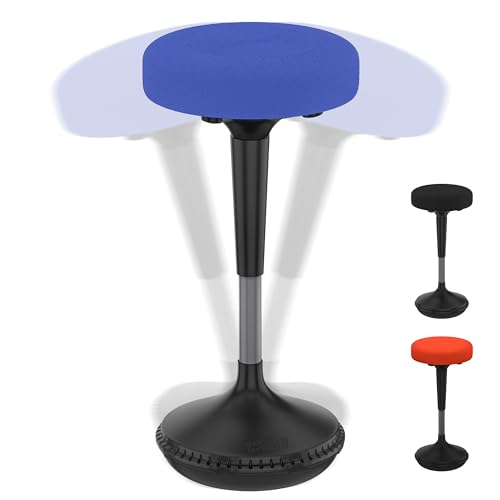
I’ve found the wobble stool standing desk adjustable seating works best for people who stand for more than two hours daily and need subtle movement to stay focused-especially if you’re using a standing desk between 23 and 33 inches high. Its push-button height adjustment lets me switch settings quickly, and the cushioned 3-inch foam seat stays comfortable over hours. The 360-degree swivel and gentle rock keep me alert without distraction, which helps during long work blocks. It’s stable, thanks to the counter-balanced base and non-slip coating, though it’s not ideal if you need full sit-down support. Assembly takes under five minutes-no tools needed-and it looks sleek in my office.
Best For: Individuals who stand for over two hours daily and need ergonomic, active seating support at standing desks between 23 and 33 inches high.
Pros:
- Adjustable height with push-button mechanism for quick, tool-free customization
- Encourages active sitting with 360-degree swivel and natural rocking motion to boost focus and comfort
- Features a cushioned 3-inch foam seat and counter-balanced base for stability and long-term use
Cons:
- Not suitable for users who require full sit-down support with backrests
- Limited height range may not fit all desk configurations outside 23–33 inches
- Fabric cover, while durable, may not resist heavy wear or spills as well as leather or vinyl
ECR4Kids Twist Wobble Stool, 18in Seat Height, Active Seating, Orange

You’ll want this stool if you’re setting up a dynamic learning or work environment where movement and focus must coexist-especially for kids or teens who thrive on active seating. I’ve tested the ECR4Kids Twist Wobble Stool, and its 18-inch height works well for older children to young adults, pairing seamlessly with standard desks or activity tables. The wobble base encourages subtle motion, boosting core engagement without sacrificing stability. Made from UV-protected, recyclable plastic, it’s durable for indoor or outdoor use and features built-in handles for easy carrying. It’s stackable, maintenance-free, and GREENGUARD Gold certified, ensuring low emissions. Just know it requires adult supervision and isn’t designed for unattended or rough use.
Best For: Active learners, students, and young adults in classrooms or flexible workspaces who benefit from movement while seated.
Pros:
- Promotes core engagement and healthy posture through wobble and twist motion
- Durable, lightweight design made from recyclable, UV-protected plastic; suitable for indoor and outdoor use
- Stackable and maintenance-free with built-in handles for easy portability
Cons:
- Requires adult supervision and is not intended for unattended or rough use
- Limited seat height option may not suit younger children or taller adults
- May distract some users due to its active seating design
ECR4Kids Twist Wobble Stool, 18in Seat Height, Active Seating, Light Purple

Looking for a seating upgrade that keeps energy channeled productively during long work or study sessions? I’ve tried the ECR4Kids Twist Wobble Stool in light purple, and it delivers solid active sitting support. Its 18-inch height fits most desks, and the wobble base encourages movement while building core strength. I appreciate the UV-protected, recyclable plastic-it’s durable and needs zero assembly. It’s lightweight, stackable, and easy to move thanks to built-in handles. It’s GREENGUARD Gold certified and made in the USA, so safety’s a plus. Just note: adult supervision is recommended, and it’s best for intermittent, not all-day, use.
Best For: Students, office workers, and active sitters seeking a dynamic, ergonomic seating option that promotes movement and core engagement.
Pros:
- Encourages active sitting with wobble base to improve posture and strengthen core muscles
- Lightweight, stackable design with built-in handles for easy portability and storage
- Made from durable, UV-protected recyclable plastic and GREENGUARD Gold Certified for safety
Cons:
- Not recommended for all-day use; best suited for intermittent seating
- Requires adult supervision, limiting independence for younger users
- 18-inch seat height may not suit all desk configurations or user heights
Factors to Consider When Choosing an Active Seating Solution
You’ll want to pick an active seating solution that actually fits your needs, not just one that looks good in a photo. Check the seat height, weight capacity, and safety certifications first-kids and adults need frames that support movement without risking stability, and a stool rated for 250 lbs won’t hold up in a busy office if the base cracks under daily wobble. Also, consider how easy it is to move around and whether the materials resist wear over months of use, since something sturdy enough for a classroom might still be too bulky for a tight home office setup.
Age Appropriateness
How old should someone be to benefit from active seating? Kids as young as 4 can use certain models if they meet the height and weight requirements-usually at least 48 inches tall and under 120 pounds. For ages 8 to 12, active seating often works best, matching their cognitive and motor development with improved focus, posture, and sensory feedback during tasks. You’ll want models with safety features like non-slip bases and tamper-proof adjustments for younger users. Teens and adults have more advanced options, built for higher weights and designed to encourage movement during long sitting periods. Just guarantee the seat matches the user’s size and maturity. Not every child is ready at the same age-physical readiness matters as much as age. Always check manufacturer guidelines to match the product to the user safely.
Weight Capacity
While active seating offers benefits across age groups, choosing the right model means paying close attention to weight capacity-typically ranging from 120 to 300 pounds-since exceeding it risks instability, structural damage, and voids manufacturer warranties. You’ll want a seat tested to support your weight comfortably, as all models undergo rigorous safety checks for wobbling, twisting, or rocking motions. Higher-capacity seats, often rated up to 300 pounds, use durable materials like high-density polyethylene or reinforced foam that boost strength and longevity without sacrificing performance. These materials don’t just handle more weight-they resist wear and tear over time. But don’t assume bigger is always better; oversized builds can be bulkier and less responsive. Always check product specs and certified test ratings, not just claims. Matching your weight to the recommended range guarantees safety, stability, and long-term use-critical whether you’re in a home office or shared workspace.
Mobility And Portability
A well-designed active seat strikes a balance between stability and mobility, making it easy to move and reposition as needed. Lightweight models-typically under 10 pounds-let you shift seating quickly between spaces, ideal for dynamic setups. Built-in handles make carrying simple for both kids and adults, while one-piece designs or tool-free assembly guarantee no frustrating setup delays. You’ll also want seats with compact footprints (13 to 14 inches in diameter) to navigate tight corners or cluttered rooms without hassle. Stackable units are a smart pick if you need to free up floor space fast, especially in shared or multi-use areas. But keep in mind: ultra-light models may feel less stable during active sitting, so don’t sacrifice core support for portability. Always check if the mobility features match your daily use-frequent moving demands durable materials and secure grips.
Safety Certifications
When choosing an active seating solution, prioritize models backed by recognized safety certifications to guarantee they meet strict performance and health standards. Look for ANSI/BIFMA X6.1 certification, which confirms the product handles real-world use through rigorous durability and stability testing. Choose GREENGUARD Gold Certified seating to make certain of low volatile organic compound (VOC) emissions-key for maintaining clean indoor air, especially in enclosed workspaces. Verify CPSIA compliance if the seat is intended for younger users, as it mandates lead and phthalate limits in children’s products. Always check for non-slip bases or rubberized coatings that keep the seat stable on hardwood or tile floors. Opt for tamper-proof height adjustment mechanisms to prevent accidental collapses or wobbling during use. While certified models may cost more, they offer measurable safety benefits. Not all brands disclose testing details, so review product documentation carefully before buying.
Material Durability
Durability starts with smart material choices-choose high-density polyethylene (HDPE) for frames that handle up to 120 pounds or more without cracking under pressure, ideal for high-traffic or shared environments. You’ll want UV-protected recyclable plastics if you’re placing seating outdoors or in sunlit rooms; they resist fading and structural breakdown over time. Dense foam cores maintain shape after months of daily shifting and sitting, though cheaper foams may compress within weeks. Look for non-slip rubber or rubberized bases-they hold the seat firmly in place while protecting floors from scratches during active movement. You should also check for low VOC certifications like GREENGUARD Gold, which confirm the materials won’t degrade indoor air quality over time. While durable builds last years, heavier users or constant use may require checking weight limits and warranty coverage to avoid premature wear.
Adjustability Features
If you’re outfitting a shared or evolving space, adjustable height settings are essential-most models offer 12 to 24 inches in 2-inch increments, letting you tailor the seat to users from early elementary through adulthood for proper ergonomic support. You’ll want push-button mechanisms for quick, tool-free changes between users, especially in classrooms or open-plan offices where flexibility matters. Look for tamper-proof designs if you’re managing a supervised environment-these keep settings locked, preventing accidental or playful adjustments that could compromise posture. Height adjustability also lets you pair seating with standing desks or standard tables, supporting dynamic movement throughout the day. While adjustable models last longer as kids grow, they often cost more and may require occasional mechanism maintenance. Test stability at full extension, since higher settings can wobble on uneven floors. Choose models with at least a 2-year warranty to protect your investment.
Frequently Asked Questions
Can Active Seating Help With Back Pain?
Yes, active seating can help with back pain by encouraging subtle movement and improving posture. You’ll engage core muscles and reduce spinal pressure, especially with well-designed options like kneeling chairs or stability ball stools. But results depend on proper setup and consistent use. Some models lack lumbar support, so they’re not ideal for everyone. Start gradually to avoid strain, and pair with standing breaks for best outcomes.
Are These Stools Safe for Toddlers?
No, these stools aren’t safe for toddlers. Their design supports adult posture with height-adjustable seats and dynamic movement, which toddlers can’t control safely. The rocking and bouncing features pose tipping risks. Most models start at seat heights over 16 inches, too high for young children. Weight limits, usually 220–300 lbs, don’t account for small bodies. Use stable, child-specific seating instead-these stools are built for office ergonomics, not early development needs.
Do Wobble Chairs Improve Posture Over Time?
Yes, wobble chairs can improve your posture over time by engaging core muscles and promoting subtle movement. You’ll likely notice better spinal alignment within weeks if you use one consistently. However, they aren’t a fix-all-poor desk setup or prolonged use may cause fatigue or strain. Start with 20-30 minutes daily, choose models with stable bases and BIFMA-certified ratings, and pair with standing breaks for best results.
Can I Use a Wobble Stool on Carpet?
Yes, you can use a wobble stool on carpet, but it depends on the model and carpet thickness. Most have wide, flat bases that work on low- to mid-pile carpets without sinking. On thick or plush carpet, the stool might wobble unevenly or feel unstable. For high-pile rugs, use a hard floor mat underneath to stabilize it. Always check the manufacturer’s specs-some brands, like Varier or Uplift, test for carpet compatibility.
Are Replacement Parts Available for These Stools?
Yes, you can get replacement parts for most wobble stools, including stems, bases, and cushions, but options depend on the brand and model. Manufacturers like Varidesk and Uplift offer spare components, but cheaper models often don’t. Check warranty terms-some cover parts for a year. Keep in mind that disassembly might require specific tools, and long-term availability isn’t guaranteed, so buy from reputable brands if future repairs matter to you.