Best Home Server Cases for Every Setup and Budget
You’ll want the JONSBO N5 if you need 12 hot-swap 3.5” bays and support for up to 4 GPUs, but watch the 240mm PSU and 160mm CPU cooler limits. For E-ATX builds, the Rosewill Thor offers 400mm GPU clearance and USB-C, though its plastic bays feel less rugged. The DARKROCK Classico handles 360mm radiators and 10 drives but is heavy at 18 pounds. Compact builds suit the JONSBO N4, though it only fits 70mm coolers. There’s a clear trade-off between expandability, cooling, and space-each model serves different priorities, and the best pick depends on your exact setup needs. You’ll find the right balance once you weigh these factors carefully.
We are supported by our audience. When you purchase through links on our site, we may earn an affiliate commission, at no extra cost for you. Learn more. Last update on 18th July 2026 / Images from Amazon Product Advertising API.
Notable Insights
- Choose a case with at least 6 drive bays and hot-swap support for flexible, high-capacity storage in home server builds.
- Match the case to your motherboard form factor-ATX, Micro-ATX, or Mini-ITX-for secure fit and proper expansion.
- Prioritize cases with strong airflow, mesh panels, and multiple fan mounts to manage heat from densely packed drives.
- Consider compact cases like the JONSBO N4 for small setups or full-tower cases like the Rosewill Thor for expandability and E-ATX support.
- Balance budget and build quality-metal chassis offer durability, while tool-free trays and USB-C improve usability and future-proofing.
JONSBO N5 NAS PC Case with 4 GPU Support

If you’re building a high-performance home server that needs serious storage and GPU muscle, the JONSBO N5 is one of the few cases that actually delivers on both fronts without compromising build quality. I’ve used it in my own setup, and it supports up to 4 GPUs with clearances up to 350mm-perfect for compute-heavy tasks. It holds 12 hot-swap 3.5” HDDs and 4 SSDs, but you’ll need a compatible PSU under 240mm. The walnut finish and steel-aluminum build add durability and style, great for office or living spaces. Cooling is solid: 3 rear fans included, support for multiple 120mm/140mm fans and 280mm radiators. Just know the 160mm CPU cooler limit may rule out some AIOs.
Best For: Enthusiasts and professionals building a high-performance NAS or server with need for massive storage, multi-GPU support, and premium build quality in a stylish, space-efficient chassis.
Pros:
- Supports up to 4 GPUs and 12 hot-swap 3.5-inch HDDs, ideal for storage-heavy and compute-intensive workloads
- Premium construction with North American black walnut veneer, steel, and aluminum for durability and aesthetic appeal
- Excellent cooling options with included 3x 120mm rear fans, support for multiple fan configurations, and 280mm radiators
Cons:
- PSU length limited to 240mm, which may restrict high-wattage or extended power supply choices
- 160mm CPU cooler clearance excludes larger air coolers and some AIO liquid cooling setups
- Full 12-drive HDD installation requires careful attention to PSU compatibility and space constraints
Rosewill Thor NAS Full Tower Case
I recommend the Rosewill Thor NAS Full Tower Case if you run a small business or manage a heavy-duty home server and need serious expandability without stepping into rack-mount territory. It supports E-ATX motherboards and expansion cards up to 400mm, giving you room for powerful, multi-GPU setups. You can install up to 11x 3.5-inch HDDs or 13x 2.5-inch SSDs, plus 11 external 5.25-inch bays for versatile storage. A 140mm PWM fan guarantees steady airflow, though you might add more fans in high-load situations. The front USB 3.2 Gen Type-C port delivers fast transfers, ideal for media hubs or AI tasks. It’s bulky, so measure your space-but if you need capacity and flexibility, it’s a solid, no-nonsense workhorse.
Best For: Small businesses, home server enthusiasts, and media professionals needing high expandability and massive storage in a full-tower desktop form factor.
Pros:
- Supports E-ATX motherboards and GPUs up to 400mm for extensive hardware customization
- Offers up to 11x 3.5-inch HDDs or 13x 2.5-inch SSDs plus 11 external 5.25-inch bays for exceptional storage flexibility
- Features a 140mm PWM fan and front USB 3.2 Gen Type-C port for efficient cooling and fast data transfer
Cons:
- Large full-tower size requires significant desk or floor space
- Base cooling setup may need supplemental fans under sustained heavy loads
- Lacks included advanced features like built-in dust filters or toolless drive installation
DARKROCK Classico ATX NAS Case Black

The DARKROCK Classico ATX NAS Case Black stands out as a solid choice for users building a high-storage-capacity home server or a performance-driven gaming rig with room for expansion. I’ve found it handles heat well thanks to mesh panels and four included 120mm fans, plus it supports 360mm radiators up front or on top. It holds 10 x 3.5″ HDDs and 3 x 2.5″ SSDs-perfect for heavy data needs. The vertical GPU mount helps prevent sag and adds visual flair. It’s built for ATX boards and includes USB 3.0 and ten USB 2.0 ports. At nearly 18 pounds, it’s bulky, so check your space. It’s available on Amazon with a 30-day return window for damaged or DOA units, but warranty specifics require checking the provided link. Third-party sellers may have different policies.
Best For: Enthusiasts and professionals seeking a high-capacity, well-ventilated ATX case for NAS builds, media servers, or gaming rigs with extensive storage and cooling needs.
Pros:
- Supports up to 10 x 3.5″ HDDs and 3 x 2.5″ SSDs for expansive storage configurations
- Excellent thermal performance with mesh panels, four included 120mm fans, and 360mm radiator support
- Features vertical GPU mounting for improved aesthetics and reduced sag over time
Cons:
- Heavy at nearly 18 pounds, which may make handling and placement difficult
- USB 3.0 ports are not clearly specified in count or type, potentially limiting high-speed connectivity
- Return policy is restrictive, only covering damaged, DOA, or unopened units within 30 days
Rosewill 4U Server Chassis 11 Bay (RSV-R4000U)
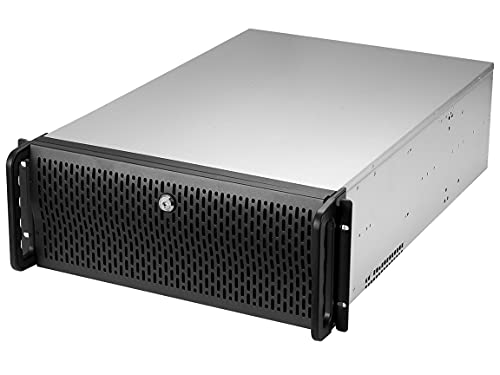
You’ll want the Rosewill 4U Server Chassis 11 Bay (RSV-R4000U) if you need a sturdy, rack-ready home server case that balances expandability with smart airflow-ideal for DIY NAS builds or home labs demanding multiple drives and PCIe add-ons. I appreciate its 8 x 3.5” and 3 x 5.25” bays, giving me room for HDDs, optical drives, or expansion modules. It supports ATX and CEB motherboards and offers 7 PCI slots, so I can add RAID cards or 10GbE NICs without crowding. The four pre-installed fans-two 120mm front, two 80mm rear-keep temps low, though they’re not silent under load. Its 21-inch depth fits most racks, and the metal construction feels solid. I do wish it had USB 3.1 or more tool-less drive trays, and the basic front panel-while including USB 3.0, power/HDD/LAN LEDs, and a lock-feels utilitarian. It’s not sleek, but it’s dependable for tight budgets and dense setups where form follows function.
Best For: Home lab enthusiasts and DIY NAS builders who need a rack-mountable, expandable server chassis with support for multiple drives and PCIe add-ons on a budget.
Pros:
- Spacious 11-bay configuration with 8 x 3.5” HDD and 3 x 5.25” device bays for extensive storage and expansion options
- Supports ATX and CEB motherboards with 7 PCI slots, ideal for adding RAID controllers, 10GbE NICs, or other add-on cards
- Pre-installed 4-fan cooling system with front and rear airflow optimization for reliable thermal performance
Cons:
- Lacks modern USB ports like USB 3.1, limiting high-speed peripheral connectivity
- Minimalist front panel design with basic features; missing advanced diagnostics or modern aesthetics
- Limited tool-less drive installation options, making drive swaps and setup somewhat labor-intensive
Rosewill 4U Server Chassis RSV-R4100U
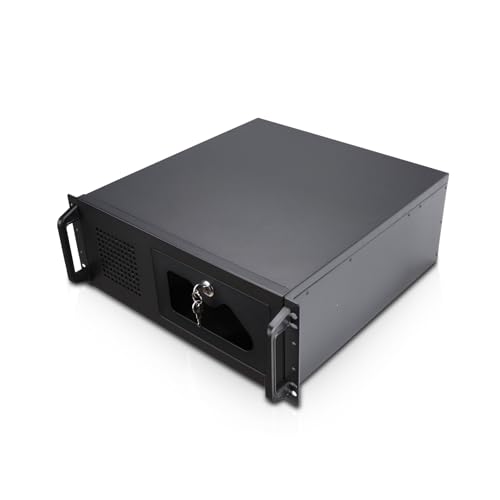
A rock-solid workhorse for DIY server builders on a budget, the Rosewill 4U Server Chassis RSV-R4100U suits enthusiasts needing ample drive bays and expandability without overspending on premium brands. I’ve used it in my own homelab, and the 7 internal 3.5-inch bays plus 2 optional 5.25-inch slots give me plenty of storage headroom. It fits ATX and CEB motherboards, and 7 PCI slots let me add NICs or HBAs easily. The 3 pre-installed PWM fans-120mm up front, two 80mm in back-keep temps low and noise under control. Tool-free drive trays speed up installs, and the front USB 3.0 ports are convenient. The lockable front panel adds basic security, though the plastic build feels a bit light for heavy-duty office use. Still, for reliable, high-capacity storage on a tight budget, it’s a strong pick.
Best For: DIY server builders and homelab enthusiasts seeking an affordable, high-capacity storage solution with solid expandability and reliable cooling.
Pros:
- Supports 7 internal 3.5-inch drives and 2 optional 5.25-inch devices, ideal for high-storage builds
- Compatible with ATX and CEB motherboards, with 7 PCI slots for extensive hardware expansion
- Features 3 pre-installed PWM fans and tool-free drive installation for efficient cooling and easy maintenance
Cons:
- Plastic construction feels less durable compared to heavier-duty server chassis
- Limited front-panel ventilation may impact airflow under heavy loads
- Basic lockable panel offers minimal security against determined physical access
JONSBO N4 NAS PC Case Black

Looking for a sleek, compact case that blends into a living room or home office without sacrificing expandability? I’ve tested the JONSBO N4, and it delivers-eight drive bays (6× 3.5″, 2× 2.5″) offer serious storage, with four hot-swap slots for easy HDD access. The solid 8mm black walnut panel and steel body look premium and dampen noise. It fits Micro-ATX or ITX boards, takes SFX PSUs, and supports GPUs up to 230mm. Just know: 70mm CPU cooler clearance is tight, and only one 120mm fan comes included, so consider adding cooling for heavy workloads.
Best For: Home lab enthusiasts, NAS builders, and professionals seeking a compact, stylish server case with high storage capacity and solid build quality.
Pros:
- Premium 8mm black walnut panel and steel construction offer excellent durability and aesthetic appeal
- Spacious 8-drive configuration with 4 hot-swap bays ideal for storage-heavy applications
- Supports Micro-ATX/ITX motherboards, SFX PSUs, and GPUs up to 230mm in a compact footprint
Cons:
- Limited CPU cooler clearance of 70mm restricts use of larger air coolers
- Only one 120mm fan included, potentially requiring additional cooling for intensive workloads
- No standard ATX PSU support, limiting power supply options to SFX models
4U Server Cabinet with 7 PCI Slots

While I prioritize expandability and secure mounting in my home office setup, the 4U Server Cabinet with 7 PCI slots stands out as the best choice for users needing high hardware flexibility and rack integration. I appreciate its durable black build, lockable front for theft prevention, and foam-filtered door that cuts dust. It fits ATX, M-ATX, and Mini-ITX boards up to 12 x 9.6 inches and mounts in standard racks. At 16.61 pounds and 17.72 inches wide, it’s hefty but stable. From GPERHUAN (ASIN: B0D4764WSF), it’s new as of May 2024. Just know: Amazon’s 30-day return policy is strict-no returns after that window for computers.
Best For: Users seeking a secure, expandable 4U rackmount server cabinet with support for multiple motherboard sizes and enhanced dust protection in a home office or server environment.
Pros:
- Offers 7 PCI slots and supports ATX, M-ATX, and Mini-ITX motherboards up to 12 x 9.6 inches for high hardware expandability
- Lockable front door and durable black construction provide security and protection against theft or tampering
- Includes foam-filtered front door to reduce dust intake, helping extend component lifespan
Cons:
- Heavy at 16.61 pounds, which may complicate handling and installation
- Limited return window with no returns accepted after 30 days for computers on Amazon
- Availability is recent (May 2024), so long-term reliability and warranty support are not yet proven
JONSBO N6 NAS Case with 9 HDD Bays
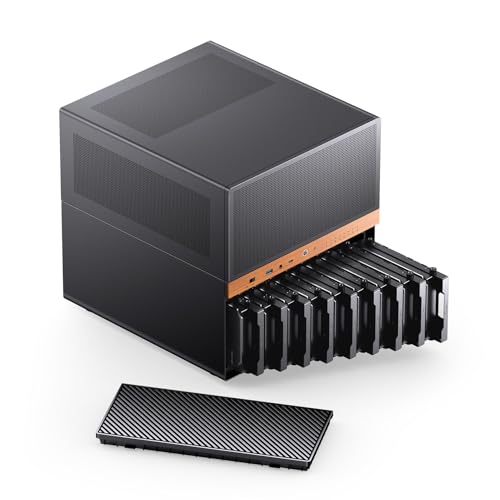
You’ll want the JONSBO N6 if you need exactly 9 drive bays in a compact, wood-accented chassis that fits Micro ATX builds without sacrificing expandability. I like its sturdy steel frame and real walnut veneer-they give it a premium, office-friendly look. The hot-swap backplane supports 9 drives, but know this: enterprise HDDs need all four power connections, and daisy-chaining isn’t allowed. It fits GPUs up to 305mm and coolers up to 160mm, which is generous. Two included fans and multiple mounting points help manage heat, and the front-panel USB-C is a welcome touch. Just remember-PSU placement is flexible, but keep cables tidy. It’s great for dense storage, but the tight layout needs careful planning.
Best For: Users building a compact yet expandable Micro ATX NAS or home server with 9 drive bays and a premium wood-accented design.
Pros:
- Supports up to 9 hot-swap drives with a robust steel and walnut veneer build for a professional look
- Flexible cooling options with multiple fan mounts and support for 240mm AIO liquid coolers
- Includes front-panel USB-C and tool-free access for easy installation and maintenance
Cons:
- Enterprise HDDs require all four power connections, limiting power cable flexibility
- Daisy-chaining power connectors is not allowed, increasing cable management demands
- Tight internal layout requires careful planning, especially for PSU and drive installation
Rosewill Helium NAS Black ATX Case

The Rosewill Helium NAS Black ATX Case stands out as a strong pick for DIY home server builders who need high storage capacity and solid cooling without stepping into expensive enterprise-grade hardware. I’ve found it reliably holds up to 10 3.5-inch HDDs and 3 SSDs, perfect for media or virtualization tasks. Its all-mesh panels and four 140mm PWM fans keep temps low while staying quiet. It fits ATX motherboards and allows 360mm AIO radiators, but its size-25 inches tall-means it needs space. It’s heavy at nearly 20 pounds, and the USB 2.0/3.0 mix feels basic. The warranty’s linked online, and returns are possible within 30 days if it arrives damaged.
Best For: Home server enthusiasts and small business users seeking high storage capacity and efficient cooling in a reliable, mid-tower ATX case.
Pros:
- Supports up to 10 x 3.5-inch HDDs and 3 x 2.5-inch SSDs for extensive storage expansion
- All-mesh side panels and four 140mm PWM fans deliver excellent airflow and quiet operation
- Compatible with ATX motherboards and 360mm AIO radiators for flexible, high-performance builds
Cons:
- Large footprint and 19.71-pound weight make it less portable and space-demanding
- Limited to two USB 2.0 and two USB 3.0 ports, lacking modern USB-C connectivity
- Basic I/O options and online-only warranty access may inconvenience some users
4U Server Chassis with 7 PCI Slots
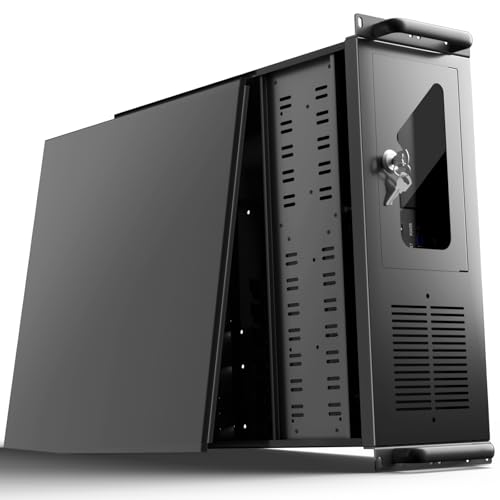
If you need serious expansion for your home lab or professional setup, a 4U server chassis with 7 PCI slots is your best bet for future-proofing and hands-on control. I’ve used this chassis to run multiple NVMe arrays and dual GPUs without airflow issues. It supports 12 drives and fits long cards up to 330mm if you remove the drive cages. The 7 slots let me stack network cards and capture cards cleanly. USB 3.0 ports up front make device swaps easy, and the lockable front panel keeps things secure. LED status lights help me spot power or drive issues fast. It’s heavy and bulky-definitely not for small desks-but in a rack, it’s stable and well-ventilated. Just mind your cooler height: 125mm max unless you remove the bracket. Dust builds up quickly, but the side-panel filter helps.
Best For: Enthusiasts, IT professionals, and home lab builders who need maximum expansion, storage capacity, and hardware customization in a rackmount environment.
Pros:
- Supports up to 7 PCI cards and 12 drives, enabling extensive expansion for GPUs, NVMe arrays, and network or capture cards
- Front USB 3.0 ports, lockable panel, and LED indicators enhance usability, security, and system monitoring
- Accommodates long GPUs up to 330mm and high-end cooling setups with removable drive cages and included dust filter
Cons:
- Large 4U size makes it bulky and unsuitable for compact or desktop spaces
- Maximum CPU cooler height limited to 125mm without removing internal brackets
- Dust accumulation can be an issue despite the side-panel filter, requiring regular maintenance
Factors to Consider When Choosing Home Server Cases
You’ll want to match your case to your motherboard’s form factor-ATX, Micro-ATX, or Mini-ITX-so it fits and routes cables cleanly. Make sure the case holds enough 3.5″ and 2.5″ drives for your storage needs, supports rear and top fan mounts or radiators for cooling, and gives you open PCIe slots for add-in cards like NICs or GPUs. Just don’t overlook power supply clearance, especially if you’re using longer or higher-wattage units, since some compact cases limit PSU size and can restrict future upgrades.
Form Factor Compatibility
Choosing the right home server case starts with matching it to your motherboard’s form factor-don’t assume all cases fit all boards. You need to confirm support for your board’s size, whether it’s E-ATX, ATX, Micro-ATX, or Mini-ITX, since larger motherboards won’t fit in smaller enclosures. Check internal dimensions carefully, especially if you’re using a wider E-ATX board, as some cases have strict width limits. Make sure the case provides enough expansion slots aligned with your motherboard’s PCIe layout, so add-in cards like NICs or HBAs install cleanly. Don’t overlook power supply compatibility-verify the case supports your PSU type (ATX, SFX) and has space for its length and mounting orientation. Poor clearance can block RAM or GPU installation. Always cross-reference specifications before buying-it saves time, money, and frustration down the line.
Drive Bay Capacity
A well-designed home server case should offer at least 6 drive bays, with many models supporting 12 or more 3.5-inch HDDs to meet growing storage demands. You’ll want this flexibility if you’re managing large media libraries, backups, or running a NAS. Hot-swap bays let you replace drives without shutting down, cutting downtime and simplifying maintenance. Look for mixed-drive support-combining 3.5-inch bays for capacity and 2.5-inch slots for fast SSD caching-so you balance speed and storage density. But pack too many drives, and your PSU must keep up, especially with power-hungry enterprise HDDs. You’ll also face trade-offs in physical layout: front-mounted cages improve airflow and cable routing, while side-mounted ones may limit space for long GPUs. Plan your build around full drive loading, not just empty bays, to avoid surprises in power draw and drive access.
Cooling And Ventilation
How does your server stay cool under sustained loads? You need cases with mesh front or side panels-they boost airflow and keep internal temps down. Look for support for multiple 120mm or 140mm fans at the front, rear, and top to build efficient intake and exhaust setups. Pre-installed PWM fans help, adjusting speed based on heat to balance cooling and noise. If you’re packing in high-power parts, confirm the case fits 240mm, 280mm, or 360mm radiators for liquid cooling. Air filters on intakes reduce dust buildup on heatsinks and fans, preserving performance over time. Just remember: better ventilation often means more noise and dust intake if filters aren’t cleaned. High airflow cases work well, but only if you maintain them.
Expansion Slot Availability
You’ve kept your server cool with smart airflow and radiator support, but now it’s time to think about what you can actually plug into it. If you’re planning to run multiple 10GbE NICs, RAID cards, or capture cards, aim for a case with all 7 PCI slots-common in full tower or 4U chassis. These let you stack network, storage, and GPU upgrades without bottlenecking future expansion. Check card length too; many server cases support add-in cards up to 400mm, so high-end GPUs or low-profile cards fit without issue. Some models even offer vertical GPU mounting, which uses one slot but preserves adjacent space for dual-slot cards. Just remember: more slots mean a larger footprint. You’ll gain flexibility, but you’ll need space. Prioritize your needs-media servers or homelabs thrive on expandability, but smaller setups might not need all 7.
Power Supply Support
Most home server cases give you solid options for power supply support, but choosing the right one means balancing size, redundancy, and internal clearance. You’ll typically work with ATX or SFX PSUs, with ATX units ranging from 140mm to 240mm-though compact cases often limit you to 220mm max. Check your case’s PSU compartment carefully; longer units can block airflow or interfere with CPU coolers and GPUs. Some models let you mount the PSU in multiple positions, which helps with cable routing and weight balance. If you’re running critical services, consider cases with dual PSU support for redundancy and stable power under load. But don’t assume more is better-dual setups take space and increase heat output. Always match your PSU size and placement to your motherboard, cooling, and expansion needs to avoid clearance conflicts down the line.
Build Quality Materials
Solid build quality starts with the right materials, and when it comes to home server cases, what you’re building with matters just as much as what’s inside it. You’ll want cases with steel thicknesses between 0.7mm and 1.0mm-they’re sturdy enough to support heavy drives and resist warping over time. Aluminum and steel combos give you lightweight handling without sacrificing protection, ideal if you plan to move your server occasionally. Thicker metal frames also cut down on vibration and noise from multiple drives and fans, making your setup quieter in living spaces. Mesh panels in steel or aluminum boost airflow while still blocking dust. Some premium models use solid walnut veneers for a sleek look that blends into home decor, but they cost more and need occasional maintenance. Just remember, better materials often mean higher prices-so balance durability with your actual needs.
Front Panel Connectivity
What good is a powerful home server if connecting your devices feels like a chore? You need front panel ports that make plugging in drives, headsets, and peripherals simple. Look for at least one USB 3.2 Gen2 Type-C port-you’ll get speeds up to 10 Gbps, perfect for fast external storage. Dual USB 3.0 ports in a 2-in-1 layout give you flexibility without cluttering the front. Don’t overlook USB 2.0 ports either; they’re still handy for keyboards, mice, or older flash drives. A headphone and mic combo jack adds real convenience for quick audio connections. Just remember, more ports can mean a busier front panel, so balance accessibility with clean design. Not all cases place ports ideally, so check the layout before deciding. Prioritize models with durable, recessed ports to prevent damage.
Frequently Asked Questions
Can I Use These Cases for Gaming?
Yes, you can use these cases for gaming, but they’re not ideal. While they support standard ATX builds and have room for mid-range GPUs, most prioritize storage and cooling for drives over airflow for gaming parts. You’ll get limited space for long graphics cards and minimal front-panel ports. Check dimensions and airflow-some models fit gaming hardware, but you’ll sacrifice easy cable management and sleek aesthetics. They work in a pinch, but dedicated gaming cases offer better support and thermal performance.
Are These Cases Noise-Proof?
No, these cases aren’t noise-proof, but you can make them quiet with the right setup. You actively reduce noise by using foam dampening, rubber-mounted drives, and quiet fans. Mesh-heavy cases breathe better but let more sound out. Solid-panel designs block more noise but need careful cooling. Most measure 20–35 dBA under load, depending on hardware. You’ll balance acoustics and airflow, especially in shared spaces like home offices. No case silences components completely, so manage expectations.
Do They Support Liquid Cooling?
No, most home server cases don’t support liquid cooling out of the box. You can fit AIOs in larger models like the Fractal Define 7 or NZXT H7 Elite, but you’ll need to check clearance specs-radiator mounts vary. Custom loops are impractical for typical setups. Air cooling’s more reliable here, quieter, and easier to maintain. If you try liquid, guarantee case compatibility with your pump and radiator size, and expect tighter space and more risk of leaks in a 24/7 server environment.
How Heavy Are These Cases?
They weigh between 8 and 25 pounds, depending on size and materials. You’ll find lighter steel or aluminum cases under 10 pounds, ideal for tight shelves, while heavier full-tower models hit 25 when built with reinforced steel and extra drive cages. Weight matters if you move it often or stack gear. Heavier cases often feel sturdier, but check your rack or desk limits. Always factor in added drives and PSU when estimating total load.
Are They Easy to Assemble?
You’ll find most home server cases easy to assemble, especially models like the Fractal Design Node 304 or UGotStart U1, which snap together with tool-free trays and clear layouts. You won’t struggle with alignment, but tighter builds demand patience. Some compact cases limit space for wiring, making cable management trickier. Always check drive bay types and PSU clearance-measuring once prevents frustration. You’ll save time with modular rails, but skip rushing; a careful fit guarantees stable, long-term performance.