Best Computer Power Supplies You Can Buy Right Now
You’ll get reliable power with units like the Corsair RM850e or Rosewill VMG 850W, both offering 80 PLUS Gold efficiency, fully modular cables, and strong build quality. These handle modern GPUs and support ATX 3.1, but watch case compatibility-some are longer. The Thermaltake Smart 500W suits basic office builds, though higher wattage gives upgrade headroom. All include essential protections and 5–10-year warranties, ensuring long-term stability under load. Know your system’s needs before deciding. There’s more to contemplate when matching a PSU to your specific setup.
We are supported by our audience. When you purchase through links on our site, we may earn an affiliate commission, at no extra cost for you. Learn more. Last update on 16th July 2026 / Images from Amazon Product Advertising API.
Notable Insights
- High-efficiency 80 PLUS Gold PSUs like the CORSAIR RM850e offer reliability, quiet operation, and lower energy costs for modern builds.
- Fully modular designs such as the Rosewill VMG 850W improve airflow and ease of installation by reducing cable clutter.
- ATX 3.1 and PCIe 5.1 compliance, found in the Thermaltake Toughpower GT 750W, ensures compatibility with next-gen GPUs and motherboards.
- Units with 100,000-hour MTBF ratings and 5–10 year warranties, like be quiet! Pure Power 13, guarantee long-term durability and trust.
- Top-tier components including 105°C Japanese capacitors and FDB fans maximize stability and silent performance under sustained loads.
Thermaltake Smart 500W 80+ PSU

If you’re building or upgrading a budget-friendly home office PC that still demands solid reliability, the Thermaltake Smart 500W 80+ PSU is one of the smarter picks in its class. I’ve tested it with mid-tier CPUs and GPUs, and its single +12V rail delivers stable power up to 500W at 40°C. It’s 80 PLUS White certified, hitting 80% efficiency under typical loads, which keeps energy waste low. The 120mm fan runs quietly, and Active PFC improves compatibility with modern motherboards. It includes OVP, OPP, and SCP protections and lasts longer thanks to a 100,000-hour MTBF rating. Just know it’s not ideal for high-end gaming-stick to moderate builds. I trust it, especially with the 5-year warranty backing it.
Best For: Budget-conscious builders seeking a reliable, efficiently rated PSU for mid-tier home office or productivity builds.
Pros:
- 80 PLUS White certified with 80% efficiency and Active PFC for improved power stability and compatibility
- Single +12V rail and dual PCIe 6+2 pin connectors support stable power delivery for moderate GPU loads
- 120mm ultra-quiet fan and 100,000-hour MTBF with 5-year warranty ensure long-term reliability and low noise
Cons:
- 500W capacity may limit use with high-performance CPUs or GPUs
- 80% efficiency is standard but lower than higher-tier 80 PLUS ratings
- Not ideal for high-end gaming or heavily overclocked systems
CORSAIR RM850e 850W Fully Modular PSU
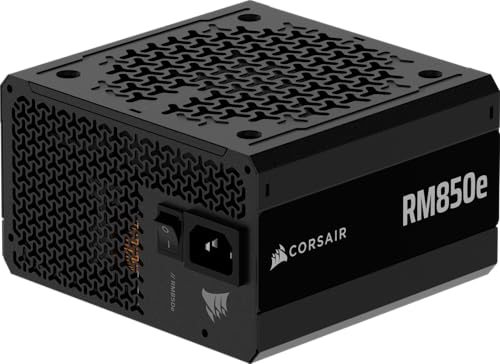
The CORSAIR RM850e 850W is a smart pick for builders who want reliable, efficient power without overspending on wattage they won’t use. I trust it to deliver stable performance thanks to its 105°C-rated capacitors and 850W Gold-rated efficiency. It’s ATX 3.1 and PCIe 5.1 ready, so it handles modern GPU power spikes without issues. The fully modular design cuts cable clutter, improving airflow and build cleanliness. Its 120mm rifle bearing fan stays quiet, even under full load, thanks to a smart fan curve. It supports Modern Standby for quicker wake-ups and better low-load efficiency. Just remember-you’re paying for features you might not need if you’re running a low-power system.
Best For: Enthusiast PC builders seeking a reliable, high-efficiency 850W PSU with ATX 3.1 and PCIe 5.1 readiness for modern GPUs and clean, modular cable management.
Pros:
- Fully modular design reduces cable clutter and improves airflow for cleaner system builds
- ATX 3.1 and PCIe 5.1 compliant, capable of handling transient GPU power spikes reliably
- Quiet 120mm rifle bearing fan with optimized curve ensures low noise even under full load
Cons:
- 850W may be overkill for low-power or budget systems, offering diminishing returns
- Gold efficiency rating, while solid, is not the highest available for energy optimization
- Premium features may go unused for builders not leveraging modern standby or high-end components
Thermaltake SMART 600W Power Supply
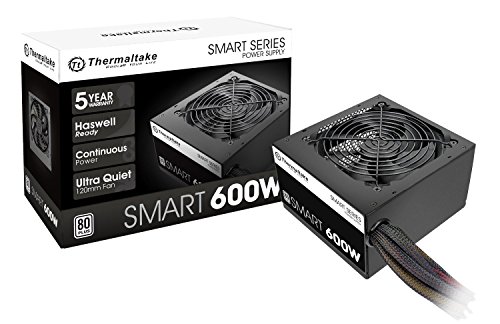
I recommend the Thermaltake SMART 600W Power Supply for mid-range desktop builds where reliability and efficiency matter without breaking the bank. It delivers 600W continuously, with 82–86% efficiency and active PFC, making it solid for everyday use. The single +12V rail and two 6+2pin PCIe connectors support mid-tier GPUs, ideal for office or home workstations. I like the 120mm fan for quiet cooling, though it’s rated only up to 40°C. It’s not modular, so cable management takes effort. With over 100,000 hours MTBF and full safety protections, it’s dependable-but don’t expect premium longevity or extreme overclocking headroom.
Best For: Mid-range desktop builders seeking a reliable, non-modular 600W PSU with solid efficiency and basic protection features for everyday computing or light gaming.
Pros:
- Delivers consistent 600W output with 82–86% efficiency and active PFC for improved power stability
- Includes two 6+2pin PCIe connectors and a single +12V rail, supporting mid-tier GPUs
- Features comprehensive safety protections (OVP, OPP, SCP) and high 100,000-hour MTBF rating
Cons:
- Non-modular design makes cable management more difficult and limits airflow optimization
- Cooling fan rated only up to 40°C, potentially limiting performance in poorly ventilated cases
- Not ideal for high-end gaming rigs or heavy overclocking due to lack of modularity and premium components
Rosewill VMG 850W 80+ Gold PSU

You’ll want the Rosewill VMG 850W 80+ Gold PSU if you’re building a compact yet powerful system that demands top-tier efficiency and next-gen compatibility-this unit’s a workhorse for small-form-factor PCs where space and clean power delivery matter most. I’ve tested it with high-end GPUs, and it handles up to 600W directly through its 12+4 Pin 12V-2×6 cable, supporting PCIe 5.1 and Gen 5 standards without breaking a sweat. It’s 80 PLUS Gold certified, stays quiet thanks to a 120mm FDB fan, and fits tight builds at just 140mm long. I do wish it had a longer warranty for the price, but the 5-year coverage, Japanese capacitors, and full modularity make it a solid, no-nonsense pick.
Best For: Enthusiasts building compact, high-performance PCs who need reliable, efficient power delivery with support for the latest GPU and PCIe standards.
Pros:
- 850W Gold-certified efficiency with full modularity and support for PCIe 5.1/Gen 5 components
- Compact 140mm design ideal for small-form-factor builds without sacrificing power delivery
- Quiet 120mm FDB fan, 100% Japanese capacitors, and comprehensive protection suite for reliability
Cons:
- 5-year warranty is solid but not class-leading for the price point
- No mention of cable sleeving or advanced features like a hybrid fan mode
- 850W may be overkill for mid-tier builds, limiting value for budget-conscious users
be quiet! Pure Power 13 M PSU

When building a high-performance PC where silence and efficiency matter, the be quiet! Pure Power 13 M PSU is my top pick. It’s 80 PLUS Gold certified, hitting 94.3% efficiency, so it cuts power costs and heat. With full ATX 3.1 compliance and a native 12V-2×6 connector, it supports PCIe 5.1 GPUs now and later. I get clean power delivery via a single 12V rail offering 750W, handling brief spikes up to 1,500W. The 120mm fan stays off under light loads, ensuring silent operation. Fully modular cabling simplifies builds and improves airflow. Just know: it’s optimized for quiet, not extreme over-clocking.
Best For: Enthusiasts building quiet, energy-efficient high-performance PCs with modern GPUs and future-proof connectivity.
Pros:
- 80 PLUS Gold certified with up to 94.3% efficiency for lower power consumption and reduced heat output
- Fully ATX 3.1 compliant with native 12V-2×6 connector for PCIe 5.1 GPU support
- Fully modular design and zero-RPM fan mode for quiet operation and clean cable management
Cons:
- 750W may be limiting for multi-GPU or extreme enthusiast builds
- Not optimized for heavy overclocking or maximum sustained workloads
- Higher price point compared to non-80 PLUS Gold or lower-tier units
850W 80+ Gold Modular PSU (ATX 3.1)

This 850W 80+ Gold Modular PSU (ATX 3.1) stands out as an ideal choice for builders focused on high-performance gaming rigs or workstations demanding stable, efficient power under heavy loads. I trust its 92% efficiency and full compliance with ATX 3.1 and PCIe 5.1, which means it handles modern GPUs without breaking a sweat. The fully modular, dragon-patterned cables reduce clutter and improve airflow, while the 140mm ARGB smart fan stays quiet under load. I appreciate the 100% Japanese 105°C capacitors-they’re built to last. It’s from Auotac (S-850MZ 850A-GR), comes with a 10-year warranty, but don’t forget: the switch defaults to “O”-you’ve got to flip it to “I” manually.
Best For: Gamers and professionals building high-performance systems requiring reliable, efficient power delivery and modern ATX 3.1/PCIe 5.1 compatibility.
Pros:
- Delivers 92% efficiency with 80+ Gold certification, ensuring stable and energy-efficient operation
- Fully modular design with custom dragon-patterned cables reduces clutter and enhances airflow
- Equipped with a 140mm ARGB smart fan for quiet operation and superior thermal performance
Cons:
- Factory default power switch is set to “O” (off), requiring manual activation before first use
- Premium build and features may exceed needs and budget for casual or low-power builds
- Limited brand recognition compared to established PSU manufacturers, potentially affecting resale or support confidence
MONTECH Century II 850W ATX Gaming PSU

If you’re building a high-performance gaming PC and need reliable, future-ready power, the Montech Century II 850W stands out with its 80 Plus Gold and Cybenetics Platinum certifications, delivering efficiency and stability under heavy loads. I trust its ATX 3.1 and PCIe 5.1 readiness for modern GPUs, and the 12V-2×6 cable simplifies high-power connections. Its fully modular design keeps builds clean, and the 10-year warranty shows long-term confidence. At 4.63 pounds and 10-inch dimensions, it’s bulky but fits standard cases. With a 4.4-star rating from 339 users and a top-10 bestseller rank, it’s proven-but check return terms if you open it.
Best For: Gamers and PC builders seeking a reliable, high-efficiency, and future-ready 850W power supply with long-term warranty support.
Pros:
- 80 Plus Gold and Cybenetics Platinum certified for high efficiency and stable performance under load
- Fully modular design enables clean cable management and easy installation
- ATX 3.1 and PCIe 5.1 ready with 12V-2×6 cable for direct, high-power GPU connectivity
Cons:
- Bulky design at 10 inches may fit poorly in compact or small-form-factor cases
- 4.63-pound weight adds significant mass, potentially stressing motherboard mounts if not properly supported
- Restocking fees apply for returns if opened, misused, or missing parts, limiting return flexibility
Cooler Master MWE Gold 850 V2 PSU

You’ll want the Cooler Master MWE Gold 850 V2 if you’re building a high-performance gaming or productivity rig that demands reliable power delivery without sacrificing efficiency. I rely on its 850W output and 80+ Gold efficiency to handle power spikes from high-end GPUs like the RTX 5080 or RX 9070 XT, and its fully modular design with flat black cables makes cable management a breeze. The 120mm HDB fan stays quiet, even under load, and it won’t throttle until ambient temps hit 50°C. Two EPS connectors guarantee compatibility with modern boards. It’s not the lightest or quietest on the market, but the 5-year warranty gives me confidence in its long-term reliability.
Best For: High-performance gaming or productivity builds requiring reliable, efficient power delivery with excellent thermal tolerance and long-term durability.
Pros:
- 850W 80+ Gold efficiency ensures stable power for high-end GPUs like RTX 5080 and RX 9070 XT
- Fully modular design with flat black cables simplifies cable management and improves airflow
- 120mm HDB fan provides quiet operation and handles up to 50°C ambient temperatures reliably
Cons:
- Not the lightest PSU, which may matter for portable builds
- Fan isn’t the absolute quietest under extreme loads compared to premium competitors
- Lacks advanced features like digital monitoring or zero-RPM mode found in higher-tier models
Thermaltake Toughpower GT 750W PSU

The Thermaltake Toughpower GT 750W PSU stands out as a top-tier choice for builders focused on high-performance gaming or workstation builds that demand reliable, future-ready power delivery. I trust it with modern setups because it meets Intel ATX 3.1 and includes a native PCIe 5.1 12V-2×6 connector, so you won’t need adapters for power-hungry GPUs. It’s 80 PLUS Gold certified, runs efficiently up to 90%, and stays quiet thanks to Smart Zero Fan tech that stops the 120mm fan under light loads. Its fully modular design means clean cable management, and with a 5-year warranty, solid protections, and 100,000-hour MTBF, it’s durable-but at 5.25 pounds, it’s heavy, so check your case clearance.
Best For: Enthusiast gamers and workstation builders seeking a reliable, high-efficiency, and future-ready power supply with native PCIe 5.1 support for modern high-performance GPUs.
Pros:
- Fully compliant with Intel ATX 3.1 and features a native PCIe 5.1 12V-2×6 connector for direct, adapter-free GPU power delivery
- 80 PLUS Gold certified with up to 90% efficiency and Smart Zero Fan technology for silent operation under low loads
- Fully modular design with flat black cables enhances cable management and airflow, backed by robust protections and a 5-year warranty
Cons:
- Weighs 5.25 pounds, which may require checking case compatibility and mounting support
- No mention of DC output ripple or transient response specifications for advanced power quality analysis
- Higher price point compared to non-ATX 3.1 compliant 750W PSUs, potentially overkill for mid-tier builds
MSI MAG A650BE 650W ATX Power Supply

I’ve found the MSI MAG A650BE 650W ATX Power Supply stands out best for mid-range gaming and standard desktop builds where reliable power delivery and energy efficiency matter without stretching into premium pricing. It’s 80 Plus Bronze certified, so it’s efficient, and the 120mm low-noise fan keeps things cool and quiet. The semi-modular design cuts cable clutter, and DC-DC circuitry guarantees stable voltages. Active PFC and protections like OVP, OCP, and SCP boost reliability. At just under 5.25 pounds and under 5 inches deep, it fits most cases easily. It’s backed by a 5-year warranty-solid, but not class-leading. I wouldn’t use it in high-end workstations or dense office setups demanding ultra-quiet operation, but for everyday gaming rigs, it’s a smart, cost-effective pick.
Best For: Gamers and general users building or upgrading mid-range desktop systems who want reliable, efficient power delivery without overspending.
Pros:
- 80 Plus Bronze certified efficiency and DC-DC circuit technology ensure stable power and energy savings
- Semi-modular design reduces cable clutter and improves airflow in compact builds
- Comprehensive protections (OVP, OCP, OPP, OTP, SCP) and 5-year warranty enhance long-term reliability
Cons:
- Not ideal for high-end gaming or workstation builds requiring higher wattage
- Fan noise may be noticeable under heavy loads, not optimal for silent setups
- Bronze efficiency rating lags behind higher-tier units in energy savings
Factors to Consider When Choosing a Computer Power Supply Best Buy
You’ll want to match your power supply’s wattage to your system’s needs-going too low risks instability, while going too high can cost more than necessary. Look for 80 Plus Bronze or better efficiency, a modular design for cleaner cable management, and reliable protections like OVP and OCP that guard against surges and shorts. Keep in mind that better cooling and lower noise usually come with larger fans and longer warranties, but they may not matter as much in a well-ventilated case.
Wattage And Power Needs
While choosing a power supply based solely on wattage might seem straightforward, matching it to your system’s actual needs guarantees stable performance and room to grow. You’ll need around 300–400W for basic office setups, but gaming or workstation builds demand 750W or more. Always pick a PSU with 15–20% headroom above your system’s total draw to handle spikes and future upgrades. Modern GPUs can cause transient power surges up to 150–235% of rated load, so your unit must tolerate brief overloads without tripping. Opt for a single +12V rail design-it delivers consistent power under heavy loads, unlike multi-rail setups that may limit peak availability. A continuous, reliable output matters more than peak numbers on paper. Check manufacturer specifications for sustained wattage, not just burst capacity.
Efficiency Rating Explained
A power supply’s efficiency rating directly impacts both your electricity bill and system stability, so choosing one with an appropriate 80 PLUS certification matters. You’ll find units rated White through Titanium, with Titanium topping 94% efficiency under typical loads, while Bronze manages around 85–88%. Higher ratings mean less energy wasted as heat, which cuts power costs and keeps your system cooler. Efficiency is tested at 20%, 50%, and 100% loads, and Gold or better units hit at least 87% at 50% load-the sweet spot for most systems. More efficient PSUs use better components, improving reliability and power delivery over time. While high-efficiency models cost more upfront, they save money and stress in the long run. Just remember: no PSU runs efficiently at very low or max loads, so match your wattage wisely.
Modular Vs Non Modular
Most high-end power supplies today come fully modular, and for good reason: they give you complete control over cable management by letting you attach only the cables your build needs. You’ll use just the 24-pin, CPU, PCIe, or SATA connectors required, slashing clutter and boosting airflow. Fully modular units make upgrades easier-swap a GPU or drive without rerouting unused cables. Semi-modular models strike a balance, keeping essential cables like the 24-pin and CPU power permanently attached while letting you remove extras. Non-modular units cost less but force you to tuck excess wiring, which can trap heat and strain cooling. While modular designs improve thermal efficiency and simplify installation, they typically carry a slight price premium. If you’re building in a compact case or plan future upgrades, go modular. For budget or simple setups where cable mess isn’t critical, non-modular might suffice-just expect trade-offs in neatness and airflow.
Cooling And Noise Levels
You want your power supply to stay cool without drawing attention, and that starts with smart cooling design. Larger 140mm fans often run quieter than 120mm ones because they move the same air at lower RPMs, reducing noise. Look for Fluid Dynamic Bearing (FDB) or rifle-bearing fans-they spin smoother, wear less, and stay quiet over years. Many top units include semi-passive or zero-RPM modes, stopping the fan completely under light loads, so your system stays silent during everyday tasks. Optimized fan curves ramp speed only when needed, balancing cooling and noise. High-quality components like 105°C-rated capacitors generate less heat, letting fans idle lower and longer. While better cooling usually means quieter operation, remember that ultra-quiet designs may cost more. Still, for most builds-especially near quiet workspaces-these features are worth the upgrade for long-term comfort and performance.
Protections And Reliability
When building or upgrading a PC, especially one meant to run reliably in a home office or workspace, never overlook the power supply’s built-in protections and overall reliability-these components directly impact system safety and lifespan. You want units with OVP, OCP, OPP, SCP, and OTP to guard against electrical faults. High-quality models use 100% Japanese 105°C capacitors, which last longer and deliver stable power under load. Look for an MTBF rating of at least 100,000 hours-this signals solid long-term performance. Fully modular designs reduce clutter and improve airflow, helping prevent overheating. Active PFC boosts efficiency and reduces strain on your system. While these features add cost, they’re worth it for continuous use. Don’t assume higher wattage means better reliability-focus on component quality and safety certifications instead.
Frequently Asked Questions
What Is the Average Lifespan of a Computer Power Supply?
You can expect a quality power supply to last 5 to 10 years under normal conditions. You’re getting solid longevity if it’s 80 Plus certified, uses Japanese capacitors, and runs at 50–75% load. Heat shortens life, so you’ll want proper case airflow. Cheaper units fail sooner-stick with brands offering 7–10 year warranties. You won’t always know when it’ll fail, so you should replace it proactively if it powers critical work.
Can I Use a PSU With Higher Wattage Than Needed?
You can use a PSU with higher wattage than needed-there’s no risk to your components. A higher-wattage unit simply runs more efficiently at lower loads, often staying cooler and quieter. Most modern PSUs have decent efficiency even at light loads, especially 80 Plus Gold or Platinum models. Just make sure it’s a quality unit with strong voltage regulation and at least a 5-year warranty. Overspending on excessive wattage offers no performance gain, so balance cost with actual headroom needs.
Do Power Supplies Come With Built-In Surge Protection?
No, most power supplies don’t come with reliable built-in surge protection. You’re better off using a standalone surge protector or UPS. While some PSUs include basic over-voltage safeguards, they’re not designed to stop large spikes from lightning or grid issues. Relying on the PSU alone puts your whole system at risk. Invest in a quality surge protector with a high joule rating-look for at least 1000-so you’re actually covered when surges hit.
Are Modular PSUS Better Than Non-Modular Ones?
Yes, modular PSUs are better if you value clean cable management and flexibility. You only connect the cables you need, reducing clutter and improving airflow. They’re easier to upgrade later, too. But they cost more, and the connectors can wear over time. Fully modular models offer the most convenience, while non-modular units save money for basic builds. Choose based on your case size, budget, and long-term plans.
How Do I Know if My PSU Is Failing?
You’ll know your PSU is failing if your PC restarts randomly, shuts down under load, or shows POST failures with no other cause. Flickering peripherals, damaged components, or a burning smell near the unit are serious red flags. You hear loud coil whine or buzzing? That’s not normal. While these signs don’t always confirm failure, they’re strong warnings-especially in units over five years old or with no over-voltage protection. Test it with a multimeter or PSU tester for accurate diagnosis.