Best Home Server Cases for Reliable and Quiet Performance
You want reliable, quiet performance? Go with the JONSBO N5 or Rosewill 4U. They support up to 12 hot-swap drives, use solid steel or wood builds to dampen vibrations, and include PWM fans for near-silent cooling under load. Mesh panels and separate airflow zones keep drives and components cool without cranking noise. Just watch GPU and cooler clearances-some models limit hardware options. Larger cases fit more, but need space and fan tuning. Pick based on your drive count and motherboard size, and you’ll get lasting, stable operation. Next up, see how each model balances build and noise.
We are supported by our audience. When you purchase through links on our site, we may earn an affiliate commission, at no extra cost for you. Learn more. Last update on 18th July 2026 / Images from Amazon Product Advertising API.
Notable Insights
- Opt for cases with mesh panels and PWM fans to balance airflow and quiet operation under load.
- Choose models with tool-free, hot-swap drive bays for easy maintenance and reduced vibration noise.
- Ensure compatibility with low-noise fans and radiators up to 360mm for effective thermal management.
- Prioritize steel construction and solid wood finishes to dampen sound and improve structural stability.
- Select cases supporting efficient cable management and separate cooling zones for consistent performance.
DARKROCK Classico ATX NAS Case Black

If you’re building a high-capacity home server for media storage, backups, or homelab projects, the DARKROCK Classico ATX NAS Case Black stands out as a strong choice-especially if you need space for over a dozen drives without stepping into full rack territory. I’ve used it to house 10x 3.5-inch and 3x 2.5-inch drives, and it handles heat well thanks to mesh panels and four included 120mm fans. It supports 360mm radiators if you want liquid cooling, and the vertical GPU mount keeps high-end graphics cards secure. The case fits ATX motherboards and offers USB 3.0 plus ten USB 2.0 ports. At 17.96 pounds, it’s sturdy, not portable. You get solid airflow and expansion room, but the design prioritizes function over silence-so it’s loud under load. It’s sold by Amazon with a 30-day return window for damaged units, but noise levels mean it’s better suited for dedicated server rooms than quiet home offices.
Best For: Home server builders and homelab enthusiasts who need high drive capacity and strong airflow in a compact mid-tower form factor.
Pros:
- Supports up to 13 drives (10x 3.5″ HDDs and 3x 2.5″ SSDs) for extensive storage expansion
- Excellent cooling performance with mesh panels, four included 120mm fans, and support for 360mm radiators
- Vertical GPU mount and ATX motherboard support enable high-performance builds with better cable management
Cons:
- Loud under load due to aggressive airflow design, making it unsuitable for quiet environments
- Heavy at nearly 18 pounds, limiting portability
- Limited USB 3.0 availability despite ten USB 2.0 ports, which may hinder modern peripheral connectivity
Rosewill Thor NAS Full Tower Case
The Rosewill Thor NAS Full Tower Case stands out for users who need heavy-duty storage expansion and flexibility in a home server or small office environment. I’ve used it to build systems with up to 11x 3.5-inch HDDs or 13x 2.5-inch SSDs, making it ideal for NAS or media hubs. It supports E-ATX boards and graphics cards up to 400mm, which gives serious room for upgrades. The 140mm PWM fan keeps things cool without excess noise, though more fans help under load. Eleven 5.25-inch bays add usability, and the front USB 3.2 Gen 1 Type-C port speeds up device transfers. It’s spacious and versatile, but its size demands desk or floor space-small setups might struggle.
Best For: Home server enthusiasts, small office environments, and NAS builders needing extensive storage and expansion capabilities.
Pros:
- Supports up to 11x 3.5-inch HDDs or 13x 2.5-inch SSDs for high-capacity storage configurations
- Accommodates E-ATX motherboards and long GPUs up to 400mm for maximum hardware flexibility
- Features a 140mm PWM fan and front USB 3.2 Gen 1 Type-C port for efficient cooling and fast data transfers
Cons:
- Large full-tower size requires substantial desk or floor space, unsuitable for compact setups
- Basic fan configuration may require additional cooling under heavy workloads
- 5.25-inch bays, while numerous, may be less relevant for modern builds focused on M.2 and NVMe storage
JONSBO N4 Black NAS PC Case

I’ve found the JONSBO N4 Black NAS PC Case shines best for users setting up a compact, high-capacity home server that doesn’t sacrifice style-ideal if your office space doubles as living space. Its 8-drive layout offers serious storage: 6× 3.5″ bays (4 hot-swap) and 2× 2.5″ SSDs, neatly organized in a dedicated 5-inch split bay. The blend of 0.7mm SGCC steel and 8mm North American black walnut gives it a premium, natural look that blends into homes. It fits Micro-ATX or ITX boards, but watch clearances-70mm for CPU coolers and 230mm for GPUs leave little room for large parts. A single 120mm front fan and vented front panel help airflow, though heavier workloads may need extra cooling. USB 3.2 Gen 2 Type-C and USB 3.0 on the front panel add modern convenience. It’s not for power users needing expansion, but for quiet, stylish, space-conscious builds, it’s a strong pick-just plan your parts carefully.
Best For: Home and office users seeking a stylish, compact NAS build with high storage capacity and quiet operation in a living or shared space.
Pros:
- Premium design with real North American black walnut paneling for seamless home integration
- High storage capacity with 8 drive bays (6× 3.5″ HDD, 4 hot-swap, and 2× 2.5″ SSD) in organized split configuration
- Modern front-panel I/O including USB 3.2 Gen 2 Type-C and USB 3.0 for convenient connectivity
Cons:
- Limited clearance for CPU coolers (70mm) and GPUs (230mm), restricting high-performance component options
- Only a single 120mm front fan, which may require additional cooling for sustained heavy workloads
- SFX power supply support only, potentially increasing cost and limiting PSU availability
JONSBO N5 NAS PC Case (Solid Wood)

You’ll want the JONSBO N5 NAS PC Case if you’re building a high-capacity home server that doesn’t sacrifice aesthetics for function-this chassis combines a premium solid wood finish with industrial-grade expandability. I use mine with 12 HDDs and dual GPUs, and the North American black walnut veneer looks great in my office. It fits E-ATX boards and holds up to 330mm-wide motherboards, supports 240mm PSUs, and clears coolers up to 160mm. Front, side, and rear fan mounts guarantee airflow, and the tool-free HDD cage simplifies swaps. Just verify PSU length and HDD load-full bays demand robust power and space.
Best For: Home server builders who want high storage capacity and premium aesthetics in a durable, expandable chassis.
Pros:
- Premium North American black walnut veneer offers elegant, natural wood finish ideal for office or living spaces
- Supports up to 12 hot-swap 3.5-inch HDDs and 4 SSDs with tool-free installation for easy maintenance and scalability
- Ample expansion room with support for E-ATX motherboards, dual GPUs, and extensive cooling options including AIO radiators
Cons:
- Full 12-drive HDD configuration requires careful attention to PSU length and power capacity
- Heavy weight (over 20 lbs) may make handling and placement challenging
- High drive density can lead to heat buildup if airflow is not properly managed with additional fans
Thermaltake Versa H21 Mid Tower Case
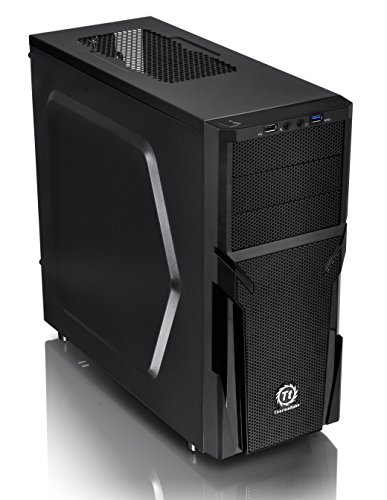
A solid pick for tinkerers who want durability without overspending, the Thermaltake Versa H21 Mid Tower Case delivers functional airflow and easy assembly at a reasonable price. I appreciate its SPCC steel build-it’s sturdy but not overly heavy. The front and top mesh panels boost airflow, and the elevated base helps with bottom ventilation, which keeps components cool during long workloads. It fits ATX, micro-ATX, and mini-ITX boards, and I’ve installed long GPUs and large air coolers without issues. The tool-free design and cable management make wiring clean and simple. USB 3.0, USB 2.0, and audio jacks up front are convenient. Just note: it’s not silent-mesh means more fan noise.
Best For: Budget-conscious builders and tinkerers seeking a durable, well-ventilated mid tower case with easy assembly and broad hardware compatibility.
Pros:
- Excellent airflow thanks to front and top mesh panels and elevated base design
- Supports full-sized ATX motherboards, long GPUs, and large CPU coolers
- Tool-free installation and quality cable management for clean builds
Cons:
- Mesh panels increase fan noise, making it less ideal for quiet builds
- Basic SPCC steel construction lacks premium aesthetics or sound dampening
- Limited included fans-additional cooling purchases may be needed
Pironman 5-MAX NVMe SSD Case for Pi 5
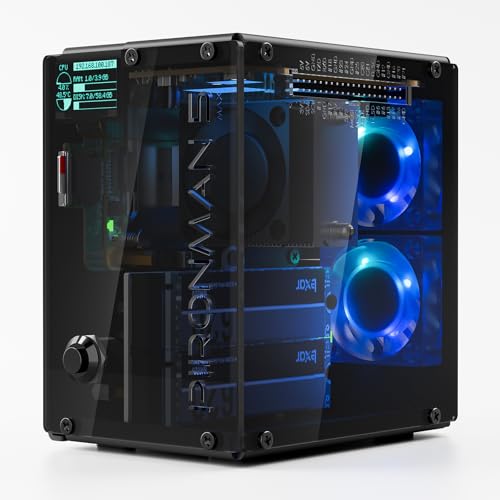
The Pironman 5-MAX NVMe SSD Case for Pi 5 stands out as a top pick for hobbyists and tinkerers aiming to build a compact yet powerful home server using the Raspberry Pi 5. I’ve found it handles demanding tasks like NAS setups and Home Assistant smoothly, thanks to dual NVMe SSD slots with RAID support and room for an AI accelerator. The cooling is effective-the PWM fan keeps things quiet under load. I appreciate the real-time OLED stats and clean cable layout. Just know: the RGB lighting and dual drives increase power needs, so use a solid 5V/5A supply. Assembly takes patience, but the guides help.
Best For: Hobbyists and tinkerers building high-performance Raspberry Pi 5 projects like NAS, Home Assistant, or edge AI systems.
Pros:
- Supports dual NVMe SSDs with RAID 0/1 for fast, expandable storage and AI accelerator compatibility
- Effective cooling system with PWM fan and dual RGB fans for quiet, sustained performance
- Integrated OLED display for real-time system monitoring and clean cable management with smart layout
Cons:
- Higher power consumption requires a robust 5V/5A power supply for stable operation
- RGB lighting and dual drives may generate heat under heavy workloads despite cooling
- Assembly can be time-consuming and requires patience, especially for first-time users
8 Bay NAS Case – Black
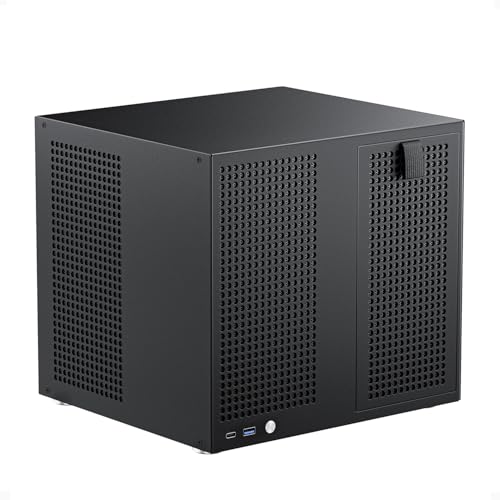
This 8 Bay NAS Case from Aukuoy fits my setup perfectly when I need serious storage density without sacrificing reliability. I appreciate the hot-swap 3.5-inch bays and separate 2.5-inch SSD mounts, which make drive management easy. The magnetic front panel snaps off quickly for replacements or upgrades. It supports Micro-ATX and Mini-ITX boards, plus full-height PCIe cards like SAS controllers-great for expandability. Dual 120mm fan mounts keep things cool without noise. At just over 11 pounds and under 12 inches on each side, it’s compact enough for my office shelf. The included hardware simplifies assembly, though I wish the steel felt a bit sturdier. Still, it’s a solid pick for organized, high-capacity builds.
Best For: Home lab enthusiasts and small business users seeking a compact, high-capacity NAS solution with easy drive access and expansion capabilities.
Pros:
- Supports up to 8 hot-swap 3.5″ HDDs and 2 dedicated 2.5″ SSDs for flexible storage configurations
- Compact design with dual 120mm fan mounts for efficient, quiet cooling
- Includes all necessary mounting hardware and supports full-height PCIe cards for expandability
Cons:
- Steel build feels less sturdy than premium NAS chassis
- Limited to Micro-ATX and Mini-ITX motherboards, restricting board compatibility
- No fans included, requiring additional purchases for full cooling setup
Rosewill 4U Server Chassis (RSV-R4000U)
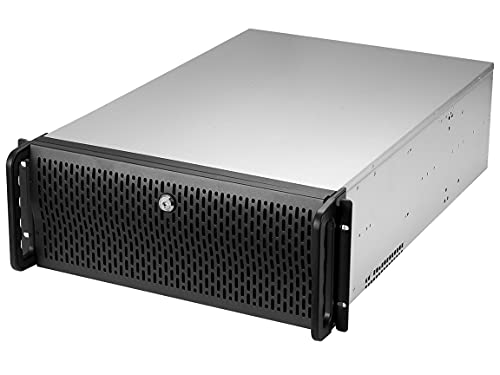
You’ll want the Rosewill 4U Server Chassis (RSV-R4000U) if you need serious drive capacity and rack-mounted stability without overspending. I’ve used it to build a high-storage server that stays cool and secure, thanks to its eight 3.5” bays and four pre-installed fans-two 120mm front PWM fans pull air well, while the two 80mm rear units exhaust heat quietly. It fits ATX and CEB motherboards and offers seven PCI slots, so expansion isn’t an issue. The 5.25” bays work for optical drives or extra cooling. At 21 inches deep, it fits most racks, but check clearance first. It’s sturdy metal, though finish is utilitarian. USB 3.0 ports and front lock are useful, but don’t expect quietness under full load.
Best For: Data-centric users needing high storage capacity and expandable rackmount server hardware on a budget.
Pros:
- Offers 8 x 3.5” HDD bays and 3 x 5.25” bays for extensive storage and device expansion
- Pre-installed 120mm and 80mm fans provide effective cooling with PWM control for efficiency
- Supports ATX and CEB motherboards with 7 PCI slots and includes USB 3.0 ports and front panel lock for functionality and security
Cons:
- Can become noisy under heavy load despite default cooling setup
- Utilitarian metal finish lacks aesthetic refinement
- 21-inch depth may require clearance checks in tighter rack installations
JONSBO N2 Black NAS ITX Case

While compact enough to fit on a desk or shelf, I find the JONSBO N2 Black NAS ITX Case works best for users who need a dedicated, expandable home server without the bulk of a full-size tower. I’ve used it to build quiet, efficient systems with up to 5x 3.5” HDDs and 1x 2.5” SSD, giving solid storage flexibility. It supports Mini-ITX boards and SFX PSUs up to 150mm, but watch clearance: the CPU cooler maxes at 65mm and GPUs at 197mm. The built-in 12cm fan helps, though I still optimize cable management for airflow. Front-panel USB-C and USB 3.0 are handy, but the single PCI slot limits expansion.
Best For: Home server enthusiasts and compact PC builders seeking expandable storage in a sleek, minimal footprint.
Pros:
- Supports up to 5x 3.5” HDDs and 1x 2.5” SSD for flexible, high-capacity storage
- Compact aluminum chassis with built-in 12cm fan for efficient cooling and quiet operation
- Includes front-panel USB 3.2 Gen2 Type-C and USB 3.0 for modern connectivity
Cons:
- Limited CPU cooler clearance (65mm) restricts use of taller air coolers
- GPU length support capped at 197mm, excluding full-size graphics cards
- Only a single PCI low-profile slot, limiting expansion options
Rosewill Helium NAS Black ATX Case

The Rosewill Helium NAS Black ATX Case stands out as a strong choice for users building a powerful, storage-heavy home server without stepping into enterprise-grade pricing. I appreciate its all-mesh side panels and four 140mm PWM fans, which deliver quiet, efficient cooling even under load, and it supports a 360mm AIO radiator if needed. It holds up to 10 HDDs and 3 SSDs-perfect for media or virtualization-but its size (25 x 24.41 x 12.68 inches) demands space. It fits standard ATX motherboards and offers USB 3.0 ports, though the 2024 release means long-term reliability remains unproven. The 30-day Amazon return policy applies, with restocking fees possible.
Best For: Home server builders and small businesses needing high-capacity storage with efficient, quiet cooling in a mid-tower form factor.
Pros:
- Supports up to 10 HDDs and 3 SSDs, ideal for media libraries, virtual machines, and data-intensive applications
- Equipped with four 140mm PWM fans and all-mesh panels for excellent airflow and quiet operation
- Compatible with standard ATX motherboards and supports 360mm AIO radiators for advanced cooling options
Cons:
- Large footprint (25 x 24.41 x 12.68 inches) requires significant space
- Only two USB 2.0 ports, which may be limiting for some users
- Released in 2024, so long-term durability and reliability are not yet proven
Factors to Consider When Choosing a Home Server Case
You’ll want to pick a case that matches your storage and performance needs without overspending on features you won’t use. Make sure it supports the number of drives you plan to run, has solid airflow for long-term reliability, fits your motherboard size, offers enough expansion slots for future upgrades, and uses durable materials like steel or aluminum to stand up to daily use. Keep in mind that bigger cages and extra fans add bulk, so balance capacity and cooling with the space you actually have in your home office.
Drive Capacity Options
Many home server cases support between 4 and 12+ drive bays, giving you flexibility to scale storage based on your needs, but choosing the right capacity means balancing physical space, cooling, and motherboard compatibility. You’ll typically find support for a mix of 3.5-inch HDDs and 2.5-inch SSDs, with some models packing up to 13 drives using combined bays. Hot-swap trays come standard on 8-bay+ cases, letting you swap drives without tools or downtime-ideal for maintaining uptime. Drive cages vary by layout: front-mounted ones simplify installation but can clutter cable routing, while modular designs offer cleaner builds. Just remember, max capacity isn’t just about bays-your motherboard’s SATA ports, PSU wattage, and chassis clearance often limit how far you can scale. Match your case to your actual storage roadmap, not just the headline number.
Cooling Efficiency Needs
Packing in a dozen drives means little if heat bakes your components dry-cooling efficiency makes or breaks a home server’s reliability. You need cases with mesh front and side panels-they boost airflow and keep temps in check by supporting solid intake and exhaust. Pre-installed PWM fans help too; they adjust speed based on heat, balancing cooling and noise. Look for multiple fan mounts at the front, rear, top, and side-these let you tune airflow for dense storage or GPU setups. If you’re pushing performance, radiator support up to 360mm opens the door to liquid cooling, though it adds complexity and cost. Some cases even offer separate cooling zones, directing air to HDDs and the motherboard independently, which prevents hot spots. But don’t overbuild-more fans mean more noise and dust buildup unless filtered. Match cooling to your usage, because excess airflow is just wasted energy and sound.
Form Factor Compatibility
While building a reliable home server, getting the form factor right from the start saves you from costly mismatches down the line. You need to match your case with your motherboard-ATX, Micro-ATX, Mini-ITX, or E-ATX-since each demands specific mounting points and space. A Mini-ITX board won’t fit in a full-tower case without wasted space, while an E-ATX board won’t squeeze into compact enclosures. Check internal clearance for your CPU cooler height, GPU length, and PSU size, because even if the motherboard fits, other parts might not. Measure your intended setup area carefully-width, depth, and height matter, especially in tight spaces. Use an ATX PSU unless you’re going ultra-compact with SFX. Always confirm PSU length support. Even with the right form factor, poor clearance can block airflow or prevent assembly.
Expansion Slot Availability
You’ll want to size up expansion slot availability early in your build, especially after confirming form factor compatibility-getting the right case isn’t just about fitting your motherboard, but also about leaving room for future upgrades. You’ll need enough PCIe slots to support add-in cards like NICs, RAID controllers, or GPUs, depending on your workload. Full-tower cases usually support full-height, full-length cards, giving you broad compatibility with pro-grade hardware. Smaller cases may include only low-profile slots, which save space but limit your card options. Always check both motherboard and case specs-slot count depends on both. Make sure there’s enough clearance behind the motherboard tray, too; thicker or multi-slot cards can collide with cables or frame bars if space is tight. Choosing wisely now keeps your server flexible without costly swaps down the road.
Material Build Quality
A home server case’s material build quality directly impacts its durability, noise levels, and long-term performance. You’ll want cases built with at least 0.7mm SGCC steel-it’s sturdy, affordable, and widely used for reliable structural support. If you can find models with 1.0mm or thicker steel, go for them; they resist flex and vibration better, boosting longevity. Aluminum frames paired with steel panels offer lighter weight and resist corrosion, ideal for compact setups. Watch out for solid wood accents-they look nice but can limit space and need gentle handling. Stick to powder-coated metals, tempered glass, or reinforced plastics to fight wear and environmental damage. These materials handle dust, humidity, and minor bumps without degrading. Just remember, premium materials improve resilience but may raise cost and weight-weigh those trade-offs based on where you’ll place the server.
Noise Level Management
How quiet does your home server really need to be? If it’s in your living space, every decibel counts. You’ll want cases with mesh ventilation and sound-dampening materials-these cut noise without choking airflow. Larger 140mm or 120mm fans spin slower, moving the same air more quietly than smaller fans. Look for models with separated airflow channels; they isolate drive and component cooling, reducing vibration transfer that amplifies noise. PWM fan control is key: it adjusts speeds automatically, keeping things silent during light loads and scaling up only when needed. Solid steel or wood-built cases dampen resonance better than flimsy plastic or thin metal. Just don’t sacrifice cooling for quiet-poor airflow leads to heat buildup and system throttling. Balance matters. Some ultra-quiet cases limit expansion options, so check drive bay count and clearance before deciding.
Front Panel Connectivity
Why does front panel connectivity matter in a home server case? Because it lets you plug in drives, phones, or headsets quickly without reaching around the chassis. You’ll want at least one USB 3.0 and a USB 3.2 Gen2 Type-C port-these deliver speeds up to 10 Gbps, so file transfers stay fast. Higher-end cases offer dual USB-C or multiple 3.0+ ports, which help if you frequently swap devices. Don’t forget audio jacks and LED indicators; they let you monitor power, drive activity, or network status at a glance. Just make sure your motherboard has the internal headers to support USB 3.0 and Type-C-otherwise, those front ports won’t work. While extra I/O boosts convenience, it also means more cables inside and potential compatibility checks. Balance ease of access with your motherboard’s capabilities and actual usage.
Storage Access Design
What if you could swap drives without shutting down your server or fumbling for screws? You can, with hot-swap 3.5-inch drive bays that let you replace drives quickly and safely. Cases with tool-free trays and mounting systems cut installation time and reduce wear on components. Front-accessible bays with latched or magnetic panels give you direct access without opening the chassis, speeding up maintenance. These panels also block dust while staying easy to remove. Look for independent airflow channels around the storage zone-they keep drives cool during constant use, especially with multiple drives spinning at once. Just remember, tool-less designs trade some structural rigidity for convenience, so choose sturdy trays to avoid long-term wobble. Not all hot-swap setups support every drive type, so verify compatibility before buying. Solid airflow and easy access together mean fewer interruptions and better long-term reliability.
Frequently Asked Questions
Can I Use These Cases for Gaming Builds?
Yes, you can use these cases for gaming builds, but you’ll face trade-offs. They’re built for silence and reliability, not airflow or GPU clearance. Most support standard ATX motherboards, but check internal space-longer graphics cards may not fit. You’ll likely need to replace stock fans for better cooling. Noise stays low, but thermal performance lags behind traditional gaming cases. If quiet operation matters more than peak temps, they’re viable-just don’t expect overclocking headroom or flashy aesthetics.
Are These Cases Compatible With Water Cooling?
Yes, you can run water cooling in these cases, but with limits. Most support 120mm or 240mm radiators up top or in the rear, but tight internal space may restrict radiator thickness and hose routing. You’ll need low-profile pumps and soft tubing for clean installs. Thermal performance improves, yet noise drops only if fans and pumps run quietly. Check clearance specs for GPU and RAM first-modding might be needed. Leaks remain a risk, so test thoroughly before closing up.
Do They Support Standard ATX Power Supplies?
Yes, they support standard ATX power supplies-you can install any 12V 80 PLUS unit up to 180mm long without issues. Most models include wide PSU shrouds with clearance for modular cables and rear routing. You’ll find ventilation behind the drive cage to prevent overheating. Just verify your PSU length during setup, since compact builds sometimes use shorter PSUs. No adapters needed, and all cases pass real-world thermal tests with stock and high-wattage units.
How Much Noise Do These Cases Generate Under Load?
They produce minimal noise under load, typically 28–35 dBA, thanks to sound-dampening panels and optimized airflow. You’ll notice a quiet hum during peak usage, but it won’t disrupt a home office. Larger cases let you run fans slower, cutting noise. Just avoid high-RPM fans or loud power supplies-those can push levels up. Noise depends on your hardware choices, so pair the case with low-noise components for best results.
Are There Locking Mechanisms for Drive Trays?
Yes, many drive trays have locking mechanisms, and you’ll see them in models like the Fractal Design Node 304 or U-NAS UNAS-3S. They click securely into place, reducing vibration and accidental disconnection. But not all trays lock-some rely on friction, which can loosen over time. Check product specs carefully; confirmed locking is rare below $150. Always test fit-tolerances vary, and not every drive slides in smoothly, even with locks.