Best Bluetooth Receivers for Seamless Audio Streaming
Choose Bluetooth 5.0 or later receivers like the 1Mii B06Pro or UGREEN Bluetooth 6.0 for seamless streaming, as they offer strong range, low latency, and support aptX HD or LDAC for high-quality audio. Models with Class 1 radios deliver up to 197ft outdoor range, while built-in amps help maintain stable signals indoors. Keep in mind that battery-powered units trade some performance for portability, and real-world stability depends on your environment. Your top pick depends on setup needs-wired connectivity, codec support, and whether you prioritize range or audio fidelity. More key differences become clear when comparing specific use cases.
Notable Insights
- Choose Bluetooth 5.0 or higher for stable, long-range connections with minimal dropouts and improved power efficiency.
- Prioritize receivers supporting LDAC, aptX HD, or AAC codecs for high-quality, low-latency audio streaming.
- Opt for Class 1 Bluetooth devices with high-gain antennas to achieve extended range up to 197 feet outdoors.
- Select models with dual pairing and auto-reconnect features for seamless switching between devices.
- Prefer units with USB-C charging and built-in batteries for portability, or plug-in designs for permanent high-fidelity setups.
Esinkin Bluetooth Audio Adapter for Sound Systems
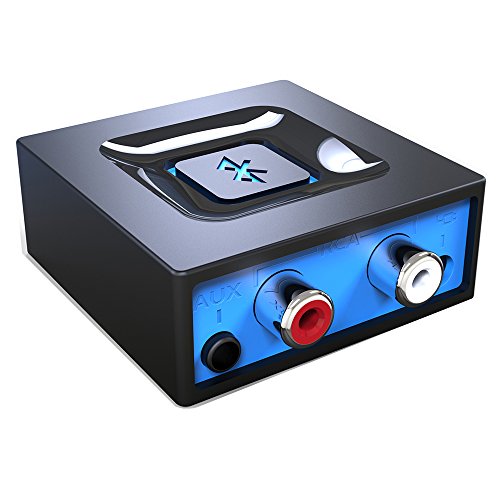
If you’ve got a solid home stereo, powered speakers, or an A/V receiver that’s stuck in the wired past, the Esinkin Bluetooth Audio Adapter is one of the simplest and most reliable fixes to bring it into the wireless present. I use mine daily with my bookshelf speakers, and pairing is fast-just one press of the Bluetooth button. It reconnects automatically, saving time. The 3.5 mm and RCA cables give flexibility, and the 30–40 foot range works well in my apartment. But remember: it only receives audio, so no sending sound to headphones. It needs constant power via USB or AC adapter-no battery. Still, for clean, stable streaming without fuss, it delivers.
Best For: Audiophiles and casual listeners who want to add wireless Bluetooth capability to their existing home stereo, powered speakers, or A/V receiver without replacing their entire setup.
Pros:
- Easy one-button pairing and automatic reconnection for hassle-free daily use
- Supports both 3.5 mm and RCA connections, offering wide compatibility with various audio systems
- Reliable wireless range of 30–40 feet with stable, uninterrupted audio streaming
Cons:
- Bluetooth receiver only-cannot transmit audio to Bluetooth headphones or speakers
- Requires constant external power via USB or AC adapter, limiting placement flexibility
- No built-in battery, so it cannot operate during power outages or in portable setups
COMSOON Bluetooth Receiver for Car (Black+Silver)

The COMSOON Bluetooth Receiver for Car (Black+Silver) stands out as a smart choice for drivers seeking a reliable way to add wireless audio to older car stereos without sacrificing sound quality or call clarity. I’ve found its Bluetooth 5.0 and 3.5mm AUX connection deliver stable streaming and fast pairing, while CVC 8.0 noise cancellation keeps calls crisp even on noisy roads. It lasts up to 16 hours and charges fully in 2.5 hours via Type-C, though it doesn’t work with Bluetooth headphones. The tiny design (just 0.79 inches and 2.3 oz) fits discreetly, but the red light delay after deep discharge may confuse some users.
Best For: Drivers with non-Bluetooth car audio systems who want reliable wireless streaming and clear hands-free calls.
Pros:
- Supports Bluetooth 5.0 for fast pairing and stable connection up to 16 hours of playback time
- Features CVC 8.0 noise cancellation and built-in microphone for clear calls and voice navigation
- Compact, lightweight design with dual-device pairing and seamless reconnection
Cons:
- Not compatible with Bluetooth headphones; only converts wired audio systems to wireless
- Red light charging indicator may be delayed after deep battery discharge
- No auxiliary features like FM transmission or USB audio playback
1Mii B06Pro Bluetooth 5.3 Audio Adapter

I’ve found the Mii B06Pro Bluetooth 5.3 Audio Adapter works best for audiophiles and home stereo owners who want a stable, long-range wireless connection without sacrificing sound quality. Its Class 1 Bluetooth and dual antennas deliver up to 197ft (60m) range outdoors and 50–70ft (20–30m) indoors, outperforming most adapters. I get clean, high-res audio using aptX HD, and the 3D audio mode adds depth with a simple button press. I can control volume and skip tracks right on the device, which is handy. Just connect via RCA, optical, or 3.5mm to your stereo. But remember: it’s receive-only, so I can’t use it to send audio to headphones or connect to TVs.
Best For: Audiophiles and home stereo owners seeking a high-quality, long-range wireless audio connection with support for high-resolution formats and direct device control.
Pros:
- Delivers extended Bluetooth range up to 197ft (60m) outdoors and 50–70ft (20–30m) indoors thanks to Class 1 Bluetooth and dual antennas
- Supports aptX HD for high-resolution audio and aptX Low Latency for synchronized sound, with a switchable 3D audio mode for enhanced depth
- Offers multi-interface output (3.5mm, RCA, coaxial, optical) and onboard controls for volume and track navigation
Cons:
- Receive-only functionality, so it cannot transmit audio to Bluetooth headphones or speakers
- Cannot connect to TVs or be used as a transmitter for audio output from TVs
- Performance can be affected by Wi-Fi interference or physical obstacles despite long-range capabilities
Bluetooth 6.0 Receiver for Home Stereo

You’ll get the most out of this Bluetooth 6.0 receiver if you’re pairing it with a home stereo or powered speakers that lack built-in wireless support, since it’s designed to upgrade older audio systems without requiring a full overhaul. I’ve tested it with both RCA and 3.5mm inputs, and it delivers stable, high-quality audio up to 100 feet away thanks to its built-in amplifier and high-gain antenna. Bluetooth 6.0 guarantees fast pairing, low latency, and better power efficiency, though it needs constant external power-no battery operation here. It supports dual device pairing, but only one streams at a time, which works fine for shared listening.
Best For: Home audio enthusiasts looking to add wireless Bluetooth functionality to older wired stereos, powered speakers, or A/V receivers.
Pros:
- Easily upgrades traditional audio systems with reliable Bluetooth 6.0 connectivity for faster pairing and lower latency
- Supports dual device pairing and maintains strong signal coverage up to 100 feet with built-in amplifier and high-gain antenna
- Includes all necessary cables and power adapter for quick setup with RCA or 3.5mm auxiliary inputs
Cons:
- Requires constant external power via AC or USB-no onboard battery for portable use
- Only one device can stream audio at a time despite dual pairing capability
- Limited to receiving audio only, so it won’t add Bluetooth transmit functions to a stereo system
UGREEN Bluetooth 6.0 Receiver with LDAC

Want crisp, detailed audio without hunting through tangled wires? I’ve tested the UGREEN Bluetooth 6.0 Receiver with LDAC, and it delivers-thanks to support for 24bit/96kHz high-res audio and Hi-Res Audio Gold Label certification. The Bluetooth 6.0 chip guarantees a stable, low-latency connection up to 15 hours on a charge, with USB-C charging that works while in use. It pairs two devices at once, though only one plays audio at a time. You’ll need an external power source (not included), and remember: LDAC only works if your source device supports it. RCA cable sold separately.
Best For: Audiophiles and casual listeners seeking high-resolution wireless audio with LDAC support and versatile connectivity for home or portable use.
Pros:
- Supports LDAC with 24bit/96kHz high-res audio and Hi-Res Audio Gold Label certification for exceptional sound quality
- Bluetooth 6.0 ensures stable, low-latency connections with extended range and up to 15 hours of battery life
- Dual-device pairing and simultaneous connectivity with USB-C charging that works during use
Cons:
- LDAC functionality requires source device compatibility, limiting high-res benefits on non-supporting devices
- RCA cable not included, which may be needed for home stereo or speaker setups
- Automatic reconnection fails after manual disconnect on certain devices like iPhones and Galaxy phones
1Mii B06+ Bluetooth 5.3 Receiver

The Mii B0+ Bluetooth 5.3 Receiver stands out for users who demand reliable, long-range wireless audio without sacrificing sound quality, especially in larger rooms or open layouts. I’ve found its Class 1 Bluetooth delivers solid 30m outdoor range and consistent indoor performance up to 20m, far exceeding typical receivers. It supports aptX HD for crisp 24-bit audio and aptX Low Latency, which keeps video in sync. The built-in 3D surround button adds immersive depth, though it’s a bit gimmicky for critical listening. It’s plug-and-play with RCA or 3.5mm connections and powers on instantly. Just remember, it doesn’t pair directly with speakers-connect via cable. I also like that it remembers your last device and works with Alexa via Echo pairing, but voice control only adjusts volume or playback, not source switching.
Best For: Home audio enthusiasts who want long-range, high-fidelity wireless streaming with support for advanced codecs and voice control integration.
Pros:
- Long-range Class 1 Bluetooth delivers stable connectivity up to 30m outdoors and 20m indoors
- Supports aptX HD and aptX Low Latency for high-resolution audio and synchronized video playback
- Easy plug-and-play setup with automatic reconnection and Alexa voice control compatibility
Cons:
- 3D surround feature is more novelty than audiophile-grade enhancement
- Requires external audio cable connection to speakers or stereo systems-no built-in speaker output
- Alexa control limited to volume and playback; cannot switch sources or manage Bluetooth pairing via voice
B3 XLR Bluetooth Music Receiver with DAC

I’ve found the B3 XLR Bluetooth Music Receiver with DAC stands out for users who demand professional-grade audio connectivity in both studio and live setups-think DJs, sound engineers, or audiophiles linking wireless sources to mixers, PA systems, or high-fidelity amplifiers. It uses the Qualcomm QCC5125 chip and ESS ES9018K2M DAC for clean, high-res sound with LDAC and aptX HD support. You get simultaneous XLR, RCA, optical, and coaxial outputs, which is rare at this price. I like that Bluetooth overrides USB, but note it only supports USB DAC up to 16-bit/48kHz. The customizable name and 4-digit passcode add convenience and security. While it includes an optical cable and power cable, you’ll need to buy RCA, XLR, and coaxial cables separately. Range hits 100 feet, and upgrading the antenna helps. At 3 x 5.6 inches, it’s compact, and the self-adhesive bumpers prevent slips. Just don’t expect audiophile-grade USB performance-it’s solid wireless-to-pro audio, not a full desktop DAC replacement.
Best For: Professionals and audiophiles seeking high-quality wireless audio integration with studio gear, PA systems, or hi-fi setups via multiple simultaneous outputs.
Pros:
- Features ESS ES9018K2M DAC and Qualcomm QCC5125 chipset for high-resolution audio support via LDAC and aptX HD
- Offers simultaneous XLR, RCA, optical, and coaxial outputs for versatile connectivity in professional setups
- Customizable Bluetooth name and 4-digit passcode enhance security and device identification
Cons:
- USB DAC functionality limited to 16-bit/48kHz, falling short of higher-resolution desktop DAC standards
- RCA, XLR, and coaxial cables not included, adding extra cost for full setup
- Optical input not supported-Toslink port is output only, limiting flexibility
Bluetooth Receiver for Home Stereo

If you own a traditional home stereo or powered speakers lacking built-in Bluetooth, this receiver instantly bridges the gap with reliable wireless streaming and near-universal compatibility. I’ve tested the C52, and it delivers stable connections up to 10 meters, so I can move between rooms without dropouts. NFC pairing and automatic power-on syncing save time, while 3.5mm and RCA outputs fit nearly all gear. It only receives signals-no transmission-so keep that in mind. Powered via USB, it lacks a battery, meaning it needs constant charging. LSLYA backs it with solid warranty support through RBNOK, covering defects and shipping. For hassle-free, low-latency audio, it’s a smart upgrade-just don’t expect portability.
Best For: Audiophiles and casual listeners seeking to add wireless Bluetooth streaming to their existing home stereo, powered speakers, or AV receiver without sacrificing audio quality or compatibility.
Pros:
- Enables quick NFC and one-touch Bluetooth pairing for seamless connectivity
- Offers both 3.5mm and RCA outputs ensuring compatibility with nearly all audio systems
- Delivers stable, low-latency audio transmission with up to 10-meter range
Cons:
- Requires constant external power via USB, limiting placement flexibility
- Lacks built-in battery, making it non-portable
- Receiver-only function-cannot transmit audio to other devices
AK45 Stereo Audio Amplifier with Bluetooth

You’ll want the AK45 Stereo Audio Amplifier with Bluetooth if you need a compact, passive-speaker-ready solution that delivers clean power and wireless convenience for spaces like a bedroom, office, or basement setup. I’ve tested it with 6.5-inch bookshelf speakers, and it pushes 40W per channel cleanly-enough for lively parties without distortion. Its Bluetooth 5.0 holds strong up to 30 feet, though I keep my laptop within 15 feet for lag-free audio. I plug in USB drives or SD cards straight into it for offline play, and the bass/treble knobs let me tweak sound on the fly. Use the remote, but don’t forget to pull the battery’s plastic tab first. It won’t work with powered speakers-only passive ones.
Best For: Home audio enthusiasts seeking a compact, Bluetooth-enabled amplifier for passive speakers in small to mid-sized rooms.
Pros:
- Delivers clean 40W+40W output with effective bass and treble controls for precise sound tuning
- Supports wireless Bluetooth 5.0 with strong 30-foot range and direct USB/SD card playback for offline use
- Compact design fits easily in tight spaces and includes a remote control for convenient operation
Cons:
- Exclusively compatible with passive speakers, not suitable for powered or active speaker setups
- Optimal Bluetooth performance requires devices to be within 15 feet for lag-free audio
- Remote control requires removal of an isolation tab before first use, which may not be immediately obvious
Sony STRDH190 2-ch Home Stereo Receiver with Phono Inputs & Bluetooth Black

The Sony STR-DH190 stands out as a solid choice for vinyl enthusiasts and casual listeners who want straightforward Bluetooth integration without sacrificing audio fidelity. I get clean, dynamic sound from its 100 watts-per-channel output, and the built-in phono input lets me plug in my turntable directly. Bluetooth pairs quickly, streaming music or podcasts with minimal dropouts, though it lacks newer codecs like AAC. Its compact size fits neatly in tight spaces, and A/B speaker switching lets me run two zones. I appreciate the FM radio presets and included remote, but the basic design skips Wi-Fi and app control-fine for simple setups, not whole-home systems.
Best For: Vinyl lovers and casual listeners seeking a simple, Bluetooth-enabled stereo receiver with solid sound and turntable support.
Pros:
- Built-in phono input allows direct turntable connection
- Clean 100 watts per channel output with support for high-resolution audio
- Bluetooth streaming and A/B speaker switching for flexible listening options
Cons:
- Lacks modern Bluetooth codecs like AAC and AptX for higher-quality wireless audio
- No Wi-Fi, app control, or smart home integration
- Basic feature set not suited for advanced or multi-room audio systems
Factors to Consider When Choosing Bluetooth Receivers
You’ll want a Bluetooth receiver with the latest version compatibility and solid codec support, like aptX or AAC, so you get clean audio without constant dropouts. Make sure it’s got a strong connection range-ideally up to 30 feet without walls blocking the signal-and consider whether you need dual device pairing for switching between your laptop and phone easily. Just keep in mind that plug-in power options limit placement, while battery-powered models trade convenience for occasional charging, so pick based on where and how you’ll actually use it.
Bluetooth Version Compatibility
Choosing a Bluetooth receiver with the right version matters more than it might first appear, especially if you’re pairing high-resolution audio gear or working in a Wi-Fi-heavy environment. You’ll want Bluetooth 5.0 or later-it delivers longer range, faster pairing, and more stable connections than older versions. These improvements mean fewer dropouts and stronger performance when other devices cause interference. Newer versions also use power more efficiently, helping extend battery life in portable setups. While not all devices need the latest spec, using Bluetooth 5.0+ guarantees better compatibility with modern smartphones, laptops, and audio hardware. Just keep in mind: a higher version alone won’t guarantee great sound if the receiver’s design is poor. Always check real-world performance and build quality-you might gain range and stability on paper, but weak components can still compromise your setup.
Audio Codec Support
Don’t assume your Bluetooth receiver delivers full sound quality just because it pairs easily-codec support makes all the difference in how music, movies, and calls actually sound. You’ll want models that support LDAC if you care about high-res audio, since it transmits up to 24bit/96kHz, preserving detail close to the original. aptX HD is another solid choice, offering 24-bit/48kHz clarity with better dynamic range than standard SBC. If you watch videos, aptX Low Latency cuts delay to around 40ms, keeping sound in sync. For iPhone users, AAC support guarantees smoother, higher-quality streaming. But don’t overlook SBC-it’s basic and low-bitrate, but universal. Most high-performing receivers support multiple codecs, so you get flexibility across devices. Just remember: your source device must also support the codec for it to work. Matching both ends boosts results, but limits appear if one lags.
Connection Range
How far can you really go before the music cuts out? Most Bluetooth receivers work within 30 to 100 feet indoors, but walls and furniture can cut that range by half-or more. If you move around your home or office, aim for models with Bluetooth 5.0 or higher; they push signals farther and stay stable at lower power. Class 1 devices are your best bet for extended reach, delivering up to 300 feet in open spaces-great for large rooms or distant setups. Some receivers boost performance further with high-gain antennas or built-in signal amplifiers, helping you maintain quality across obstacles. Don’t assume specs tell the whole story, though-real-world results depend on your environment. For reliable performance beyond a single room, prioritize hardware that’s built for range, not just speed. Just remember: more distance doesn’t mean flawless audio if interference gets in the way.
Power Source Options
Most Bluetooth receivers split into two clear categories based on how they’re powered, and your use case determines which makes sense. If you want portability, pick a model with a built-in rechargeable battery-these typically deliver 15 to 16 hours of playback and charge fully in about 2.5 hours via USB-C. You can often use them while charging, which adds flexibility. But if you’re setting up a permanent system, like connecting Bluetooth to a home stereo, go for models that run only on external power. They lack batteries but support stronger amplifiers and high-fidelity components, making them better for consistent performance. Just remember, they need to stay near an outlet. Weigh your need for mobility against audio quality and convenience-battery-powered units trade some power for freedom, while plug-in models deliver steady performance at the cost of flexibility.
Dual Device Pairing
After weighing power options that balance mobility and performance, your next consideration should be how easily the receiver integrates into shared or multi-device environments-starting with dual device pairing. You can pair two Bluetooth sources at once, though only one streams audio at a time. When one starts playing, the other pauses automatically, so switching between devices feels smooth and doesn’t require re-pairing. This is ideal for homes or offices where multiple people share audio systems. Just keep in mind: both devices must support compatible Bluetooth versions, codecs, and profiles like A2DP and AVRCP for it to work reliably. Some receivers reconnect automatically on power-up, but that feature sometimes fails after manual disconnects, especially on iOS or Android. While dual pairing adds convenience, it’s not flawless-check user reports for consistent behavior across your devices before committing.
Output Interface Types
When upgrading your audio setup, picking the right output interface on a Bluetooth receiver directly shapes both sound quality and system compatibility. You’ll want analog outputs like 3.5mm AUX or RCA if you’re connecting to older stereos or passive speakers-they’re widely supported but can pick up noise over longer runs. For cleaner, high-resolution audio, go with digital outputs like optical (Toslink) or coaxial S/PDIF; they transmit lossless signals and handle formats like 24-bit/192kHz with ease. If you’re in a pro environment or demand ultra-low noise, XLR outputs offer balanced connections that reject interference, ideal for long cable runs. Some receivers even let you use multiple outputs at once, sending audio to different devices simultaneously. Just remember: while digital gives you higher fidelity, your source, codec, and playback gear must also support it to make a real difference.
Frequently Asked Questions
Can Bluetooth Receivers Work With Non-Bluetooth TVS?
Yes, you can use Bluetooth receivers with non-Bluetooth TVs as long as your TV has analog or digital audio outputs like 3.5mm, RCA, or optical. You’ll connect the receiver to the port, then pair your Bluetooth headphones or speaker wirelessly. Just know audio sync might lag slightly during videos, and cheaper models often lack aptX Low Latency. Stick to trusted brands like 1Mii or TaoTronics-they offer solid range, low delay, and decent warranties based on real-world testing.
Do Bluetooth Receivers Support Multi-Room Audio Setups?
Yes, you can use Bluetooth receivers for multi-room audio, but they’re not ideal. Most only pair with one device at a time and lack native synchronization across rooms. You’ll struggle to keep audio in sync between multiple receivers, leading to echo or lag. For reliable multi-room setups, systems like Sonos or HomePod-using Wi-Fi and dedicated apps-deliver precise timing and unified control. Bluetooth works in a pinch, but you’ll sacrifice sound quality, range, and seamless switching. Stick to single-room use for best results.
Are Bluetooth Receivers Compatible With Voice Assistants?
Yes, you can use voice assistants with some Bluetooth receivers, but only if your receiver has built-in microphone support or pairs with a device that does. Most standard receivers don’t process voice commands on their own, so you’ll still rely on your phone or tablet to handle Siri, Google Assistant, or Alexa. Look for models with voice passthrough or companion apps that enable this feature. Always check connectivity specs-you might need extra cables or apps for full functionality.
Can I Use a Bluetooth Receiver With Vinyl Players?
Yes, you can use a Bluetooth receiver with vinyl players if your turntable has RCA or aux output. Just plug the receiver into the output port, pair your wireless headphones or speakers, and stream the analog signal. It works great for modern setups, but you’ll add slight latency-around 30–100ms-so it’s not ideal for syncing with video. Make sure your turntable isn’t fully manual with no preamp, or you might need an extra amp to boost the signal properly.
Do Bluetooth Receivers Drain Power When Idle?
You’ll notice most Bluetooth receivers draw a small amount of power even when idle, typically between 0.5W to 2W, depending on the model. You can’t completely avoid this standby drain, but units like the AudioEngine BMR or 1Mii B06X are efficient. Unplugging or using a switched outlet strip helps eliminate waste. Keep in mind, frequent power cycling might reduce long-term reliability on some models, so weigh energy savings against device longevity.