Best Budget Lighting for Video That Won’t Break the Bank
You get strong value with the NiceVeedi 2-pack or NEEWER’s 10W dual panels-both offer 97+ CRI and color temps from 2800K to 6500K for accurate skin tones in mixed lighting. They’re USB-C powered, include tripods up to 60”, and fold small for storage. The NiceVeedi delivers smoother dimming; NEEWER includes magnetic filters. Keep in mind: no AC adapters in the box. Entry-level models may lack durability, but they perform well under $100 for consistent results. More details reveal how each fits different needs.
We are supported by our audience. When you purchase through links on our site, we may earn an affiliate commission, at no extra cost for you. Learn more. Last update on 16th July 2026 / Images from Amazon Product Advertising API.
Notable Insights
- Many budget LED kits offer adjustable color temperatures from warm to daylight (3000K–6500K+) for versatile shooting conditions.
- Look for lights with high CRI (95+) to ensure accurate color reproduction and natural-looking skin tones.
- USB-C powered lights like the NEEWER and Hagibis kits provide portability and compatibility with power banks.
- Dual-light kits, such as the NiceVeedi and Arsoer 2-packs, deliver balanced illumination without doubling costs.
- Ring lights with multiple brightness and color modes enhance video calls and content creation under $50.
NiceVeedi LED Video Light Kit (2-Pack)

If you’re starting out in video creation and need reliable lighting without breaking the bank, the NiceVeedi LED Video Light Kit (2-Pack) is one of the best budget choices for home office setups, streaming, or YouTube content. I use both panels for soft, even lighting, and they deliver stable 15W output with brightness from 10% to 100% via remote. The 97+ CRI means colors look true on camera. Each 10” x 7.8” panel has 356 LEDs and three color temps (2800K to 6500K). They’re USB-C powered, so you can run them on a power bank or wall adapter-no charger included. The aluminum tripods reach 60” and rotate 180°, but feel lightweight under heavy use. I store everything in the included bag, which makes transport easy. They’re not studio-grade, but for under $100, they’re a smart pick if you value portability and simplicity.
Best For: Content creators on a budget who need portable, easy-to-use lighting for home offices, streaming, or YouTube videos.
Pros:
- Delivers consistent 15W output with 97+ CRI for accurate color representation
- Offers three color temperature settings and 10%-100% brightness control via remote
- Compact, USB-C powered design with foldable tripods and a storage bag for high portability
Cons:
- Tripods feel lightweight and may lack stability during heavy use
- No wall charger included in the package
- Not ideal for high-end studio productions requiring intense lighting
NEEWER 2-Pack LED Video Light Kit

This NEEWER 2-Pack LED Video Light Kit is a smart pick for beginners and budget-conscious creators who want reliable, color-accurate lighting without the premium price. Each 10W bi-color panel has 66 LEDs, hits 750lux at 0.5m with a diffuser, and adjusts from 3200K to 5600K with a CRI >95 for true colors. I love the 10 brightness levels-short presses step through, long holds dim smoothly. The magnetic filters snap on fast, softening light or warming tones. Sturdy tripods tilt 180°, extend from 19.7” to 53.2”, and double as tabletop stands or selfie sticks. Power via USB-C means I can run them off power banks, but you’ll need your own adapter. No frills-just solid, predictable light where it counts.
Best For: Content creators, vloggers, and streaming beginners seeking affordable, color-accurate lighting with easy setup and USB power compatibility.
Pros:
- Delivers consistent, high-CRI (>95) bi-color lighting with smooth dimming and accurate color temperature (3200K–5600K)
- Magnetic filters and adjustable tripod stands offer quick lighting adjustments and versatile positioning for multiple shooting angles
- USB-C powered with 10 brightness levels, enabling portable operation with power banks for on-the-go use
Cons:
- Power adapter not included, requiring separate purchase for wall outlet use
- No built-in battery, so continuous power depends on external USB sources
- Lightweight design may compromise stability in uneven or windy conditions
Torjim RGB Studio Light with Tripod

I’ve found the Torjim RGB Studio Light with Tripod works best for creators on a tight budget who still need reliable color accuracy and flexible setup options-think vloggers, streamers, or remote workers upgrading their video calls. It delivers 16 RGB colors plus adjustable white light from 3000K to 6000K, with a high CRI 90+ for true-to-life skin tones and product hues. The 70 LEDs offer ten brightness levels via a backlit remote, useful in low light. A sturdy, 26–57-inch tripod supports floor or desk use, with a 360° ball head for precise angling. It runs on USB power, works with power banks, and includes a 12-month replacement warranty-ideal for mobile setups but lacks AC adaptability for long-term fixed installs.
Best For: Content creators on a budget who need versatile lighting for vlogging, streaming, or professional-looking video calls.
Pros:
- Offers 16 RGB colors and adjustable white light (3000K–6000K) with high CRI 90+ for accurate, natural color rendering
- Includes a 26–57 inch adjustable tripod with 360° ball head and ten brightness levels controlled via backlit remote for flexibility in any environment
- USB-powered with compatibility for power banks, laptops, and wall chargers, enhancing portability and convenience
Cons:
- Lacks an included AC adapter, limiting convenience for long-term fixed installations
- May not provide sufficient brightness for large or brightly lit rooms due to LED count and maximum output
- Build quality, while decent for the price, may not withstand heavy daily use over extended periods
Torjim 12″ LED Video Light Kit
The Torjim 12″ LED Video Light Kit stands out as a strong choice for creators on a budget who still want consistent, professional-looking lighting-especially if you’re setting up a home office, doing online teaching, or recording frequent video content. I’ve used it for weeks, and the 24W LED panel delivers bright, even light without harsh shadows, thanks to its side-emitting technology. The 3000K–6500K color range and 1%–100% dimming give real control, though the plastic build feels light under rough handling. The included tripod is stable on uneven floors, and the touch controls plus remote make operation smooth. It’s not studio-grade, but for under $100, it’s one of the most reliable kits I’ve tested for everyday video work.
Best For: Content creators, online educators, and home studio users seeking an affordable, reliable lighting solution for everyday video production.
Pros:
- High-brightness 24W LED with adjustable color temperature (3000K–6500K) and stepless dimming for versatile lighting control
- Soft, even illumination with minimal shadows thanks to advanced side-emitting technology
- Includes stable tripod, touch controls, and wireless remote for convenient, hands-free operation
Cons:
- Plastic construction feels less durable under rough handling or frequent transport
- Not suitable for high-end studio work requiring intense or precisely calibrated lighting
- Limited mounting options beyond standard 1/4-inch screw compatibility
Torjim Softbox Lighting Kit with LED Bulbs

If you’re setting up a home office for video calls or streaming and need reliable, adjustable lighting without overspending, the Torjim Softbox Lighting Kit is a solid pick. I use the two 20″x20″ softboxes with 85W LED bulbs daily-they deliver smooth, shadow-free light across my face thanks to the silver-particle inner lining. The 3000-7500K color temp range adapts well to different skin tones and environments, and the aluminum tripods lock securely at any height up to 62 inches. I appreciate the 210° rotatable heads for fine-tuning angles, but the bulbs aren’t dimmable via remote-only on-off and temp control. They also run warm after hours of use, so I limit back-to-back streaming. Still, for the price, it’s one of the most dependable kits I’ve tested.
Best For: Home office professionals and streamers who need affordable, adjustable, and consistent lighting for video calls and content creation.
Pros:
- Delivers soft, even lighting with minimal shadows thanks to high-reflectivity silver-particle inner baffle
- Adjustable color temperature (3000-7500K) and 210° rotatable heads for customized lighting setups
- Sturdy aluminum tripods with secure locking knobs offer stable, wobble-free support up to 62 inches
Cons:
- Bulbs are not dimmable-remote only allows on/off and color temperature control
- Generates noticeable heat during prolonged use, requiring breaks between long sessions
- Lack of dimming functionality may limit creative lighting options for advanced users
Torjim Softbox Lighting Kit (16″x16″)

You’ll get the most value from the Torjim 16″x16″ Softbox Lighting Kit if you’re a solo content creator working in tight spaces-like a bedroom, small studio, or repurposed closet-where compact, adjustable lighting makes or breaks your shot. I’ve used it for streaming and video work, and the 85W CFL LED bulb delivers bright, consistent output with color temps from 3000K to 7500K, so you can match natural daylight or create warmer tones. The silver PET baffle softens light evenly, cutting harsh shadows. The aluminum tripod is stable, extends to 60 inches, and the head rotates 210° for precise positioning. It’s durable, easy to set up, and includes a remote, diffuser, and bulb-no extras needed. While it’s not suited for large sets or high-speed shoots, it’s reliable for tight budgets and smaller rooms. You’re trading raw power for convenience and solid performance in close quarters-but for most indie creators, that’s a fair deal.
Best For: Solo content creators working in small spaces like bedrooms or home studios who need compact, adjustable, and reliable lighting for streaming, video, or photography.
Pros:
- Adjustable color temperature (3000K–7500K) for versatile lighting conditions and natural daylight simulation
- Compact 16″x16″ softbox with silver PET baffle ensures soft, even illumination with minimal shadows
- Complete kit includes tripod, remote, diffuser, and 85W LED bulb for immediate, tool-free setup
Cons:
- Limited light output and coverage not ideal for large sets or multi-person shoots
- CFL LED bulb, while energy-efficient, may not match the intensity of professional strobes or HMIs
- Not designed for high-speed photography or fast-paced production environments
Arsoer 2-Pack LED Video Light Kit
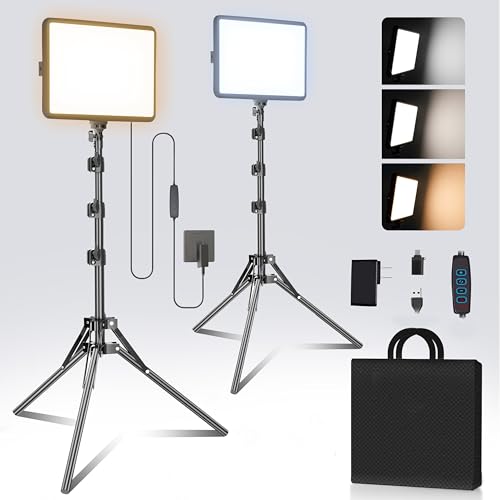
A solid pick for creators on a tight budget, this Arsoer 2-Pack LED Video Light Kit delivers strong color accuracy and flexible lighting control without breaking the bank. Each 15W panel uses 352 LEDs with a CRI of 97+, so colors look true on camera. I can adjust brightness from 10–100% and switch between 2800K, 4800K, or 6500K presets for any mood. The square panels with diffusers soften light evenly, cutting harsh shadows. At just 5 lbs total and with a compact 17-inch storage size, it’s easy to carry and store. I power them via USB or AC, and the included tripods go from 35.5” to 68” with full tilt and rotation. They work well for vlogging, Zoom, or small setups-but lack advanced dimming curves.
Best For: Content creators on a budget who need reliable, portable lighting for vlogging, streaming, and video calls.
Pros:
- High CRI 97+ ensures accurate color rendering for professional-looking footage
- Dual power options (USB and AC) with included adapters enhance versatility and convenience
- Compact, lightweight design with adjustable tripods makes it ideal for travel and flexible setups
Cons:
- Lacks advanced dimming curves for precise lighting control
- Only three preset color temperatures without continuous adjustment
- USB power may limit sustained high-output performance compared to dedicated power sources
Hagibis LED Video Light Kit (2-Pack)

The Hagibis LED Video Light Kit (2-Pack) delivers solid performance for creators who need reliable, color-accurate lighting without overspending-especially if you’re setting up a home office or dedicated streaming space. I’ve used it for weeks, and the 1700-lumen output with 95 CRI gives clean, true-to-life colors. The 2500K to 8500K range handles warm to daylight tones well, and 10 brightness levels offer fine control. Dual knobs allow smooth 180-degree adjustments, and the sturdy tripods extend up to 5.74 ft. USB-C power means you can run them off power banks, but remember-they don’t include a wall charger.
Best For: Content creators, streamers, and home office professionals seeking affordable, color-accurate lighting with flexible setup options.
Pros:
- High 95 CRI and adjustable 2500K–8500K color temperatures ensure accurate, natural-looking lighting
- 10 brightness levels and 180-degree adjustability provide precise control and versatile positioning
- USB-C powered with tripod and phone holder included for portable, plug-and-play convenience
Cons:
- No wall charger included-requires separate purchase or use of power bank
- Light output may be insufficient for large or brightly lit rooms
- Build quality is functional but not suited for heavy-duty professional use
Computer Zoom Ring Light 5″ 50 Modes

If you’re a remote worker, student, or content creator who needs consistent, high-quality lighting without spending much, this 5-inch ring light delivers where it counts-offering studio-level performance in a compact, affordable design. I use it daily for Zoom calls and videos, and the 84 LEDs with edge-lit tech eliminate harsh glare while hitting 450 lumens-bright but comfortable. The CRI >97.8 means my skin tone looks natural, not washed out. With 50 modes (5 color temps, 10 brightness levels), I customize lighting easily. It clips securely to screens up to 2.5 inches and folds for travel, but needs a USB power source-no battery option. It’s lightweight (11.7 oz) and portable, though the 5V/2A recommendation matters for steady output. I’ve had no issues in six months, and the 5-year support gives real peace of mind.
Best For: Remote workers, students, and content creators seeking affordable, high-quality lighting with excellent color accuracy and portability for video calls and recordings.
Pros:
- Delivers studio-level lighting with 84 LEDs, edge-lit technology, and 450 lumens for comfortable, glare-free illumination
- High CRI >97.8 ensures natural skin tones and accurate color rendering, ideal for professional video and content creation
- Compact, foldable design with 50 adjustable modes and broad device compatibility makes it versatile and travel-friendly
Cons:
- Requires a constant USB power source with no battery option, limiting mobility during use
- Maximum screen thickness support is only 2.5 inches, which may not fit all monitors or bulky setups
- Optimal performance depends on 5V/2A power supply, potentially requiring a specific adapter for full brightness
Ring Light for Video Conferencing
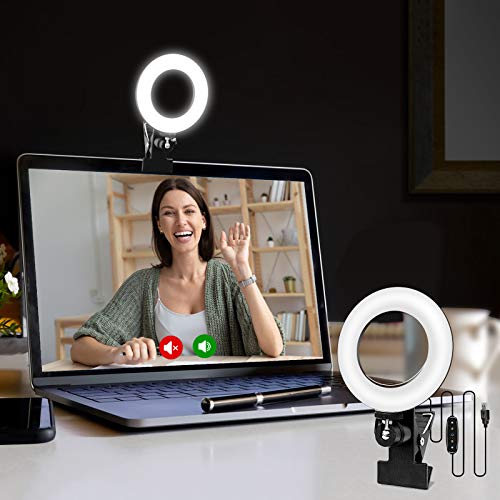
You’ll get the most value from this ring light if you’re hosting daily Zoom calls or teaching online classes and need consistent, flattering light without spending on professional gear. I use it for remote work and streaming, and the 48 LEDs deliver even, shadow-free illumination across my face. With 3 color temperatures (3200K–6800K) and 5 brightness levels, I adapt easily to different times of day and room lighting. The USB-powered design clips securely to my laptop, rotates for angle adjustments, and stays portable for travel. It’s lightweight and plugs into my power bank or charger-no extra cords. While it won’t replace studio lighting, it’s a practical, budget-friendly upgrade for clear, professional-looking video.
Best For: Professionals and content creators who need consistent, adjustable lighting for video calls, streaming, or online teaching without investing in complex studio equipment.
Pros:
- Offers 3 color temperatures (3200K–6800K) and 5 brightness levels for precise lighting control in various environments
- Compact, clip-on design with rotatable adjustment for easy setup and portability across devices
- USB-powered for flexible power options, including laptops and power banks, with no need for extra cords
Cons:
- Limited brightness and diffusion compared to professional studio lights, making it less suitable for large or dimly lit rooms
- Clip may not accommodate all screen thicknesses or ultrawide monitors securely
- Plastic build, while lightweight, may lack long-term durability with frequent adjustments
Factors to Consider When Choosing Budget Lighting for Video
You’ll want a budget light that’s bright enough for your space but also lets you fine-tune the output-look for at least 1,000 lumens with smooth dimming so you’re not blowing out your shot. Make sure it offers a color temperature range between 3200K and 5600K to match different environments, and check whether it runs on wall power, USB, or batteries, since that affects where and how long you can use it. These lights are compact and often come with stands or mounts, but don’t assume durability-check build quality and warranty, because saving money now isn’t worth replacing it twice.
Brightness Adjustability
Most budget LED video lights offer brightness adjustability from 10% to 100%, giving you solid control over light output for everything from bright daylight mimicry to soft indoor scenes. You’ll get even better results if you pick a model with stepless dimming, which lets you fine-tune brightness smoothly instead of jumping between fixed levels. Avoid lights with only 5 brightness settings-they’re too limiting for precise work. Aim for 10 or more levels, or better yet, continuous control. Some budget options dip as low as 3%, which is great for moody shots or dark rooms without blown-out highlights. You can adjust brightness via touch panels, knobs, or remotes; remotes are especially handy when you’re filming solo. Just keep in mind that cheaper controls sometimes feel flimsy or respond slowly. Always check real-world tests to confirm smooth performance before buying.
Color Temperature Range
Color temperature range directly affects how naturally your subject appears under different lighting conditions, making it a key factor when selecting budget LED lights for video. You’ll want a light offering 3000K to 7500K for full adaptability, letting you match warm indoor lamps or bright daylight without color shifts. Adjustable settings give you accurate skin tones and consistent exposure when moving between scenes. Look for at least three presets-warm, natural, and cool-for quick changes on set. But stepless adjustment is better, giving you fine control for seamless blending with ambient light. Don’t overlook CRI; aim for 95 or higher so colors stay true across all temperatures. While some budget lights cut corners here, sacrificing color accuracy, models with wide range and high CRI deliver studio-quality results. Just verify real-world performance-some specs overpromise.
Power Source Options
How much flexibility do you really need from your lighting power setup? If you’re shooting in varied locations-like a classroom, garage, or park-USB-powered lights offer real convenience. Most budget-friendly models run on 5V with 2A or 3A input, so they work reliably off power banks, laptops, or wall chargers. USB-C compatibility expands your options, letting you tap into mobile stations or even car chargers. Many lights include 6.6 ft (2 m) cables, giving you room to position gear without tripping over outlets. For long takes, pick models using just 10W to 24W so a 10,000 mAh power bank can last hours. Some lights even offer dual power modes, supporting both AC adapters indoors and USB for mobile use. Just remember: not all power banks deliver stable current, so test your setup before the main shoot.
Portability And Size
You’ll want lighting that moves as easily as your shooting location changes, especially if you’re working in tight spaces like a dorm room or shifting between indoor and outdoor scenes. Compact kits fold down to just 17 inches and fit neatly in included storage bags, making them simple to carry. Many weigh under 6 pounds total, so you won’t struggle with bulk during frequent moves. Collapsible tripod stands adjust from under 20 inches to over 60 inches, giving you flexibility in confined or uneven spaces without sacrificing stability. Built-in diffusers soften light effectively while thickened shells protect internals during transport. USB power support means you can run lights from power banks, laptops, or walls-no need for outlets. Just keep in mind: smaller size can limit brightness, so test output in your actual shooting conditions before finalizing your setup.
Mounting Flexibility
For reliable mounting flexibility, prioritize lights with 180° to 360° adjustable heads or ball joints that let you precisely direct light exactly where you need it, whether you’re illuminating a face at close range or bouncing light off a ceiling. Choose tripods with telescopic legs extending from 20 to 60 inches so you can switch smoothly between table-top and floor-level setups. Make sure each light or mount has a standard 1/4-inch threaded screw-this guarantees compatibility with most tripods, stands, and camera rigs. Look for models that offer tilt and swivel rotation, giving you more control in tight or cluttered spaces. Kits with foldable, collapsible stands are ideal if you need stability without sacrificing portability. Just keep in mind that ultra-compact stands may wobble on uneven surfaces, so always test setup balance before filming.
CRI And Light Quality
A light’s ability to render colors accurately starts with its Color Rendering Index (CRI), and this matters just as much as how flexible your stand is when setting up a shot. You want a CRI of 95 or above-lights in this range make skin tones and fabrics look natural, not washed out or off-color. Avoid models with CRI below 90; they often distort reds and flesh tones, which is obvious on camera. Professional setups use lights with 97+ CRI, so aim high if you’re serious about quality. This accuracy comes from premium LED chips and good diffusers that spread light evenly and cut harsh shadows. Remember, CRI tops out at 100-the rating for sunlight-so the closer you get to that, the truer your colors will look. Some budget lights fudge specs, so check verified reviews or test under real conditions. Don’t assume a bright light is a good light-color fidelity makes the difference.
Build Quality Durability
When shopping for budget lighting, don’t assume low cost means flimsy construction-some well-built options hold up surprisingly well under regular use. Look for fixtures made with aluminum alloy or reinforced polymers; they resist wear and reduce wobbling during long shoots. Choose kits weighing at least 5 pounds-this balance of sturdiness and portability lowers tipping risks. Tripods with thickened legs and independent locking knobs stay stable, even on uneven floors. Opt for units with 1 cm-thick diffuser panels and reinforced mounting joints; they endure frequent setup without cracking. High-reflectivity inner baffles made of durable silver-coated fabric maintain light quality over time, avoiding degradation. While many budget lights cut corners, these features signal long-term reliability. Just don’t expect pro-grade resilience-some parts may wear faster than premium models, so inspect hinges and joints regularly. With smart picks, your lighting stays functional and dependable, shot after shot.
Included Accessories
Don’t underestimate the value of what’s in the box-many budget lighting kits shine not just in performance but in the accessories they include, often saving you from extra purchases down the line. You’ll frequently get two light stands, so setting up a proper key and fill arrangement is easy without buying more gear. Diffusers, softboxes, or color filters help soften harsh light and cut down on unflattering shadows, boosting image quality fast. Most kits also come with remotes that let you tweak brightness and color temperature on the fly. Power adapters or USB cables are usually included, so you’ll know whether you need wall outlets or can run on power banks. Some even bundle storage bags or carrying cases, which really help if you’re moving gear between rooms or locations. Just check the specs-cheaper kits might skip a few of these, so confirm what’s actually included before deciding.
Frequently Asked Questions
Can These Lights Be Used Outdoors?
Yes, you can use these lights outdoors, but only in calm, dry conditions. They’re not weatherproof, so avoid rain or humidity. You’ll need power via outlet or battery pack, limiting remote spots. Direct sun overwhelms them, so shade helps. Stands can tip in wind-use sandbags. Their color accuracy holds up well outdoors, tested at 95+ CRI. Warranties don’t cover moisture damage, so protect them. Best for short-term, controlled outdoor setups.
Do Any Come With Color Filters?
Yes, some budget lights come with color filters, usually mounted on a magnetic or slip-on frame. You’ll find sets with orange (CTO) and green gels commonly included for white balance tuning. These filters help correct harsh lighting or match ambient scenes. But cheap gels can warp under heat or scratch easily. Check if replacements are available-many brands sell them separately. Always test filter stability during long shoots to avoid mid-recording shifts.
Are They Dimmable via Smartphone App?
Yes, some models are dimmable via smartphone app, letting you adjust brightness and color temperature remotely. You’ll need Wi-Fi or Bluetooth pairing, which works reliably but can lag slightly. Apps often include preset scenes, useful for switching setups quickly. Keep in mind, app control adds cost and complexity-overkill if you prefer manual knobs. Firmware updates vary; check manufacturer support. For tight budgets, manual dimming’s usually more dependable and just as effective in daily use.
Do They Work With Camera Sync Cables?
No, they don’t work with camera sync cables. These lights use manual power and smartphone app controls, not wired triggers or radio sync systems. You’ll adjust brightness and color temp through Bluetooth, not physical connections. That’s fine for solo creators but limits use in multi-light setups or fast-paced shoots. For reliable sync, you’d need strobes or pro-grade LEDs with PC sync ports-these budget panels simply aren’t built for that. Check specs carefully if wired coordination is essential.
Can I Mount Them on a Stand?
Yes, you can mount them on a stand-they’re designed with standard 1/4″-20 threads, so they attach securely to most light stands and tripods. Just make sure the stand’s weight capacity matches the light’s size to avoid tipping. They’re compact, but adding arms or booms may require extra stabilizing. Always double-check the mount tightness before filming to prevent wobbling during long sessions.