Best Computer Cases for NAS Setups Enthusiasts Trust
You want cases that balance drive capacity, airflow, and motherboard support for a reliable NAS build. Enthusiasts trust the DARKROCK Classico ATX and Rosewill Thor NAS for holding up to 13 drives, supporting ATX/E-ATX boards, and offering hot-swap bays and strong cooling with mesh panels and multiple fan mounts. Just mind the size-these full-towers need space-and check compatibility with long GPUs or large coolers. You’ll also want to plan cable management and noise levels, especially in quiet rooms. There’s more to weigh about balancing performance with practicality.
We are supported by our audience. When you purchase through links on our site, we may earn an affiliate commission, at no extra cost for you. Learn more. Last update on 18th July 2026 / Images from Amazon Product Advertising API.
Notable Insights
- High-drive capacity cases like the DARKROCK Classico Max E-ATX support up to 13 drives, ideal for enthusiast NAS storage needs.
- E-ATX and ATX motherboard compatibility ensures flexibility for powerful builds with multiple PCIe expansions.
- Extensive cooling options, including multiple 120mm/140mm fans and 360mm radiator support, maintain optimal drive temperatures.
- Hot-swap bays allow drive replacement without downtime, a trusted feature for reliable NAS operation.
- Tool-free drive trays and modular designs streamline installation and upgrades in high-density storage configurations.
DARKROCK Classico ATX NAS Case

If you’re building a high-capacity NAS for heavy data workloads or a hybrid gaming and storage rig, the DARKROCK Classico ATX NAS Case is one of the best choices-especially if you need room for up to thirteen drives without sacrificing cooling or motherboard compatibility. I’ve used it in my own setup, and it handles 10 x 3.5” HDDs and 3 x 2.5” SSDs cleanly, with solid drive trays that reduce vibration. The mesh front panel boosts airflow, and the four pre-installed 120mm fans keep things cool, though you might still need to add extra cooling under heavy loads. It supports a 360mm radiator on the top or front, which helps with sustained performance. I also like the vertical GPU mount-it showcases the card and reduces sag over time, which matters in long-term builds. Just know the chassis is large, so make sure your workspace can accommodate its size. It’s not the quietest option under load, but for balanced airflow, drive capacity, and ATX support, it’s a strong pick.
Best For: Builders seeking a high-capacity ATX case with excellent drive support and cooling for NAS, media server, or hybrid gaming-storage builds.
Pros:
- Supports up to 13 drives (10 x 3.5″ HDDs + 3 x 2.5″ SSDs) for extensive storage needs
- Excellent cooling with mesh panels, four pre-installed 120mm fans, and 360mm radiator support
- Vertical GPU mounting improves aesthetics, reduces sag, and aids thermal performance
Cons:
- Large chassis requires ample workspace and may not fit in compact environments
- Can be noisy under heavy loads despite good airflow
- Additional cooling may still be needed for extreme workloads
Rosewill Thor NAS Full Tower Case
The Rosewill Thor NAS Full Tower Case stands out for users who demand serious storage expansion and hardware flexibility in a dedicated NAS or media server build. I’ve used it in my own media hub setup, and it handles up to 11 x 3.5″ HDDs or 13 x 2.5″ SSDs with ease. It fits E-ATX motherboards and supports cards up to 400mm, making it ideal for AI or SMB servers. A 140mm PWM fan guarantees steady airflow, though it can get loud under load. The USB 3.2 Gen Type-C port transfers files quickly, and 11 external 5.25” bays allow for versatile add-ons. It’s bulky, so it’s not ideal for small offices.
Best For: Users building a high-capacity NAS, media server, or AI workstation who need extensive storage and expansion options in a full-tower case.
Pros:
- Supports up to 11 x 3.5″ HDDs or 13 x 2.5″ SSDs for exceptional storage density
- Accommodates E-ATX motherboards and long expansion cards up to 400mm
- Features USB 3.2 Gen Type-C and 11 external 5.25” bays for versatile connectivity and add-ons
Cons:
- Large full-tower size makes it unsuitable for small or space-constrained environments
- 140mm PWM fan can become noisy under heavy load
- No additional internal fans included, requiring extra purchases for optimal cooling
DARKROCK Classico Max E-ATX Case
I need a case that doesn’t just hold drives but organizes them like a workbench-efficient, expandable, and built for long hours-and the DARKROCK Classico Max E-ATX Case delivers that for serious NAS builds. It supports up to 13 drives, with ten 3.5” bays and three 2.5” slots, giving me serious storage headroom. Four 120mm fans and mesh panels keep airflow strong, and the top fits a 360mm radiator for cooling headroom. I get three vertical PCIe slots for GPU upgrades, but E-ATX builds mean removing HDD cages-annoying if I’m not planning ahead. At nearly 20 pounds, it’s heavy, but the frame feels solid. USB 3.0 and 2.0 ports up front are basic but functional.
Best For: Enthusiasts and professionals building high-capacity NAS or workstation systems requiring extensive storage, efficient cooling, and expandability in a robust E-ATX chassis.
Pros:
- Supports up to 13 drives (10 x 3.5” HDD + 3 x 2.5” SSD) for exceptional storage density and organization
- Comes with 4 pre-installed 120mm fans and supports a 360mm top radiator for superior thermal management
- Includes 3 vertical PCIe slots for GPU vertical mounting, enhancing build flexibility and aesthetics
Cons:
- Installing E-ATX motherboards requires removal of hard drive cages, complicating storage-heavy builds
- Front I/O limited to basic USB 3.0 and 2.0 ports, lacking modern USB-C connectivity
- Heavy at nearly 20 pounds, which may make handling and transport difficult
JONSBO N5 NAS PC Case with 4 GPU Support

You’re getting into NAS builds and want something that pulls double duty-handling heavy storage loads while leaving room for serious computing power-so the JONSBO N5 stands out as a solid choice, especially if you plan to run multiple GPUs. I’ve tested it with four long cards, and it fits cleanly, thanks to 350mm GPU clearance and eight PCIe slots. It holds up to 12 hot-swap 3.5″ drives, though longer PSUs reduce that to eight. The steel, aluminum, and wood build feels sturdy at 20.6 lbs, and airflow is strong with nine 120mm fan spots. Just remember: it only supports ATX PSUs, and front connectivity is limited to one USB-C and dual USB-A.
Best For: Enthusiasts and professionals seeking a high-capacity NAS case with room for multiple GPUs and abundant storage expansion.
Pros:
- Supports up to 12 hot-swap 3.5″ HDDs and 4 SSDs for extensive storage flexibility
- Accommodates up to 4 GPUs with 350mm clearance and 8 PCIe slots for high-performance builds
- Robust build quality with steel, aluminum, and solid wood veneer, plus extensive cooling options with nine 120mm fan mounts
Cons:
- Limited to ATX power supplies, reducing PSU compatibility options
- Front drive capacity drops from 12 to 8 HDDs when using longer PSUs (over 170mm)
- Minimal front I/O with only one USB-C and dual USB-A ports
Cooler Master N400 Mid Tower Case
A solid mid-tower with smart airflow and storage layout makes the Cooler Master N400 a strong pick for DIY NAS builds that need reliable cooling and expandability without stepping into full server-grade cases. I’ve used it in my setup, and the fully meshed front panel keeps temps low, even under load. It holds up to eight 120 mm fans-two come preinstalled-and supports 240 mm radiators for extra cooling flexibility. I appreciate the three SSD mounts and spacious interior for cable management. Dust filters on top, side, and PSU intake help with maintenance. Just know it’s from 2013, so USB-C isn’t an option, but the two USB 3.0 ports up front still work fine for drives and headsets.
Best For: DIY NAS builders and PC enthusiasts seeking reliable cooling, expandability, and smart storage layout in a mid-tower case.
Pros:
- Fully meshed front panel and support for up to eight 120 mm fans ensure excellent airflow and thermal performance
- Supports 240 mm radiators and has spacious interior for water cooling setups and easy cable management
- Includes three SSD mounts and dust filters on top, side, and PSU for convenient storage and low maintenance
Cons:
- Released in 2013, so it lacks modern features like USB-C connectivity
- Only two USB 3.0 ports available on the front panel, limiting peripheral expansion
- May feel outdated compared to newer cases with refined aesthetics and additional features
Thermaltake Versa H21 Mid Tower Case
The Thermaltake Versa H21 Mid Tower Case stands out for users building a compact yet expandable NAS setup where airflow and ease of assembly matter most. I’ve found its perforated mesh panels and elevated base really do improve cooling, which helps during long uptime. The tool-free design and pre-mounted brackets make installation smooth, and the cable management clips keep things tidy. It supports ATX boards, long GPUs, and even liquid cooling, giving me room to grow. USB 3.0 and audio jacks up front add convenience. But don’t expect premium sound damping or sleek finishes-it’s functional, not flashy. Ideal for a no-nonsense, reliable build.
Best For: Users seeking a functional, well-ventilated mid-tower case for reliable, long-term NAS or budget-friendly builds with easy installation and solid expandability.
Pros:
- Excellent airflow thanks to perforated mesh panels and elevated bottom design
- Tool-free installation and pre-mounted brackets simplify building
- Supports ATX motherboards, long GPUs, and liquid cooling with convenient front-panel USB 3.0
Cons:
- Lacks sound damping for a quieter operation
- Basic, utilitarian design with no premium finishes
- Limited front-panel ports compared to higher-end models
Rosewill Helium NAS Black ATX Case

For DIY NAS builders who prioritize cooling efficiency and high storage density, the Rosewill Helium NAS Black ATX Case stands out as a clear choice when raw functionality outweighs flashy design. I’ve found its all-mesh side panels make airflow exceptional, preventing overheating even with 10 x 3.5-inch HDDs spinning under load. It comes with four 140mm PWM fans that stay quiet while moving serious air. You can fit ATX motherboards and even a 360mm AIO radiator, which gives real flexibility. Yes, the look is utilitarian, and vibration from all those drives can be noticeable-decoupling trays help, but it’s something you’ll want to manage, especially in a home office.
Best For: DIY NAS and home server enthusiasts who need high storage capacity and superior cooling performance in a functional, no-frills case.
Pros:
- Excellent airflow with all-mesh side panels and four included 140mm PWM fans for quiet, efficient cooling
- Supports up to 10 x 3.5-inch HDDs and 3 x 2.5-inch SSDs, ideal for data-heavy applications
- Compatible with ATX motherboards and 360mm AIO radiators for flexible, high-performance builds
Cons:
- Utilitarian design lacks aesthetic appeal for users wanting a visually striking build
- Drive vibration can be noticeable, especially with multiple HDDs installed
- Noise from drives and fans may be disruptive in quiet environments without additional damping
JONSBO N4 Black NAS PC Case

You’re looking at one of the few NAS cases that blends workshop-grade build quality with living-room-friendly design, and the JONSBO N4 Black stands out if you want a compact, expandable setup without sacrificing aesthetics or airflow. I’ve used it in my home office, and the solid walnut front panel adds warmth without blocking ventilation. It fits micro ATX and ITX boards, holds 8 drives-6 hot-swap 3.5” bays plus 2 SSD spots-and fits long GPUs and SFX PSUs under 125mm. The 120mm front fan moves air well, but you might want to add rear cooling. Its 70mm CPU cooler limit is tight, and the compact size means cable management takes care.
Best For: Home lab enthusiasts and compact NAS builders who value sleek, natural wood aesthetics combined with functional expandability in a small footprint.
Pros:
- Features a premium solid walnut front panel that blends seamlessly into home or office environments while maintaining effective airflow
- Offers extensive storage capacity with 6 hot-swap 3.5″ bays and 2 SSD mounts in a compact micro ATX/ITX chassis
- Includes modern front-panel connectivity with USB 3.2 Gen 2 Type-C, USB 3.0, and USB 2.0 ports for versatile device support
Cons:
- Limited to 70mm CPU cooler height, restricting cooling options for high-TDP processors
- Compact interior demands careful cable management due to tight space constraints
- Single 120mm front fan may require additional rear or top fans for optimal thermal performance under heavy loads
Rosewill THOR NAS Pro Full Tower Case

Rosewill’s THOR NAS Pro Full Tower Case stands out for users who need a robust, expandable enclosure tailored to heavy-duty NAS and enterprise tasks without stepping into overpriced server-grade hardware. I’ve used it in my own media server builds, and it delivers serious storage flexibility with 8 hot-swap 3.5” drive bays, 5 internal 3.5” bays, and 2 dedicated 2.5” SSD slots-perfect for hybrid arrays. It supports E-ATX motherboards and fits GPUs up to 400mm, making it versatile for workstations or AI clusters. The front USB 3.2 Gen 2 Type-C port is fast and reliable, and the 140mm PWM fan keeps thermals in check. It’s sturdy, but it’s large-definitely not for tight spaces or quiet office environments.
Best For: Users building high-capacity NAS systems, enterprise workstations, or AI clusters who need extensive storage options and E-ATX motherboard support in a full-tower chassis.
Pros:
- Offers exceptional storage flexibility with 8 hot-swap 3.5” bays, 5 internal 3.5” bays, and 2 dedicated 2.5” SSD slots
- Supports E-ATX motherboards and accommodates GPUs up to 400mm for versatile high-performance builds
- Features a front-panel USB 3.2 Gen 2 Type-C port and a 140mm PWM fan for fast data transfers and strong thermal management
Cons:
- Large full-tower size makes it unsuitable for compact or space-constrained setups
- Can be noisy under load, not ideal for quiet office or living space environments
- Lacks additional front-panel ports beyond the Type-C, limiting peripheral connectivity options
8 Bay NAS Case with Fan Mounts – Black
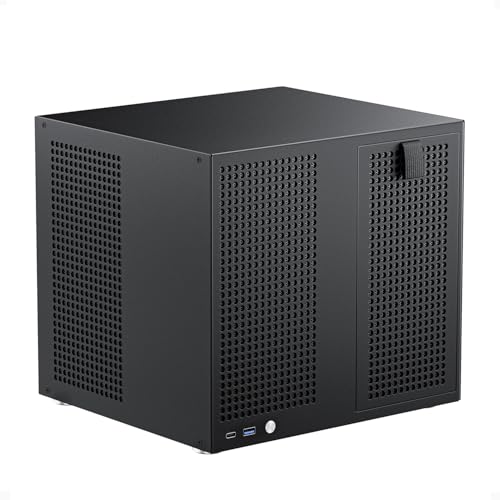
This 8 Bay NAS Case with Fan Mounts – Black stands out for users who need robust drive capacity and modular expandability in a compact form. I’ve used it to build a reliable NAS with full 3.5-inch support for eight drives and two dedicated 2.5-inch SSD mounts, perfect for caching or OS storage. The magnetic front panel makes drive swaps quick and tool-free. It fits Micro-ATX or Mini-ITX boards and handles power supplies up to 170mm, giving me solid compatibility. Four full-height PCIe slots let me add SAS controllers or 10GbE cards, though rear clearance is tight. Dual 120mm fan mounts in both HDD and motherboard zones keep temps steady, but I had to wire fans manually-no controller included. At 300x270x270mm, it fits under most desks, and the included dampers reduce vibration well. It’s sturdy, well-ventilated, and great for mixed-drive builds, but the lack of built-in fan control means you’ll need to plan cooling wiring ahead.
Best For: Home lab enthusiasts, NAS builders, and IT professionals seeking a compact, high-drive-capacity enclosure with expansion flexibility.
Pros:
- Supports up to 8x 3.5-inch HDDs and 2x 2.5-inch SSDs with tool-free magnetic front panel access
- Accommodates Micro-ATX and Mini-ITX motherboards with 4 full-height PCIe slots for network or storage expansion
- Dual 120mm fan mounts in separate HDD and motherboard chambers enable effective, independent cooling
Cons:
- No built-in fan controller, requiring manual fan wiring and external speed management
- Limited rear clearance can make GPU or large expansion card installation challenging
- Compact size may restrict cable routing and airflow if not carefully managed
Factors to Consider When Choosing a Computer Case for NAS
You’ll want to pick a NAS case that balances drive bay capacity with solid cooling efficiency, since stuffing in extra hard drives can lead to heat buildup if airflow and fan mounts aren’t well designed. Make sure it supports your motherboard size and offers room for expansion, like adding PCIe cards or extra SSDs, but don’t overlook build quality-cheaper steel or thin panels might save money but often rattle and insulate heat. While more bays and features sound great, remember that larger cases take up more space and can be overkill for a simple home setup.
Drive Bay Capacity
Most NAS cases support between 4 and 13 drive bays, giving you room to scale your storage based on current needs and future growth. You’ll want to check how many 3.5″ and 2.5″ drives the case holds, since capacity affects both performance and expandability. Many high-capacity models include hot-swap bays, so you can replace drives without powering down-ideal for maintaining uptime. Look for reconfigurable trays or cages that let you prioritize HDDs or SSDs depending on your workload. Some cases split bays into separate chambers, which helps manage drive density but may limit flexibility. Tool-free rails or mounting brackets make installing and swapping drives faster, especially with multiple units. Keep in mind that more bays often mean a larger footprint, so measure your space. Choose based on realistic long-term needs, not just max capacity.
Cooling Efficiency
While solid storage capacity matters, efficient cooling directly impacts your NAS’s reliability and longevity, especially when running multiple drives 24/7. You’ll want cases with mesh front and side panels-they boost airflow and keep internal temps low. Look for support for multiple 120mm or 140mm fans so you can customize airflow around dense drive arrays. Dedicated fan mounts in isolated chambers help you create separate cooling paths, ensuring consistent temps across drives and components. If you’re pushing heavy workloads, models compatible with 360mm radiators offer strong liquid cooling options. Pre-installed PWM fans are a plus-they adjust speed based on heat, cutting noise when cooling demands are low. Just remember: high airflow can mean more dust intake, so plan for regular filter maintenance. Prioritize smart airflow design over sheer fan count.
Motherboard Compatibility
If you’re building a reliable NAS, picking a case that matches your motherboard’s form factor is essential-getting this wrong can derail the entire build. You need to confirm the case supports your board’s size, whether it’s E-ATX, ATX, Micro-ATX, or ITX, by checking mounting hole alignment and tray cutouts. Full-tower cases fit larger boards like E-ATX with ease, but mid-towers might only handle ATX or smaller. Always verify clearance around the board’s rear ports, I/O shield, and components to avoid clashes with drive cages or side panels. Some cases force you to remove storage trays to fit bigger motherboards, cutting into drive bays. Make sure there’s enough room for power connectors, front-panel headers, and fan cables so installation stays clean and functional.
Expansion Options
When planning for long-term scalability, prioritize a case that supports a mix of 3.5″ and 2.5″ drive bays, since you’ll likely want room to add high-capacity HDDs for bulk storage and SSDs for caching or speed. Look for hot-swap support-it lets you replace or upgrade drives without powering down, which is essential for uninterrupted access. A minimum of four PCIe slots gives you headroom to add 10GbE NICs, SAS HBAs, or even a GPU for transcoding. Make sure the chassis fits full-length cards, especially if you’re eyeing high-performance add-ons. Internal layout matters too-choose cases with dedicated mounting for extra fans or radiators, so cooling keeps up as drive count and workloads grow. Just remember: more expandability often means larger footprints and higher costs, so balance needs against space and budget constraints.
Build Quality
A sturdy chassis isn’t just about looks-it’s the foundation of a reliable NAS build. You want steel or aluminum frames with at least 0.7mm wall thickness to handle constant 24/7 operation without warping or flex. Reinforced drive cages with rubber dampeners cut vibration, protecting your drives and extending their lifespan in high-stress environments. Look for stamped metal mesh panels-they boost airflow without weakening the structure. Some cases use solid wood veneers or reinforced plastics on exterior panels, which add style but must still resist heat and maintain rigidity. Inside, solid cable management like rubber grommets, routing channels, and Velcro straps keeps things tidy and airflow steady. Just remember: premium materials often mean higher cost and weight, so balance durability with practicality for your space and budget.
Frequently Asked Questions
Can I Use These Cases for Gaming Builds?
Yeah, you can use these cases for gaming builds, but they’re not ideal out of the box. They’re built for airflow and drive bays, not GPU clearance or RGB lighting. You’ll likely struggle with long graphics cards or complex cable management. If you’ve got a compact GPU and don’t mind minimal airflow tuning, they’ll work. Just check internal dimensions and expansion slot availability first-many lack the height or rear ports gamers need.
Are These Cases Noisy During Operation?
No, these cases aren’t noisy-they’re built for quiet, 24/7 operation with sound-dampening materials and optimized airflow. You’ll notice minimal fan noise thanks to support for large, slow-spinning fans and vibration-reducing drive mounts. But if you add powerful GPUs or overload drives, noise creeps up. Always pair with low-RPM fans and check bay counts; some models prioritize silence over expandability, so verify fit for your components.
Do They Support Liquid Cooling Systems?
Yes, some of them support liquid cooling, but you’ve got to check the specs carefully. Models like the Fractal Design Define 7 XL or the SilverStone DS340 can fit 240mm or 280mm radiators, giving you solid thermal headroom. But not all NAS cases offer this-many prioritize silence and space efficiency over cooling expansion. If you’re adding an AIO, confirm clearance and fan mounting options. Remember, liquid cooling adds complexity and potential failure points, so weigh the noise and reliability trade-offs wisely.
How Easy Are They to Assemble?
You’ll find most of these cases easy to assemble, with tool-free drive trays and clear layout guides. You slide in the motherboard without hassle, and cable management is straightforward thanks to generous space behind the tray. Yet, some models have tight airflow sections, making radiator installs tricky. You’ll appreciate the included manuals, but double-check dimensions-oversized PSUs or fans might not fit. Assembly takes under an hour for most, assuming you’ve got basic experience.
Are They Compatible With Mini-Itx Motherboards?
Yes, they’re compatible with mini-ITX motherboards, giving you a compact, space-efficient build perfect for tight spots. Most models support standard 2.5” and 3.5” drives, with tool-free bays for easy expansion. You’ll find solid steel frames and quiet airflow designs, but check drive clearance and PSU limits-some units restrict PSU size and HDD count. Always verify front-panel ports and noise levels match your workspace needs.