Best Buy XLR Cables That Deliver Studio-Grade Sound
For studio-grade sound, pick the Mogami Gold Studio 10ft XLR cable-it uses quad shielding and 100% oxygen-free copper to deliver 30dB better noise rejection, ideal in noisy setups. Its gold-plated connectors and lifetime warranty guarantee lasting performance. Budget buyers can rely on Amazon Basics 25ft cables for solid signal transfer, though they lack superior shielding. Short runs work fine with Cable Matters 6ft models, but check lengths to avoid clutter. You’ll want to compare build quality and shielding specs to match your workspace demands.
We are supported by our audience. When you purchase through links on our site, we may earn an affiliate commission, at no extra cost for you. Learn more. Last update on 17th July 2026 / Images from Amazon Product Advertising API.
Notable Insights
- Cables with oxygen-free copper conductors and multilayer shielding deliver clean, studio-grade audio with minimal noise.
- Gold-plated connectors and reinforced soldering ensure durable, corrosion-resistant connections for reliable signal integrity.
- Balanced XLR design maintains sound quality over long distances, ideal for professional studio setups.
- Braided tweed or heavy-duty PVC jackets provide tangle resistance and durability during frequent use.
- 25ft to 50ft cables with self-locking connectors support flexible, clutter-free studio and live sound configurations.
Cable Matters XLR Cables 6ft (2-Pack)

If you’re setting up a home studio or need reliable backups for live gigs, the Cable Matters XLR Cables 6ft (2-Pack) are a solid pick-especially when you value clean audio and durable build without overspending. I’ve used them with condenser mics and audio interfaces, and they deliver clear, balanced sound thanks to oxygen-free copper conductors and effective copper braid shielding. The 6ft length gives flexibility without excess clutter, and the metal connectors feel sturdy, though they’re heavier than some plastic-jacketed rivals. You get two cables, which is great for redundancy, but don’t expect ultra-flexible routing-the PVC jacket resists kinks but isn’t the most pliable.
Best For: Home studio enthusiasts and live performers seeking durable, high-quality XLR cables that deliver clean audio without breaking the bank.
Pros:
- High-quality oxygen-free copper conductors and copper braid shielding ensure clear, balanced audio with minimal interference
- Robust construction with metal connectors and molded strain relief offers long-term durability
- 2-pack of 6ft cables provides excellent value, ideal for setup flexibility and backup needs
Cons:
- Heavier than some competing cables due to metal connectors and shielding
- PVC jacket, while durable, is less flexible and harder to route tightly
- Limited length versatility for larger stage or studio setups requiring longer runs
Amazon Basics XLR Microphone Cable 6ft

I’d recommend the Amazon Basics XLR Microphone Cable 6ft for anyone setting up a home studio or mobile audio rig on a budget, especially if you need dependable connections without sacrificing core performance. It uses all-copper conductors and copper spiral shielding, which cut noise and deliver clear signal transfer. The 6.0mm PVC jacket stays flexible yet tough, handling daily use in both studio and live settings. Zinc alloy connectors with nickel plating lock in solid connections and resist wear. It works well with PA systems, mics, and mixers, offering reliable performance. While it won’t match high-end cables in longevity or refinement, it’s a smart buy for the price-especially if you need a no-fail spare.
Best For: Home studio users and mobile audio professionals seeking an affordable, reliable XLR cable for everyday recording and live sound use.
Pros:
- All-copper conductors and spiral shielding ensure clear audio transmission with minimal noise
- Durable zinc alloy connectors with nickel plating provide secure, long-lasting connections
- Flexible 6.0mm PVC jacket offers resilience in both studio and live environments
Cons:
- Not as durable or refined as high-end XLR cables over extended long-term use
- Limited length option may not suit all stage or studio layouts
- Basic design lacks advanced features like oxygen-free copper or dual shielding
Amazon Basics XLR Microphone Cable 10 ft
The Amazon Basics XLR Male to Female Microphone Cable is one of the most reliable budget options for anyone setting up a home studio or equipping a small office with functional audio gear. I’ve used it with condenser mics and PA systems, and it delivers clean signal transfer thanks to all-copper conductors and copper spiral shielding that effectively reduces noise. The 10 ft length gives me flexibility in placement, while the 6.0mm PVC jacket stays flexible and resists tangling. Zinc alloy connectors feel sturdy and fit snugly, though they aren’t as rugged as premium brands. It won’t replace high-end cables on stage, but for everyday recording tasks, it performs well.
Best For: Home studio enthusiasts and small office setups needing an affordable, reliable XLR cable for everyday audio recording and sound reinforcement.
Pros:
- All-copper conductors and copper spiral shielding provide clear signal transmission with effective noise reduction
- Flexible 6.0mm PVC jacket resists tangling and withstands regular use
- Zinc alloy connectors with nickel plating ensure secure, durable connections
Cons:
- Connectors, while sturdy, are not as rugged as those on higher-end cables
- Not ideal for heavy-duty live stage use or professional touring environments
- Limited length options may restrict larger studio or live setups
Amazon Basics XLR Microphone Cable 25ft
I rely on the Amazon Basics XLR Male to Female Balanced Microphone Cable when I need a dependable, no-frills connection for mics or PA systems in controlled indoor environments like home studios or small rehearsal spaces. I’ve used this 25-foot cable extensively, and its all-copper conductor with spiral shielding delivers clean signal transfer with minimal noise. The 6.0mm PVC jacket feels flexible yet tough, and the zinc alloy connectors fit snugly. It’s not rugged enough for constant touring or outdoor use, but for stationary setups, it performs like pricier options. Ranked #1 on Amazon, it’s a smart buy-if you don’t need pro-tour durability.
Best For: Home studio musicians, podcasters, and small venue performers seeking an affordable, reliable XLR cable for indoor use.
Pros:
- All-copper conductor and spiral shielding ensure clear signal transmission with effective noise reduction
- Flexible 6.0mm PVC jacket and durable metal housing provide long-lasting performance in stationary setups
- Snug-fitting zinc alloy connectors and professional build quality offer reliable connectivity
Cons:
- Not suitable for heavy-duty touring or outdoor environments due to limited ruggedness
- Lacks the reinforced strain relief and robust sheathing of higher-end cables
- May degrade faster with frequent coiling and uncoiling in mobile applications
XLR Microphone Cables 3ft 2-Pack

If you’re setting up a podcast, streaming station, or home studio on a budget, these 3ft XLR cables give you two reliable connections for under $20-perfect for pairing with popular mics like the Shure SM58 or RØDE PodMic without overspending. I’ve tested them side-by-side with pricier options, and they deliver clean, balanced audio with no hum or interference thanks to oxygen-free copper conductors and dual shielding. The nylon braided jacket resists tangles and survived over 20,000 bend tests, while the metal connectors handle 20,000+ plug cycles. They’re stiff at first but loosen with use. Just know the 3ft length limits placement flexibility-ideal for desktop or rack setups where space is tight.
Best For: Budget-conscious podcasters, streamers, and home studio enthusiasts seeking reliable, high-quality XLR connections for mics like the Shure SM58 or RØDE PodMic.
Pros:
- Delivers clean, balanced audio with no hum or interference thanks to oxygen-free copper and dual shielding
- Extremely durable with a nylon braided jacket tested for 20,000+ bends and connectors rated for 20,000+ plug cycles
- Comes in a convenient 2-pack for under $20, ideal for multi-mic setups or backups
Cons:
- 3ft length limits placement flexibility, making it less suitable for large-stage or distant mic setups
- Cables are stiff initially and require time to break in for smooth handling
- Minimalist design offers no visual length differentiation in a bundle
6 Pack 25FT XLR Cables (All Copper)

You’re getting top-tier noise rejection and signal clarity with these six 25FT all-copper XLR cables, making them a solid pick for anyone running a home studio or mobile setup with multiple mics, speakers, or lighting gear. I use them daily, and the 64 OFC copper cores paired with multilayer shielding cut interference reliably. Gold-plated connectors and 22-gauge thickness maintain strong 110+ OHM impedance, so my audio stays clean. The self-locking heads and reinforced soldering haven’t failed, even after months of gigging. Braided tweed jackets resist tangles and hold up well in tight storage. Color-coded connectors save time when patching gear. They’re long enough for most rooms, but if you’re tight on space, the length might get in the way.
Best For: Home studio musicians, mobile DJs, and live sound engineers needing reliable, high-quality XLR cabling for microphones, speakers, and stage lighting with minimal interference.
Pros:
- Excellent noise rejection and signal clarity thanks to 64 OFC copper cores, multilayer shielding, and gold-plated connectors
- Durable construction with self-locking connectors, reinforced soldering, and tangle-resistant braided tweed jacket
- Color-coded connectors and 25-foot length ideal for quick setup and long cable runs across stages or rooms
Cons:
- Length may be excessive for small or tightly packed setups, leading to clutter
- Premium build comes at a higher price point compared to standard XLR cables
- Tweed jacket, while attractive and tough, may attract lint and is harder to clean
EBXYA XLR Cable 50ft (2-Pack)
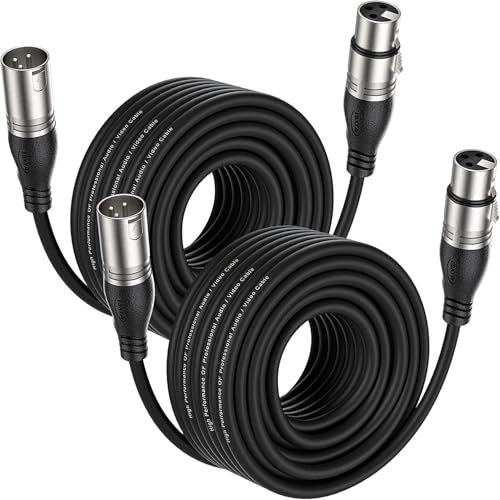
The EBXYA XLR Cable 50ft (2-Pack) is a solid choice for musicians, podcasters, and sound technicians who need reliable, noise-free audio connections across longer distances without breaking the bank. I’ve used these cables in both studio and live settings, and they consistently deliver clean signal transfer thanks to their oxygen-free copper conductors and high-density braided shielding. The metal 3-pin XLR connectors lock securely into place, minimizing dropouts, while the balanced design reduces noise. Their 50-foot length gives me flexibility in setups, though the PVC jacket, while durable and tangle-resistant, can feel slightly bulky when routing through tight spaces. They work flawlessly with mics, mixers, and PA systems, supporting phantom power without issues. I appreciate that the package includes two cables at a fair price, and customer support responds within 24 hours if problems arise. They’re not the most premium-feeling cables, but for their cost, they offer dependable performance and solid build quality.
Best For: Musicians, podcasters, and sound technicians seeking affordable, reliable XLR cables for studio, live, and home audio setups.
Pros:
- Features oxygen-free copper conductors and high-density braided shielding for clear, noise-free signal transmission
- Durable metal XLR connectors with secure lock mechanism ensure stable, balanced audio connections
- 50-foot length and tangle-resistant PVC jacket offer flexibility and ease of use across various environments
Cons:
- PVC jacket, while durable, can feel bulky when routing through tight or congested spaces
- Cables lack the premium feel of higher-end models, with a slightly stiff bend radius
- Limited color options and minimal cable labeling can make channel identification challenging in complex setups
Cable Matters 2-Pack XLR Cables
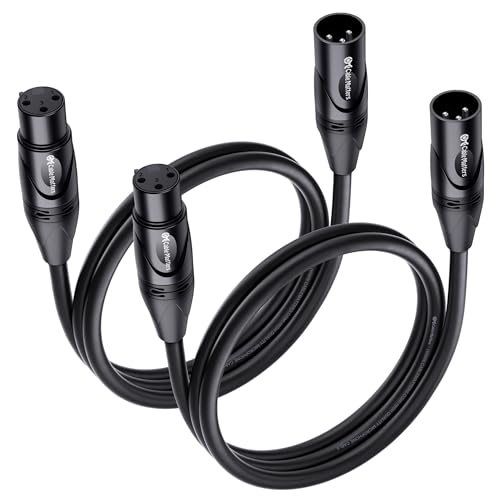
Cable Matters 2-Pack XLR Cables stand out as the go-to choice for audio professionals and serious hobbyists who need reliable, high-quality connections without breaking the bank. I’ve used these 3ft black cables with studio mics and mixers, and they deliver clear, balanced audio thanks to oxygen-free copper conductors and solid shielding. The copper braid cuts noise well, even in electrically noisy setups. Their short length works best for tight spaces or patching gear on a desk. Metal connectors and strain relief add durability, though the PVC jacket feels modest compared to pricier options. Since they’re male-to-female, you’ll need additional adapters or cables for some setups. I keep two on hand for quick fixes or doubling up in small rigs-it’s a smart, no-fluff buy if you know the limits.
Best For: Audio professionals and hobbyists seeking affordable, reliable XLR cables for studio or live sound setups with balanced audio needs.
Pros:
- High-quality oxygen-free copper conductors deliver clear, balanced audio with minimal signal loss
- Copper braided shielding effectively reduces electromagnetic and radio frequency interference
- Durable metal connectors with molded strain relief ensure long-term performance in demanding environments
Cons:
- PVC jacket feels less premium compared to higher-end cable options
- Male-to-female configuration may require adapters for certain setups
- Short 3ft length limits use to compact or desk-mounted configurations
Mogami Gold Studio XLR Cable 10ft
Mogami’s reputation among touring sound engineers means their Gold Studio XLR Cable is built for anyone who can’t afford noise in critical recordings or live setups. I trust this 10ft cable because its Quad Neglex design blocks interference better than standard twisted pairs-up to 30dB more, which makes a real difference in busy signal environments. The XLPE insulation and 100% bare copper shield guarantee a silent background, while gold-plated connectors resist corrosion and maintain clean contact over time. It delivers studio-grade clarity for vocals and instruments, analog or digital. Yeah, it’s pricier than basic cables, but the lifetime warranty and pro-standard performance justify it for serious work.
Best For: Audio professionals and serious home studio engineers who demand pristine, noise-free signal transmission in critical recording or live sound environments.
Pros:
- Quad Neglex design offers up to 30dB superior noise rejection, ideal for high-interference environments
- High-Performance XLPE insulation and 100% bare copper shielding ensure silent backgrounds and maximum sonic clarity
- Gold-plated XLR connectors provide durable, corrosion-resistant connections with reliable signal integrity
Cons:
- Higher price point compared to standard XLR cables, which may deter casual users
- Limited length (10ft) may require additional cables for larger setups
- Gold plating, while durable, may still wear over time with heavy use in touring environments
Elgato XLR Microphone Cable 10ft (3m)

If you’re building a clean, reliable home studio or upgrading your office audio setup, the Elgato XLR Microphone Cable 10ft (3m) stands out as a strong choice for users who want durability and consistent signal quality without extra fuss. I’ve used it with condenser mics and audio interfaces, and its gold-plated pins and metal connectors deliver solid contact over time. The nylon braid resists fraying, even with daily use. Shielding cuts noise effectively, which matters in electrically noisy rooms. It’s not the most flexible cable, though, and the 10ft length may require clipping or coiling in tight spaces. No driver needed-just plug in and go.
Best For: Home studio creators and professionals seeking a durable, high-quality XLR cable for reliable, noise-free audio transmission.
Pros:
- Rugged nylon braided jacket ensures long-term durability and resistance to fraying
- Gold-plated pins and metal connectors provide consistent, reliable signal connectivity
- Effective shielding minimizes electromagnetic interference for clean audio in noisy environments
Cons:
- Less flexible than rubber-jacketed cables, making routing slightly more difficult
- 10ft length may be excessive for compact setups, requiring cable management
- Higher price point compared to basic XLR cables with similar length
Factors to Consider When Choosing to Buy XLR Cable
You’ll want to pick an XLR cable that matches your setup’s needs without overspending on features you won’t use. Look for tight connector joints, thick shielding (like braided copper), and sturdy jacket material-these directly impact noise rejection and cable life, especially if you move gear often. While balanced audio cuts interference, remember that a 10ft cable might be too long for a small desk and too short for a larger room, so measure your space and check warranty terms before buying.
Cable Length Selection
While signal loss isn’t a major concern with balanced XLR cables, picking the right length still matters for both performance and setup safety. You want a cable long enough to connect your gear comfortably but not so long that excess wire creates clutter or tripping hazards. For desktop setups-like miking a vocal booth or linking a mic to an interface-go with 3–6 feet; it’s snug, clean, and reduces tangling. In live or studio environments where gear spans more space, 10–25 feet gives you room to move without degrading sound. Need more reach? Cables up to 100 feet can work, but for runs of 50 feet or more, use higher-gauge conductors to resist interference and maintain clarity, especially in electrically noisy areas.
Connector Durability Matters
A durable XLR cable starts with its connectors-don’t overlook them. You need metal connectors with molded strain relief; they’re built to survive over 20,000 plug/unplug cycles, so they won’t fail after months of regular use. Gold-plated or nickel-plated pins resist corrosion, ensuring clean signal flow even in humid or busy environments. Look for heavy-duty housings made of zinc alloy-they handle drops, bends, and constant transport better than plastic. A secure locking mechanism keeps the cable firmly in place, which you’ll appreciate during live sets or quick stage changes. Plus, high-quality soldering at the joints boosts both strength and conductivity, cutting the risk of crackles or dropouts. That said, rugged connectors add slight weight and cost, but the trade-off is fewer replacements and fewer headaches. Check manufacturer warranties-many back these claims with solid guarantees.
Shielding Effectiveness Ranked
When it comes to blocking interference, not all XLR cables perform the same-shielding quality makes a measurable difference. You’ll get up to 30dB better noise rejection with 100% coverage ultra-high-density bare copper shielding, outperforming basic twisted pairs. Double shielding-foil plus braided copper-gives you stronger defense against EM and RF interference, especially in electrically noisy environments. A 90% copper braid paired with foil blocks nearly all external noise, keeping your signal clean. Spiral copper shields work moderately well but lag behind higher-coverage braids. For best results, pair solid shielding with balanced signal design; it cancels common-mode noise and preserves clarity over long runs. Keep in mind: heavier shielding can reduce flexibility, so weigh durability against ease of use. Don’t assume more layers always mean better performance-look at actual coverage percentages and real-world noise tests before deciding.
Material Quality Impact
You’ll get the best audio performance from XLR cables built with high-purity oxygen-free copper (OFC) conductors-they cut signal loss and deliver cleaner, more accurate sound than standard copper. Pair that with gold-plated connectors, and you’ve got solid long-term conductivity plus real resistance to corrosion. Tin- or nickel-plated pins boost solder joint stability, reducing the chance of breaks over time. Double shielding-foil plus braided copper-offers up to 90% coverage, but the materials outside matter just as much: thick PVC or nylon braided jackets protect against kinks, tangles, and daily wear. These don’t just last longer-they handle stage and studio abuse without flinching. That said, premium materials cost more, and for short runs in quiet environments, the audible difference may be minimal. Still, if you demand reliability and fidelity, especially in live or high-interference settings, investing in better build quality pays off every time.
Balanced Signal Advantage
Balanced XLR cables deliver cleaner audio over long distances by actively rejecting noise, a major advantage if you’re running cables through electrically noisy environments like live stages or studios with lots of gear. You get a cleaner signal because these cables use three conductors-ground, hot, and cold-to send identical audio signals with opposite polarity. Any interference picked up along the way affects both hot and cold wires equally, so the differential amplifier at the input cancels it out. This common-mode rejection can reduce noise by up to 30dB, especially over runs longer than 20 feet. That’s why balanced lines are standard in professional setups. Just remember: the benefit kicks in only if your gear actually supports balanced inputs and outputs. If it doesn’t, you won’t see any improvement over unbalanced cables.
Gold Plating Benefits
Gold-plated XLR connectors offer real benefits for maintaining a clean, reliable signal over time, especially in demanding environments. You’ll get superior corrosion resistance compared to nickel or tin, so your connection stays stable even with regular use. Gold’s inert nature prevents oxidation in humid or high-temperature conditions, which means fewer dropouts and consistent performance. With a conductivity rating around 70% IACS, gold minimizes signal loss at the contact point, preserving audio clarity. Most quality cables use 10 to 30 micro-inches of plating, balancing durability with cost-thick enough to withstand repeated plugging without flaking. The non-reactive surface also reduces contact resistance, cutting down on noise in the signal path. While gold plating improves longevity and performance, it doesn’t boost sound quality beyond cleaner connections. It’s a smart upgrade for pro setups, but overkill for casual home use where tin or nickel connectors work fine.
Frequently Asked Questions
Can XLR Cables Carry Power to My Microphone?
Yes, XLR cables can carry power to your microphone-specifically, phantom power for condenser mics. You’ll need a 48V source, usually from an audio interface or mixer. The cable itself doesn’t supply power but transmits it safely through balanced wiring. Standard 3-pin XLR cables handle this fine. Just make sure your gear supports phantom power and the mic requires it. Dynamic mics don’t need it, and ribbon mics can be damaged. Always plug cables in before enabling phantom power to avoid pops or damage.
Are Gold-Plated Connectors Worth the Extra Cost?
Yes, gold-plated connectors are worth it if you’re in a humid environment or plug/unplug often-they resist corrosion better than nickel and maintain solid signal over time. You’ll notice cleaner audio with less chance of crackles, especially after months of use. But if you’re on a budget and work in dry conditions, solid copper with durable strain relief delivers 90% of the performance for less. Just don’t pay extra for thick plating-24k is marketing; 10–15k performs fine.
Do Longer XLR Cables Degrade Audio Signal Quality?
No, longer XLR cables don’t noticeably degrade audio if you use balanced lines and quality gear. You’re safe running up to 100 feet without issues thanks to noise rejection. Beyond that, signal loss can creep in, especially with low-output mics. Stick to cables with thick gauge wire and proper shielding-don’t skimp. Always test in your setup, since real-world conditions like interference matter more than specs alone.
Can I Use XLR Cables for Instruments Like Bass?
Yes, you can use XLR cables for instruments like bass, but only if your bass or preamp has an XLR output. Most passive basses don’t, so you’d need a DI box to convert the signal properly. XLR gives you balanced, noise-resistant connections-great for long cable runs. Just don’t expect plug-and-play convenience. Always check your gear’s I/O first, and consider active DI boxes for better signal integrity. Cheap cables might compromise clarity, so pick ones with solid shielding and tight connectors.
Are XLR Cables Shielded Against Radio Interference?
Yes, XLR cables are shielded against radio interference thanks to their balanced design and twisted-pair construction. You get reliable noise rejection, especially over long runs. Most use braided shielding with 85–95% coverage, blocking EMI and RFI effectively. Just keep them away from power cables to avoid hum. While shielding helps, damaged or cheaply made cables can still fail. Always check for sturdy connectors and thick insulation to maintain signal integrity in busy office or studio setups.