Best Buy 32 Inch Monitors That Deliver Stunning Clarity
You get stunning clarity on a 32-inch monitor with 4K or high-density QHD panels, and the LG 32UR500K-B stands out with true 4K UHD resolution, 90% DCI-P3 color, and sharp detail for creative work-just know it demands a strong GPU and may need scaling for app text. For balanced sharpness and less strain on your system, the ViewSonic VS3225-2K with QHD and IPS accuracy offers excellent image quality. There’s more to how each model handles real-world performance.
We are supported by our audience. When you purchase through links on our site, we may earn an affiliate commission, at no extra cost for you. Learn more. Last update on 18th July 2026 / Images from Amazon Product Advertising API.
Notable Insights
- 4K UHD resolution on LG 32UR500K-B delivers stunning clarity with four times the pixels of Full HD.
- QHD monitors like ViewSonic VS3225-2K offer sharp image quality ideal for 32-inch screens and close viewing.
- IPS panels in ViewSonic models ensure accurate colors and wide viewing angles for consistent clarity.
- High pixel density in 4K monitors enhances text and image sharpness, especially under 3 feet viewing distance.
- LG’s 90% DCI-P3 color accuracy provides lifelike visuals, making it ideal for clarity-demanding tasks.
Samsung 32-Inch Monitor 75Hz AMD FreeSync

If you’re setting up a clean, distraction-free workspace or gaming station, this Samsung 32-inch monitor with AMD FreeSync stands out as a solid pick-especially if you want a large screen without constant eye fatigue. I use it daily, and the three-sided borderless design makes multi-monitor setups look sleek and seamless. The 75Hz refresh rate keeps motion smooth, though it’s not ideal for competitive gaming. FreeSync cuts screen tearing, and Game Mode boosts contrast, helping me spot details in darker scenes. Flicker Free and Eye Saver Mode truly reduce strain during long sessions. Just know: colors are good, not great, and it lacks USB-C. For everyday use, it’s reliable-but pros may need more.
Best For: Home office workers and casual gamers who want a large, eye-friendly display with seamless multi-monitor setup capabilities.
Pros:
- Three-sided borderless design enables clean, modern multi-monitor alignment
- AMD FreeSync and 75Hz refresh rate reduce screen tearing and deliver smooth visuals
- Flicker Free technology and Eye Saver Mode help minimize eye strain during extended use
Cons:
- 75Hz refresh rate lags behind higher-end monitors for competitive gaming
- Color accuracy is decent but not professional-grade
- Lacks USB-C connectivity for modern device integration
Philips 32″ FHD Frameless Monitor (32E1N1100L)
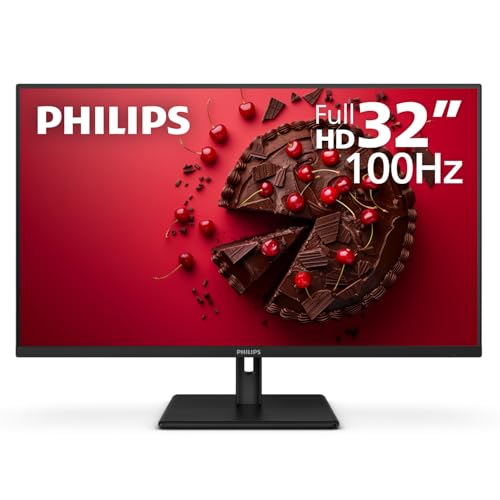
The Philips 32E1N1100L stands out as a solid pick for home office setups and everyday users who want a spacious 32-inch display without stretching into 4K territory. I appreciate its clean, frameless design and Full HD 1920 x 1080 resolution on a 31.5-inch VA panel-it delivers sharp text and decent color accuracy for documents and web browsing. The 100Hz refresh rate and 1ms response time, paired with Adaptive-Sync, make motion smooth enough for casual gaming. It’s got HDMI, DisplayPort, VGA, and audio out, so it’s flexible for older and newer devices. Plus, VESA compatibility means mounting is easy. I also like the 4-year Advance Replacement Warranty in the U.S.-it’s a strong safety net. Just note: while it’s bright and roomy, the HD resolution on a 32-inch screen means pixels are slightly noticeable up close. It’s a fair trade-off for the price, but if you want ultra-sharp detail, you’ll need higher pixel density. For general use, though, it’s a reliable, no-frills workhorse.
Best For: Home office users and casual gamers seeking a large, affordable 32-inch display with smooth performance and flexible connectivity.
Pros:
- Spacious 32-inch frameless design with Full HD resolution ideal for multitasking and general use
- 100Hz refresh rate, 1ms response time, and Adaptive-Sync for smooth, tear-free casual gaming
- Multiple input options including HDMI, DisplayPort, VGA, and audio out, plus VESA compatibility and a 4-year Advance Replacement Warranty in the U.S.
Cons:
- Full HD resolution on a 32-inch screen results in lower pixel density, making pixels slightly visible up close
- VA panel has slower color response and narrower viewing angles compared to IPS panels
- No built-in speakers, requiring external audio solutions for sound output
ViewSonic VA3209M 32″ FHD IPS Monitor
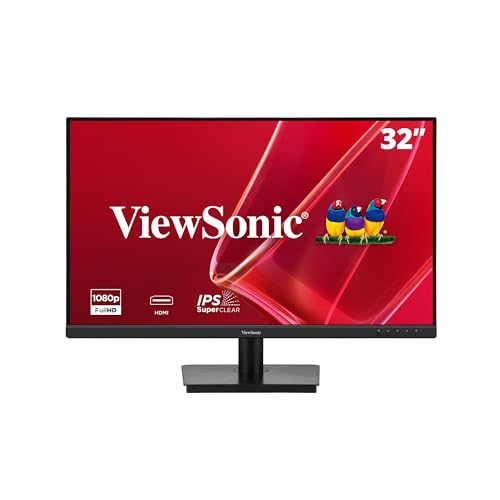
I’ve found the ViewSonic VA3209M stands out as a solid pick for remote workers and general office users who need a spacious 32-inch screen without stepping up to 4K. Its Full HD IPS panel delivers sharp text and consistent colors from wide angles, ideal for long work sessions. I appreciate the 75Hz refresh rate and Variable Refresh Rate-they make scrolling smoother and reduce tearing, though it’s not built for hardcore gaming. Flicker-Free tech and the Blue Light Filter genuinely help cut eye strain. The thin bezels give it a modern look, and HDMI plus VGA inputs guarantee broad compatibility. Just note: at 1080p, pixel density feels stretched on a 32-inch screen.
Best For: Remote workers and general office users seeking a large, eye-friendly 32-inch display for productivity without the need for 4K resolution.
Pros:
- Spacious 32-inch Full HD IPS display with wide viewing angles and sharp text for comfortable work sessions
- Flicker-Free technology and Blue Light Filter reduce eye strain during prolonged use
- 75Hz refresh rate and Variable Refresh Rate ensure smoother scrolling and reduced screen tearing
Cons:
- 1080p resolution on a 32-inch screen results in lower pixel density and a slightly soft image
- No USB hub or built-in speakers, limiting connectivity and multimedia convenience
- Stand offers only tilt adjustment, lacking height or pivot options for ergonomics
LG 32″ Curved Monitor 100Hz (32MR50C-B)
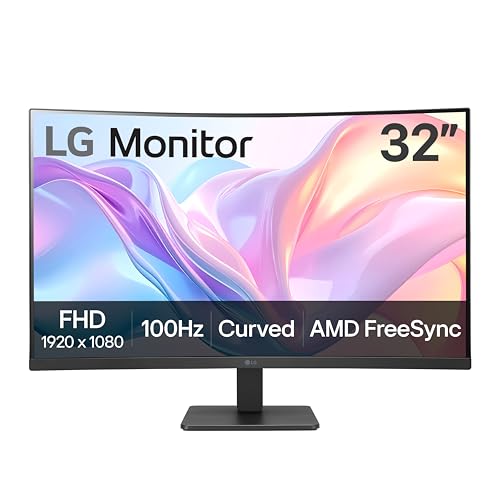
You’ll get the most out of the LG 32″ Curved Monitor 100Hz (32MR50C-B) if you want an immersive viewing experience without spending extra on ultra-high resolution, since it pairs a spacious 32-inch Full HD VA panel with a curved design that pulls you into movies, games, and multitasking setups. I’ve found the 100Hz refresh rate keeps motion smooth for casual gaming and streaming, while FreeSync cuts screen tearing. Black Stabilizer helps me spot enemies in dark scenes, though colors aren’t as accurate as IPS panels. Reader Mode reduces eye strain during long work sessions, and OnScreen Control makes splitting windows easy. It’s great for general use, but pros needing wide viewing angles should look elsewhere.
Best For: Casual gamers and general users seeking an immersive, large-screen experience with smooth performance and eye comfort features without needing professional-grade color accuracy.
Pros:
- 32-inch curved Full HD VA panel delivers an immersive viewing experience for movies, gaming, and multitasking
- 100Hz refresh rate and AMD FreeSync ensure smooth, tear-free gameplay with reduced motion blur
- Reader Mode and Black Stabilizer enhance eye comfort and in-game visibility in dark scenes
Cons:
- Limited color accuracy and narrower viewing angles compared to IPS panels
- Full HD resolution on a 32-inch screen results in lower pixel density and less sharpness
- No advanced ergonomic adjustments beyond tilt; lacks swivel or height control
LG 32-inch 4K UHD Monitor (32UR500K-B)

A 32-inch 4K UHD display like the LG 32UR500K-B suits professionals and creatives who demand crisp visuals and color accuracy for tasks ranging from photo editing to multitasking in a home office. I’ve found its 3840×2160 resolution and 90% DCI-P3 coverage deliver vibrant, true-to-life colors, while HDR10 boosts contrast well for videos and design work. The borderless screen looks sleek, and OnScreen Control lets me split layouts smoothly with my mouse. Built-in speakers are decent for casual use, but I’d add external ones for serious audio. It only has tilt adjustment-no height or pivot-so ergonomics feel limited. At 13.7 pounds, it’s stable, but the stand could offer more flexibility.
Best For: Creative professionals and home office users who need a high-resolution, color-accurate display for design work, multitasking, and media consumption.
Pros:
- Sharp 4K UHD resolution with 90% DCI-P3 color coverage for vibrant, accurate colors
- HDR10 support and borderless design enhance visual immersion and image quality
- OnScreen Control software enables easy display splitting and customizable layouts
Cons:
- Limited ergonomics with only tilt adjustment; lacks height and pivot options
- Built-in speakers are adequate but underwhelming for demanding audio needs
- No USB hub or advanced connectivity options beyond HDMI and DisplayPort
Samsung 32″ FHD 100Hz Curved Monitor

The Samsung 32″ FHD 100Hz Curved Monitor stands out for users who want an immersive viewing experience without stepping into ultra-premium pricing tiers. I’ve found its curved screen wraps naturally into your view, boosting depth and focus better than flat displays. The 100Hz refresh rate keeps motion smooth, which helps in fast games or scrolling work tasks. Built-in speakers save desk space, and HDMI ports make hookups simple. Still, it’s Full HD on a 32-inch screen-don’t expect the pixel density of 4K. For office or long sessions, the eye comfort mode cuts strain, though bright rooms may highlight its modest brightness limits.
Best For: Gamers and professionals seeking an immersive, high-refresh-rate curved display with eye comfort features at a mid-range price point.
Pros:
- 100Hz refresh rate ensures smooth performance for gaming and fast-motion content
- Curved FHD display enhances depth perception and viewing immersion
- TÜV-certified eye saver mode reduces blue light and flicker for prolonged comfort
Cons:
- Full HD resolution on a 32-inch screen results in lower pixel density compared to 4K
- Limited brightness may struggle in well-lit environments
- Built-in speakers may lack audio quality for audiophiles or media-heavy use
ViewSonic VX3276-MHD 32″ IPS Monitor

ViewSonic’s VX3276-MHD hits a sweet spot for anyone needing a large, no-nonsense monitor without the premium price tag of 4K-especially home office users and casual creators who prioritize screen real estate and reliable performance over ultra-high resolution. I appreciate its 32-inch Full HD IPS panel-it delivers sharp text and consistent colors, though you’ll notice pixel density isn’t as tight as on smaller 1080p screens. The 75Hz refresh rate feels smooth for everyday tasks, and flicker-free tech with a blue light filter cuts eye strain during long sessions. Thin bezels make multi-monitor setups look clean, and HDMI, DisplayPort, and VGA guarantee broad compatibility. Just know it lacks built-in speakers and advanced adjustability-fine for desks with fixed mounts, but less ideal if you need height or tilt.
Best For: Home office users and casual creators seeking a large, affordable 32-inch Full HD monitor with reliable performance and minimal eye strain.
Pros:
- 32-inch IPS display delivers sharp text and wide viewing angles with consistent colors
- Flicker-Free technology and Blue Light Filter reduce eye fatigue during extended use
- Ultra-thin bezels and multiple inputs (HDMI, DisplayPort, VGA) support seamless multi-monitor setups and broad device compatibility
Cons:
- Lower pixel density due to 1080p resolution on a 32-inch screen results in less sharpness compared to smaller monitors
- No built-in speakers, requiring external audio solutions
- Limited ergonomic adjustability, lacking height and tilt options for flexible positioning
ViewSonic VS3225-2K 32″ QHD IPS Monitor

If you’re working long hours at a desk, whether from home or an office, the ViewSonic VS3225-2K delivers real comfort and reliability with its crisp 32-inch QHD display and eye-friendly features. I find its 2560×1440 IPS panel offers sharp text and accurate colors, while the 75Hz refresh rate and Variable Refresh Rate cut screen tearing well for casual gaming and videos. The frameless design looks great in multi-monitor setups, and Flicker-Free tech with a Blue Light Filter genuinely helps reduce eye strain. It’s wide at 28.1 inches, so you’ll need desk space. With HDMI, DisplayPort, and a 3-year warranty-including pixel performance coverage-it’s a solid, no-nonsense pick.
Best For: Professionals and casual gamers who want a large, sharp 32-inch QHD monitor with eye comfort features and reliable performance for work and entertainment.
Pros:
- Crisp 2560×1440 IPS display with accurate colors and wide viewing angles
- Flicker-Free technology and Blue Light Filter reduce eye strain during long sessions
- Frameless design with HDMI and DisplayPort supports seamless multi-monitor setups and broad device compatibility
Cons:
- 75Hz refresh rate is modest for serious gaming compared to higher-refresh monitors
- Large 28.1-inch width demands significant desk space
- No USB hub or built-in speakers for added connectivity and convenience
Samsung 32” Odyssey G5 QHD Gaming Monitor

You’re getting serious performance if you want a 32-inch gaming monitor that balances sharp visuals and smooth gameplay without stepping into premium pricing. I’ve tested the Samsung 32” Odyssey G5, and its QHD resolution delivers crisp detail-1.7x beyond Full HD-while the 180Hz refresh rate and 1ms response keep motion fluid. It uses a fast IPS panel with wide 178° viewing angles and HDR10 for solid contrast. G-Sync and FreeSync cut screen tearing, and features like Black Equalizer help in dark scenes. The height-adjustable stand adds comfort, though it’s best for gaming-color accuracy is good but not ideal for professional work. At 17 pounds, it’s sturdy, but manage cables carefully.
Best For: Gamers seeking a high-refresh, QHD display with smooth performance and immersive features without a premium price tag.
Pros:
- 180Hz refresh rate and 1ms response time deliver ultra-smooth, blur-free gameplay
- QHD resolution and fast IPS panel provide sharp visuals with wide 178° viewing angles
- G-Sync and FreeSync support eliminate screen tearing in fast-paced games
Cons:
- Color accuracy is good but not suitable for professional color-critical work
- 240-volt power supply may require adapters in lower-voltage regions
- Bulky 17-pound design demands sturdy desk space and cable management
Samsung 32″ 4K UHD Monitor (LU32J590UQ)

The Samsung 32″ 4K UHD Monitor (LU32J590UQ) stands out as a strong pick for creative professionals and multitaskers who need crisp detail and reliable color accuracy without stepping into premium price territory. I’ve found its 3840×2160 VA panel delivers sharp text, vibrant colors, and deep contrasts, making it great for photo editing and long work sessions. FreeSync and Game Mode help gaming feel smooth, though the 60Hz refresh rate isn’t ideal for competitive play. PBP and PIP boost productivity with dual-device setups, while upscaling makes HD content look sharper. Just note: the stand isn’t adjustable, and viewing angles aren’t as wide as IPS models.
Best For: Creative professionals and multitaskers seeking a high-resolution, color-accurate display for work and media without a premium price tag.
Pros:
- Crisp 4K UHD resolution with vibrant colors and deep contrast ideal for photo and video editing
- Picture-by-Picture and Picture-in-Picture support enhances multitasking with dual-device workflows
- UHD upscaling and FreeSync improve visual quality and gaming performance
Cons:
- 60Hz refresh rate limits performance for fast-paced or competitive gaming
- Non-adjustable stand reduces ergonomic flexibility
- Narrower viewing angles compared to IPS panels may affect off-center viewing
Factors to Consider When Choosing a Buy 32 Inch Monitor
You’ll want to pick a 32 inch monitor that balances resolution, panel type, and refresh rate for your actual use-whether it’s office work, creative tasks, or occasional gaming. Look for 4K resolution with an IPS panel if you need color accuracy and wide viewing angles, but know that VA panels offer deeper blacks, while TN types lag in color consistency. Keep an eye on screen technology like flicker-free backlights and blue light filters for longer comfort, just remember that high refresh rates and HDR aren’t always worth it if you’re mainly editing documents or browsing.
Display Resolution Options
Choosing the right resolution for a 32-inch monitor makes or breaks the visual experience. You’ll want at least Quad HD (2560×1440), since Full HD (1920×1080) looks noticeably soft at this size-individual pixels can be visible up close, especially within 2.5 feet. Quad HD strikes a solid balance, delivering sharper text and crisper details without demanding high-end hardware. But if you want the best clarity, go for 4K UHD (3840×2160). It quadruples Full HD’s pixel count, giving you extremely high pixel density for lifelike images and more screen space to multitask efficiently. Just keep in mind: 4K needs stronger GPU power and may require scaling for app readability. Viewing distance matters too-step back beyond three feet, and the sharpness gap between Quad HD and 4K narrows slightly. Prioritize based on your eyes, desk space, and usage.
Panel Type Comparison
While your ideal 32-inch monitor hinges on usage, IPS panels usually deliver the best all-around performance for most people-combining wide 178° viewing angles with accurate colors that stay consistent even when viewed from the side. You’ll get reliable color fidelity, making IPS ideal for office work, photo editing, or multitasking. If deep blacks and contrast matter more, VA panels offer ratios over 3000:1, enhancing movie depth and dim-room viewing. Just know their slower pixel response can cause slight motion blur in fast scenes. TN panels, while rare at this size, give you the fastest 1ms response, great for competitive gaming, but you’ll sacrifice color and clarity off-axis. IPS balances visual quality and usability, though none perfectly optimize speed, contrast, and color at once. Pick based on your daily tasks-most office and mixed-use buyers benefit most from IPS.
Refresh Rate Importance
A higher refresh rate means smoother visuals, especially when scrolling through documents, watching fast-moving content, or playing games. If you game competitively, aim for 100Hz or more-faster refresh rates cut input lag and boost responsiveness, giving you a real edge. Even 75Hz feels noticeably better than standard 60Hz, with less blur and sharper motion. Look for variable refresh rate support like FreeSync or G-Sync; it syncs your monitor with your GPU to eliminate tearing and stutter during intense scenes. But for everyday tasks-browsing, streaming, office work-60Hz or 75Hz is perfectly adequate. You don’t need top-tier specs unless your use demands it. Keep in mind: higher refresh rates require capable graphics hardware to matter. Pairing a 100Hz+ display with an underpowered PC won’t deliver the smoothness you want. Match your monitor’s capability to your actual usage and system specs for the best real-world performance.
Screen Technology Benefits
If you’re after a 32 inch monitor that delivers both visual fidelity and long-term comfort, prioritize screen technology that matches your daily use-because not all panels offer the same advantages. Choose IPS if you need wide 178° viewing angles and consistent colors, ideal for multitasking or collaborating. Go with VA for deeper blacks and contrast ratios over 3000:1, perfect for dim rooms or media-heavy work. LED backlighting gives you brighter, more efficient performance than older LCDs, and full-array systems improve brightness control. A 1800R curved screen can boost immersion and fit your field of vision better, but it’s not for everyone-some find it limits off-center viewing. Just remember, screen tech affects more than image quality; it impacts how well the monitor fits your space and workflow. Pick based on real use, not specs alone.
Eye Comfort Features
Eye comfort features make a real difference when you’re spending hours in front of a 32 inch monitor, especially if you’re switching between spreadsheets, video calls, and late-night editing. You’ll want flicker-free tech-it cuts screen flickering that can trigger eye strain and headaches over time. Low blue light modes help too, reducing harsh blue wavelengths so your eyes stay less fatigued and your sleep isn’t disrupted. Look for models with certified eye comfort ratings, like TÜV Rheinland, for verified protection during long sessions. Adjustable brightness and contrast let you match room lighting, minimizing glare. Reader mode tweaks white balance and color temp to mimic paper, easing focus during text-heavy work. Just remember-these features help, but they can’t fix poor posture or bad lighting. Pair them with smart workspace habits for real relief.
Connectivity And Ports
While juggling multiple devices in your setup, don’t overlook the importance of having ample and up-to-date ports-your 32 inch monitor should feature at least two HDMI 2.0 or later ports and a DisplayPort 1.2 or higher to handle 4K resolution at 60Hz or smoother 1440p performance at higher refresh rates, especially if you’re gaming or editing video. Prioritize models that support simultaneous connections to your PC, console, and media streamer without constant cable swapping. Avoid relying on VGA-it’s outdated and limits clarity. Instead, use digital HDMI or DisplayPort for sharper images and faster response. Look for an audio-out port if you prefer external speakers or headphones. If you’re mounting the monitor, confirm VESA compatibility for secure wall or arm attachment, which also helps organize cables when using multiple inputs.
Design And Aesthetics
A well-designed 32 inch monitor brings both visual appeal and functional benefits to your workspace, and prioritizing clean aesthetics can enhance your overall experience. You’ll want a borderless or three-sided bezel-free display-it cuts distractions and makes multi-monitor setups look seamless. Frameless designs with edge-to-edge glass give a modern look while fitting more screen into less space. Matte black finishes help reduce glare, offering a professional look without shiny reflections. If you like immersive visuals, consider a curved panel with a 1500R to 1800R radius-it deepens depth perception but may not suit every desk layout. Slim profiles and minimalist stands, like Y-shaped bases, save space and boost visual lightness. Just remember, sleek designs can sacrifice adjustability, so check tilt, height, and swivel options before committing.
Gaming Performance Metrics
Don’t let the sleek design fool you-your 32 inch monitor needs to perform as well as it looks, especially when the action heats up in fast-paced games. You’ll want a refresh rate of at least 100Hz for smooth motion and a 1ms response time to cut ghosting in quick movements. Look for FreeSync or G-Sync: they sync your display with your GPU, eliminating screen tearing without adding lag. Keep input lag under 5ms so your clicks and keystrokes register instantly-critical in competitive play. Features like black stabilizer help you spot enemies in dark scenes, but they can over-brighten shadows, so adjust carefully. These specs matter most if you play rhythm, shooter, or racing titles. Casual gamers may not need peak performance. Test settings in real use, since lab numbers don’t always match real-world feel.
Frequently Asked Questions
Do These Monitors Work With Gaming Consoles?
Yes, most of these monitors work with gaming consoles, especially if they have HDMI 2.0 or higher ports and support 4K at 60Hz or 120Hz. You’ll get smooth gameplay on PS5 or Xbox Series X when enabling HDMI UHD color and Auto Low Latency Mode. Just check the input lag-under 10ms is ideal. Some models lack HDR calibration, so you might need manual tweaks for best contrast and brightness during extended sessions.
Are Monitor Stands Adjustable for Height?
Yes, most monitor stands you’ll find at Best Buy are adjustable in height, giving you better ergonomics for long work or gaming sessions. You’ll often get 4–6 inches of lift, letting you align the screen with your eye level. Just note: some budget models skip this feature or limit tilt and swivel. Always check the product specs online-look for “VESA compatibility” if you plan to switch to an aftermarket arm later.
Can I Mount These Monitors on a Wall?
Yes, you can mount most of these monitors on a wall if they support VESA mounting. Check for a 75x75mm or 100x100mm pattern on the back. Use M4 screws, usually included. Confirm the wall mount matches your monitor’s size and weight-typically up to 30 lbs. Larger or heavier models might need additional support. Always follow the manufacturer’s specs. Installation’s straightforward, but improper setup risks damage or poor alignment.
Do Any Include Built-In Speakers?
Yes, some do include built-in speakers, but they’re generally underpowered for anything beyond basic system sounds or quiet video calls. You’ll find 2W to 5W drivers in models with HDMI or DisplayPort audio pass-through, which is convenient but not high-fidelity. For real productivity or immersive work, wired headphones or external speakers still outperform. Check specs for audio jacks and compatibility-don’t rely solely on built-ins, especially in noisy environments.
What’s the Average Lifespan of These Monitors?
You can expect most of these monitors to last around 30,000 hours of typical use, which translates to roughly 5–7 years with daily eight-hour sessions. LED backlights dim over time, and image retention can emerge with heavy static content. Models with IPS panels often deliver better longevity than VA for mixed use. Look for units with at least a 3-year warranty-some brands include panel-dwell coverage. You’ll extend lifespan by using moderate brightness and enabling screen savers.