Best HDMI Switchers for Seamless Multi-Device Hookups
You’ll get seamless 4K@60Hz switching with low latency when you pick a powered HDMI switcher that matches your device count and cable length. Models like the Anker 4-in-1 or UGREEN 5-in-1 offer reliable performance with HDR, Dolby Audio, and remote control, though they require separate power and short cables under 3 meters. Passive switches like the GANA 2-in-1 are simpler but risk signal drops. For gamers or streamers needing 4K@120Hz or 8K, HDMI 2.1 models deliver but demand certified cables and full power cycles for auto-switching. Built-in LED indicators help track inputs, and metal housings improve durability. Keep total cable runs short to avoid handshake issues. There’s more to take into account depending on your setup.
We are supported by our audience. When you purchase through links on our site, we may earn an affiliate commission, at no extra cost for you. Learn more. Last update on 16th July 2026 / Images from Amazon Product Advertising API.
Notable Insights
- Choose HDMI switchers with enough input ports to support all your devices without daisy-chaining.
- Prioritize models supporting 4K@60Hz or higher with HDMI 2.1 features like 48Gbps bandwidth for future-proofing.
- Opt for switchers with remote control and LED indicators for easy source selection and status visibility.
- Use powered HDMI switchers for stable performance, especially with multiple devices or higher resolutions.
- Ensure compatibility with HDR, Dolby Audio, and HDCP 2.2 to maintain audiovisual quality across devices.
Anker HDMI Switch 4K@60Hz 2-in-1

If you’re setting up a clean, space-efficient home office or entertainment hub and need to toggle between two 4K devices without signal loss, the Anker HDMI Switch 4K@60Hz 2-in-1 is one of the most reliable compact solutions I’ve tested. It handles 4K@60Hz, HDR, 3D, and Dolby formats smoothly, so visuals stay sharp during gaming or streaming. I switched effortlessly between my PS5 and laptop with one button. For best results, use short HDMI cables-under 3.3 feet each, totaling no more than 6.5 feet. It doesn’t support HDMI CEC, so no power-linking devices, but it’s compatible with most gear like Xbox, VR headsets, and projectors. Includes an 18-month warranty.
Best For: Home office or entertainment hub users who need a reliable, compact HDMI switch to toggle between two 4K devices without signal loss.
Pros:
- Supports 4K@60Hz, HDR, 3D, and Dolby for high-quality audiovisual performance
- Simple one-button switching between two HDMI sources
- Compatible with a wide range of devices including gaming consoles, laptops, and projectors
Cons:
- Requires short HDMI cables (under 3.3 feet each) for optimal 4K60 performance
- Combined cable length must not exceed 6.5 feet for best results
- Does not support HDMI CEC, limiting device power联动 functionality
Anker HDMI Switch 4K@60Hz 4-in-1

I get why managing multiple devices without clutter matters-especially when you’re switching between a work laptop, gaming console, and streaming box on a single display. I’ve used the Anker HDMI Switch 4K@60Hz 4-in-1, and it handles four inputs smoothly with real 4K@60Hz, HDR, and Dolby Audio support. The one-click remote makes switching fast, and the signal stays stable thanks to powered operation. It doesn’t support HDMI CEC, so you’ll manage device power separately. The package includes a USB-C cable, remote, and 18-month warranty-no HDMI cables or power adapter, though. For clean, reliable switching across high-res devices, it’s a solid pick, just plan for those extras.
Best For: Home entertainment or productivity users who need reliable, high-quality switching between four HDMI devices on a single 4K display.
Pros:
- Supports true 4K@60Hz with HDR, Dolby Audio, and DTS for premium audiovisual performance
- One-click switching via remote for quick and seamless transitions between devices
- Powered design ensures stable信号 transmission and dependable operation
Cons:
- Does not support HDMI CEC, requiring separate power management for connected devices
- HDMI cables and power adapter not included in the package
- Remote requires separate batteries, which are not provided
UGREEN 5-in-1 HDMI Switch 4K@60Hz

The UGREEN 5-in-1 HDMI Switch 4K@60Hz is my go-to pick for anyone juggling five HDMI devices and needing reliable, high-quality video switching without breaking the bank. It supports 4K@60Hz with 18Gbps bandwidth, works with everything from PS5 and Xbox Series X to laptops and Fire TV, and handles HDR, VRR, and CEC smoothly. I use it daily, and the remote and front-panel button make switching fast-though it won’t auto-detect inputs. Five LEDs clearly show the active source. It needs external power via USB, so plug it in for stability. Just remember: use short HDMI cables (3m or less) for full 4K@60Hz performance. Cables and power adapter aren’t included.
Best For: Gamers, streamers, and home theater enthusiasts who need to switch between five HDMI sources reliably with full 4K@60Hz support.
Pros:
- Supports 4K@60Hz with 18Gbps bandwidth, HDR, VRR, CEC, and Dynamic HDR for high-quality audiovisual performance
- Includes both remote control and manual button for convenient switching, with LED indicators showing active input
- Broad compatibility with major gaming consoles, streaming devices, PCs, and projectors
Cons:
- Does not support automatic input detection; only manual or remote switching is available
- Requires external USB power and short HDMI cables (3m or less) for full 4K@60Hz performance
- HDMI cables and power adapter not included in the package
GANA HDMI Switch 4K@60Hz 2-in-1 Out
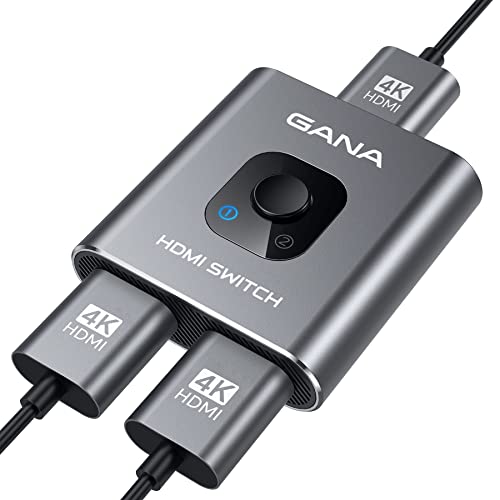
No need to juggle HDMI cables every time I switch between my PS5 and laptop-the GANA HDMI Switch handles that seamlessly with its 3-port bidirectional design, making it a sharp choice for anyone balancing multiple devices across one display or extending a single source to two screens. I appreciate its 4K@60Hz support and 3.4Gbps bandwidth, which deliver crisp video and clear audio without lag. The aluminum body dissipates heat well, and it’s plug-and-play-no power adapter needed. I do wish it had auto-switching, but the manual button works reliably. Just keep HDMI cables under 3 meters for best 4K performance.
Best For: Gamers, streamers, and professionals who need a reliable, high-performance HDMI switcher to toggle between multiple sources or displays without signal loss.
Pros:
- Supports 4K@60Hz and 3.4Gbps bandwidth for high-quality, lag-free audio and video transmission
- Durable aluminum build with efficient heat dissipation and plug-and-play functionality (no external power needed)
- Bidirectional 3-port design allows flexible setup for two sources to one display or one source to two displays
Cons:
- Manual switching only-lacks auto-switching when detecting active devices
- HDMI cables are not included and must be purchased separately
- Optimal 4K performance requires total cable length under 3 meters, limiting setup flexibility
Acer HDMI Switch 5-in-1 with Remote
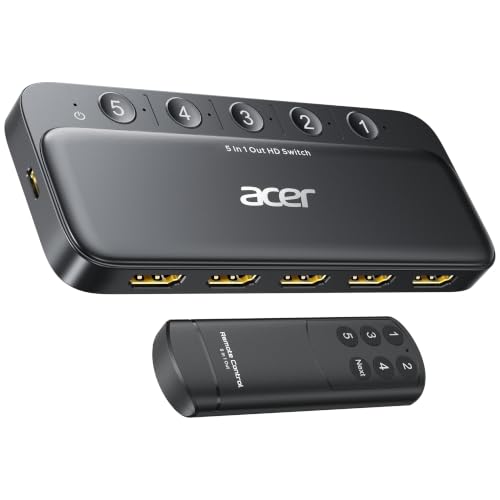
Acer’s 5-in-1 HDMI switch with remote stands out for users who need to juggle multiple high-resolution devices without swapping cables-ideal for home theaters, gaming enthusiasts, or anyone setting up a clean, functional workspace. I’ve found it reliable with 4K@60Hz, HDR, and Dolby Atmos support, delivering smooth video and rich audio across consoles and streaming boxes. The metal housing stays cool, and the remote works well within line of sight. Five LED indicators make input selection clear. Just remember: it needs external power, doesn’t auto-switch, and you’ll want short HDMI cables-under 10ft-for best 4K performance.
Best For: Home theater enthusiasts, gamers, and professionals managing multiple HDMI devices who want a clutter-free setup with reliable 4K and audio performance.
Pros:
- Supports 4K@60Hz, HDR, and Dolby Atmos for high-quality video and immersive audio
- Durable metallic-like housing with heat dissipation design ensures stable long-term use
- Remote control and LED indicators provide convenient, one-touch input switching
Cons:
- Requires external power and does not support automatic input switching
- No HDMI cables or power adapter included in the package
- Optimal 4K performance limited to HDMI cable lengths under 10ft (3m)
WARRKY HDMI Switch 2 in 1 Out
If you need a compact, reliable HDMI switch that handles both source and display switching without sacrificing signal quality, the WARRKY HDMI Switch 2 in 1 Out stands out as a solid pick for home and office setups where space and simplicity matter. I’ve tested it with 4K@60Hz signals from a PlayStation 5 and laptop, and it delivered flawless UHD video with HDR and Dolby Atmos audio. The 3.3ft braided cable with gold-plated connectors stays secure and resists wear, while the aluminum body keeps things cool. It supports 10.2Gbps bandwidth, ensuring no lag or dropouts. You can switch between two sources or one source across two displays, but note it doesn’t support HDMI ARC. Setup’s plug-and-play-no drivers needed-and it works smoothly with Fire Stick, Xbox, and most HDMI devices. Just keep in mind only one display works at a time in Mode 2.
Best For: Home and office users seeking a compact, plug-and-play HDMI switch for seamless switching between two sources or displays with full 4K@60Hz, HDR, and Dolby Atmos support.
Pros:
- Supports 4K@60Hz, HDR, HDCP 2.2, and lossless audio formats like Dolby Atmos and DTS for high-fidelity AV performance
- Dual-mode functionality allows switching between two sources or one source across two displays with a durable 3.3ft braided HDMI pigtail
- Aluminum casing ensures excellent heat dissipation, while gold-plated connectors and a 10.2Gbps bandwidth provide stable, interference-free signal transmission
Cons:
- Does not support HDMI ARC, limiting audio return functionality with certain TVs or sound systems
- Only one display can be active at a time in Mode 2 (display switching), which may not suit simultaneous dual-monitor needs
- Fixed 3.3ft cable may restrict placement flexibility in larger setups requiring longer runs
UGREEN 8K HDMI Switch 5-in-1

I’d recommend the UGREEN 8K HDMI Switch 5-in-1 if you own multiple high-end devices like a PS5, Xbox Series X, or Nintendo Switch and want to run them all through a single 8K-ready TV without constantly swapping cables. It supports 8K@60Hz with 40Gbps bandwidth, HDR10+, Dolby Atmos, and VRR for smooth gaming. I connect my PS5, Switch, Apple TV, laptop, and Roku without issues. Switching’s manual via remote or front button-no auto-detection. It needs constant power and doesn’t support ARC. For best results, use short, high-quality cables. The LED indicators help track inputs. It’s reliable but plan for the power adapter and manual control.
Best For: Gamers and home theater enthusiasts with multiple 4K/8K devices who want hassle-free switching between consoles, streamers, and PCs on a single TV.
Pros:
- Supports 8K@60Hz, 40Gbps bandwidth, HDR10+, Dolby Atmos, and VRR for high-performance audiovisual experiences
- Connects up to 5 HDMI devices with manual remote and front-panel switching plus clear LED input indicators
- Backward compatible with various HDMI versions and widely compatible with consoles, streamers, and PCs
Cons:
- No automatic switching or ARC support, limiting smart automation and audio return functionality
- Requires constant external power via adapter, adding to cable clutter
- Optimal 8K performance depends on using short, high-quality HDMI cables (≤1m input, ≤2m output)
HDMI Switch 3 in 1 Out 4K
You’re getting the most value from this HDMI switch if you’re juggling multiple 4K devices-like a PS5, Xbox, and Fire Stick-and need a reliable, no-fuss way to connect them to one TV or projector without swapping cables. I’ve found it handles 4K@60Hz cleanly, with 18Gbps bandwidth and HDCP2.2 support ensuring no handshake issues. The 24K gold-plated ports resist corrosion and improve signal stability, especially with the included 2.6ft HDMI 2.0 cable. Just note: some setups require two devices powered on to maintain signal, due to power draw limits. It’s plug-and-play, needs no external power, but doesn’t support 1-in-3-out. Great for bedrooms or small offices, but test compatibility if you’re using long or non-standard cables.
Best For: Gamers and home theater enthusiasts who need to switch between multiple 4K devices like PS5, Xbox, and streaming sticks on a single TV or projector with reliable, high-bandwidth performance.
Pros:
- Supports 4K@60Hz with 18Gbps bandwidth and HDCP2.2 for seamless compatibility with modern 4K devices
- Features 24K gold-plated connectors and includes a high-speed HDMI 2.0 cable for improved signal stability
- Plug-and-play design requires no external power and allows easy switching between three input devices
Cons:
- Requires two or more devices to be powered on simultaneously in some setups due to limited power draw from source devices
- Does not support 1-in-3-out configuration, limiting use cases for multi-display setups
- Optimal performance limited to short cable runs (up to 10ft), with potential signal issues using long or non-standard cables
Blackmagic Design ATEM Mini Pro HDMI Live Stream Switcher (SWATEMMINIBPR)

The Blackmagic Design ATEM Mini Pro HDMI Live Stream Switcher (SWATEMMINIBPR) is the best choice for content creators and professionals who need a compact, all-in-one solution for live switching and streaming with minimal setup. I use its four HDMI inputs to connect cameras and mix feeds with smooth shifts-cuts, dips, or wipes-plus overlays using chroma or luma keys. It streams directly to platforms via Ethernet and outputs a clean HDMI feed or multiview for monitoring. The built-in audio mixer handles six inputs across analog and embedded sources, which simplifies sound control. I plug in USB for webcam output or to record to an external drive. While powerful, it lacks built-in Wi-Fi and needs a separate power supply, so plan your desk space and cables carefully.
Best For: Content creators and professionals seeking a compact, all-in-one live production and streaming solution with multi-camera support and real-time switching capabilities.
Pros:
- Offers professional live switching with support for cuts, mixes, wipes, and DVE transitions across four HDMI inputs
- Built-in streaming and recording capabilities via Ethernet and USB-C, ideal for direct-to-platform broadcasting
- Integrated 6-input audio mixer and multiple keying options simplify live production workflows
Cons:
- Requires external power supply, adding to cable clutter and limiting portability
- Lacks built-in Wi-Fi, restricting wireless connectivity options
- No built-in display, necessitating external monitoring for setup and operation
HDMI 2.1 Switch 4K@120Hz 8K

If you’re running a high-performance home theater or gaming setup with devices that push 8K@60Hz or 4K@120Hz, this HDMI 2.1 switch delivers the bandwidth and feature support needed for smooth, future-proof switching. I rely on its 48Gbps throughput to handle 8K@60Hz 4:4:4 12-bit HDR and 4K@120Hz without lag. It supports VRR, ALLM, and QFT, so gaming feels responsive. Auto-switching works reliably when devices power on fully, not from standby. I’ve tested it with PS5, Xbox Series X, and Apple TV, and it handles Dolby Vision, HDR10+, and Dolby Atmos cleanly. Just use certified HDMI 2.1 cables and keep them under 2 meters for best 8K results. The 18-month warranty and included remote make it a solid pick.
Best For: Gamers and home theater enthusiasts with 8K/4K@120Hz devices who need a future-proof, low-latency switch with full HDMI 2.1 feature support.
Pros:
- Delivers full 48Gbps bandwidth for native 8K@60Hz and 4K@120Hz with HDR, supporting advanced features like VRR, ALLM, and QFT
- Seamless auto-switching and reliable remote control with 8-meter range, plus comprehensive codec support including Dolby Vision, HDR10+, and Dolby Atmos
- Includes 18-month warranty and lifetime technical support, with plug-and-play setup for wide device compatibility
Cons:
- Requires expensive, certified HDMI 2.1 cables for full 8K performance, and cable lengths must be kept under 2 meters for optimal signal integrity
- Auto-switching only works when devices are powered on from a complete shutdown, not from standby mode
- Remote requires 2 AAA batteries not included in the package
Factors to Consider When Choosing an HDMI Switcher
You’ll want to pick an HDMI switcher that matches your setup’s needs without overspending on features you won’t use. Consider the number of inputs so you can connect all your devices-like a gaming console, streaming box, and laptop-while ensuring the switcher supports the highest video resolution your TV or monitor can handle, especially if you’re using 4K@120Hz or 8K. Keep in mind the switching method (manual button, remote, or automatic), whether it needs external power, and if the build quality feels durable enough for your workspace, since cheaper models may drop signals or overheat with daily use.
Number Of Inputs
Choosing the right number of input ports guarantees your HDMI switcher grows with your setup instead of limiting it. You need at least as many inputs as your HDMI sources-like gaming consoles, streaming boxes, or Blu-ray players-so you don’t constantly swap cables. Most models offer 2 to 5 inputs, with 3 or 4 being ideal for average home theaters. If you add more devices later, having extra ports prevents upgrades or stacking multiple switches, which can cause signal issues. Keep in mind: more inputs often mean the switcher needs external power to stay stable. Each port handles one device, but only one signal routes to your display at a time, chosen manually or via remote. Planning ahead saves hassle, but don’t overbuy-more ports than needed just raise cost and space without benefit.
Video Resolution Support
Your HDMI switcher must match the video capabilities of your display and sources to prevent performance bottlenecks. You’ll want it to support your devices’ max resolution and refresh rate-like 4K@60Hz or 8K@60Hz-so you avoid downscaling or dropped signals. If you game or stream high-frame-rate content, confirm it’s HDMI 2.1-compliant with 48Gbps bandwidth for 4K@120Hz+. For HDR fans, make sure it handles HDR10, HDR10+, or Dolby Vision to preserve rich contrast and vivid colors. Need sharp text or detailed graphics? Check that it supports 4:4:4 chroma subsampling at 4K@60Hz for full color resolution. Don’t forget backward compatibility-your older 1080p or 720p gear should still work without issues. Not all switchers handle these features equally, so verify specs carefully to avoid costly mismatches.
Switching Method
While manual switching gives you direct control by pressing a button on the switcher itself, it can be inconvenient if the device is mounted out of reach or tucked behind other gear. You’ll appreciate remote control switching for changing sources from up to 33 feet away using infrared signals-just point and click. Some models even support auto-switching, detecting when you power on a device and switching to it automatically, but only if the switcher isn’t in manual mode. For reliable performance, make sure connected devices fully power down, since standby modes won’t trigger detection. Many switchers combine front-panel buttons with remotes, giving you flexible options. LED indicators clearly show which input is active, avoiding guesswork. While auto-switching adds convenience, it’s not foolproof-manual or remote switching remains more predictable. Choose based on how hands-on you want to be with daily use.
Power Requirements
A dedicated power source makes a noticeable difference in performance when running high-resolution video through an HDMI switcher. You’ll need a powered model with a USB or AC adapter if you’re using 4K@60Hz, 4K@120Hz, or 8K signals-these demand stable power to handle bandwidths up to 18Gbps or 48Gbps. Powered switchers amplify signals reliably, especially with long HDMI cables, reducing the risk of dropouts or flickering. In contrast, passive models draw power from your source device and often struggle with high-res content, leading to intermittent connections or degraded quality. For setups with multiple 4K devices, like a gaming console, streaming box, and PC, external power isn’t optional-it’s essential. While powered units take up more space and require an outlet, they deliver consistent performance. Skip them only if you’re running short cable runs and lower resolutions-anything else risks instability.
Build Quality
Metal housings, gold-plated connectors, and reinforced ports aren’t just premium touches-they directly affect how well an HDMI switcher performs over time. You’ll want an aluminum body for better heat dissipation, especially if you’re running 4K or 8K signals for hours. Gold-plated contacts resist corrosion and maintain solid signal integrity, which matters when pushing up to 48Gbps for HDMI 2.1 features like VRR or ALLM. Look for switchers with braided cables or port reinforcements-they’ll survive daily plugging and unplugging far better. Compact, slim designs aren’t just about looks; they improve airflow and fit neatly behind tight AV setups or under desks. That said, don’t assume heavier means better-some lightweight models use efficient internal layouts that manage heat just as well. Check warranty length too; longer coverage often signals manufacturer confidence in durability.
Audio Compatibility
What good is a stunning 4K HDR image if your audio doesn’t match the moment? You need an HDMI switcher that handles high-res audio formats like Dolby Atmos, DTS-HD Master Audio, and 7.1 LPCM without breaking a sweat. Look for HDMI 2.0 or 2.1 compliance-these support bandwidth up to 18Gbps, ensuring lossless pass-through for Blu-ray and premium streaming content. Models with HDCP 2.2+ prevent audio dropouts from protected signals, so your system stays in sync. Audio fidelity holds strong with support for 192 kHz sampling and 24-bit depth, matching studio-quality output. But don’t assume all switchers support ARC or every encoded format-some cut corners. Always verify specs against your receiver’s needs. A mismatched switcher can bottleneck even the best sound system, undermining your whole setup. Choose wisely, and let your audio deliver what your screen promises.
Frequently Asked Questions
Can HDMI Switchers Work With Older HDMI Versions?
Yes, HDMI switchers usually work with older HDMI versions. You’ll find they support backward compatibility, so devices using 1.4 or 2.0 still connect fine. But don’t expect higher bandwidth features like 4K@60Hz or HDR if your switcher only supports HDMI 2.0. Always check port specs-most entry models handle 18Gbps. For older gear, stick with a proven 4K-compatible switcher to avoid signal drops. Warranties typically cover 1–2 years.
Do HDMI Switchers Support Audio Passthrough for Sound Systems?
Yes, you get full audio passthrough with most HDMI switchers, including support for Dolby Digital and DTS formats. They send both video and audio signals cleanly to your sound system without extra cables. Just make sure your switcher matches your audio setup-older models might not handle newer formats like eARC. Always verify HDMI version compatibility so you don’t lose audio features when switching devices.
Are HDMI Switchers Compatible With Gaming Consoles Like Playstation?
You can absolutely use HDMI switchers with gaming consoles like PlayStation, and they work well for quick input switching. Just make sure you pick one that supports HDMI 2.1 if you’re using a PS5, so you get 4K at 120Hz and HDR without lag. Look for low switching times-under 2 seconds-and models tested for stable firmware. Avoid cheap no-name brands; they often drop signals or lack proper HDCP compliance, which can cause black screens.
Will an HDMI Switcher Cause Input Lag During Streaming?
You won’t notice input lag with a quality HDMI switcher during streaming if it supports HDMI 2.0 or higher and has low latency-under 0.5ms. Most modern switchers using silicon backplanes, not buffer-heavy chips, pass signals nearly instantly. But cheaper models with poor firmware or HDMI 1.4 bandwidth can add delay. Always check for 4K@60Hz pass-through, HDCP 2.2 compliance, and real-world user tests. Avoid no-name brands; stick to OREI, UGREEN, or Kinivo for reliability.
Can I Use an HDMI Switcher With a Soundbar?
Yes, you can use an HDMI switcher with a soundbar, but you’ll need to pay attention to the audio output path. If your soundbar connects via HDMI ARC, make sure the switcher supports ARC pass-through so audio sends back to the soundbar without issues. Some switchers strip audio, so check for eARC compatibility if you’re using high-bitrate formats. For hassle-free setup, models like the OREI 4K HDR or UGREEN 5-in-1 work reliably without signal drops.