Best Microphone Stands for Your Desk Setup (And Sound Perfect)
For a reliable desk mic stand, choose the FIFINE BM88 or InnoGear Boom Arm-they’re built with all-metal construction, support up to 3.3 lbs, and offer 360° rotation and 29-inch reach for flexible positioning. Their sturdy clamps fit desks up to 2.4 inches thick, and built-in cable management keeps your setup clean. Just make certain your mic’s weight and thread size (like 5/8” or 3/8”) match the stand’s limits to prevent sagging or wobble-some models struggle with heavy mics like the SM7B over time. You’ll see which stand fits your mic type and space next.
We are supported by our audience. When you purchase through links on our site, we may earn an affiliate commission, at no extra cost for you. Learn more. Last update on 19th July 2026 / Images from Amazon Product Advertising API.
Notable Insights
- Choose a boom arm with 360° rotation and 20+ inch reach for flexible positioning and clean cable management.
- Opt for a weighted steel base or clamp-on design to ensure stability and prevent tipping with heavy microphones.
- Select a stand with a height adjustment range between 10 and 16 inches to suit various desk setups and speaker heights.
- Use a shock mount-compatible stand to reduce vibrations and improve audio quality for podcasting or streaming.
- Pick a foldable, space-saving model if desk space is limited or portability is needed for on-the-go recording.
InnoGear Boom Arm Mic Stand
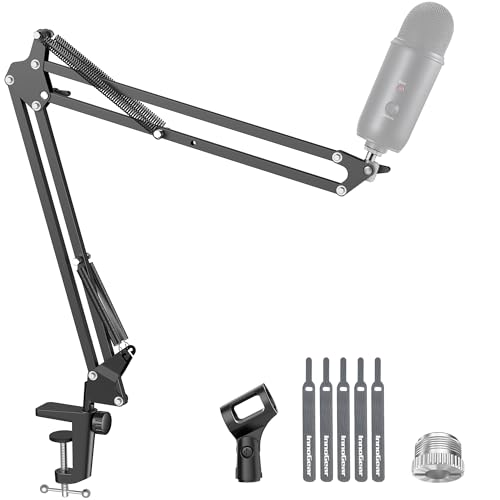
If you need one reliable boom arm for heavy microphones and frequent positioning changes, the InnoGear Boom Arm Mic Stand stands out as a top contender. I’ve used it with mics up to 3.3lb-like the Shure SM7B and Blue Yeti-and it holds firm without sagging. The steel build and reinforced springs feel sturdy, and the internal mechanism avoids the knob interference that weakens cheaper arms. You get smooth 360° base rotation, 135° extension, and 270° adapter spin for exact positioning. It folds flat for storage, which saves space. Just note: the clamp only fits flat, squared desks up to 2 inches thick. It works great if your desk fits, but won’t mount securely on rounded or slanted edges. Includes a mic clip and 5/8″ to 3/8″ adapter for mics like the HyperX SoloCast, QuadCast, and Razer Seiren V3 Mini-though you’ll need to buy a shock mount separately.
Best For: Content creators and podcasters who need a durable, highly adjustable mic stand for heavy microphones and frequent positioning.
Pros:
- Supports up to 3.3lb with reinforced springs and steel construction, ideal for heavy mics like the Shure SM7B and Blue Yeti
- Fully articulating design with 360° base rotation, 135° extension, and 270° adapter spin enables precise microphone positioning
- Foldable design and compact storage make it space-efficient for desktop setups
Cons:
- Clamp only fits flat, squared desk edges up to 2 inches thick, not compatible with rounded or slanted surfaces
- Does not include a shock mount, requiring an additional purchase for vibration isolation
- Limited adjustability on the boom arm shaft due to fixed knob placement despite overall high mobility
InnoGear Adjustable Desktop Mic Stand for Blue Yeti

The InnoGear Adjustable Desktop Mic Stand is my top pick for anyone using a Blue Yeti or similar desktop condenser mic in a space-limited setup, like a home office or streaming station. Its 5.12-inch metal base weighs 1.85 lbs and stays put, thanks to non-slip pads that protect surfaces and resist knocks. I can adjust the height from 10.6 to 15.4 inches using a secure screw knob that locks the position-no sliding. It holds up to 3.3 lbs, so heavier mics like the Blue Yeti Pro or HyperX QuadCast stay steady without noise. The included 5/8″ to 3/8″ adapter works with most mics, and the clip fits dynamic models like the SM58. It’s compact and light, so I toss it in my bag for meetings, church, or events. While it won’t offer boom arm reach, it’s stable, simple, and ideal if desk space is tight.
Best For: Users of desktop condenser microphones like the Blue Yeti who need a compact, stable, and portable stand for space-limited environments such as home offices or streaming setups.
Pros:
- Sturdy 1.85 lb metal base with non-slip pads ensures stability and surface protection
- Height adjusts securely from 10.6 to 15.4 inches with a locking knob to prevent sliding
- Compatible with a wide range of microphones via included 5/8″ to 3/8″ adapter and holds up to 3.3 lbs
Cons:
- Limited height and reach compared to boom arm stands
- Not suitable for large or heavy studio mics exceeding 3.3 lbs
- Fixed desktop placement limits positioning flexibility
InnoGear Adjustable Desk Microphone Stand Black

You’ll get the most out of the InnoGear Adjustable Desk Microphone Stand Black if you need a stable, no-frills base for heavier mics like the Blue Yeti or Shure SM7B without taking up much desk space. Its heavy-duty, powder-coated base with a rubber gasket resists tipping and cuts vibration, which I’ve found critical when recording near speakers or loud instruments. The boom arm supports up to 4.4 lbs halfway extended-enough for most large condensers-but don’t max it out fully or risk sagging. Height adjusts from 11 to 15.8 inches via a reliable twist clutch, and the included 3/8″ to 5/8″ adapter guarantees compatibility across mics like the AT2035 or Razer Seiren X.
Best For: Audio professionals and content creators needing a compact, stable mic stand for heavy microphones like the Blue Yeti or Shure SM7B in space-constrained environments.
Pros:
- Sturdy powder-coated base with rubber gasket provides excellent stability and vibration isolation
- Adjustable boom arm supports up to 4.4 lbs halfway extended, accommodating most large condenser mics
- Includes 3/8″ to 5/8″ adapter for broad microphone compatibility and secure height adjustment via twist clutch
Cons:
- Load capacity decreases when boom arm is fully extended, risking sag under heavy loads
- Limited height adjustment range (11–15.8 inches) may not suit all desk setups
- No storage or cable management features included
TODI Mic Arm for Lightweight Mics (3LB)

I’ve found the TODI Mic Arm works best for people using lightweight microphones under 3 pounds, especially if desk space matters and setup needs to stay minimal. Its all-metal build with reinforced screws prevents wobble, making it more stable than gas arms. The boom extends 29 inches, fitting large desks, and folds neatly when not in use. You get full 360° base rotation and flexible positioning with a hex wrench for fine-tuning angles. Built-in cable management keeps cords tidy. It includes 3/8″ and 5/8″ threads, so most mics fit-just not 1/4″ models like the Blue Yeti X or Shure MV7i.
Best For: People using lightweight microphones under 3 pounds who want a sturdy, space-saving mic arm with clean cable management and flexible positioning on large desks.
Pros:
- Sturdy all-metal construction with reinforced screws for enhanced stability and reduced wobble
- Adjustable boom arm extends up to 29 inches and folds neatly, ideal for large desks with minimal footprint
- 360° base rotation, integrated cable management, and dual 3/8″ and 5/8″ threads for broad mic compatibility
Cons:
- Not suitable for heavy-duty or studio-grade microphones exceeding 3 pounds
- Limited compatibility with microphones requiring 1/4″ thread, such as Blue Yeti X and Shure MV7i
- Hex wrench required for adjustments, which may slow down frequent repositioning
BILIONE Portable Foldable Microphone Stand

Compact podcast weakening and mobile streamers gravitate toward the BILIONE Portable Foldable Microphone Stand for its no-fuss stability and space-saving design. I’ve found its high-quality iron base and tripod structure resists tipping well, especially with one leg forward. It adjusts from 6.29 to 7 inches-perfect for desk setups needing low-profile gear. The universal clip with anti-slip padding and included 3/8-to-5/8 adapter fits most dynamic mics securely. It’s ideal for podcasts, streaming, or classroom use, and the included storage bag makes travel easy. Just note: its fixed height range limits taller mics, so it’s best for compact, handheld setups.
Best For: Mobile content creators and podcasters seeking a compact, stable microphone stand for desktop use in space-limited environments.
Pros:
- Stable tripod design with high-quality iron construction resists tipping, especially with one leg positioned forward
- Includes universal mic clip with anti-slip padding and a 3/8-to-5/8-inch thread adapter for broad microphone compatibility
- Foldable and portable with a compact height range and included storage bag for easy transport
Cons:
- Limited height adjustment (6.29 to 7 inches) restricts use with taller microphones
- Not suitable for large or heavy microphones due to compact size and fixed design
- Desktop use only-lacks boom arm or extended reach for flexible positioning
BILIONE Multifunctional Desktop Microphone Stand

The BILIONE Multifunctional Desktop Microphone Stand delivers a complete, studio-ready setup that’s ideal for streamers, podcasters, and remote workers who need reliable, professional-grade gear without cluttering their desk. Its 1.5 lb metal base stays put, and the 0.74-inch thick rod supports heavy mics like the AT2035 or HyperX QuadCast. I appreciate the dual-layer pop filter-it kills plosives effectively-and the shock mount cuts desk vibrations. It fits mics 1.77–2.05 inches wide, but skip it if you have a Blue Yeti. The included 5/8″ to 3/8″ adapter boosts compatibility, and the removable anti-slip pads help with stability. It’s solid, functional, and minimizes clutter-just don’t overload it.
Best For: Streamers, podcasters, and remote workers seeking a clean, stable, and professional microphone setup without desk clutter.
Pros:
- Includes a full studio kit (shock mount, pop filter, mic clip, adapter) for immediate use
- Heavy 1.5 lb metal base and thick 0.74-inch rod ensure stability with heavy microphones
- Dual-layer pop filter and effective shock mount deliver clean, vibration-free audio
Cons:
- Not compatible with Blue Yeti microphones
- Removable anti-slip pads may be inconvenient for frequent repositioning
- Limited shock mount size range (1.77–2.05 inches) excludes some larger microphone models
InnoGear Studio Mic Stand for Desktop

If you’re setting up a tight workspace and need solid support for heavier mics like the Blue Yeti or HyperX QuadCast, this stand holds up-literally. I’ve used the InnoGear Studio Mic Stand daily for weeks, and its 2.4 lb steel base stays put, supporting up to 2.64 lb-more than most rivals. Two pivot points let me adjust angles smoothly, and the 270° range fits snug desks. Non-slip pads prevent scratches, and the foldable arm saves space. It includes both 3/8” to 5/8” and 3/8” to 1/4” adapters, so it works with Fifine, AT2020, and even webcams. You’ll need an Allen wrench to tighten joints, which stores neatly on the base-minor hassle, worth the secure hold.
Best For: Creators with compact workspaces who need a durable, adjustable stand for heavier microphones like the Blue Yeti or HyperX QuadCast.
Pros:
- Supports up to 2.64 lb with a sturdy 2.4 lb steel base, offering superior load capacity compared to competitors
- Includes universal adapters (3/8” to 5/8” and 3/8” to 1/4”) for compatibility with a wide range of microphones, webcams, and cameras
- Compact, foldable design with non-slip pads and 270° adjustability for flexible positioning and desk protection
Cons:
- Requires an Allen wrench to tighten joints, which may be inconvenient for frequent adjustments
- Limited height extension compared to boom arms, restricting vertical positioning options
- Base, while stable, may still be too wide for extremely tight desk spaces
FIFINE Microphone Boom Arm Stand (BM88)

I’ve found the FIFINE BM88 delivers solid performance for creators who need a durable, full-featured boom arm without breaking the bank-ideal if you’re setting up a podcasting station, streaming desk, or voice recording space. Its all-metal build feels sturdy at 2.87 pounds, and the 29-inch reach gives me plenty of positioning room. I can adjust it 220 degrees vertically and 360 degrees horizontally, though the base near the clamp doesn’t tilt. The C-clamp fits desks 0.8 to 2.4 inches thick and stays put without scratching. Built-in cable management keeps my XLR cable tidy, and the included thread adapters handle most mic mounts. It’s stable, even at full extension. Just note: the low-profile design helps, but make sure you’ve got clearance under your monitor.
Best For: Content creators, streamers, and podcasters seeking a durable, adjustable, and affordable microphone boom arm for a clean and professional setup.
Pros:
- All-metal construction provides excellent durability and stability, even at full 29-inch extension
- Full 360° horizontal and 220° vertical adjustability with a low-profile design that fits neatly under monitors
- Includes built-in cable management and multiple thread adapters (1/4″, 3/8″, 5/8″) for broad microphone and shock mount compatibility
Cons:
- Base near the clamp does not tilt vertically, limiting some fine-tuning positioning options
- Weighs 2.87 pounds, which may require secure clamp placement on lighter desks
- Microphone and shock mount sold separately, adding to overall setup cost
QuadCast Boom Arm Mic Stand by SUNMON

You’ll get the most out of this boom arm if you own a HyperX QuadCast or another large-diaphragm condenser like the Blue Yeti or Shure MV7, since the SUNMON stand comes with a silver 3/8″ to 5/8″ threaded adapter pre-installed and ready to mount-no extra parts or guesswork needed. I’ve used it with a Blue Yeti and a Rode NT-USB, and the dual suspension springs held both securely without sagging. The reinforced knobs stay tight, even after daily adjustments. Its clamp fits desks up to 1.89” thick and includes padding to protect surfaces. Setup took under five minutes-just attach the boom, tighten the knob, and mount your mic. It doesn’t wobble during typing or armrest contact, which many cheaper arms do. While it’s not built for ultra-heavy mics like the Shure SM7B long-term, it handles most popular models reliably. I’ve had mine for six months with zero issues. Just don’t max out the arm’s full extension-it loses stability.
Best For: Content creators and streamers using popular microphones like the HyperX QuadCast, Blue Yeti, or Shure MV7 who want a sturdy, easy-to-set-up boom arm with reliable stability and desk protection.
Pros:
- Pre-installed 3/8″ to 5/8″ adapter allows immediate, tool-free setup with HyperX QuadCast and other compatible mics
- Dual suspension springs and reinforced knobs provide excellent stability with minimal sag or wobble
- Clamp fits thick desks up to 1.89” with protective padding to prevent damage
Cons:
- Not recommended for long-term use with very heavy microphones like the Shure SM7B
- Full extension reduces stability, requiring careful positioning for optimal performance
- Microphone not included, which may confuse first-time buyers
Hoteam 4 Pcs Adjustable Desktop Mic Stand
The Hoteam 4 Pcs Adjustable Desktop Mic Stand is a solid choice for anyone setting up multiple microphones on a single desk-think podcasters running guest mics, streamers using backup mics, or voice actors recording layered audio. I’ve used them side by side, and they stay put thanks to the 5.12-inch metal base and non-slip rubber feet. Each stand adjusts from 10.24 to 15 inches, which fits most desk setups, and the all-metal build resists bending over time. They come with mic clips and a 5/8″ to 3/8″ adapter, so they work with nearly every mic I’ve tried. Just know they take up space-four bases add clutter fast.
Best For: Podcasters, streamers, and voice actors needing multiple stable, adjustable mic stands for desk setups.
Pros:
- Durable all-metal construction resists deformation and ensures long-term reliability
- Non-slip rubber feet and 5.12-inch metal base provide excellent stability and surface protection
- Includes mic clips and 5/8″ to 3/8″ adapter for broad microphone compatibility
Cons:
- Four separate bases can clutter desks with limited space
- Limited height adjustment range may not suit all microphone positioning needs
- No cable management features included
Factors to Consider When Choosing a Microphone Stand for Desk
You’ll want a desk mic stand that’s stable, adjustable, and built to match your mic and workspace. Look for sturdy base options-whether clamp, desktop, or weighted-since a wobbly mount ruins recordings, and check that the stand’s material (like steel or aluminum) supports your mic’s weight without tipping. Also, confirm compatibility with your mic’s size and thread type, and make sure the adjustability range actually fits your seated or standing setup-some booms limit movement more than they let you fine-tune.
Mount Type Options
A clamp mount gives your desk setup a secure foundation, attaching firmly to edges up to 2.4 inches thick without drilling or permanent modification. You’ll appreciate the space-saving benefit, especially if your desk is already crowded. Many models use rubber padding or gaskets to protect surfaces and prevent slipping during use. If your desk can’t support clamping, a weighted base stand offers a solid alternative, relying on a 5 to 7-inch footprint and low center of gravity to resist tipping. Threaded mounts typically come in 5/8-inch or 3/8-inch sizes, and most stands include adapters so you can switch between mic types easily. Foldable or low-profile designs let you tuck the boom arm close to the desk when not in use, maximizing clearance. Just remember-clamp strength and thread compatibility matter most for long-term reliability.
Weight And Stability
Don’t overlook weight and stability when securing your microphone setup-how well a stand resists tipping depends on both its mass and design. Look for a base weighing at least 1.5 pounds with a diameter over 5 inches; this mass and spread offer solid resistance to knocks. Wider tripod bases lower the center of gravity and improve balance, especially with extended boom arms. Non-slip padding on the feet keeps the stand from sliding on smooth desks. Choose stands made from high-quality metal with reinforced joints-they handle stress better and won’t sag over time. Make sure the load capacity exceeds your mic setup by at least 0.5 pounds to avoid droop. Even well-built stands can tip if overloaded, so match your gear carefully. Heavy doesn’t always mean better if the design is flawed, so prioritize balanced engineering over sheer weight.
Adjustability Range
A microphone boom arm with at least 20 inches of vertical adjustment gives you the flexibility to position your mic precisely at mouth level, whether you’re sitting or standing, and models offering up to 29 inches of travel accommodate a wider range of desk heights and chair configurations. You’ll also want at least 27 inches of horizontal reach so the mic can extend over your desk without tipping. Look for 360° base rotation and 270° swivel joints to fine-tune mic placement without repositioning the clamp. Pivot points should allow up to 220° of tilt and a full 180° forward-backward sweep, so you can angle the mic just right. If space is tight, choose a foldable model that retracts under 15 inches when not in use. Keep in mind: more adjustability often means more moving parts, which can reduce long-term stability if not well-built.
Build Quality Materials
When choosing a desk microphone stand, prioritize build quality by focusing on materials that deliver lasting stability and smooth performance. Opt for high-quality steel construction-it’s durable and handles mics up to 4.4 lbs without sagging. All-metal bodies with reinforced screws resist wobble and cut down on vibrations, unlike flimsy plastic bases. Look for a weighted base between 1.5 and 2.4 lbs; it lowers the center of gravity and reduces tipping during daily use. Powder-coated finishes resist scratches, while rubberized contact points protect your desk and dampen noise. Upgraded metal joints and internal spring mechanisms maintain their position over time, avoiding the droop common in cheaper stands. While sturdier materials add some weight, the trade-off is reliable, long-term performance. Avoid hybrid models with plastic joints-they may save a few bucks but wear out faster under constant adjustment.
Microphone Compatibility
Solid build quality sets the foundation, but just as important is making sure the stand actually works with your microphone. You need the right thread size-most mics use a 5/8″, but adapters for 3/8″ or 1/4″ are common, so confirm the stand includes them. Check the load capacity too; if your mic is heavy, like a large-diaphragm condenser, the stand must support it without drooping. You’ll also want a secure clip or shock mount that fits your mic’s diameter-standard mounts handle 1.9–2.0″, but oversized models may need special fittings. Some microphones require specific mounts or boom arms, so consider whether a desktop, tripod, or articulated arm design suits your space and positioning needs. Not all stands handle every setup, so verify compatibility before buying.
Cable Management Features
Your desk setup’s clean look hinges on smart cable management, and the right microphone stand makes it effortless. Look for models with built-in cable channels or hidden routing that guide XLR or USB cables neatly along the arm-this reduces clutter and stops accidental tugs that can damage your mic or cause audio noise. Many stands include snap-on covers or open grooves, so you can easily insert or reposition cables without hassle. These systems typically support up to 6-foot cables, running them fully enclosed from mic to interface. Proper management doesn’t just look sharp; it boosts cable and microphone lifespan by preventing snags and tension. Just make sure the stand’s routing fits your cable thickness-some tight channels struggle with bulky or right-angle connectors. Test access if you swap gear often, since deeper channels can be slower to reload.
Portability And Size
For those tight on space or always on the move, a compact and lightweight microphone stand makes a real difference. You’ll want a model under 16 inches tall and weighing less than 2 pounds-these fit easily in bags and work smoothly on cramped desks. Foldable arms reduce clutter and simplify storage, while tripod bases provide stability even on uneven surfaces. Height adjustability between 6 and 16 inches gives you control without sacrificing space. Built-in cable management keeps wires tidy, making teardown and transport faster. Just know that ultra-compact designs may limit microphone positioning options, so check your mic’s weight and size compatibility. These stands aren’t ideal for heavy studio mics but excel with lightweight USB or small condenser models. Test the build quality-look for solid joints and a stable base. For mobile users and minimalists, the right small stand delivers solid performance without the bulk.
Frequently Asked Questions
Can I Use a Microphone Stand With a Lavalier Mic?
Yes, you can use a microphone stand with a lavalier mic, but it’s not ideal for most desk setups. Lavalier mics are designed to clip onto clothing and stay close to your mouth, so mounting them on a stand often leads to weaker audio and inconsistent pickup. If you do use a stand, pick a small articulating arm to position the lavalier just below your chin. Be ready to tweak placement constantly. Use only if you’ve tested audio levels and confirmed clarity-otherwise, stick to a headset or dedicated condenser mic.
Are Microphone Stands Compatible With All Desk Thicknesses?
No, microphone stands aren’t compatible with all desk thicknesses. Most clamps fit desks 0.5 to 2.5 inches thick; thicker desks need extended or detachable jaws. You’ll check your desk first-measure carefully. Some models offer padding to protect surfaces, while others wobble on edges under heavy mics. Even sturdy stands fail if the clamp’s range doesn’t match your setup. Always verify specs, and consider a grommet mount if your desk exceeds limits.
Do Mic Stands Reduce Background Noise?
No, mic stands don’t reduce background noise. They position your mic correctly, which helps capture cleaner audio by minimizing handling noise and desk vibrations. Shock mounts on stands offer some isolation, but they won’t block room echo or ambient sound. For noise reduction, focus on mic placement, room treatment, and using directional mics. A sturdy stand improves stability and setup flexibility, but don’t rely on it to fix audio issues-your environment and gear choice matter more.
How Do I Clean and Maintain My Microphone Stand?
You clean and maintain your microphone stand by wiping it down monthly with a microfiber cloth and mild soapy water, avoiding harsh chemicals that damage finishes. Dry thoroughly to prevent rust, especially on steel parts. Check clamps and joints every few weeks-tighten loose screws and lubricate moving parts lightly with silicone spray. Don’t over-tighten knobs; it strips threads. Aluminum stands stay lighter but scratch easier. Always unmount your mic before cleaning.
Can I Mount Multiple Microphones on One Boom Arm?
Yes, you can mount multiple mics on one boom arm, but only if the arm’s weight capacity and design allow it. Most standard boom arms support one mic, typically up to 5 lbs. Adding a second mic risks sagging or instability unless you use a heavy-duty model like those with dual counterweights or a studio-grade build. Always check load specs, balance carefully, and avoid overcrowding-clutter affects mic positioning and sound quality.