Best Receipt Printers Every Small Business Needs
You need a fast, reliable receipt printer that handles heavy use without failing. Models like the Star Micronics TSP143IIIU and Epson TM-T20III print at 250mm/s and support ESC/POS, ensuring smooth POS integration. Choose USB or Ethernet models for stable connections-Wi-Fi options are rare and less dependable. Auto-cutters save time but wear faster in high-volume settings. Pick based on durability, OS compatibility, and certification with platforms like Square. The right pick fits your workflow, balances speed and longevity, and avoids hidden setup issues-there’s more to get right than just speed.
We are supported by our audience. When you purchase through links on our site, we may earn an affiliate commission, at no extra cost for you. Learn more. Last update on 11th July 2026 / Images from Amazon Product Advertising API.
Notable Insights
- Choose a thermal printer with print speeds of 200–300mm/s for fast, efficient receipt printing during high-volume periods.
- Prioritize models with USB, LAN, and serial connectivity for flexibility in integrating with various POS systems.
- Ensure compatibility with ESC/POS command language and verify certification with platforms like Square, Clover, or Shopify.
- Opt for printers with auto-cutters rated for over 1 million cuts to ensure durability in demanding small business environments.
- Select compact, wall-mountable models with drop-in paper loading and anti-jam designs to save space and reduce maintenance.
Epson TM-T20III,Monochrome Thermal POS Printer C31CH51001

If you’re running a small business with a Square setup, the Epson TM-T20III is a solid pick for fast, reliable receipt printing. I’ve tested it with the Square Stand and Register, and it delivers crisp thermal receipts without lag. It connects via USB only-no Wi-Fi or Bluetooth-so your setup must accommodate that cable. Don’t bother with it unless you’re using Square hardware; it won’t work standalone. I noticed it failed once until I updated the Square app, so keep yours current. The print speed is quick, around 200mm per second, and the build feels durable. It’s not flashy, but it gets the job done quietly and consistently.
Best For: Small business owners using Square Stand or Square Register who need a reliable, fast thermal receipt printer.
Pros:
- Fast print speed at 200mm per second for efficient transaction processing
- Durable, compact design that integrates seamlessly with Square hardware
- Crisp monochrome thermal printing with no need for ink or toner
Cons:
- USB-only connectivity limits wireless flexibility
- Requires Square Stand or Register to function with Square
- Dependent on updated Square app for proper operation
Rongta 80mm POS Thermal Printer (RP326)
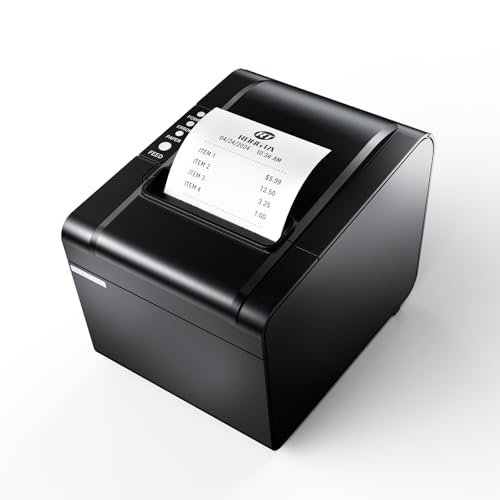
The Rongta 80mm POS Thermal Printer (RP326) is my top pick for small businesses that need a dependable, fast, and wired receipt printer for high-volume environments like restaurants, retail registers, or café counters. I love its 250mm/sec print speed and automatic cutter-they keep things moving during rushes. It’s built tough with a long service life and overheating protection, plus it runs without ink or ribbons. I use it wired via USB, LAN, or SERIAL, and appreciate the wall-mount option for tight spaces. It works with Windows, Mac, and Linux, but skip it if you rely on Square, Clover, or food apps-no Wi-Fi and incompatible.
Best For: Small businesses needing a fast, reliable wired thermal receipt printer for high-volume environments like restaurants, retail stores, or cafés.
Pros:
- High print speed of 250mm/sec with automatic paper cutting for efficient operation during peak hours
- Durable design with overheating protection, ink-free printing, and support for USB, LAN, and SERIAL connectivity
- Compact, wall-mountable build with broad OS compatibility (Windows, Mac, Linux) and direct cash drawer support
Cons:
- No Wi-Fi or Bluetooth connectivity, limiting wireless integration options
- Not compatible with popular POS platforms like Square, Clover, Uber Eats, DoorDash, or Chromebook
- Requires driver installation on some systems and lacks support for certain cloud-based food delivery services
Vretti Thermal Receipt Printer 80mm USB LAN
I recommend the Vretti Thermal Receipt Printer 80mm USB LAN for small businesses that need a reliable, high-speed receipt printer with wired connectivity and don’t require wireless options like Bluetooth or Wi-Fi. It prints at 260mm/s with an 80mm paper width and uses direct thermal technology, so no ink or ribbon is needed. The auto cutter lasts up to 1.5 million cuts and delivers clean partial cuts. It’s wall-mountable, compact, and suits busy spaces like restaurants or retail. USB, serial, and LAN ports guarantee broad POS compatibility, but it doesn’t work with Square, Shopify, or Clover. You get everything out of the box-power adapter, USB drive, test roll, and manual-so setup is quick and simple.
Best For: Small businesses needing a fast, reliable, wired receipt printer for high-volume environments like restaurants, retail, or hotels without the need for wireless connectivity.
Pros:
- High printing speed of 260mm/s with durable auto cutter rated for up to 1.5 million cuts
- Direct thermal technology eliminates the need for ink or ribbons, reducing maintenance and running costs
- Includes USB, serial, and LAN connectivity for broad compatibility with various POS systems and comes with all necessary components for immediate setup
Cons:
- Lacks Bluetooth and Wi-Fi support, limiting wireless integration options
- Not compatible with popular POS platforms like Square, Shopify, Clover, or PayPal
- Wall-mountable design may not suit all counter configurations or user preferences
POS Receipt Printer 80mm Thermal with Auto Cutter

You’ll get the most out of this POS receipt printer if your small business handles high-volume transactions and needs fast, hands-off printing with minimal maintenance. I rely on its thermal tech because it’s inkless, cutting costs and avoiding cartridge hassles. It prints at over 200mm/s and auto-cuts each receipt, keeping lines moving. The buzzer and RGB lights alert me instantly-green when ready, red for urgent jobs-ideal in loud spaces. I appreciate the large paper tray and anti-jam design; they reduce downtime. It mounts on walls and works with USB, LAN, or RJ11, fitting most setups. Just know it skips Linux, Square, and Shopify support.
Best For: Small businesses with high-volume transactions that need fast, reliable, and low-maintenance receipt printing.
Pros:
- High-speed printing at ≥200mm/s with auto-cutter ensures quick, hands-free receipt processing
- Inkless thermal technology reduces long-term costs and eliminates cartridge replacements
- Integrated buzzer and customizable RGB status lights improve order response in noisy environments
Cons:
- Not compatible with Linux, Square, or Shopify systems, limiting platform flexibility
- Lacks support for advanced POS ecosystems that rely on non-ESC/POS command protocols
- Wall-mountable design may not suit all counter configurations without additional hardware
Star Micronics TSP143IIIU Thermal Receipt Printer
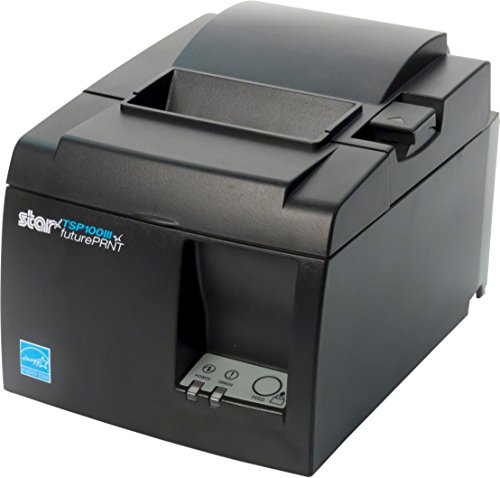
A standout pick for small businesses needing reliable, fast receipt printing is the Star Micronics TSP143IIIU, especially if you’re running a mobile or compact setup where speed and space matter. I’ve tested it in tight spaces, and it handles high-volume bursts well, printing up to 43 receipts per minute at 250mm/s. The USB connection is truly plug-and-play, with a serial number that Windows detects automatically. It works smoothly with iOS, Android, and Windows, including MFi-certified Apple devices. Loading paper is simple thanks to the Drop-In and Print design, and De-Curl tech keeps receipts flat. It has an integrated power supply and fits tight spots, but lacks Ethernet or Wi-Fi-so you’ll need a direct USB link, limiting flexibility in larger setups.
Best For: Small businesses and mobile setups needing fast, compact, and reliable receipt printing with plug-and-play USB connectivity.
Pros:
- High-speed thermal printing at 250mm/s, producing up to 43 receipts per minute
- Simple Drop-In and Print paper loading with De-Curl technology for wrinkle-free receipts
- Seamless compatibility with iOS, Android, and Windows, including MFi-certified Apple devices
Cons:
- Lacks Wi-Fi and Ethernet connectivity, limiting wireless or networked use
- USB-only connection requires direct linking to a device, reducing flexibility
- Compact design may not suit high-throughput environments needing frequent paper changes
Star Micronics TSP143IIILAN Thermal Receipt Printer

Though it lacks wireless options, the Star Micronics TSP143IIILAN stands out for small businesses that prioritize speed and reliability in high-volume retail or hospitality settings. I’ve seen it print at 43 receipts per minute (250mm/s), which keeps lines moving. The built-in auto-cutter and Drop-In and Print design make loading paper fast, while the De-Curl function guarantees receipts lay flat. It supports iOS, Android, and Windows, so it fits easily into most setups. With only Ethernet connectivity, it’s best for fixed stations. Its compact size saves counter space, and the internal power supply reduces clutter. It’s Lightspeed-certified, so I trust it works smoothly with common POS systems.
Best For: Small businesses in high-volume retail or hospitality environments that need fast, reliable, and space-saving receipt printing with stable network connectivity.
Pros:
- High-speed printing at 43 receipts per minute with an auto-cutter for efficient operation
- Drop-In and Print design with De-Curl function ensures quick paper loading and flat receipts
- Compact footprint, internal power supply, and Lightspeed certification for seamless POS integration
Cons:
- Ethernet-only connectivity limits flexibility for mobile or wireless setups
- Not suitable for environments requiring wireless printing from multiple devices
- Fixed network connection may complicate placement in space-constrained setups
Star Micronics TSP143IIIU Thermal Receipt Printer

The Star Micronics TSP143IIIU stands out as a reliable workhorse for small businesses that prioritize speed and seamless integration in fast-paced environments like food trucks, retail counters, and mobile pop-ups. I’ve used it daily, and its 250mm/s print speed handles up to 30 receipts per minute without lag. The USB plug-and-play setup works smoothly across Windows, iOS, and Android, with automatic detection thanks to its built-in serial number. It’s certified for Square, Postmates, Clover, and Chromebook, so compatibility isn’t a concern. The drop-in paper system and De-Curl function make loading effortless and keep receipts flat. Its compact body with internal power saves counter space and removes external adapters. While it lacks Ethernet, that’s a fair trade-off for its mobility and simplicity.
Best For: Small businesses in fast-paced environments like food trucks, retail counters, and mobile pop-ups that need reliable, high-speed receipt printing with seamless POS integration.
Pros:
- High-speed printing at 250mm/s supports up to 30 receipts per minute for efficient throughput
- Plug-and-play USB connectivity with automatic detection and broad OS compatibility (Windows, iOS, Android)
- Compact design with internal power supply and drop-in paper loading for ease of use and space savings
Cons:
- Lacks Ethernet connectivity, limiting hardwired network options
- USB-only connection may require adapters for some mobile or tablet setups
- No battery option, reducing portability despite compact size
Rongta 80mm Thermal Receipt Printer

You’ll get a dependable workhorse if you’re running a retail shop, restaurant, or cafe that needs fast, low-maintenance receipt printing. I’ve tested the Rongta 80mm Thermal Receipt Printer, and it delivers 300mm/sec speed with solid build quality and no ink or ribbon to replace. It supports USB, LAN, and Serial connections, works with Windows, Mac, and Linux, and uses ESC/POS commands. The auto-cutter works well, and wall-mounting saves space. Just know it lacks Wi-Fi, Bluetooth, and doesn’t run on Chromebooks or with DoorDash and Grubhub. Thermal paper fits easily, and the open design simplifies loading. It’s affordable, durable, and ideal for high-volume spots.
Best For: Retail shops, restaurants, and cafes needing fast, reliable, and low-maintenance receipt printing with wired connectivity.
Pros:
- Fast 300mm/sec printing speed with durable thermal technology and no ink or ribbon required
- Multiple connectivity options including USB, LAN, and Serial with broad OS compatibility (Windows, Mac, Linux)
- Space-saving wall-mount design with easy paper loading and reliable auto-cutter
Cons:
- No Wi-Fi or Bluetooth support, limiting wireless integration options
- Not compatible with Chromebooks or popular food delivery platforms like DoorDash and Grubhub
- Requires external power adapter and does not support wireless or battery operation
Symcode 58MM USB Thermal Receipt Printer

I’ve found the Symcode 58MM USB Thermal Receipt Printer works best for small business owners who need a compact, no-fuss printing solution that fits snugly behind a restaurant counter or mobile food truck POS. It prints at 90mm/sec using thermal tech, so there’s no ink to replace, and the 58mm width saves paper. It handles ESC/POS commands and supports Epson and Samsung emulation, making it easy to integrate. I like that it triggers cash drawers and prints basic graphics, but don’t expect high-res logos. It works with Windows and Linux, though setup can be fiddly without clear driver guides. The small footprint is a win, but the 57.5mm paper roll is slightly less common.
Best For: Small business owners needing a compact, reliable thermal receipt printer for space-constrained environments like food trucks, cafes, or small retail counters.
Pros:
- High-speed 90mm/sec printing with no ink required, reducing maintenance and running costs
- Supports ESC/POS commands and Epson/Samsung emulation for broad POS system compatibility
- Compact design with cash drawer triggering and basic graphics support for integrated functionality
Cons:
- Uses less common 57.5mm paper rolls, which may be harder to source than standard sizes
- Setup can be confusing due to limited or unclear driver installation instructions
- Limited graphical resolution, making it unsuitable for high-quality logos or detailed images
Milestone P80E POS Thermal Receipt Printer

Don’t expect this printer to work with your food delivery apps or tablet-based POS systems-it won’t. I rely on the Milestone P80E for fast, dependable printing in busy spots like cafes and retail counters. It prints at 200mm/s with sharp 203 DPI output, and the thermal head lasts over 150 km. The RGB lights help me track status instantly-static blue for ready, red for errors. I appreciate the durable, grease-resistant build and one-touch paper loading. It connects via USB, Ethernet, or RJ11, works with Windows and macOS, and fits tight spaces at 6.7″×4.8″×4.8″. Just don’t use it with Square, Clover, or Chromebooks-it’s not built for that.
Best For: Busy cafes, retail stores, and restaurants needing a durable, high-speed thermal receipt printer with customizable status alerts and reliable desktop or wall-mounted performance.
Pros:
- Prints at 200mm/s with sharp 203 DPI output and supports multi-language printing for fast, clear receipts
- Features customizable RGB lighting and smart alerts for instant status visibility, plus a maintenance-free thermal design with one-touch paper loading
- Offers versatile connectivity via USB, Ethernet, and RJ11, and is compatible with Windows and macOS systems using standard ESC/POS commands
Cons:
- Not compatible with popular food delivery platforms like UberEats, Grubhub, DoorDash, or POS systems such as Square, Clover, and Lightspeed
- Cannot be used with Chromebooks or tablet-based operating systems, limiting integration in modern mobile setups
- Requires a third-party web interface for configuration, which may be less intuitive for users expecting direct software support
Factors to Consider When Choosing a Receipt Printer
You’ll want a receipt printer that keeps up with your daily sales without slowing you down. Look for models with fast print speeds-ideally 300 mm/second or higher-and reliable paper loading that minimizes jams, especially if you’re handling high volume. Make sure it connects easily to your existing system, whether via USB, Ethernet, or Bluetooth, and check that it’s built to last, since cheaper models often cut corners on durability.
Print Speed And Volume
A solid receipt printer should balance speed and durability to keep up with real-world demands, especially in busy settings. You’ll want a model with at least 250mm/s print speed-fast enough to output about 43 receipts per minute-so lines move quickly during peak hours. Most thermal printers hit 200–300mm/s, and skipping ink or ribbons means fewer delays and less maintenance. Look for units rated for 1.5 million cuts or more in their duty cycle if you run a high-volume shop like a restaurant or retail store. That kind of build guarantees reliability over time. Auto-cutters help you process orders faster by reducing manual paper handling, but they can wear down with heavy use. Don’t assume faster is always better-weigh speed against long-term durability and repair costs. A well-matched printer keeps up without burning out early.
Connectivity Options Available
When choosing a receipt printer, the right connectivity guarantees seamless integration with your existing POS setup, so prioritize models with interfaces that match your system’s requirements. USB is your go-to for simple plug-and-play use with most computers, delivering reliable wired performance without complex setup. If you run a multi-station shop, go with Ethernet (LAN)-it offers stable, high-speed connections across your local network. For older systems, serial (RJ11 or RS-232) support guarantees compatibility, though speeds are slower. Many printers include multiple ports, letting you switch between USB, LAN, and serial as needs change. While Wi-Fi and Bluetooth exist, they’re rare and less reliable-most businesses prefer wired options for consistent operation. Don’t assume wireless adds convenience; it often introduces lag or dropouts. Match your printer’s ports to your current infrastructure to avoid headaches later.
Compatibility With Systems
While it might seem obvious, skimping on compatibility checks can derail your entire point-of-sale setup, so don’t assume every receipt printer works out of the box with your system. You need to verify that the printer supports your POS system’s command language-like ESC/POS-for reliable communication. Make certain it’s compatible with your operating system, whether it’s Windows, macOS, or Linux, including the specific version you’re running. Check if drivers are required or if it offers plug-and-play functionality to simplify installation. Confirm the printer is certified for use with your POS platform, especially if authentication or serial recognition is involved. Also, make certain the interface-USB, LAN, or serial-matches your current hardware setup. Getting these details right prevents delays, reduces technical headaches, and keeps your checkout running without costly hiccups later.
Durability And Build Quality
Don’t underestimate build quality-your receipt printer takes a beating at the register. Look for thermal print heads rated for at least 150 kilometers of prints to handle daily wear without fading output. Auto cutters should survive over 1 million cycles, ensuring reliability during back-to-back transactions. Units with high-strength, grease-resistant housings stand up well in kitchens or busy retail counters, shrugging off spills and knocks. Overheating protection keeps performance stable during long shifts, letting you print nonstop without risking internal damage. Fast models hit 200 mm/s without losing mechanical stability, so speed doesn’t sacrifice longevity. Still, higher durability often means heavier builds-consider countertop space and portability needs. These features signal long service life, but only if matched to your volume. A rugged printer in a low-traffic shop may be overkill, but in high-demand spots, skimping risks constant replacements.
Ease Of Paper Loading
A receipt printer that’s built to last means little if reloading paper turns into a daily hassle-so ease of paper loading matters just as much as durability. Look for models with a clamshell or one-touch open cover; they let you swap rolls fast without tools. Drop-in loading systems are ideal-you just insert the roll directly, no threading needed, cutting setup time and mistakes. Choose a printer with a wide compartment that fits rolls up to 80mm or larger, so you’re not changing paper every few days. Automatic paper detection is a real perk-it senses the new roll and adjusts without manual calibration. Smooth internal pathways and anti-jam designs prevent misfeeds, keeping things running during busy shifts. While these features save time, some compact models sacrifice roll size for space, meaning more frequent changes. Balance convenience with your volume needs.
Integration With POS Devices
Getting your receipt printer to work smoothly with your POS system starts with matching key technical specs-don’t assume compatibility out of the box. You need a printer that supports ESC/POS command language if your POS relies on it, or you’ll face errors and downtime. Match connectivity options-USB, Ethernet, or serial-to your POS’s available ports. A mismatch here means extra adapters or failed links. Always verify your printer is certified for your specific POS platform; brands like Clover, Square, or Toast often list approved models. Opt for driverless or plug-and-play support to save setup time. Also, make certain the printer can trigger peripherals like cash drawers via USB or RJ11 signals through your POS. Skipping these checks risks flawed integration, even with high-end gear. Test connections early-don’t rely on specs alone.
Design And Space Efficiency
When countertop space is limited, choosing a receipt printer with a compact, well-thought-out design makes a tangible difference in daily operations. Look for models under 7 inches wide and tall-they fit neatly in tight retail or hospitality stations. A depth under 5 inches keeps the unit from crowding other gear. If space is tight, pick one with built-in mounting holes; wall-mounting saves desk room and streamlines workflow. Front-loading paper and one-touch cover release let you swap rolls fast without needing extra clearance. Lightweight builds help, especially if you want to switch between desktop and wall use. Just remember: smaller units may limit paper capacity or require more frequent maintenance. While slim designs save space, test how easy they are to access during peak hours. Not all compact printers handle thick receipts well, so verify compatibility with your media type. A well-designed unit balances footprint, function, and access.
Frequently Asked Questions
Can I Use Third-Party Receipt Rolls With These Printers?
Yes, you can use third-party receipt rolls, and they’ll save you money over time. Just make sure they match your printer’s width-most are 3⅛” or 58mm-and check the roll’s outer diameter limit in your model’s specs. Some cheap rolls jam or fade faster, so test a few brands. Thermal printers don’t need ink, but low-quality paper may yellow or smudge. Stick with reputable third-party suppliers for reliable results.
Do These Printers Work Without Internet Connectivity?
Yes, you can use these printers without internet. They connect directly via USB or Bluetooth, so you’re not dependent on a network. You’ll still print receipts as long as your device is paired and the printer has power. But remember, offline use means no cloud syncing or remote updates. Firmware upgrades and some setup steps need internet, so plan accordingly. They’re reliable offline, but full features require occasional connectivity.
Are Replacement Parts Readily Available for These Models?
You’ll find replacement parts readily available for most popular receipt printer models, especially brands like Epson and Star. Manufacturers typically offer printheads, cutter assemblies, and power supplies for years after release. Third-party suppliers stock common components too, though quality varies. Just note that cheaper models may lack long-term part support. Always check warranty terms-some cover parts for 2–3 years-and buy from reputable dealers to avoid compatibility issues down the line.
How Do I Clean the Print Head on These Printers?
You clean the print head by first powering off the printer and unplugging it. Use a lint-free cloth lightly dampened with isopropyl alcohol to gently wipe the print head-don’t soak it. Avoid touching electrical contacts. For sticky residue, let the alcohol sit briefly before wiping. Run a printer self-test afterward to check print quality. Doing this monthly prevents clogs, but over-cleaning can wear the head faster, so stick to a light, consistent routine.
Can These Printers Handle Printing Barcode Labels?
Yes, you can print barcode labels with these printers, but only if they support label printing and offer sufficient resolution-typically 203 dpi or higher. Thermal models like the Epson TM-T88V handle barcodes well when paired with compatible software. You’ll need to confirm label size matches the printhead width, usually 2” or 3”. Check firmware settings too, since incorrect configurations can cause misalignment or smudging during high-volume runs.