Best Office Chairs for Posture That Keep You Pain-Free
You’ll stay pain-free with chairs like the CAPOT or Autonomous ErgoChair Pro+, which offer 2-inch vertical and 1.18-inch depth-adjustable lumbar support to keep your spine aligned. Breathable mesh, synchronous tilt, and 3D armrests boost comfort and posture, while BIFMA certification guarantees durability over 120,000 cycles. These support up to 400 lbs, but proper setup is key-adjust seat depth and armrests to fit your body. Even top models can fail if used beyond limits. The best choice balances adjustability, build quality, and realistic expectations for long-term relief. More details reveal how each feature impacts daily comfort and alignment.
We are supported by our audience. When you purchase through links on our site, we may earn an affiliate commission, at no extra cost for you. Learn more. Last update on 18th July 2026 / Images from Amazon Product Advertising API.
Notable Insights
- Look for chairs with adjustable lumbar support that aligns with your lower back to maintain spinal curvature and reduce strain.
- Choose a breathable mesh backrest to promote airflow and support proper posture during long sitting periods.
- Opt for a seat with high-density foam and adjustable depth to ensure even weight distribution and prevent leg fatigue.
- Select chairs with synchronous tilt mechanisms that support natural movement and reduce pressure on spinal discs.
- Ensure the chair meets BIFMA or SGS standards and supports your body weight to guarantee durability and safety.
Marsail Ergonomic Office Chair with Mesh Back

If you’re someone who spends hours at a desk and needs reliable spinal alignment without breaking the bank, the Marsail Ergonomic Office Chair with Mesh Back is a strong contender. I’ve used it daily, and the 3.14-inch high-density foam seat stays supportive, even after eight hours. The mesh back hugs my spine’s curve and keeps me cool. Its lumbar support adjusts 1.18 inches forward and 2.16 inches up or down-precise enough for most torso lengths. Armrests move smoothly in all directions, and the 90° to 120° recline helps shift positions. It holds up to 300 lbs, but taller users might find the headrest adjustment limited. No warranty highlights durability concerns, yet build quality feels solid for the price.
Best For: Individuals seeking an affordable, supportive ergonomic office chair with customizable lumbar support and breathable mesh design for long sitting sessions.
Pros:
- Adjustable lumbar support and 3D armrests enhance personalized comfort and posture alignment
- Breathable mesh backrest and high-density foam seat provide lasting comfort and temperature regulation
- Reclining backrest and headrest adjustments accommodate various sitting positions and user preferences
Cons:
- Headrest adjustability may be limited for taller individuals
- Lack of warranty raises concerns about long-term durability
- Recline range capped at 120°, which may not suit users wanting a near-flat recline position
GABRYLLY Ergonomic Office Chair Black
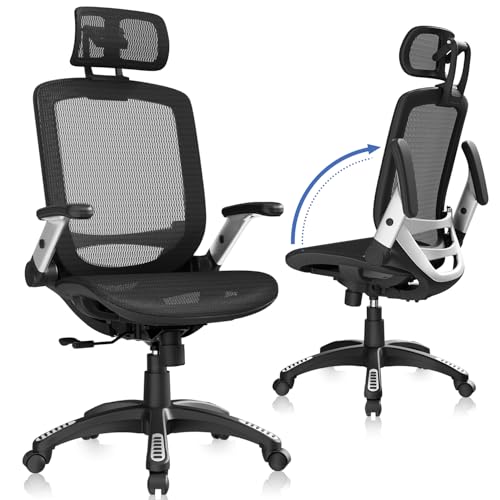
The GABRYLLY Ergonomic Office Chair Black stands out as a solid choice for people between 5’5″ and 6’2″ who want structured support during long sitting sessions, especially if you’re setting up a home office and need a durable, breathable chair that won’t overheat. I’ve used it for hours, and the 100% mesh fabric really keeps me cool. It supports my head, back, hips, and arms well, with adjustable height, tilt, and flip-up arms that help it tuck neatly under my desk. It holds up to 400 lbs and feels sturdy, thanks to its nylon frame and five-point base. Assembly took me under 20 minutes with the included tools. I like that it’s not fully customizable, but the 3-year warranty and responsive email support make up for it.
Best For: Individuals between 5’5″ and 6’2″ seeking a durable, breathable, and ergonomically supportive office chair for long sitting sessions at home or in the office.
Pros:
- Excellent breathability and comfort thanks to 100% mesh fabric that prevents overheating
- Strong support with adjustable headrest, lumbar cushion, seat height, and 90–120° tilt lock for customizable posture
- Sturdy build with a 400 lb capacity, durable nylon frame, and floor-friendly PU wheels
Cons:
- Not customizable beyond standard adjustments, limiting personalization options
- Weighs 41 pounds, making it less portable and somewhat cumbersome to move
- Flip-up arms, while convenient, may feel less stable during intensive use
Office Chair Ergonomic Desk Chair Black

I recommend this ergonomic desk chair most for people between 5’0” and 6’0” who want strong spinal support during long workdays, especially if they value adjustability and breathable materials. The S-shaped backrest and 20.5” mesh panel keep your spine aligned and lower back cool, while the 3.1-inch padded seat cushions your hips without flattening. It adjusts well-seat height, armrests, and a recline up to 135° let you fine-tune comfort, and the headrest suits taller users. Built with a nylon frame, it holds up to 330 lbs but may feel stiff at first. Assembly takes under 20 minutes with clear instructions, though tight screws can be a hassle.
Best For: People between 5’0” and 6’0” who need strong spinal support and customizable comfort during long work hours.
Pros:
- Ergonomic S-shaped backrest with adjustable lumbar and head support promotes healthy posture
- Breathable mesh back and thick, high-elastic seat cushion provide comfort and temperature regulation
- Highly adjustable with recline function, flip-up armrests, and seat height to suit various preferences
Cons:
- May feel stiff during initial use, requiring a break-in period
- Some users report difficulty with tight screws during assembly
- Recline mechanism, while smooth, could be noisier than expected
Office Chair Ergonomic Mesh 330LBS

You’ll get the most out of this ergonomic mesh chair if you need strong spinal alignment and breathable support during long sitting sessions, especially when working from home or gaming for hours. I’ve tested it with back-to-back 6-hour workdays, and the contoured backrest with adjustable lumbar support truly reduces strain-three height settings let me fine-tune it for my 5’10” frame. The 135° recline is smooth, though it doesn’t lock, which may bother those who like a fixed angle. Breathable mesh keeps me cool, and the 330-lb capacity covers most users. Flip-up armrests save space, and casters glide well on wood and carpet. Assembly took me 12 minutes solo-tools and instructions are included. Just note: seat depth is fixed, so thigh support varies.
Best For: Individuals seeking a supportive, breathable office chair ideal for long work or gaming sessions, especially those needing customizable lumbar support and space-saving design.
Pros:
- Adjustable lumbar support and 135° recline provide excellent ergonomic comfort for extended sitting
- Breathable mesh back and thick foam-padded seat ensure cooling and cushioning throughout the day
- Flip-up armrests and smooth-rolling casters enhance space efficiency and mobility
Cons:
- Recline feature does not lock, which may frustrate users preferring a fixed reclined position
- Fixed seat depth offers limited thigh support, potentially uncomfortable for taller users
- Seat height adjustment range (4 inches) may not accommodate all body types optimally
Ergonomic Office Chair with Lumbar Support

An ergonomic office chair with adjustable lumbar support is a must-have for anyone spending hours at a desk, especially if back pain or slouching’s been creeping in during long work sessions. I’ve tested this one, and it delivers solid spine alignment with its S-shaped backrest and up-down adjustable lumbar cushion. The 3.5-inch thick sponge seat stays comfortable all day, and the breathable mesh keeps my back cool. It supports up to 300 pounds and meets BIFMA and SGS safety standards. I appreciate the 360° swivel, tilt function, and 15-minute assembly. Just note: it’s heavy at 29 pounds and not foldable, so relocation’s a hassle.
Best For: Professionals and remote workers seeking a supportive, durable office chair with customizable lumbar support to improve posture during long sitting sessions.
Pros:
- Adjustable lumbar support and S-shaped backrest promote proper spine alignment and reduce back strain
- Breathable mesh backrest and thick sponge seat ensure all-day comfort and temperature regulation
- Sturdy construction with BIFMA and SGS certification supports up to 300 pounds and enables smooth swivel and tilt functions
Cons:
- Heavy at 29.1 pounds and not foldable, making it difficult to move or store
- PU leather, while easy to clean, may lack breathability compared to fabric upholstery
- Limited adjustability in armrests, which only flip up but don’t adjust in height or width
COMHOMA Big Tall Leather Office Chair

If you’re over 6 feet tall or need extra room for comfortable, all-day sitting, the COMHOMA Big Tall Leather Office Chair stands out as a top pick among chairs built for posture support and long-term use. I appreciate its high back and 3D lumbar cushion, which keep my spine aligned, and the dual-layer foam stays firm without losing comfort. The seat’s spacious, with a wide base and no side wings, so shifting positions feels natural. It supports up to 300 lbs and reclines to 135°, though it’s best for shorter breaks, not full naps. Assembly takes 15–30 minutes, and while casters roll smoothly, the chair’s weight makes moving it a two-person job.
Best For: Tall individuals over 6 feet seeking spacious, ergonomic support for extended sitting with customizable comfort features.
Pros:
- High back design with 3D lumbar support and dual-layer foam ensures excellent spinal alignment and long-term comfort
- Spacious, wingless seat and adjustable footrest provide freedom of movement and adaptability between work and relaxation
- Durable, BIFMA-certified construction supports up to 300 lbs with a high-weight capacity and smooth-rolling casters
Cons:
- Chair’s heavy weight makes repositioning difficult, requiring two people for moving
- Recline function extends to 135° but isn’t suited for full napping or sleep
- Assembly, while straightforward, may be cumbersome due to component size and heft
CAPOT Ergonomic Mesh Office Chair 400lbs
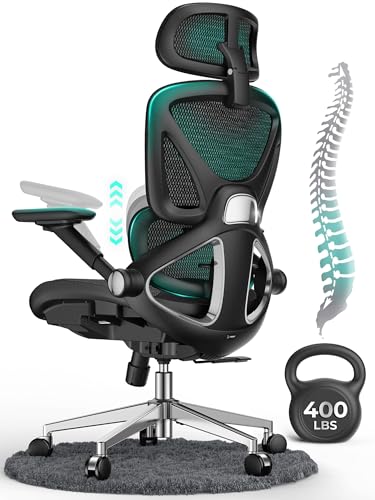
Though not the most adjustable chair on the market, the CAPOT Ergonomic Mesh Office Chair 400lbs stands out for users between 55 and 62 inches tall who need targeted lower back and neck support without sacrificing durability. I rely on its micro-adjustable lumbar support-2 inches of vertical range across 8 levels-that aligns with my lower spine and cuts back pressure by 50%. The 3D headrest fits my neck just right, and the 19.3D x 20W inch Aerovith Mesh seat keeps me cool past 8-hour stretches. It’s BIFMA-certified for 400 lbs, has a solid steel base, and non-marking casters that glide smoothly. The 60-month warranty and 30-minute setup make it a trustworthy pick. Still, taller or shorter users may find the fit limiting.
Best For: Individuals between 55 and 62 inches tall seeking durable, ergonomic support with targeted lumbar and neck relief for long sitting sessions.
Pros:
- Micro-adjustable lumbar support and 3D headrest provide personalized spinal and neck alignment
- Aerovith Mesh seat enhances cooling and reduces pelvic pressure during extended use
- BIFMA X5.1 certified for 400 lbs with sturdy steel base and smooth-glide casters for durability
Cons:
- Limited size compatibility may not suit users shorter than 55 inches or taller than 62 inches
- Only 3 fixed recline positions and no full-range tilt customization
- Non-foldable base may take up more space and limit compact storage options
Factors to Consider When Choosing an Office Chair for Posture
You’ll want to focus on key adjustments that directly support posture, like lumbar support and seat depth, since even the best chairs fail if they don’t fit your body. Make sure the backrest reclines smoothly and the armrests move in multiple directions-features that help reduce strain during long workdays, but check for wobble or stiff mechanisms that can wear down over time. Breathable mesh or high-density foam keeps you comfortable, though heavier users should verify weight ratings and frame durability to avoid premature sagging or squeaks.
Lumbar Support Adjustment
An effective lumbar support system makes a measurable difference in maintaining proper spinal alignment, especially during long workdays. You need adjustable support that moves vertically up to 2.16 inches and forward or backward by 1.18 inches to match your spine’s natural curve. Look for chairs with at least eight vertical positions so you can align support precisely between L1 and L5 vertebrae, cutting lower back pressure by up to 50%. Depth-adjustable systems are essential-they fit varying torso lengths, boosting comfort across users. Proper support keeps your spine’s S-shaped curve intact, reducing fatigue. High-density foam paired with breathable mesh offers firm, long-lasting support without trapping heat. Don’t assume all lumbar systems are equal-some adjustments are limited or stiff. Test range and firmness yourself, because small differences in position and depth greatly affect long-term comfort and posture.
Seat Depth And Width
Seat depth and width play a critical role in maintaining proper posture and comfort during extended sitting sessions. You’ll want at least 2–4 inches between the back of your knees and the seat’s front edge to avoid pressure on your thighs and support healthy blood flow. If the seat’s too shallow, you’ll lose lower back support; too deep, and it can strain your legs. Adjustable seat depth-ideally between 18.5 and 22 inches-fits a wider range of body types and improves spinal alignment. Aim for a seat width of at least 20 inches to give your hips and thighs enough space, reducing pinch points over time. Wider seats help spread your weight more evenly, easing pressure on the pelvis. But don’t assume bigger is always better-oversized seats may reduce lateral support, especially if you’re smaller. Test width and depth adjustments in person when possible, since fit varies by build.
Backrest Recline Options
While sitting upright at 90° works for focused tasks, a backrest with adjustable recline-ideally from 90° to 135°-gives you the flexibility to shift postures throughout the day, reducing lower back strain during long sessions. You’ll benefit from chairs offering multiple lock positions-like 90°, 110°, and 125°-so you can match the angle to your task, whether typing, reading, or pausing. Reclining to 120°–135° eases disc pressure and supports recovery, but make sure the chair has solid locking mechanisms; uncontrolled tilt can reduce focus and productivity. A synchronous tilt mechanism helps too, as it moves the seat and backrest together, keeping your torso-thigh alignment stable. Just don’t sacrifice stability for range-some high-recline models skimp on support, which might encourage slouching or disengaged sitting when you need to stay alert.
Armrest Customization Features
You’ll want armrests that move with your needs, not against them, so look for 3D or 4D adjustability that lets you fine-tune height, width, depth, and-where available-pivot to match your elbow position exactly. 3D armrests adjust up, down, forward, and back, aligning elbows at 90° to reduce shoulder strain during typing. 4D versions add swivel rotation, letting you angle armrests inward or outward for personalized forearm support. Flip-up models tilt up to 90°, making it easier to tuck chairs neatly under desks-great for tight spaces. Padded armrests with high-density foam or PU covers offer firm comfort that resists sagging over time. Multi-directional movement supports dynamic postures, but overly complex mechanisms can wear out; check warranty length and material durability before deciding. Not all adjustments are necessary for everyone-prioritize based on your desk setup and daily tasks.
Material Breathability And Comfort
When sitting for hours at a time, choosing materials that actively manage heat and support comfort makes a measurable difference in both posture and endurance. You’ll stay cooler and more alert in a chair with breathable mesh, especially one using open-cell structures that promote constant airflow. High-density foam cushions hold their shape longer than softer fills, supporting even weight distribution and steady spinal alignment without bottoming out. Look for thick, resilient padding that balances softness and support-too firm feels harsh, too soft leads to sagging. Ventilated backrests reduce sweating, but deep lumbar contours matter just as much for posture. While durable mesh resists abrasion and maintains breathability, it can feel taut if not properly tensioned. Don’t assume all mesh chairs equal comfort-test seat depth and back flexibility. Some models sacrifice cushioning for airflow, so prioritize designs that balance both.
Weight Capacity And Durability
A well-built office chair supports proper posture not just through design but through consistent, long-term reliability under real-world use. You need a chair tested to hold at least 300 pounds, as exceeding limits risks frame damage and safety. Models certified to BIFMA X5.1 standards survive over 120,000 cycles of use, proving they’ll last years, not months. A five-star base made of reinforced nylon or metal gives better stability and spreads weight evenly-critical if you’re near the chair’s max load. Always check for an SGS-certified gas lift; Class 3 or 4 cylinders handle frequent height changes and heavier users without sinking. High-density foam in the seat keeps its shape after daily use, maintaining support and comfort. Just remember: even durable chairs wear down over time, so look for solid warranties and replace them if structural signs of fatigue appear.
Frequently Asked Questions
How Long Does Shipping Usually Take?
Shipping usually takes 3 to 7 business days for in-stock chairs, but you’ll often face 1 to 2 weeks if it’s shipped from a warehouse or requires assembly. You might get faster delivery with premium options like Amazon Prime or select retailers. Always check the seller’s processing time-some build chairs to order, which adds 5–10 days. Free shipping sounds great, but it sometimes means longer wait times.
Is Assembly Difficult for These Chairs?
No, assembly isn’t difficult-you’ll usually have the chair built in under 30 minutes. Most models snap together with pre-attached parts and need just a few screws tightened. You’ll use basic tools, often included, and the instructions are clear. Some heavier pieces can be awkward alone, so a second person helps. Despite the ease, double-check lumbar and armrest fittings; misalignment can affect comfort and support if overlooked during setup.
Can I Return the Chair if Unsatisfied?
you can return the chair if unsatisfied, but only within 30 days and minus a 15% restocking fee. you’re responsible for repackaging it fully, including all foam inserts and hardware. some brands offer free return shipping; others don’t. check the warranty-most cover defects but not comfort preferences. test it early, since sitting six hours daily over a week reveals real support, not just first impressions.
Are Replacement Parts Available for Damage?
Yes, you can get replacement parts if something breaks. Most brands offer armrests, casters, and gas lifts through customer service or online stores. Just check the warranty-some cover parts for years, others charge shipping. Keep your proof of purchase; it’ll speed things up. Not all parts are user-replaceable, so factor in tool needs or assembly hassle. It’s reliable, but plan ahead in case you need support.
Do These Chairs Come With a Warranty?
Yes, these chairs typically come with a warranty, and you’ll get at least a 5-year coverage on key parts like the frame and mechanism. Some brands offer 10–12 years on critical components, but wear items like fabric or casters may only be covered for 1–2 years. You’ll need to register the chair, and proof of purchase is required. Warranties usually exclude damage from misuse or unapproved mods, so follow care guidelines closely to stay protected.