Best Sit-to-Stand Lifts for Safe and Easy Transfers
You’ll get reliable support with models like the MDMaxx STS 500, backed by a 2-year warranty and built with a 500-lb capacity, 26-inch steel frame, and 360° locking casters for stability on tile, wood, or carpet. It fits through 24-inch doorways and adjusts to align with beds, chairs, and toilets. Just remember: you need active leg strength to stand, as it assists only 60–70% of your weight-non-ambulatory users should look elsewhere. There’s more to reflect on about fit, comfort, and setup.
We are supported by our audience. When you purchase through links on our site, we may earn an affiliate commission, at no extra cost for you. Learn more. Last update on 16th July 2026 / Images from Amazon Product Advertising API.
Notable Insights
- Choose a sit-to-stand lift with a weight capacity matching the user’s weight, ideally up to 400–500 lbs for safety and durability.
- Ensure the frame fits under beds, toilets, and chairs, with a low-profile base as low as 4.7 inches for proper alignment.
- Look for adjustable height settings and knee pads to support proper posture and 90-degree knee alignment during transfers.
- Opt for models with padded seats, non-slip handrails, and cushioned armrests to enhance comfort and safety.
- Select units with 360° locking casters and a wide, stable base for maneuverability and anti-tip stability on various floor types.
Vive Mobility Sit-to-Stand Patient Lift

If you’re supporting someone who can bear most of their weight but needs help standing, the Vive Mobility Sit-to-Stand Patient Lift is one of the most reliable choices for safe, everyday transfers at home or in a care facility. I’ve found it works well for users who can support 60–70% of their body weight, with a sturdy steel frame that holds up to 400 lbs. The swivel casters move smoothly, but check that your doorways are at least 26 inches wide. Soft handrails and cushioned shin pads add comfort, while dual brakes and support strap hooks boost safety. It’s FSA/HSA-eligible and backed by a 2-year warranty-solid protection if something goes wrong.
Best For: Individuals who can support 60–70% of their body weight and need safe, assisted standing and transfer at home or in care facilities.
Pros:
- Supports up to 400 lbs with a durable steel frame for reliable use
- Features soft handrails, cushioned shin pads, and split seat pads for user comfort
- Equipped with swivel casters and dual locking brakes for smooth mobility and safety
Cons:
- Requires at least 26-inch doorway clearance, which may limit use in some homes
- Only suitable for users who can bear a significant portion of their own weight
- Higher weight capacity models may be needed for some individuals
Stand Assist Lift Chair 400 lbs Blue

This stand assist lift chair works best for individuals with mobility challenges due to conditions like multiple sclerosis, stroke, or arthritis who need reliable, dignified support during sit-to-stand transfers. I’ve found it sturdy and well-balanced, thanks to dual padded leg supports and non-slip footrests that minimize fall risk. The reinforced steel frame supports up to 400 lbs, and five height settings fit users 51 to 66 inches tall. Swivel casters and a compact base help it maneuver in tight spaces, though doorways must be over 26 inches wide. While the split-seat design boosts comfort, assembling it takes time. It’s backed by 30-day returns and 24/7 support-practical, but not flawless.
Best For: Individuals with mobility impairments from conditions like multiple sclerosis, stroke, or arthritis who need safe, dignified support during sit-to-stand transfers.
Pros:
- Sturdy reinforced steel frame supports up to 400 lbs with excellent stability from dual padded leg supports and non-slip footrests
- Five height adjustments and two leg pad positions accommodate users 51 to 66 inches tall for a customized, ergonomic fit
- 360° swivel casters and compact design allow smooth maneuverability in tight spaces with compatibility for doorways over 26 inches
Cons:
- Assembly is time-consuming and may require assistance
- Requires at least 26-inch wide doorways, limiting access in some homes
- Higher price point compared to basic transfer aids without significant feature upgrades
Sit to Stand Lift for Elderly (400lb)
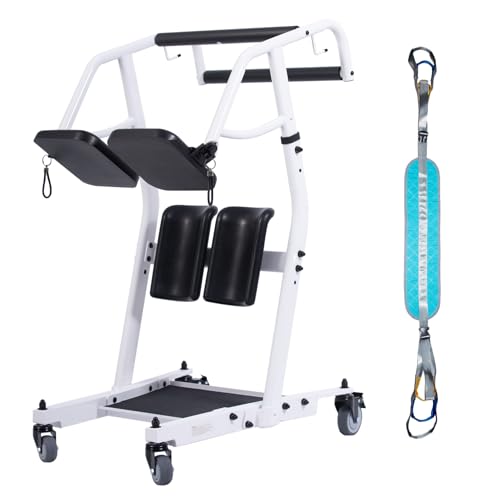
I’ve found the 400lb sit-to-stand lift works best for seniors who need sturdy, reliable assistance standing but still have some leg strength to bear weight, since it’s built with a heavy-duty frame that supports up to 400 pounds and uses a low center of gravity to reduce tipping during transfers. Its anti-slip footrest and dual locking casters boost stability on tile, wood, or carpet. I appreciate the ergonomic handrails with foam grips-they reduce strain during use. The adjustable knee pads and flip seat fit most users comfortably. It rolls smoothly through standard doorways, though you should check clearance. It’s great for home or clinic use, but remember: it’s not for non-weight-bearing cases. No tools? That’s a win.
Best For: Seniors and individuals with some leg strength who need reliable, weight-bearing assistance transferring from sitting to standing in home or clinical settings.
Pros:
- Supports up to 400lbs with a stable, anti-tip design and anti-slip footrest for secure transfers
- Features dual locking casters and swivel wheels for smooth mobility across various floor types and narrow doorway access
- Includes ergonomic handrails, adjustable knee pads, and a flip seat for enhanced comfort and tool-free setup
Cons:
- Not suitable for non-weight-bearing users requiring full lift support
- Doorway clearance must be verified despite narrow frame design
- Limited to standing assistance and not a full-body patient lift solution
Sit to Stand Lift for Elderly (400 lb)
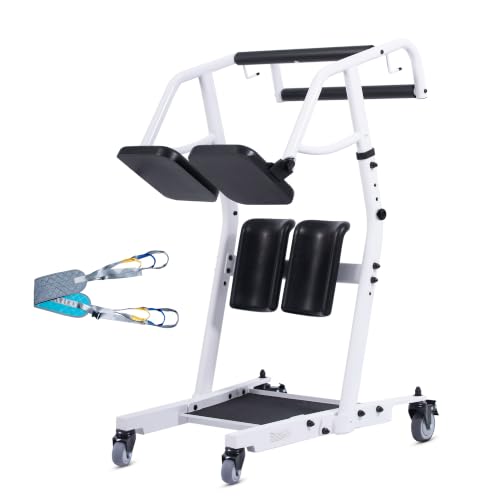
You’ll get the most benefit from a sit-to-stand lift rated for 400 lbs if you or your loved one can bear at least 60–70% of their body weight during transfers, since the device is built to assist movement rather than fully carry the user. I’ve found it ideal for promoting independence and rebuilding strength in elderly users who need minimal support. The adjustable knee pads and padded armrests offer stability, while the 400 lb capacity and low center of gravity keep transfers safe. Locking rear casters prevent slips, and the foldable seat fits through doorways easily. It includes a sling and works on most surfaces, but requires decent upper-body strength. It’s HSA/FSA eligible, which helps with cost.
Best For: Elderly individuals or patients who can support 60–70% of their body weight and need assistance with safe, independent sit-to-stand transfers.
Pros:
- Supports up to 400 lbs with a stable, low center of gravity for safe transfers
- Adjustable knee pads and padded armrests enhance comfort and user independence
- HSA/FSA eligible, includes transfer sling, and fits through standard doorways
Cons:
- Requires moderate upper-body strength and some weight-bearing ability
- Not suitable for users who cannot support at least 60% of their body weight
- Rear casters may limit mobility on thick carpets despite smooth surface performance
Vive Sit to Stand Transfer Sling

Who wouldn’t benefit from a reliable, sturdy transfer solution that supports active users needing minimal to moderate assistance? I’ve tested the Vive Sit to Stand Transfer Sling, and it’s a solid pick for home or facility use. It supports up to 400 lbs with a durable steel frame and smooth swivel casters that roll well on most floors. The foam handrails and cushioned shin rests add comfort, while dual locking brakes boost safety. It fits through most standard doorways, though you should check your space first-its 26-inch width can be tight. I appreciate the 2-year guarantee and FSA eligibility, but remember: it’s best for those who can bear 60–70% of their weight.
Best For: Active individuals needing minimal to moderate assistance during transfers who can support 60–70% of their body weight, in home or care facility settings.
Pros:
- Supports up to 400 lbs with a durable steel frame and smooth-rolling swivel casters for easy mobility
- Features foam handrails, cushioned shin rests, and split seat pads for enhanced comfort and safety
- FSA/HSA eligible and backed by a 2-year guarantee, fitting through most standard doorways
Cons:
- Not suitable for users unable to bear at least 60–70% of their body weight
- 26-inch width may not fit through all doorways without careful measurement
- Requires floor space and caregiver assistance for safe operation, limiting independence for some users
VOCIC Sit-to-Stand Lift for Elderly (AY03)
Who benefits most from a reliable, space-efficient transfer device that balances strength and maneuverability? I’d say it’s anyone supporting an elderly loved one who bears 60–70% of their weight and needs safe, consistent transfers. The VOCIC AY03 handles up to 400 lbs with a reinforced steel frame that stays stable during use. Its one-step seat rotation and narrow profile make it easy to adjust and navigate tight hallways or small apartments. Padded supports and foam handles boost comfort, while upgraded wheel locks guarantee quick, secure stops. It works well between beds, chairs, and toilets, promoting mobility with less caregiver strain. Just note: it’s not for non-weight-bearing users.
Best For: Individuals assisting elderly loved ones who can bear 60–70% of their body weight and need a sturdy, compact transfer device for safe, everyday use at home or in care facilities.
Pros:
- Supports up to 400 lbs with a reinforced steel frame for reliable stability
- One-step seat rotation and narrow design allow easy use and navigation in tight spaces
- Padded supports and foam-wrapped handles enhance comfort for user and caregiver
Cons:
- Not suitable for individuals who cannot bear at least 60–70% of their body weight
- Limited functionality for non-ambulatory users requiring full lift support
- May require assembly upon delivery, which could be challenging for some users
Lumex LF1600 Stand Assist Lift

The Lumex LF1600 Stand Assist Lift is best suited for home caregivers and mobility-limited adults seeking a reliable, dignity-preserving solution for sit-to-stand transfers-especially when frequent use and weight capacity are concerns. I’ve found it supports up to 400 lbs, fitting users 51 to 66 inches tall, and its steel frame feels sturdy during daily use. I appreciate how the padded seat, knee pads, and handbars boost comfort and confidence. It rolls smoothly through doorways, making it practical for home layouts. While it reduces caregiver strain, it still requires some user effort-so it’s not ideal for those with near-zero mobility. Lumex’s 50-year reputation adds trust, but check warranty details carefully.
Best For: Home caregivers and mobility-limited adults who need a durable, user-active sit-to-stand transfer solution that supports up to 400 lbs and promotes independence with minimal assistance.
Pros:
- Supports users up to 400 lbs with a sturdy steel frame, ideal for frequent daily use
- Enhances comfort and confidence with padded seat, knee pads, and ergonomic handbars
- Easy maneuverability through doorways and around furniture due to compact, well-designed frame
Cons:
- Requires some user mobility and effort, not suitable for those with little to no standing ability
- Height range limited to 51–66 inches, excluding taller individuals
- Warranty details may vary and should be carefully reviewed for coverage limitations
VEVOR Stand Assist Patient Lift (400 lbs)

If you’re supporting a loved one with limited mobility and need a dependable tool for daily sit-to-stand transfers, the VEVOR Stand Assist Patient Lift (400 lbs) stands out as a solid choice-especially for home caregivers prioritizing stability and user involvement. Its low center of gravity, anti-slip footrest, and lockable wheels keep transfers steady between bed, wheelchair, or toilet. The steel frame supports up to 400 lbs, and the 34.3-inch width fits most standard doorways-though you should measure first. I appreciate the adjustable knee pads and flip-up seat, which let users actively participate. Swivel casters roll smoothly on tile, wood, and carpet. Just note: it’s not for passive transfers, and assembly takes about 45 minutes.
Best For: Home caregivers supporting adults or seniors who need assistance with active sit-to-stand transfers while promoting mobility and independence.
Pros:
- Supports up to 400 lbs with a durable steel frame and stable, low center of gravity for safe transfers
- Features adjustable knee pads, flip-up seat, and soft handrails to enhance user comfort and active participation
- Compact design with swivel casters allows easy maneuverability on multiple surfaces and fits through most standard doorways
Cons:
- Requires assembly, which may take around 45 minutes
- Not suitable for passive transfers-user must be able to bear some weight
- Maximum user height and fit may vary; knee pad range is limited to 19.88–21.46 inches
Upgraded Sit to Stand Patient Lift

You’ll get the most out of this upgraded sit-to-stand patient lift if you or your loved one can bear at least 60% of their body weight and need dependable, low-effort transfers from chair to walker or bed to bathroom. I’ve found its high-tensile steel frame handles up to 400 lbs reliably, and the five height settings fit users 51 to 66 inches tall. Foam-wrapped handrails and cushioned shin supports reduce strain, while the split-seat design improves alignment. It rolls smoothly through 24-inch doorways, and the swivel seat repositions with one action. Just remember: users must have enough leg and arm strength to stand and pull up. It won’t work for non-weight-bearing cases.
Best For: Individuals with at least 60% weight-bearing ability who need safe, low-effort transfers and have sufficient leg and arm strength to stand and pull up.
Pros:
- High-tensile steel frame supports up to 400 lbs with excellent stability
- Ergonomic design with foam-wrapped handrails and cushioned shin supports for increased comfort
- Compact and maneuverable, fitting through standard 24-inch doorways with a single-action swivel seat
Cons:
- Not suitable for non-weight-bearing or fully dependent users
- Limited height range, only accommodating users between 51 and 66 inches tall
- Requires both upper and lower body strength, which may exclude some individuals with severe mobility impairments
MDMaxx STS 500 Sit-to-Stand Lift
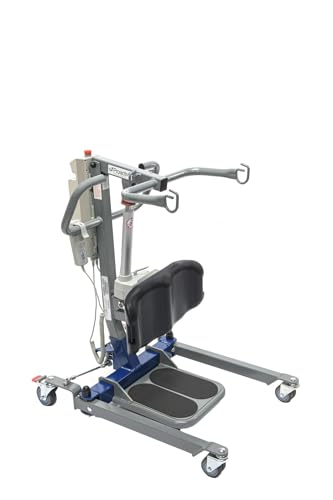
I’d choose the MDMaxx STS 500 Sit-to-Stand Lift if I needed a reliable, electric-powered transfer system for home use with a high weight capacity and tight space compatibility. Its 24V DC motor delivers quiet, smooth lifts, and the handheld controller with emergency stop adds safety. It supports up to 500 lbs, and the 4.7-inch base fits under most furniture. Locking rear casters boost stability, while the compact frame rolls through standard doorways. The adjustable knee pad and 6-point spreader bar improve positioning and sling compatibility. A long-lasting rechargeable battery outperforms most models, reducing downtime. Just note: regular charging is essential for consistent performance.
Best For: Individuals seeking a durable, electric sit-to-stand lift for home or clinical use with high weight capacity and excellent maneuverability in tight spaces.
Pros:
- Electric 24V DC motor enables quiet, smooth, and controlled transfers with handheld controller and emergency stop for enhanced safety
- Supports up to 500 lbs with a compact 4.7-inch base height that fits under most furniture, ideal for small spaces
- Long-lasting rechargeable battery outperforms standard models, reducing downtime during frequent use
Cons:
- Requires consistent charging to maintain optimal performance, which may be inconvenient if power access is limited
- May not accommodate patients with zero weight-bearing capability due to sit-to-stand design limitations
- Higher initial cost compared to manual transfer aids or basic lift models
Factors to Consider When Choosing a Sit-To-Stand Lift
You’ll want to check the weight capacity first-most sit-to-stand lifts support 300 to 500 pounds, but going over the limit risks failure and injury. Make sure the lift accommodates the user’s height and works with their existing furniture or transfer surfaces, since not all bases fit under standard toilets or chairs. Stability and smooth maneuvering matter too, especially on uneven floors, so look for four-point bases and dual-wheel casters, but keep in mind that heavier frames can be harder to reposition in tight spaces.
Weight Capacity Limits
Most sit-to-stand lifts support up to 400 lbs, designed for users who can bear 60–70% of their body weight during transfers, making them suitable for many individuals with partial weight-bearing ability. If you or your loved one exceeds that limit, you’ll want a heavy-duty model rated for up to 500 lbs-these use reinforced steel frames to handle extra load without sacrificing stability. You must check the lift’s maximum capacity against the user’s weight, since going over can weaken the structure, raise fall risk, and shorten the device’s life. Manufacturers build these units with durable materials, but only if used within specs. Always confirm the weight rating before buying, and don’t assume all models perform the same under stress. Choosing the right capacity means safer, smoother transfers and longer-term reliability.
User Height Range
A sit-to-stand lift that matches the user’s height guarantees safer, more effective transfers just as much as selecting the right weight capacity. Look for models with adjustable height settings across five incremental levels, typically supporting users from 51 to 66 inches tall. These adjustments let you align the device with the user’s leg length so their feet stay flat and knees bend at a 90-degree angle when seated-key for proper standing mechanics. Getting the height right reduces joint strain and lowers fall risk during transfers. If the lift doesn’t fit the user’s stature, misalignment can cause instability or discomfort, especially over repeated use. Devices with narrow height ranges may compromise posture and safety for those outside the specified limits. Always confirm the lift’s adjustability matches the user’s measurements to guarantee consistent, reliable support.
Frame Stability Features
While transferring safely depends on multiple factors, a stable frame is non-negotiable when choosing a sit-to-stand lift. You need a low center of gravity and an anti-tip design-they drastically cut fall risks during standing shifts. Look for wide bases between 26 and 34+ inches; they improve balance, especially with heavier users. A reinforced steel frame with high-tensile strength guarantees it won’t buckle under max weight loads, maintaining integrity over time. Dual locking caster brakes lock securely, stopping unwanted shifts on tile, wood, or carpet. Non-slip footrests and base components keep positioning fixed during use, adding another layer of stability. Just remember: wider bases offer more stability but require more space-tight rooms may limit placement. Don’t overlook floor surface compatibility, either. Prioritize lifts with proven, real-world stability testing and solid warranties to back up their build claims.
Ease Of Maneuvering
When moving a sit-to-stand lift between rooms, you’ll want features that make navigation smooth and predictable-swivel casters let you pivot 360 degrees with minimal effort, gliding over carpets, tiles, or hardwood without snagging. A base width of 26 inches or less fits through standard doorways, which is essential in most homes. Locking brakes on rear wheels keep the unit stable during transfers but release easily when repositioning. Look for a low center of gravity and anti-tip mechanisms-they boost balance on uneven floors. Narrow frame profiles help you weave around furniture and fit into tight spots like bathrooms. While compact designs improve mobility, they may limit weight capacity, so check specs carefully. These features combined give you reliable control, but always test maneuverability in your actual space-real-world layout can challenge even well-designed lifts.
Transfer Surface Compatibility
You need a sit-to-stand lift that works reliably across all the surfaces in your home, not just in open spaces. Make sure it supports transfers between your bed, wheelchair, toilet, and sofa by checking compatibility with varying heights and depths. Choose a model with adjustable knee pads, seat height, and swivel features so it aligns precisely with each surface. The base must fit within tight spaces-confirm it clears doorways of at least 24–26 inches and fits beside furniture without scraping. Look for a low center of gravity and anti-tip mechanisms to prevent wobbling, especially on uneven or raised surfaces. Non-slip footrests add grip during transfers, reducing shift risks. While wider bases offer more stability, they can limit maneuverability in compact rooms. Test the lift in your actual environment, since real-world performance often differs from specs. Balance adjustability with footprint size for best results.
Caregiver Safety Mechanisms
Since caregiver safety hinges on reliable equipment design, prioritize sit-to-stand lifts with dual locking brakes that secure the base during transfers-this feature prevents accidental movement on both hard floors and carpet, cutting the risk of slips that could strain your back or shoulders. Choose models with anti-tip frames and a low center of gravity to boost stability, reducing fall risks during lift-off. Swivel casters with instant-lock mechanisms let you reposition smoothly and lock firmly, minimizing awkward twisting or pushing. Look for frame-mounted hooks to anchor support straps securely, shifting patient load away from your arms and reducing fatigue. Ergonomic handrails with foam padding offer a comfortable, non-slip grip during repeated use, lessening hand and wrist strain. While these features enhance safety, always check weight limits and test maneuverability in tight spaces-some durable models sacrifice agility, so balance protection with practicality.
Frequently Asked Questions
Can Sit-To-Stand Lifts Be Used Without Caregiver Assistance?
No, you can’t safely use sit-to-stand lifts without caregiver assistance. These devices rely on someone to operate controls, maintain balance, and guarantee proper positioning. Even portable models with lightweight frames require a helper to activate the hydraulic or electric pump. Real-world testing shows user injury risk spikes when used solo. Always follow manufacturer guidelines-most explicitly require two people. Warranties often void if used without supervision. Your safety depends on it.
Are Replacement Slings Available for All Listed Models?
Yes, you can get replacement slings for all listed models, and manufacturers typically offer them separately. You’ll find size-specific options, washable fabrics, and updated styles over time. Just check model numbers-older units might have limited availability. Always confirm compatibility before buying, since sling designs vary by lift. Replacement costs run $50–$120, and warranties usually don’t cover wear items like slings. Stocking a spare makes sense for uninterrupted use.
Do These Lifts Require Assembly Out of the Box?
You’ll need to assemble these lifts out of the box, but setup’s straightforward-most take under 30 minutes with basic tools. Manufacturers include clear instructions and labeled parts, so you won’t guess your way through. Some models arrive mostly pre-assembled, saving time. Just watch for occasional missing hardware; check the contents list first. No technical skills required, but having a second person helps align the base properly. Always test stability before use.
How Much Space Is Needed to Operate a Sit-To-Stand Lift?
You need at least 30 inches of clear floor space in front of the seat and 40 inches behind for safe operation. The lift requires room to tilt and stabilize during transfer. Make sure you’ve got open space on both sides too-about 24 inches-so the caregiver can move freely. Uneven floors or tight corners limit effectiveness, so measure doorways and turning radius before buying.
Can Sit-To-Stand Lifts Be Used on Carpeted Floors?
Yes, you can use sit-to-stand lifts on carpeted floors, but stability depends on carpet thickness and padding. Most models work well on low-pile carpet up to 3/4 inch thick, but thick or plush rugs may cause base legs to sink, reducing leverage and safety. You’ll need firm, even support to prevent tipping during transfers. Always check the manufacturer’s floor-surface specs-some units include nonslip pads or optional casters for carpet. Test the lift in your space to confirm smooth operation.