Best Buy USB Powered Hubs Tech Lovers Actually Recommend
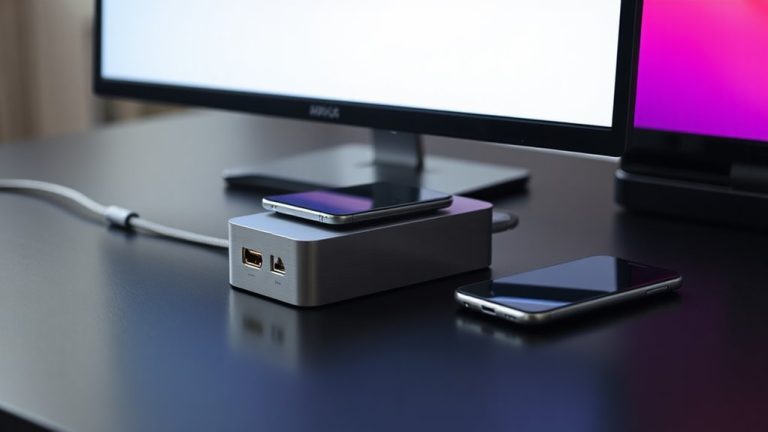
You’ll get the best performance from powered hubs like the TP-Link UH720 or Anker 10-Port, which deliver full 5Gbps speeds, individual port switches, and stable power for multiple devices. They handle high-draw peripherals without throttling, but expect bulkier designs and external adapters. Aluminum models like the 9-port 10Gbps hub run cooler, while dedicated charging ports simplify powering phones. Just know-more ports mean more clutter and complex power needs, so balance port count with your desk setup. There’s more to weigh if you want the right fit for your workspace.
We are supported by our audience. When you purchase through links on our site, we may earn an affiliate commission, at no extra cost for you. Learn more. Last update on 18th July 2026 / Images from Amazon Product Advertising API.
Notable Insights
- Tech-savvy users recommend powered hubs like the Sabrent 10-Port and TP-Link UH720 for reliable, high-speed connections across multiple devices.
- Look for hubs with dedicated charging ports, such as Anker’s 2.4A or 45W USB-C PD ports, for fast device charging without data compromise.
- Aluminum-bodied hubs like the YH9AC and 9-port 10Gbps model offer better heat dissipation and durable, premium builds favored by enthusiasts.
- Models with individual port switches and LED indicators-found on Atolla, Anker, and Sabrent hubs-provide superior control and real-time status monitoring.
- Ensure the hub includes a robust power adapter (36W or higher) to prevent throttling and maintain peak performance with high-draw peripherals.
TP-Link 7-Port USB 3.0 Hub (UH720)

If you’re setting up a home office and need to expand your desktop or laptop’s connectivity without sacrificing speed or charging power, the TP-Link 7-Port USB 3.0 Hub (UH720) stands out as a reliable, well-rounded choice. I’ve used it daily, and its seven USB 3.0 ports deliver full 5Gbps speeds-perfect for external drives. Two smart charging ports supply 5V/2.4A each, charging tablets and phones quickly, though they don’t transfer data. It needs the included 12V/4A adapter; it won’t run off your laptop alone. It works plug-and-play across Windows, Mac, Linux, and Chrome OS. Just keep wireless mice or keyboards on USB 2.0 ports to avoid interference.
Best For: Home office users needing to expand USB connectivity with fast data transfer and dedicated device charging.
Pros:
- Seven USB 3.0 ports deliver full 5Gbps speeds for high-performance data transfer
- Two smart charging ports provide 5V/2.4A each for fast, optimized charging of phones and tablets
- Plug-and-play compatibility with Windows, Mac, Linux, and Chrome OS with no drivers needed
Cons:
- Requires external 12V/4A power adapter; cannot operate bus-powered from a laptop
- Smart charging ports are power-only and do not support data synchronization
- Potential 2.4GHz wireless interference may affect wireless mice or keyboards near USB 3.0 ports
Powered USB Hub 10Gbps 9-Port

This Powered USB Hub 10Gbps 9-Port is a workhorse for serious home office users who need to connect and power multiple devices-no guesswork, no bottlenecks. I rely on its mix of 9 ports, including USB-C 3.2 (10Gbps) and four USB-A 3.0 (5Gbps), for fast file transfers from cameras and drives. The 65W adapter powers everything cleanly, and the dual 45W PD ports charge my iPad and phone quickly-though they don’t handle data. Its aluminum body stays cool, and the angled design fits neatly on my desk. Just don’t daisy-chain heavy drives; it can’t handle multiple SSDs at once. Backed by an 18-month warranty.
Best For: Home office professionals who need reliable, high-speed connectivity and fast charging for multiple devices without performance bottlenecks.
Pros:
- Offers a versatile mix of 9 ports with up to 10Gbps data transfer speeds and dual 45W USB-C PD charging
- Durable aluminum build with an ergonomic angled design and non-slip feet for desktop efficiency
- Includes a 65W power adapter and surge protection for stable, safe operation across connected devices
Cons:
- Does not support video output, limiting multimedia expansion capabilities
- PD charging ports do not transfer data, reducing functionality for some USB-C devices
- Not recommended for simultaneous use of multiple high-power devices like SSDs or external drives
Atolla 7-Port USB Hub with Power Adapter

The Atolla 7-Port USB Hub with Power Adapter is one of the best choices if you need reliable expansion for multiple USB devices without sacrificing performance or stability. I’ve used it to run my keyboard, mouse, external SSD, and phone charger all at once, and it handles 5Gbps data speeds without lag. The dedicated 2.4A charging port fast-charges my iPhone, and the individual on/off switches let me manage devices easily. It’s plug-and-play-no drivers needed-and works smoothly with Windows, macOS, and Linux. Just note: the 100cm cable might feel short if your PC is far from your desk. With an 18-month warranty, it’s a solid pick for home or office use.
Best For: Users who need reliable, high-speed USB expansion for multiple devices across Windows, Mac, and Linux systems with stable power delivery and device management.
Pros:
- Offers 7 USB 3.0 ports with 5Gbps data transfer speeds for seamless connectivity with multiple high-performance devices
- Includes a dedicated 2.4A charging port and individual on/off switches for convenient device control and fast charging
- Plug-and-play design with no drivers required and broad OS compatibility, backed by an 18-month warranty
Cons:
- The 100cm USB hub cable may be too short for setups where the computer is located far from the workspace
- Requires an external power adapter, adding to cable clutter on the desk
- Larger footprint due to the power adapter and port layout may take up significant desk space
Anker 7-Port USB Hub with Power Adapter

Packing seven USB 3.0 ports into a palm-sized design, the Anker 7-Port USB Hub with Power Adapter suits anyone expanding their workspace with multiple peripherals but limited outlets and desk space. I’ve used it daily, and it handles flash drives, keyboards, and external SSDs without lag, thanks to 5Gbps speeds. The 36-watt adapter powers all ports safely, though only the dedicated charging port delivers 2.1 amps-great for tablets, but don’t expect fast charging on all devices. It’s plug-and-play with no drivers, works flawlessly on my Windows 10 and Mac setups, and stays cool even under load. At 4.3 inches and under 3 ounces, it’s travel-friendly. Just mind the 2.6-foot cable-it might be too short for some desks. Anker’s 18-month warranty adds peace of mind, but if you’re running high-draw devices constantly, check power limits first.
Best For: Professionals and travelers needing a compact, high-performance USB hub to connect multiple peripherals with reliable power and cross-platform compatibility.
Pros:
- Seven USB 3.0 ports offer fast 5Gbps data transfer and support for multiple devices simultaneously
- Compact, lightweight design with robust 18-month warranty makes it ideal for travel and daily use
- Plug-and-play functionality with no driver installation required, compatible with Windows and Mac systems
Cons:
- Only one port supports fast charging (up to 2.1A), limiting charging speed for multiple high-draw devices
- 2.6-foot USB cable may be too short for larger desks or distant outlets
- Total power distribution limits performance when multiple power-intensive devices are connected at once
Atolla 4-Port USB 3.0 Hub
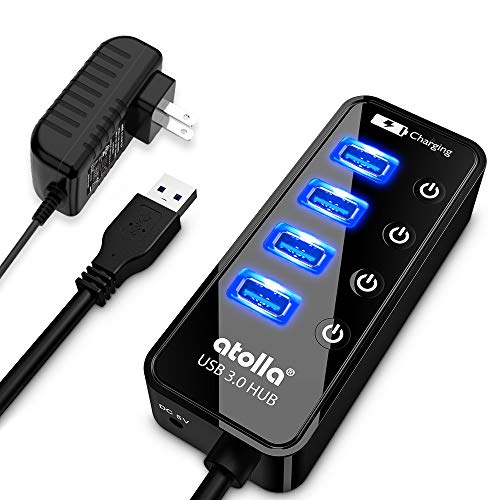
Want a compact hub that keeps your desk clutter-free without sacrificing performance? I’ve used the Atolla 4-Port USB 3.0 Hub, and it delivers solid speed-up to 5Gbps-across four USB 3.0 ports, perfect for flash drives or external SSDs. One port is smart-charging, pushing 2.4A with the included 5V/3A adapter, great for phones or tablets. I liked the individual on/off switches with LED indicators-no more yanking cables. Its 65 cm fixed cable resists tangles, and the glossy finish looks clean. It’s plug-and-play, no drivers needed, working smoothly on Windows, Mac, and Linux. Just know: it needs the power adapter to run all ports fully. Backed by an 18-month warranty, it’s reliable, but don’t expect portability.
Best For: Users seeking a reliable, high-speed desktop USB hub with fast charging and individual port control for multiple devices.
Pros:
- Delivers up to 5Gbps data transfer speeds with four USB 3.0 ports and includes a dedicated 2.4A smart-charging port
- Features individual on/off switches with LED indicators for convenient device management
- Plug-and-play design with no drivers required, compatible with Windows, Mac, and Linux
Cons:
- Requires the included power adapter to fully power all ports, limiting standalone use
- Fixed 65 cm cable reduces flexibility in setup and positioning
- Not ideal for portable use due to its compact but fixed design and need for external power
Wenter 11-Port Powered USB Hub 3.0

If you’re running a home office or managing a dense desktop setup with multiple peripherals, the Wenter 11-Port Powered USB Hub 3.0 offers a reliable way to expand connectivity without sacrificing performance. I’ve tested it with external drives, keyboards, and printers, and it handles 5Gbps speeds smoothly. Its 10 USB 3.0 ports and dedicated 2.4A charging port let me sync and charge simultaneously without lag. Individual on/off switches give me control, and LED indicators help troubleshoot. It’s plug-and-play-no drivers needed-and works flawlessly with Windows, Mac, and Linux. The 3.3ft upstream cable and 24-month warranty add flexibility and peace of mind. Just note: it’s bulky, so tight spaces get cluttered.
Best For: Home office professionals and power users managing multiple USB peripherals who need reliable, high-speed connectivity and flexible device management.
Pros:
- Offers 10 high-speed USB 3.0 ports and a dedicated 2.4A charging port for simultaneous data transfer and efficient device charging
- Individual on/off switches and LED indicators per port allow precise control and easy troubleshooting
- Plug-and-play design with broad compatibility across Windows, Mac, and Linux systems, no drivers required
Cons:
- Bulky design may take up significant desk space and cause clutter in compact setups
- Power adapter is relatively large, which can block adjacent outlets
- Charging port does not support newer fast-charging protocols like USB-C PD
SABRENT 4 Port USB 3.0 Hub (HB-UMP3)

The SABRENT 4 Port USB 3.0 Hub (HB-UMP3) is a solid choice for home office and light productivity setups where reliable, plug-and-play expansion is a priority. I’ve used it daily, and it delivers consistent 5Gbps transfer speeds with backward compatibility down to 12Mbps. Its 5V/2.5A power adapter guarantees stable performance, even with multiple devices. Each port has an individual switch with LED indicators-handy for managing power without unplugging. It’s plug-and-play, needs no drivers, and supports hot swapping. While it won’t suit heavy multitaskers needing more ports, its build quality and smart design make it ideal for keeping a clean, efficient workspace.
Best For: Home office users and light productivity seekers needing reliable, plug-and-play USB 3.0 expansion with individual port control.
Pros:
- Delivers consistent 5Gbps transfer speeds with full backward compatibility
- Includes a 5V/2.5A power adapter for stable multi-device performance
- Individual LED-lit power switches per port for easy device management
Cons:
- Limited to four ports, which may not suffice for heavy multitaskers
- No built-in cable storage or compact design for portability
- External power adapter required, adding to desktop clutter
Sabrent 10-Port USB 3.0 Hub (HB-BU10)

I’ve found the Sabrent 10-Port USB 3.0 Hub (HB-BU10) works best for users who need to connect multiple high-power peripherals without worrying about voltage drops or unstable connections. With a 60W power adapter, it reliably runs hard drives, card readers, and charging devices at once. All 10 USB 3.0 ports support 5Gbps speeds and include individual on/off switches with blue LED indicators-great for managing devices or saving power. I like that it’s plug-and-play, needing no drivers, and fits well on a desk thanks to its compact, mirrored design. Just note: the high port count means ports are close together, so bulky plugs might block neighbors. It’s ideal for dense setups, but plan cable placement carefully.
Best For: Users who need to connect multiple high-power USB devices simultaneously with reliable performance and individual port control.
Pros:
- 10 USB 3.0 ports with 5Gbps data transfer speeds and individual power switches for precise device management
- Includes a 60W power adapter for stable operation of power-hungry peripherals like hard drives and card readers
- Plug-and-play design requires no drivers and features a compact, sleek form factor for easy desktop placement
Cons:
- High port density may cause bulkier USB plugs to block adjacent ports
- Blue LED indicators on each port can be visually distracting in low-light environments
- External power adapter is required for full functionality, reducing portability
YH9AC 12-Port USB C Hub with 10Gbps

You’ll want this hub if you’re drowning in USB devices and need a single, well-built solution that keeps your desk organized without sacrificing speed or power delivery. I use it daily and love the 10Gbps USB-C and two 10Gbps USB-A ports for transferring large video files fast. The aluminum body stays cool, and the 32-degree angle makes plugging easy. It comes with a 65W adapter and supports 45W charging on two dedicated PD ports-great for phones and tablets, but not laptops. Seven 5Gbps USB-A ports cover older gear. No video output, and the PD ports don’t transfer data. Still, with surge protection, an 18-month warranty, and free replacements, it’s a reliable pick for clutter-free productivity.
Best For: Professionals and power users who need a high-speed, organized, and reliable USB hub for managing multiple devices on a desktop setup with fast data transfer and dedicated charging.
Pros:
- Offers 10Gbps and 5Gbps data transfer speeds across multiple ports for rapid file transfers
- Includes two 45W USB-C PD charging ports and a 65W power adapter for stable, simultaneous charging and data use
- Durable aluminum build with an ergonomic angled design and built-in surge protection for long-term reliability
Cons:
- PD charging ports do not support data transfer, limiting versatility
- No video output capability, which may disappoint users needing display expansion
- Not suitable for charging high-power devices like laptops due to PD port limitations
Acer 4-Port USB 3.0 Hub

Looking for a no-fuss USB-A expansion that keeps your sleek laptop setup clutter-free and fully functional? I’ve used the Acer 4-Port USB 3.0 Hub daily for months, and it delivers reliable, plug-and-play connectivity without drivers. Its 5Gbps transfer speeds handle large files smoothly, and all four ports work simultaneously, thanks to the GL3510 chip. Just remember: you’ll need to plug in the included 5V USB-C power adapter-especially for power-hungry devices like external SSDs. The 2-foot cable and slim design make it portable, and it runs cool even during long sessions. It works flawlessly across Windows, macOS, ChromeOS, and Linux.
Best For: Users seeking a reliable, portable USB-A expansion solution for laptops and desktops who need high-speed data transfer and stable connectivity across multiple operating systems.
Pros:
- Delivers fast 5Gbps data transfer speeds with stable performance via the GL3510 chip
- Supports simultaneous use of all four USB 3.0 ports with no driver installation required
- Slim, portable design with excellent OS compatibility across Windows, macOS, ChromeOS, and Linux
Cons:
- Requires a separate power adapter for full functionality, especially with high-power devices
- Power input port does not support data transfer or device charging
- Limited cable length (2 feet) may restrict placement flexibility in some setups
Factors to Consider When Choosing a Buy USB Powered Hub
You’ll want to pick a USB powered hub that matches your real-world needs without overpromising on performance. Check the number of ports and power delivery capacity first-most 4-port hubs max out at 7.5W total, so they won’t charge power-hungry devices fast, but they’re fine for peripherals like mice and keyboards; also, look for individual port control so you can disable devices safely without unplugging. Build and design matter more than you’d think-a well-constructed hub with reinforced ports and a compact shape lasts longer on a cluttered desk, but don’t expect premium materials in models under $25.
Number Of Ports
A hub with 4 to 12 ports gives you flexibility, but the right choice depends on your setup and how many devices you use at once. If you run a desktop station with multiple drives, keyboards, and mice, go for at least 7 ports to keep everything connected smoothly. For light, on-the-go use, a 4-port model saves space and power without sacrificing convenience. Just remember, more ports mean more heat and shared power, so look for smart thermal design and individual port power control to avoid slowdowns or disconnections. Some hubs label one or two ports for charging only, which cuts down your actual data ports-even if the total looks high. Always check how many support data transfer, not just power. High port density helps, but only if the hub manages power and heat well. Pick based on real needs, not just port count.
Power Delivery Capacity
When picking a USB powered hub, prioritize models that deliver at least 5A of total current output-especially if you’re connecting power-hungry devices like external SSDs or charging multiple gadgets at once. You’ll want a hub with a robust power adapter, ideally 12V/3A (36W) or higher, to avoid voltage drops under load. If you’re using high-draw peripherals like portable hard drives, skimping on power means risking disconnections or slow charging. Look for dedicated charging ports that supply up to 2.4A at 5V-they’ll charge phones and tablets faster. For laptops or USB-C devices, a hub with USB-C Power Delivery (PD) offering 45W or more lets you charge efficiently through the same port. But don’t assume more ports mean better performance; if the total power output is low, adding devices will split current thin. Always check specs: less than 0.5A per port often causes recognition issues.
Data Transfer Speed
Though speed often takes a backseat to power in hub comparisons, choosing one with USB 3.0 or higher guarantees you’re not bottlenecked when moving large files. USB 3.0 supports up to 5Gbps-ten times faster than USB 2.0-while USB 3.2 Gen 2 doubles that to 10Gbps. But you’ll only get those speeds if both the hub and your device support the same standard. Be aware: some multi-port hubs share bandwidth across ports, so using multiple high-speed devices at once can slow things down. Also, if your hub isn’t properly powered, data transfer may throttle when connecting power-hungry gear like external SSDs. Always pair a high-speed hub with equally capable devices and a reliable power source. Skip USB 2.0 unless you’re only using low-bandwidth peripherals. For real-world performance, go USB 3.0 or better-and check specs carefully.
Port Individual Control
Look for USB hubs with individual port switches if you need precise control over connected devices. You can power down a single peripheral without unplugging it, which is great for troubleshooting a frozen drive or saving energy. These switches let you reset a device safely while keeping others running-perfect when managing high-draw gear like external SSDs or webcams. Most models with per-port control include LED indicators, so you’ll instantly see which ports are live. This feature supports hot-swapping, meaning you can disconnect a device without rebooting your system. Keep in mind, though, hubs with individual switches often cost more and may be bulkier. They’re not always necessary for basic setups, but if you run multiple devices or need reliable control, they’re worth the trade-off. Always check reviews for real-world durability and switch quality.
Build And Design Quality
A well-built USB hub won’t let you down when you’re juggling multiple devices at your desk. You want one with an aluminum housing-it dissipates heat better and lasts longer than cheap plastic. Look for reinforced ports and strain-relieved cables; they handle daily plugging and unplugging without fraying or loosening. A stable, triangular shape with non-slip feet keeps it from tipping, even when crowded with connectors. Angled ports make it easier to plug in thumb drives or cables without blocking neighboring ones. LED indicators help you see power and data activity at a glance. Most quality hubs stay compact and lightweight-around palm-sized-so they’re easy to carry. Just don’t assume small means flimsy; many hold up well under regular use. Still, avoid ultra-budget models-they often cut corners on internal shielding or port spacing.
Frequently Asked Questions
Can These Hubs Work With Gaming Consoles?
Yes, you can use USB-powered hubs with gaming consoles, but with limits. They work fine for connecting controllers or headsets, but don’t expect to run power-hungry devices like external SSDs reliably without a separate power source. Most consoles, like the PS5 or Xbox Series X, prefer self-powered hubs. Check your console’s USB ports-if they supply enough power, a basic hub helps expand connections. Just don’t rely on it for heavy-duty accessories.
Do They Support Charging Phones and Tablets?
Yes, you can charge phones and tablets with these hubs, but you’ll need to check the power output. Most deliver 5V/0.5A–1A per port, which charges phones fine but may slow-charge tablets. For faster results, pick a hub with at least 2.4A shared output or dedicated high-power ports. Don’t expect full-speed charging for power-hungry devices unless it’s a powered hub with robust amps. Always verify port specs before relying on it as your main charging station.
Are Drivers Required for Mac Compatibility?
You don’t need extra drivers-these USB hubs work plug-and-play with Macs running macOS 10.11 or later. The built-in controllers handshake smoothly with Apple’s USB stack, so setup’s instant. Just plug into your MacBook’s port, and all four downstream ports deliver stable data transfer up to 5 Gbps. But note: bus-powered hubs can’t charge power-hungry devices while syncing data fast. Always check if your Mac model limits external power draw.
Will They Function Without the Power Adapter?
You can use them without the power adapter, but expect limited performance. They’ll draw power from your Mac’s USB port, which often isn’t enough for multiple devices. High-power gadgets like external hard drives may disconnect or fail to connect. For light use-like a keyboard and mouse-you’ll be fine. But if you’re daisy-chaining devices, the adapter is required. Always plug it in during heavy workflows to avoid instability or data loss.
Can I Connect Multiple Hubs Together?
You can connect multiple hubs together, but you’ll risk hitting your device’s power and bandwidth limits. Daisy-chaining more than two often causes slowdowns or unresponsive ports. Most modern USB hubs support up to 5Gbps data transfer, but shared bandwidth means heavy use-like copying large files or running multiple peripherals-can strain performance. Always use a powered hub as the first in the chain to avoid overloading your computer’s USB port.