Evaluating Air Quality Monitors: An Essential Tool for Health-Conscious Employees
You need an air quality monitor with NDIR sensors for accurate CO₂ readings and electrochemical detection for VOCs and PM2.5-avoid cheaper metal-oxide types that drift over time. Units like the uHoo or Awair Element give real-time alerts and app logging, helping you adjust ventilation before fatigue or headaches set in. Look for MERV-level insights, a clear display, and at least a one-year warranty backed by third-party calibration. Keep in mind that humidity can skew VOC data, so check sensor specs carefully-there’s more to get right than most reviews admit.
Notable Insights
- Indoor air quality directly impacts focus, health, and comfort in offices with common pollutants like VOCs and CO₂.
- CO₂ levels above 1,000 ppm impair decision-making and are common in poorly ventilated, tightly sealed workspaces.
- Reliable air quality monitors use NDIR or electrochemical sensors for accurate CO₂, PM2.5, and VOC tracking.
- Real-time alerts and app integration help users adjust ventilation before headaches or fatigue occur.
- Effective monitoring includes trend analysis and actionable responses like HVAC maintenance and customized alert thresholds.
Why Indoor Air Quality Matters at Work
Why should you care about the air you’re breathing at work? Because poor indoor air quality directly impacts your focus and long-term health. You’re likely exposed to common pollutant sources like dust, VOCs from office furniture, and printer emissions-especially in tightly sealed buildings. Without effective ventilation strategies, these contaminants accumulate, increasing respiratory risks and reducing cognitive performance. Studies show CO₂ levels above 1,000 ppm impair decision-making. While opening windows helps, it’s inconsistent and weather-dependent. Mechanical systems like MERV-rated HVAC filters offer measurable improvements, but only if properly maintained. You shouldn’t assume new office gear automatically means cleaner air-some space heaters or air purifiers emit pollutants themselves. Real-world testing reveals wide performance gaps between models. Always check for third-party certification, sensor accuracy, and filter replacement costs before acting. For those seeking reliable performance, consider models featured in a Top Office Air Purifiers guide to ensure optimal air cleaning.
How Air Quality Monitors Prevent Headaches and Fatigue
You can avoid preventable headaches and midday fatigue by tracking your office air with a reliable monitor, especially since symptoms often strike before you notice worsening air quality. Sudden changes in air pressure can trigger migraines and drowsiness, but real-time alerts let you adjust ventilation before discomfort sets in. Monitors with noise level detection also help-you’re less likely to feel drained when background hum stays below 50 dB, a threshold linked to focus and alertness. Units like the uHoo or Awair Element provide precise readings for both metrics, syncing to apps that log trends hourly. Just keep in mind: while these tools highlight risks, they don’t fix them. You’ll still need to open windows, adjust HVAC settings, or use white noise machines. And always check warranty length-two years is standard-as sensor accuracy can degrade over time.
Key Pollutants Office Workers Should Track
While you can’t always see it, the air in your office could be packed with invisible pollutants that build up over time and take a toll on your focus and health. You should track carbon dioxide levels, since high concentrations-often above 1,000 ppm in crowded or poorly ventilated offices-can cause drowsiness and poor concentration. Volatile organic compounds (VOCs) are another concern; they’re emitted by office furniture, printers, and cleaning supplies, and can trigger headaches or irritation at elevated levels. Monitoring these pollutants helps you identify when to ventilate the room or take breaks. While many monitors detect VOCs and carbon dioxide levels, accuracy varies-some sensors drift over time or confuse humidity spikes with VOC increases. Calibration and sensor type matter, so check specs and user reports before relying on the data. A reliable device gives insight, but it’s no substitute for good airflow and clean office practices.
Must-Have Features in an Air Quality Monitor
A solid air quality monitor acts as your office’s early warning system, but not all models deliver the accuracy or range needed for reliable results. You’ll want strong sensor accuracy, especially for detecting CO₂, PM2.5, and VOCs-look for units with NDIR or electrochemical sensors over cheaper metal-oxide types. Real time alerts are essential, pushing notifications to your phone or display when levels spike, so you can ventilate or act fast. A clear, readable screen helps you spot trends at a glance, and apps with logging let you track air quality over days. Most reliable models offer at least a one-year warranty and have undergone third-party calibration testing. Keep in mind, though: higher accuracy often means a bigger price tag, and some sensors need replacement after a few years.
Best Air Quality Monitors for Office Use
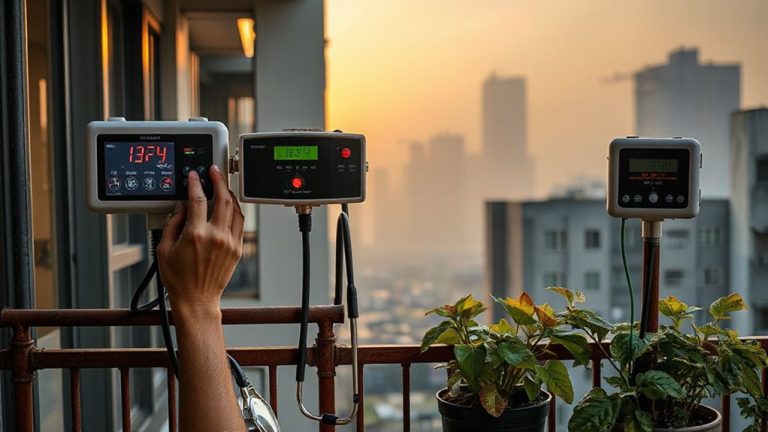
How do you find an air quality monitor that actually delivers in a busy office environment? Look for models with smart sensors that continuously track CO₂, VOCs, PM2.5, and humidity. Devices like the uHoo and Awair Element stand out for their strong data accuracy, validated in third-party lab tests, and stable long-term performance. Their real-time readings help you manage workspace conditions effectively. These monitors offer desktop or wall-mount options, quiet operation, and intuitive dashboards, making them suited for shared spaces. But don’t assume more features mean better results-some units over-promise on sensor precision. Calibration drift can occur after six months, so check for models with recalibration support or solid warranty coverage. While smart sensors improve responsiveness, make certain the unit’s update policy and app integration fit your office IT standards. Accuracy matters most when making health-related decisions.
Act on Air Quality Alerts
Getting accurate readings is only half the job-what you do with those alerts makes the real difference in maintaining a healthy office environment. You need smart data interpretation to spot trends, like rising CO₂ during afternoon meetings or VOC spikes after cleaning. Real-time alerts only help if they’re actionable, so use alert customization to set thresholds that match your team’s sensitivity-say, PM2.5 above 35 µg/m³ or humidity below 30%. High-end monitors let you fine-tune alerts by pollutant and time, reducing false alarms. But don’t assume automation replaces judgment. False alerts can cause complacency, and over-customization may mask real risks. Pair alerts with routine ventilation checks and scheduled HVAC maintenance. Look for models with clear dashboards, at least a 2-year warranty, and third-party testing validation. Balance responsiveness with practicality-your actions matter more than the device alone.
On a final note
You should get an air quality monitor if you want clearer insight into your office or home workspace. Models like the Airthings Wave Plus deliver accurate VOC, CO₂, and humidity readings with solid long-term reliability. They help reduce fatigue and headaches by catching pollution early. But don’t skip routine ventilation-sensors alert you, but don’t clean the air. Guarantee Bluetooth updates and a 2-year warranty for best value.