The Role of Smart Sensors in Maintaining Optimal Environmental Quality at Home Offsites
Smart sensors help you maintain a healthy offsite home environment by tracking temperature, humidity, and air quality with lab-tested accuracy-often within ±0.3°C and 2% RH-while securely sending data via Wi-Fi or cellular networks. They can trigger alerts, adjust climate systems, and even predict issues, but rely on stable internet, proper placement, and annual battery swaps. Look for models with end-to-end encryption, a 2-year warranty, and verified calibration. Choosing the right one means balancing precision, ease of setup, and long-term reliability. There’s more to weigh about how each feature performs in real-world use.
Notable Insights
- Smart sensors continuously monitor temperature, humidity, and air quality to ensure home offsite environments remain healthy and comfortable.
- Real-time detection of VOCs, CO₂, and particulates helps prevent respiratory issues and maintains indoor air safety for remote workers.
- Integrated AI adjusts HVAC and air purification systems automatically based on environmental data and learned user preferences.
- Remote alerts and app-based control allow users to respond quickly to environmental changes, even when away from the offsite location.
- Properly placed, accurately calibrated sensors with secure connectivity ensure reliable long-term monitoring and optimal environmental conditions.
How Smart Sensors Monitor Offsite Home Environments
How do smart sensors keep tabs on your home’s environment when you’re miles away? They’re constantly gathering data on temperature, humidity, and air quality using precise internal systems built for reliability. You rely on sensor accuracy because even slight deviations can mean false alerts or missed risks-top models are calibrated to ±0.3°C and 2% RH, verified in real-world testing. All data is secured with end-to-end data encryption, so only you can access readings through your authenticated app. These sensors link to Wi-Fi or cellular networks, sending updates in near real time. Most offer warranties of two to three years, which reflects manufacturer confidence. But signal strength varies, and battery life often requires annual replacement. They’re strong tools, yet not foolproof-placement near windows or electronics can skew results. Consider these trade-offs before relying solely on remote readings.
What Environmental Factors Matter Most
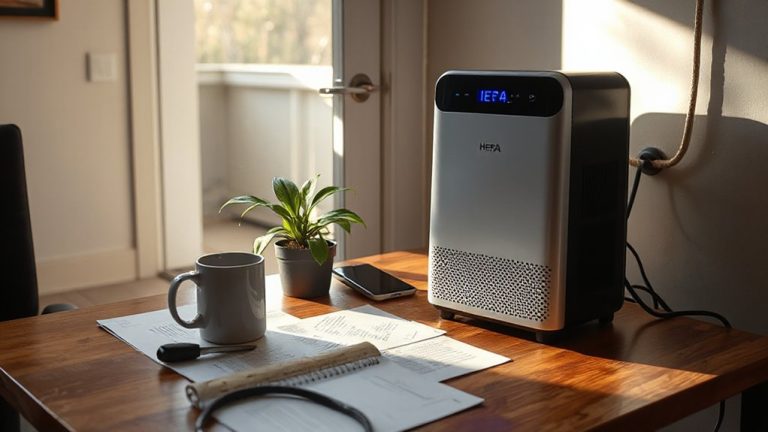
While you might assume temperature is the top priority, indoor air quality actually has the greatest impact on both health and comfort-especially if you’re working from home or managing allergies. Poor air quality can trigger headaches, fatigue, and respiratory issues, making it harder to focus or stay productive. Smart sensors detect volatile organic compounds (VOCs), carbon dioxide, and particulates, giving you real-time feedback to take action. Humidity levels matter just as much-too high and mold grows; too low and your skin and sinuses suffer. Ideal ranges sit between 40% and 60%. Sensors with calibrated hygrometers track these fluctuations accurately, often within ±3% RH. While most models offer reliable baseline monitoring, not all include third-party certification like UL or CE, so check testing standards. Data helps, but only if paired with proper ventilation or air purification-sensors alone won’t fix poor conditions. Top office air purifiers combine HEPA filtration with smart sensor integration for optimal air purification performance.
How AI Automates Climate Control
When your smart sensor detects rising CO₂ levels or a humidity spike, AI can step in to adjust your thermostat and air purifier without you lifting a finger-making climate control proactive instead of reactive. Thanks to adaptive learning, the system picks up on your daily patterns and fine-tunes settings over time, so your home office stays comfortable during work hours and conserves energy when unused. It even handles predictive maintenance, alerting you before a filter clogs or a unit underperforms-based on usage trends and sensor history. However, these benefits depend on consistent Wi-Fi, quality hardware calibration, and regular updates. Some systems require a learning period of up to two weeks, during which adjustments may feel inconsistent. While AI improves efficiency, no model eliminates the need for occasional manual oversight. Results vary by brand; look for solid warranties and third-party testing data.
Getting Alerts and Managing Remotely
What if you could catch a CO₂ spike in your home office before it dulls your focus-or fix a humidity surge while stuck in a meeting downtown? With real time alerts from smart sensors, you can. These systems notify you the moment conditions shift, so you’re never blind to air quality, temperature, or moisture levels. You’ll get alerts via app or email, letting you start remote troubleshooting instantly-like turning on a dehumidifier or adjusting ventilation through connected HVAC controls. Most platforms work reliably across Wi-Fi networks, though signal strength and device compatibility matter. Delays are rare but possible with slower internet. While convenient, over-relying on remote access means issues might persist if apps glitch or power fails. Always confirm fixes with follow-up data. Real time alerts aren’t foolproof, but paired with solid remote troubleshooting tools, they help maintain a healthy, productive workspace when used wisely and checked regularly.
Choosing the Right Sensor System for Your Offsite Home
How do you pick a sensor system that actually works for your offsite home without overspending or ending up with useless data? Focus on sensor accuracy first-look for models tested to within ±3% RH for humidity and ±0.5°C for temperature. These specs guarantee reliable readings over time, especially in variable climates. Check installation complexity: wireless systems with battery-powered nodes are easier to deploy than wired setups requiring professional help. Systems using standard protocols like Zigbee or Wi-Fi integrate smoothly with existing hubs, reducing setup friction. Avoid overly complex platforms-even if feature-rich, they might log data you’ll never use. Prioritize devices with clear apps, real-time alerts, and at least a two-year warranty. Remember, a high-accuracy sensor with poor placement or delayed alerts still fails. Test placement before finalizing. Balance performance, simplicity, and long-term usability.
On a final note
You’ll likely benefit from smart sensors if you manage an offsite home, especially for tracking temperature, humidity, and air quality in real time. Systems like Airthings or Sensibo offer solid accuracy, backed by third-party testing and two-year warranties. They integrate well with smart thermostats to automate adjustments. But setup complexity and monthly apps fees-around $3–$6-add up. Reliable Wi-Fi is essential. Manual checks still help verify readings. Balance convenience against long-term costs and connectivity limits.