Using Acoustic Ceiling Tiles in Drop Ceilings for Better Office Noise Control
You need acoustic ceiling tiles in your drop ceiling to cut office noise-open layouts let sound bounce everywhere. Tiles with an NRC of 0.7 or higher absorb up to 90% of airborne noise, especially when installed without gaps bigger than 1/8 inch. Mineral fiber offers the best balance of performance, durability, and cost. But ceiling tiles work best alongside carpet and wall panels. For real results, verify lab-tested NRC ratings and 10-year warranties-what comes next could change how you hear your workspace.
Notable Insights
- Acoustic ceiling tiles in drop ceilings absorb overhead sound, reducing noise in open-plan offices.
- Choose tiles with NRC ratings of 0.70 or higher for optimal speech intelligibility and noise control.
- Mineral fiber tiles offer balanced acoustics, durability, and moisture resistance for most office environments.
- Ensure tight installation with gaps no larger than 1/8 inch to maintain acoustic performance.
- Combine ceiling tiles with wall panels and carpeting for comprehensive office noise reduction.
Why Office Noise Demands Acoustic Ceiling Tiles
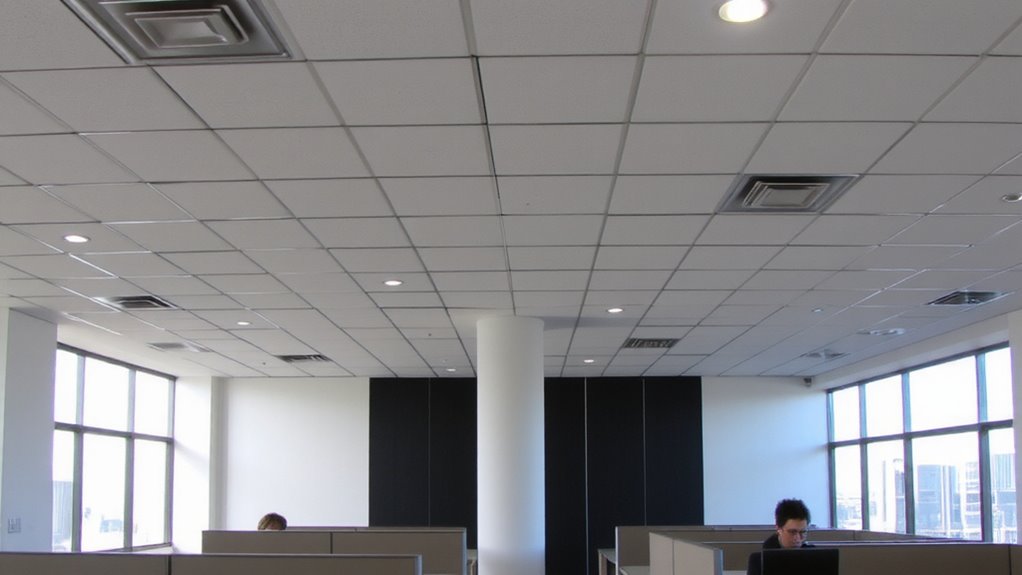
Ever wonder why your office still feels noisy even after adding carpets and wall panels? Open floor plans amplify sound, making conversations and typing carry across the room. That constant noise disrupts focus and cuts into employee productivity-studies show it can drop by over 15% in unchecked environments. While floor and wall treatments help, they don’t address sound bouncing off overhead surfaces, which make up a huge part of your office’s real estate. That’s where acoustic ceiling tiles come in-they absorb airborne noise at the source. They’re especially effective in drop ceiling setups, common in commercial spaces. Look for tiles with a Noise Reduction Coefficient (NRC) of 0.7 or higher for solid performance. But don’t expect miracles: poor placement or low ceilings reduce effectiveness. Combine them with smart office layout choices for best outcomes.
How Acoustic Ceiling Tiles Cut Office Sound

While sound bounces off hard surfaces like concrete or drywall, acoustic ceiling tiles absorb much of it-especially when you install them across large areas with minimal gaps. You get real echo reduction because the tiles turn sound energy into small amounts of heat through their porous materials. This isn’t just about volume-it’s about clarity. With better sound diffusion, noise spreads more evenly instead of clustering in harsh spots, making conversations easier without shouting. You’ll notice fewer overlapping sounds, which helps focus in open offices. But don’t expect total silence-these tiles mainly handle airborne noise, not structural vibrations. They work best when paired with wall panels and carpeting. Gaps larger than 1/8 inch at panel edges cut performance sharply, so precise fitting matters. Tests show up to 30% improvement in speech intelligibility with full coverage. Still, ceiling tiles alone aren’t a fix-all-they’re one part of a balanced noise control strategy.
Pick the Right NRC Rating for Your Office
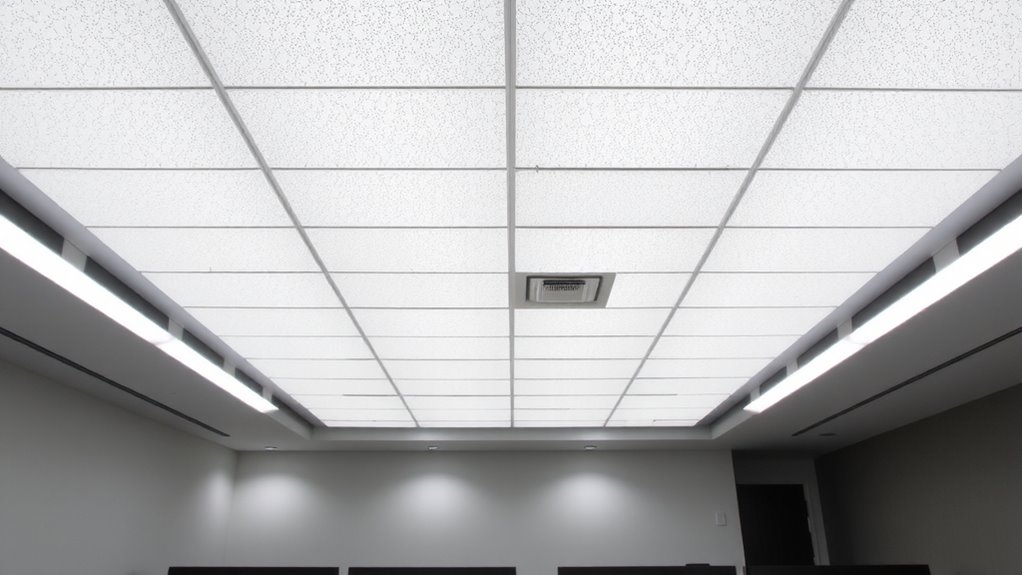
You need the right NRC rating to match your office’s noise level and layout-otherwise, you’re either overspending or underperforming. For most open-plan offices, an NRC of 0.70 to 0.90 delivers effective sound absorption without unnecessary cost. If your space has hard surfaces and high noise, go for NRC 0.85+; it handles mid to high-frequency sounds well, improving speech clarity. But don’t assume higher is always better-tiles with NRC above 0.95 offer diminishing returns and may not improve low-frequency response meaningfully. Consider the frequency response curve, not just the average NRC, since some tiles absorb certain tones better. Tiles rated at NRC 0.70 work fine for smaller offices with moderate chatter. Always verify lab test reports for real-world performance and check manufacturer warranties-most reliable ones cover sag resistance and sound performance for at least 10 years.
Compare Acoustic Tile Materials and Their Benefits
Acoustic performance starts with material choice, and mineral fiber tiles are your best bet for most office environments. They offer strong sound absorption-typically NRC 0.70 to 0.90-and provide solid tile durability, resisting sagging and moisture better than many alternatives. Their material sustainability is moderate: while they contain recycled content, they’re not always recyclable at end-of-life. Gypsum tiles deliver crisp aesthetics and excellent acoustics but are heavier and more brittle, raising installation and long-term maintenance concerns. Fiberglass options have high NRC ratings and resist mold, yet their fragility makes them less ideal where impact is likely. For eco-focused builds, cotton or PET felt tiles offer better material sustainability with decent acoustics, but at higher cost and lower tile durability. Choose mineral fiber for balanced performance, but confirm environmental specs if sustainability is a project priority.
Install Acoustic Tiles in Drop Ceilings (Step-By-Step)
Drop ceiling installations deliver fast noise control with smart prep being the key to clean results. Start by confirming your grid spacing-most systems use 2’x2’ or 2’x4’ panels-then measure the room to avoid cutting tiles unnecessarily. Slide tiles into the grid gently, maintaining consistent tile alignment to prevent gaps and uneven sound absorption. Work from the perimeter inward for better positioning.
| Step | Key Focus |
|---|---|
| 1 | Verify grid spacing matches tile size |
| 2 | Check tile alignment under overhead lighting |
| 3 | Test fit before final placement |
Misaligned tiles reduce acoustic performance and visual cohesion. While installation is DIY-friendly, poor grid stability or warped frames compromise results. Always inspect the ceiling structure first-weak suspensions lead to sagging. Proper fit guarantees maximum noise control without retrofitting.
Acoustic Ceiling Tile Styles That Fit Office Design
While noise reduction is the primary goal, the style of ceiling tiles matters just as much in shaping an office’s professional look. You’ll want tiles that support modern aesthetics without compromising performance. Many mineral fiber and fiberglass tiles now offer clean lines, subtle textures, and uniform edges that blend seamlessly into contemporary spaces. Choose white or light gray finishes to enhance lighting efficiency and maintain a bright, open feel. Design compatibility is key-match tile patterns and grid sizes (usually 2’x2’ or 2’x4’) to your existing ceiling system to avoid visual clutter. While smooth panels look sleek, perforated or fissured designs can add visual interest while improving sound absorption. Don’t sacrifice acoustics for style-check the Noise Reduction Coefficient (NRC), ideally 0.7 or higher. Be mindful that ultra-thin tiles may lack durability despite their modern look.
Avoid These Acoustic Tile Installation Errors
You’ve picked sleek, high-performance ceiling tiles that match your office’s modern look and deliver solid sound absorption-now don’t let poor installation undo all that progress. Improper grid alignment is a common misstep; if the suspension system isn’t level or square, tiles won’t seat correctly, leaving gaps that compromise both appearance and acoustic performance. You’ll also risk tile warping if you ignore environmental conditions-excess moisture or temperature swings during installation can cause panels to bend or buckle over time. Always acclimate tiles in the room for 24–48 hours before placing them. Handle them carefully, too, since dents or pressure marks won’t disappear. Use manufacturer-recommended grid spacing, typically 24” or 48”, and verify cross-tee alignment with a string line. Even high-rated NRC tiles underperform if the setup’s flawed-precision here guarantees lasting sound control and visual consistency.
On a final note
You’ll cut office noise effectively with acoustic ceiling tiles, especially in drop ceilings where sound bounces easily. Aim for tiles with an NRC of 0.7 or higher-they absorb more noise based on lab tests. Fiberglass tiles offer better performance than mineral fiber, but cost more. Install them squarely in grid frames to avoid gaps that leak sound. Remember, even top tiles won’t block all noise-combine them with rugs and panels for best results.