Choosing Ambient Lights With Uniform Light Distribution to Eliminate Hotspots
Choose LED ambient lights with wide 60–90 degree beam angles and frosted diffusers to evenly spread light and eliminate hotspots. Fixtures with matte reflectors or micro-lens arrays help prevent harsh spots, especially in home offices. Recessed troffers or surface-mounted panels spaced 4–6 feet apart deliver smooth coverage, but avoid mounting too close to walls. While LEDs offer flicker-free brightness and high CRI, cheaper models can still create glare-look for third-party tested performance. The right setup balances comfort, accuracy, and long-term reliability, and there’s more to optimizing your space than just the bulb type.
Notable Insights
- Choose fixtures with diffused lenses or frosted covers to soften light and prevent concentrated bright spots.
- Opt for LED panels with beam angles between 60° and 90° to ensure even spread without harsh intensity.
- Use symmetric or linear fixtures spaced 4 to 6 feet apart for consistent ambient illumination.
- Install ceiling-mounted white reflector panels or parabolic troffers to minimize glare and balance light output.
- Select high-CRI, flicker-free LEDs with color temperatures of 3500K–4500K for comfortable, uniform ambient lighting.
What Creates Light Hotspots in Ambient Fixtures?
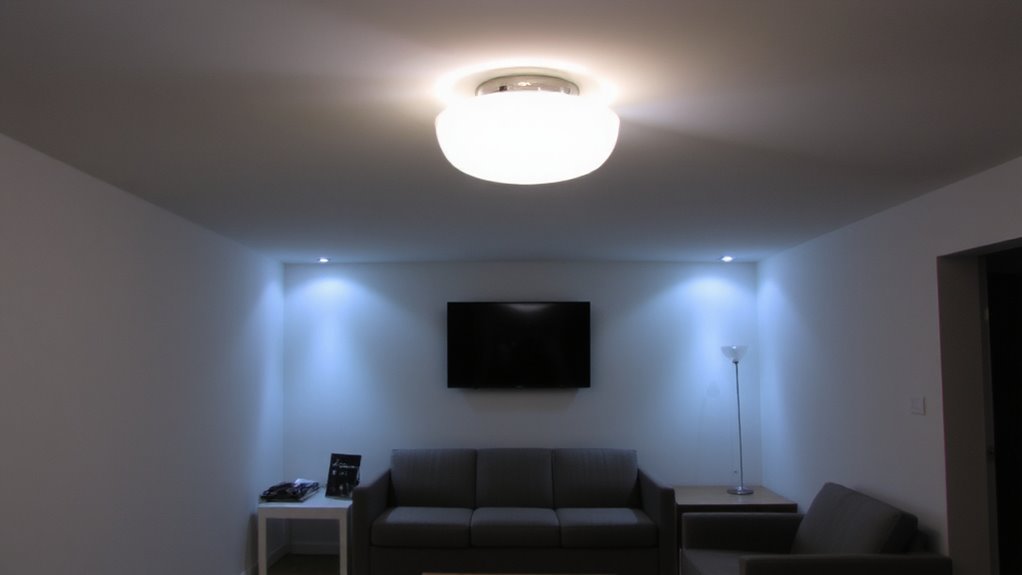
While ambient lighting should provide even, comfortable illumination, hotspots often appear when fixture design or placement isn’t carefully considered-so you’ll want to know what causes them. Hotspots usually happen when light intensity is too high in one area, often due to a narrow beam angle directing concentrated output. If your fixture has a beam angle under 90 degrees, it’s more likely to create pools of bright light instead of a smooth spread. You’ll also see this with poorly diffused LEDs, especially cheaper panels or recessed cans. Mounting height and spacing matter too-place fixtures too close together or too low, and overlapping beams increase intensity where you don’t want it. Opt for fixtures with wide beam angles (100+ degrees) and high-quality diffusers to minimize harsh contrasts. But remember, even well-designed lights can hotspot if installed incorrectly, so follow layout guidelines closely and test before finalizing placement.
How Even Lighting Improves Room Comfort
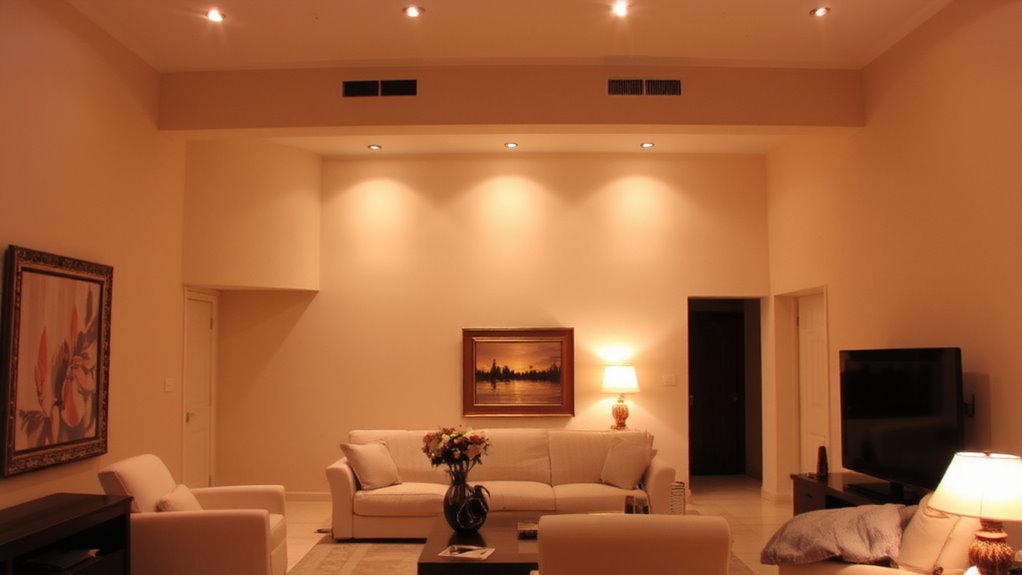
Since uneven light can strain your eyes and disrupt focus, achieving even illumination is key to a comfortable room-especially in home offices where tasks demand attention over long periods. You’ll work more comfortably when ambient lighting avoids harsh contrasts, letting your eyes adjust naturally. Pairing consistent distribution with the right color temperature-around 3500K to 4500K-supports alertness without overstimulation. This range aligns better with your natural rhythms, helping maintain energy during the day and easing shifts into rest. Uniform lighting also reduces glare on screens, a common issue with overheads that lack diffusion. While full-spectrum LEDs can enhance clarity, they’re not always necessary-many quality fixtures achieve balance without premium pricing. Look for models tested for flicker and rated for 25,000+ hours. Just remember: even output doesn’t guarantee comfort if placement or brightness is wrong for your space.
Diffusers, Reflectors, and Panels for Uniform Glow
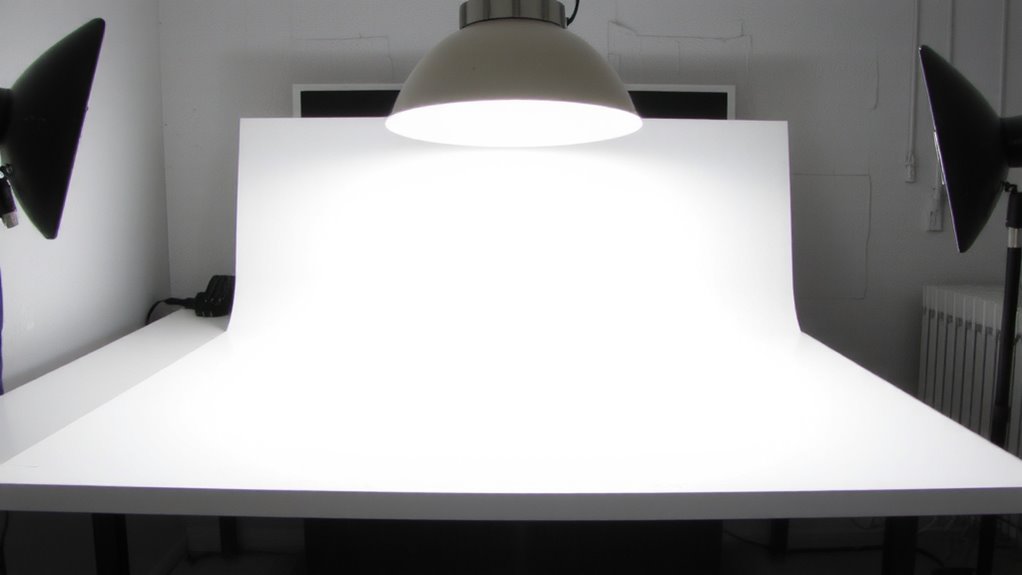
Many well-designed ambient lighting systems rely on diffusers, reflectors, and panels to create a uniform glow that reduces eye strain and enhances workspace quality. You can achieve even illumination through smart beam shaping and optical precision in fixture design. These components spread light evenly, minimizing harsh contrasts. A well-balanced setup often includes best home office lighting solutions that integrate these optical elements seamlessly.
| Component | Effect on Light |
|---|---|
| Frosted diffuser | Softens output, reduces glare |
| Parabolic reflector | Directs light with control |
| White panel | Bounces and evens distribution |
| Micro-lens array | Enhances beam shaping |
| Matte reflector | Prevents hotspots subtly |
While diffusers often lower overall brightness slightly, that trade-off is usually worth it for visual comfort. Reflectors offer stronger directionality but need correct alignment. Panels work best when ceiling-mounted with minimal gaps. For reliable performance, pick fixtures with tested optical precision and at least a 3-year warranty.
LED vs. CFL: Bulbs That Reduce Harsh Spots
How do you pick a bulb that cuts glare without sacrificing brightness? Choose LEDs over CFLs for better control and fewer harsh spots. LEDs deliver superior energy efficiency-using up to 75% less power than incandescents-and last far longer, with many rated for 25,000 hours or more, reducing replacement needs. CFLs, while somewhat efficient, dim over time and can create uneven glow, especially in open fixtures. LEDs also turn on instantly and maintain consistent color temperature, helping avoid visual fatigue. But not all LEDs are equal: look for models labeled “diffused” or “soft white” (2700K–3000K) to minimize glare. Some budget LEDs may flicker or emit cool tones that heighten eye strain, so check for flicker-free specs and a CRI above 90. Though pricier upfront, their bulb longevity and lower energy use offer real savings over time-especially in frequently used spaces. For optimal performance, pair your LED bulbs with a high-quality dimer switch.
Top Fixture Styles for Smooth Light Distribution
A well-designed fixture plays a crucial role in spreading light evenly and cutting down harsh contrasts, especially in workspaces where visual comfort matters. You’ll want fixture symmetry-like circular or square diffusers-since they distribute light uniformly, reducing glare and hotspots. Linear suspension lights and recessed troffers are top choices, especially when mounted at the right mounting height; too low and you get shadows, too high and coverage suffers. For desks or shared offices, symmetric surface-mounted panels offer consistent output without overbearing brightness. While they’re energy-efficient and long-lasting, check beam angles-ideally 60–90 degrees-and CRI values above 90 for accurate color rendering. Most come with 3–5-year warranties, but verify real-world performance. Don’t assume bigger is better; output must match room size. Fixture symmetry paired with proper mounting height guarantees balanced ambient light that supports focus without strain.
Where to Place Lights for Balanced Spread
Where should you actually position lights to avoid shadows and eye strain without overlighting the room? For balanced spread, focus on strategic ceiling placement and consistent wall spacing. Install fixtures evenly across the ceiling, spacing them about 4 to 6 feet apart in most standard rooms. This helps maintain uniform brightness and prevents dark zones. Aim for lights to be at least 2 feet from walls to reduce glare and harsh contrasts, especially in areas where tasks are performed. Recessed downlights should align in a grid, while surface-mounted panels work well in symmetrical layouts. Avoid clustering lights in one area-it creates hotspots. Keep in mind room height: if your ceiling’s over 9 feet, you may need higher-lumen fixtures. Proper layout minimizes shadows and boosts visual comfort, but incorrect spacing can undo even the best fixture choice. Consider choosing among the top office ceiling lights for models designed to provide even illumination and reduce eye fatigue.
Rooms That Need Uniform Ambient Lighting Most
Uniform ambient lighting isn’t just about brightness-it’s about consistency, and few spaces demand it more than home offices, kitchens, and study areas. You need even coverage to reduce eye strain and boost focus, especially where tasks are detail-oriented. Rooms with low natural lighting rely heavily on fixtures to fill shadows, making uniformity essential. High ceiling height can complicate this-lights mounted too high may create distance-based dimming, requiring higher lumen outputs or strategically placed units. Recessed ceiling lights or evenly spaced pendant arrays often work best, particularly when paired with diffusers to soften output. However, avoid over-lighting; too much brightness can wash out screens or cause glare. Test layouts using 3000K–4000K temperature bulbs for balance. Prioritize fixtures with wide beam angles and proven performance in independent photometric testing. Warranties of at least three years help guarantee longevity, since consistent use accelerates wear.
On a final note
You’ll get the smoothest ambient light using fixtures with diffusers and uniform LED arrays, which eliminate hotspots effectively. Look for models with wide beam angles (100+ degrees) and a CRI above 85 for truer colors. While LEDs outperform CFLs in control and efficiency, they cost more upfront. Always check warranties-5-year coverage often signals reliability. Position lights centrally or in grids, but avoid over-lighting small spaces, which can wash out screens and strain eyes.