Optimizing NVIDIA G-Sync Settings for Dual Monitor Gaming and Productivity
You should enable G-Sync only on your primary gaming monitor for smooth, tear-free gameplay, since NVIDIA officially supports it on one display only. Your secondary monitor works best with FreeSync or fixed refresh rates to avoid stutter and input lag. Match both monitors’ refresh rates-like 60Hz or 120Hz-for smoother window movement, but know that syncing doesn’t extend full G-Sync benefits. Use fullscreen mode and align displays physically for comfort. Setting this up right means better performance where it matters most-especially when you’re balancing fast-paced games with multitasking across screens.
Notable Insights
- Enable G-Sync only on the primary gaming monitor to ensure smooth, tear-free gameplay with minimal input lag.
- Set both monitors to the same refresh rate to reduce visual jarring during multitasking and window movement.
- Use a G-Sync compatible primary display and a FreeSync-capable secondary monitor for the best adaptive sync compromise.
- Disable G-Sync on the secondary monitor and when performing non-gaming tasks like video editing or browsing.
- Connect each monitor directly to the GPU using separate ports to prevent signal crosstalk and maintain optimal performance.
How G-Sync Handles Dual Monitors
While G-Sync can work across dual monitors, you’ll want to keep expectations realistic-NVIDIA officially supports G-Sync only on your primary display, meaning smooth, tear-free gameplay is guaranteed there, but the second monitor typically runs basic FreeSync or standard V-Sync without full G-Sync processing. Your display pairing matters: matching a G-Sync monitor with a FreeSync-compatible one often yields the best compromise, letting both screens benefit from adaptive sync to some degree. Signal routing through your GPU guarantees stable performance on the primary, but the secondary display doesn’t receive the same module-level calibration. You’ll notice smoother motion on your main screen, while the second may show minor tear or input lag during fast action. Real-world testing confirms this split in quality. Though not ideal for competitive gaming across both screens, it’s a functional setup for mixed productivity and leisure use-if you know the limits upfront.
Enable G-Sync for Dual-Monitor Gaming
If you’re aiming to enable G-Sync for dual-monitor gaming, start by setting your high-refresh-rate, G-Sync-compatible display as your primary monitor in both Windows and the NVIDIA Control Panel-this guarantees you get the full benefit of tear-free, low-latency gameplay where it matters most. Keep your second monitor in G-Sync Compatible mode only when extending the desktop, not during full-screen gaming across both screens.
| Setting | Recommendation | Reason |
|---|---|---|
| Cable Management | Use separate GPU ports | Prevents signal crosstalk |
| Monitor Alignment | Match physical height/angle | Reduces neck strain |
| G-Sync Mode | Enable on primary only | Avoids input lag spikes |
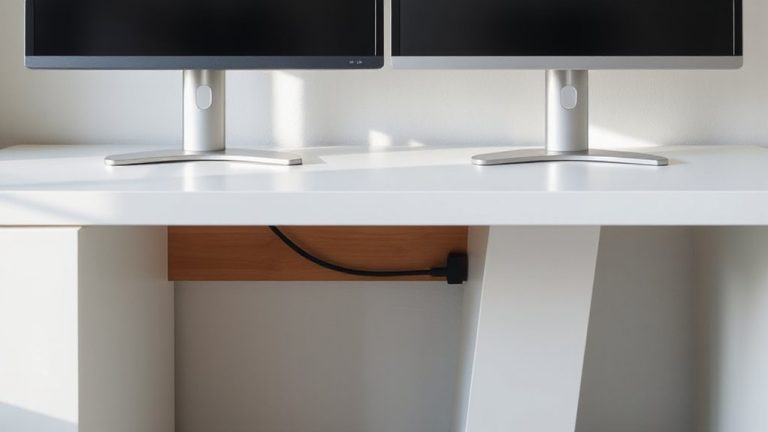
Poor cable management can cause interference, while misaligned monitors hurt posture. You’ll enjoy smoother gameplay, but expect minor syncing quirks when dragging windows across displays.
Match Both Monitors’ Refresh Rates
Though syncing both monitors at the same refresh rate can reduce visual jarring when moving windows across screens, you’ll want to set realistic expectations-matching refresh rates won’t enable G-Sync on your secondary display, and doing so may limit your primary gaming monitor’s performance. For smoother refresh synchronization, set both monitors to the lowest common refresh rate, like 60Hz or 120Hz, especially if one is a standard 60Hz productivity panel. This helps during everyday tasks, reducing motion mismatch during mouse movements or video playback. You’ll still need proper monitor calibration for color and brightness consistency. While this tweak enhances desktop fluidity, it sacrifices high-refresh performance on capable gaming displays. You’re trading peak responsiveness for visual harmony, which matters more in productivity than gaming. If your workflow involves constant window dragging across screens, the trade-off may be worth it. But prioritize performance if gaming dominates your use case.
Should G-Sync Run on One or Both Monitors?
Why would you expect G-Sync to work on both monitors when NVIDIA designed it to enhance gaming performance on a single primary display? You should enable G-Sync only on your primary gaming monitor for best results. While G Sync compatibility allows some flexibility, running it on both screens often causes lag or stutter in productivity apps. Monitor calibration also becomes harder when syncing two displays with different response behaviors.
| Use Case | Recommended | Why? |
|---|---|---|
| Gaming | One monitor | Prevents input lag |
| Video Editing | Off | Avoids playback inconsistencies |
| General Browsing | Off | No benefit, minor overhead |
| Competitive Play | One monitor | Guarantees maximum responsiveness |
Enable G-Sync selectively-your workflow and monitor calibration accuracy depend on it.
Stop Tearing When Gaming and Multitasking
When you’re gaming on your primary monitor while keeping an eye on chat, stream alerts, or a walkthrough on a second screen, screen tearing can become distracting-especially if G-Sync is disabled or misconfigured. You should enable G-Sync only on your primary display to maintain smooth frame pacing and minimize input latency during gameplay. Running G-Sync on both monitors often causes stuttering on the secondary screen, particularly when it’s running at a different refresh rate. While borderless windowed mode may help with multitasking, it can sometimes introduce minor frame pacing inconsistencies. Stick to fullscreen mode for the best performance. Make sure your GPU drivers are up to date, and manually verify G-Sync settings in the NVIDIA Control Panel. Remember, productivity gains shouldn’t compromise gaming responsiveness-prioritize stability where it matters most.
On a final note
You should enable G-Sync on both monitors if they’re both NVIDIA-compatible and run at matching refresh rates, as this cuts tearing during gaming and multitasking. Sync both displays to the same high refresh rate-like 144Hz-for smooth motion. But if one display lags in specs, turn G-Sync off there to avoid input lag. Mismatched setups can cause stutter, so test real-world performance. Use certified monitors with full G-Sync or G-Sync Compatible badges for reliability.