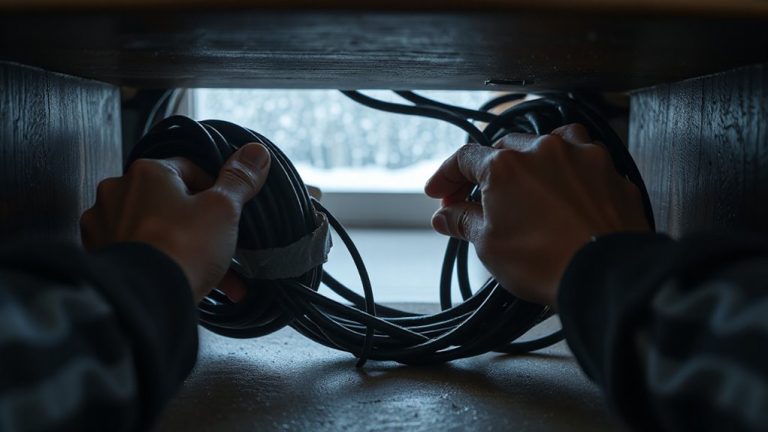
Winding Extra Ethernet Cable Around Plastic Reels Mounted Under Desk
Winding extra Ethernet cable around a plastic reel under your desk keeps things tidy and reduces connector strain, especially with models like the UCTRONICS reel that hold up to 30 feet of Cat6. Just mount it parallel to the edge using screws or adhesive pads, route the cable straight, and wind it evenly by hand without over-tightening. Avoid tight bends under 1 inch to prevent signal loss. It’s great for frequent use, but skip it if your cable stays plugged in all the time-there’s more to get right with placement and material.
Notable Insights
- Mount the plastic reel under the desk using screws or adhesive, ensuring it’s aligned parallel to the desk edge for smooth cable feed.
- Wind the Ethernet cable in even, flat loops around the reel to prevent tangles and jams during unspooling.
- Avoid tight bends smaller than 1 inch radius to maintain signal integrity and prevent internal wire damage.
- Leave 6–12 inches of slack on both ends for easy connection without needing to fully unwind the reel.
- Do not over-tighten the cable during winding and inspect the plastic reel regularly for wear or tension issues.
How Tangled Ethernet Cables Affect Your Workspace
While a few loose strands might seem harmless at first, letting your Ethernet cables tangle under the desk can quickly degrade both your workspace efficiency and overall safety. You’re not just dealing with clutter-kinks and bends introduce cable strain, weakening internal wiring over time. That physical stress can lead to fraying or connection drops, especially near the RJ45 connectors. Worse, coiled or tangled cables may suffer signal interference, particularly if routed near power cords or USB 3.0 devices, reducing your network speeds despite a wired connection. Even high-quality Cat6 or Cat7 lines aren’t immune to performance loss when poorly managed. Keeping cables loosely looped with secure fasteners reduces both strain and electromagnetic crosstalk. However, avoid tying them too tightly-tight bends exceeding a 1-inch radius can compromise signal integrity. Simple organization isn’t just tidy-it’s critical for maintaining connection stability and hardware longevity in any daily-driven setup. Using plastic reels mounted under desk can help maintain proper cable slack while keeping your setup clean and functional.
Best Under-Desk Reels for Ethernet Cable Storage
You’ll want a reel that keeps your Ethernet cable neatly coiled without risking damage, and the UCTRONICS Cable Management Reel stands out as a top pick for under-desk use. Its durable plastic frame and smooth winding mechanism make cable management simple, reducing strain on connectors during retraction. Measuring 4.7 inches in diameter, it fits most under-desk spaces while holding up to 30 feet of standard Cat6 cable. Mounting is tool-free, using strong adhesive pads that hold firm but allow repositioning. For desk organization, its low profile keeps things tidy without drawing attention. Still, the reel isn’t ideal for thick, industrial-grade cables-they may not spool evenly. Also, while the build feels solid, it’s not rated for constant heavy-duty use. If you need reliable, everyday order without clutter, this reel delivers, but inspect your cable gauge first.
How to Mount and Route Cable on Desk Reels
Since proper installation affects both function and longevity, mounting your desk reel correctly is key to maintaining clean cable control. Begin by checking the mounting alignment-most under-desk reels require a flat, stable surface and should sit parallel to the desk edge for smooth cable payout. Misalignment can create uneven cable tension, leading to snags or premature wear. Use the included screws or adhesive mounts as directed, but opt for screws where possible; they offer stronger hold over time. Route the Ethernet cable straight from the reel to your device to reduce friction and kinks. Avoid sharp bends near the reel’s exit point, as this increases internal cable stress. Test the setup by gently pulling the cable in and out-movement should feel consistent, without catching. Poor mounting alignment or excessive cable tension defeats the purpose, so take a few extra minutes to get it right. For optimal results, consider pairing your setup with a cable management solution designed for under-desk use.
Winding Techniques for Tangle-Free Ethernet Access
Getting the cable wound right on your desk reel makes all the difference when you need quick, snag-free access-think smooth payout and reliable retraction every time. Use consistent rotational tension control by hand-feeding the cable onto the reel without over-tightening, which can deform the wire or create kinks. Wrap it in even, flat loops to prevent overlapping, which leads to jams during unspooling. Ideal cable slack management means leaving 6–12 inches free at both ends so you can unplug and reach devices without rewinding frequently. Don’t wind hot or recently bent cable-let it relax first to avoid set twists. While plastic reels are lightweight and low-profile, they offer less tension precision than metal counterparts, so inspect regularly for wear. Real-world testing shows proper winding reduces tripping hazards and port strain, but poor technique increases friction, degrading performance over time. A well-organized setup enhances overall cable management efficiency and supports cleaner under-desk environments.
When to Use Under-Desk Reels (And When to Skip)
When does an under-desk reel actually make sense for your workspace? You should use one if you regularly disconnect Ethernet cables and want to reduce desk clutter. These reels keep cables tidy and within reach, especially in shared or compact setups. They’re ideal for offices where cable strain from constant tugging is a concern-reels distribute tension evenly, protecting connectors. But skip them if your Ethernet stays plugged in 24/7; in those cases, a simple cable sleeve or clip works just as well. Also avoid reels if your desk lacks at least 2 inches of clearance underneath-most plastic reels add bulk and may limit legroom. Mounting hardware varies, so check compatibility with your desk material. Reels aren’t for everyone, but when used right, they balance accessibility and cable health without overcomplicating your setup.
Keep Your Reels Neat Long-Term
Your under-desk reel’s long-term neatness hinges on consistent tension control and smart routing-skip these, and you’ll face snags or uneven coiling. You need steady tension control every time you wind the cable; too loose, and it’ll tangle, too tight, and you risk jacket damage over months of use. Route the cable in neat, sequential loops without crossing strands-that guarantees smooth payout and retraction. Cable labeling helps, especially if you’re managing multiple runs for a desktop, monitor, or VoIP phone. A labeled reel means you won’t unspool the wrong line during adjustments. Over time, dust and repeated handling wear down plastic reels, so check mounting screws every few months to prevent wobble. High-quality plastic reels with rounded edges reduce friction, but even the best fail without proper use. Balance ease of access with disciplined rewinding-neatness won’t last if you rush the process.
Why Under-Desk Reels Beat Cable Ties and Clips
While cable ties and clips might seem like quick fixes for a messy under-desk setup, they often fall short when long-term function and flexibility matter. Under-desk reels offer smarter cable management because they let you adjust cable length on the fly-no cutting or re-tying. You wind your Ethernet neatly around the reel, preserving signal quality and reducing wear. Unlike rigid ties, reels support ongoing desk organization by making it easy to unplug, move devices, or reposition your workspace. Most quality reels mount with screws or strong adhesive, staying secure without damaging surfaces. Still, they take more space-about 2–3 inches per reel-so measure clearance before installing. Reels aren’t perfect for every cable, but for Ethernet, they beat the permanence of ties. If you value clean setups and future flexibility, reels are a practical upgrade worth considering.
On a final note
You’ll keep your workspace cleaner and cable access easier with under-desk reels, especially if you frequently unplug or move equipment. Models like the J Channel or Reelworks Pro use solid ABS plastic and hold up to 50 ft of Cat6 without kinking. They mount in minutes with screws or adhesive, but avoid them on ultra-thin desks or if you rarely adjust cables-sometimes a velcro tie is simpler and just as effective. Reels work well, but only when your setup truly needs flexible access.