Stockpiling Surge Protectors Rated for Industrial Voltage Variance
You should stock surge protectors with at least 1,500 joules, sub-nanosecond response times, and IP67-rated enclosures to handle industrial voltage spikes. Look for thermal-fused MOVs, UL 1449 certification, and IEEE C62.41 compliance to guarantee durability in harsh conditions. Models like Eaton 5S15WB or Leviton 5449-CW offer reliable protection for sensitive equipment but cost more and aren’t suited for office use. Warranties up to 10 years back long-term performance-if you keep going, you’ll see how placement and specs match specific site risks.
Notable Insights
- Choose surge protectors with 1,500+ joule ratings to handle high-energy industrial voltage spikes effectively.
- Prioritize models with sub-1 nanosecond response times to block fast transients before they damage equipment.
- Select UL 1449-certified, 3-phase capable units like Eaton 5S15WB or Tripp Lite ISOBLOC6ULTRA for industrial reliability.
- Ensure IP67-rated enclosures and conformal-coated PCBs to withstand dust, moisture, and harsh environments.
- Stock units with thermal fusing and end-of-life indicators to maintain protection and prevent fire risks.
How Voltage Spikes Damage Industrial Equipment
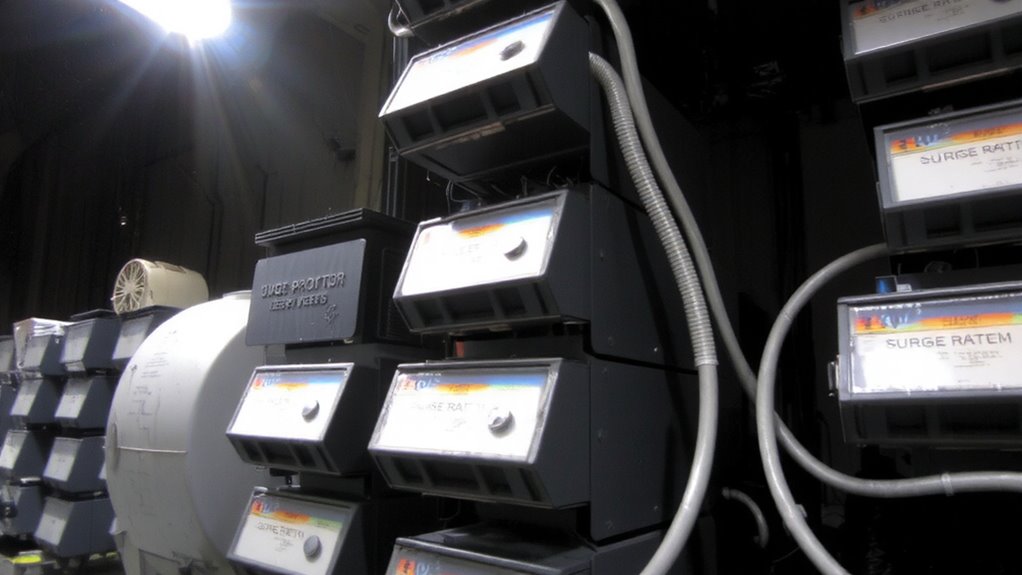
A sudden voltage spike can fry sensitive components in industrial machinery faster than you’d think-sometimes in microseconds. You’re dealing with forces that create electrical arcing, where current jumps across insulation or gaps, melting contacts and igniting fires. Even minor surges contribute to component degradation over time, weakening semiconductors, capacitors, and control boards until failure seems random-but it’s not. These repeated stresses reduce operational life by 30% or more in unguarded systems. You need protection that reacts in nanoseconds, clamping excess voltage before it penetrates. Devices with metal oxide varistors (MOVs) and gas discharge tubes help, but they wear out after big events. Check for units rated at least 40kA per phase and verify end-of-life indicators. There’s no permanent fix-just managed risk. Test regularly, replace worn units, and assume no surge protector lasts forever under constant exposure.
Choose Surge Protectors for Harsh Conditions
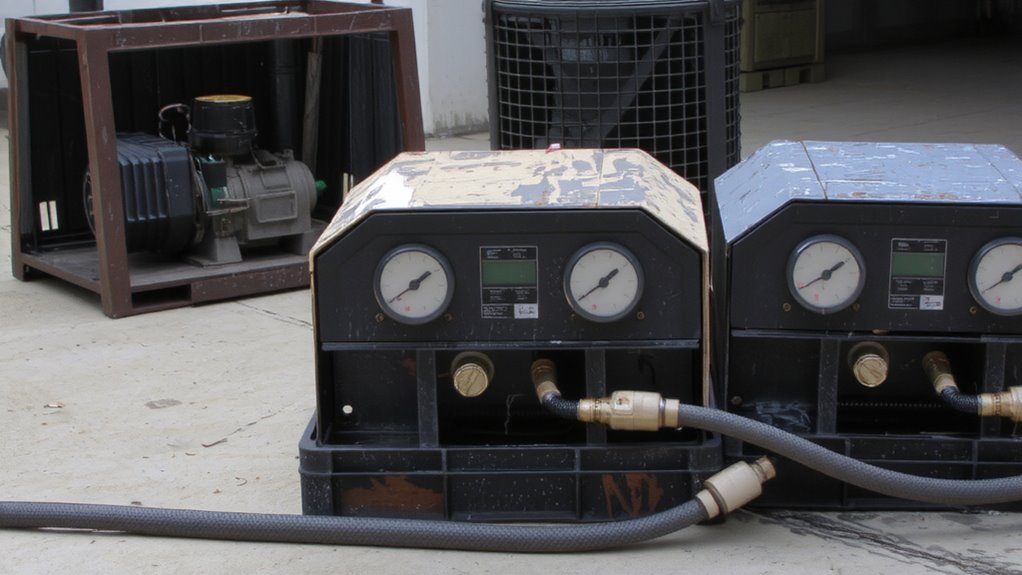
When your equipment runs in dirty power environments with extreme temperatures, dust, or moisture, you can’t rely on standard surge protectors-they’ll fail fast and leave systems exposed. You need units built for environmental exposure and mechanical durability. Look for rugged housings, sealed components, and wide operating ranges.
| Feature | Why It Matters |
|---|---|
| Metal oxide varistors (MOVs) with thermal fusing | Prevents fire risk during overload |
| Conformal-coated PCBs | Resists moisture and corrosion |
| -30°C to 85°C range | Handles extreme temps without derating |
| IP55+ rated enclosures | Blocks dust and water ingress |
These protectors withstand vibrations, thermal swings, and contaminants common in factories or outdoor setups. But remember: higher durability often means slightly slower field replacement. Test units under load before full deployment. Warranties of 5+ years signal confidence-stick with those.
Joule Ratings, Response Time, and IP Ratings Explained
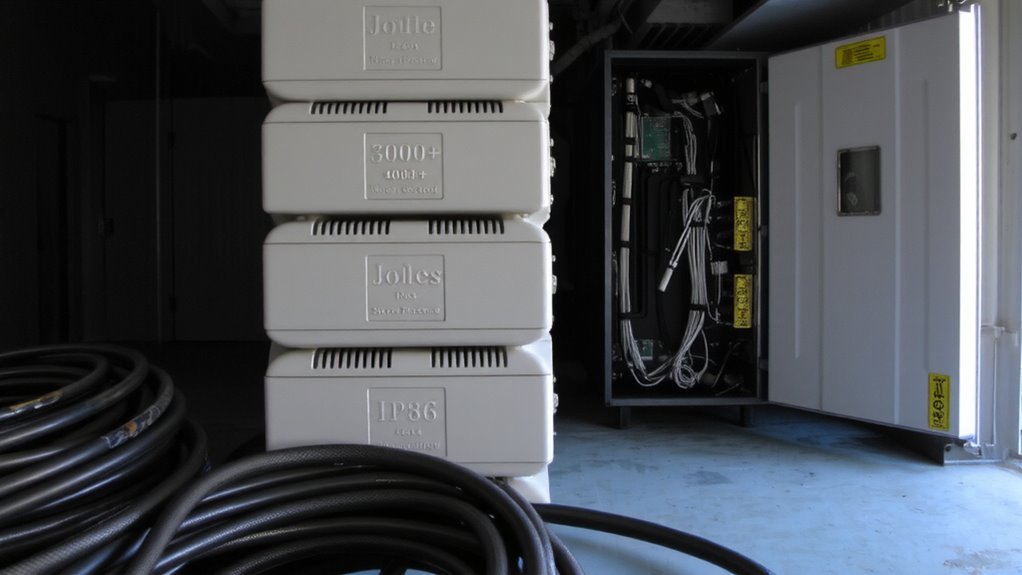
You’ll want to pay close attention to joule ratings, response time, and IP ratings-these specs aren’t just numbers on a label, they directly determine how well your surge protector defends equipment in industrial settings. A higher joule rating, like 1,500 or more, means greater energy absorption, reducing the risk of thermal runaway during sustained surges. Faster response times-under 1 nanosecond-help block spikes before they reach sensitive circuits. Look for units tested to clamp electromagnetic interference, which can disrupt control signals in motor-heavy environments. An IP67 rating guarantees dust resistance and temporary water submersion protection, essential in washdown areas or outdoor enclosures. But remember, no protector lasts forever; frequent surges degrade components even if no failure’s visible. Always verify warranty terms and indicator alerts that signal end-of-life. These specs combined offer real defense, but they’re only effective if matched precisely to your site’s electrical behavior and environmental stress.
Deploy Surge Protection Where It Matters Most
Where should you install surge protection to get the most benefit? Focus on main distribution panels and critical subpanels-these spots maximize fault isolation and support effective load balancing across systems. Placing protectors at service entrances catches surges before they spread, minimizing damage risk to downstream equipment. You’ll also want them at points where power splits to sensitive zones, like control circuits or motor drives. This setup doesn’t eliminate the need for proper grounding or coordinated protection layers, but it sharply reduces vulnerability. Keep in mind: while strategic placement improves resilience, no single device can cover every failure mode. Guarantee devices meet IEEE C62.41 standards and have at least a 10-year warranty to verify durability. Test periodically to confirm clamping performance hasn’t degraded. Smart positioning gives you stronger, more predictable protection without overbuilding.
Match Protectors to Sensitive Equipment Needs
Choosing the right surge protector isn’t just about where you install it-your equipment’s specific needs matter just as much. You need to match surge protectors to each device’s equipment compatibility and voltage tolerance. Sensitive industrial gear like PLCs or motor drives often demands tighter voltage regulation and faster clamping response than standard models offer. If your equipment can’t handle even minor fluctuations, you’ll want protectors with low let-through voltage and high joule ratings-think 600+ joules with <400-volt clamping. Just don’t assume more protection is always better; excessive filtering can interfere with signal integrity. Also, verify plug and outlet compatibility with industrial connectors like NEMA L5 or L6. Always check warranty terms-some brands offer connected equipment coverage, but exclusions apply. For dependable performance in office environments, consider models featured in the top surge protector picks.
Top Industrial-Rated Surge Protector Models
Durability and precision define the best industrial surge protectors, and three models consistently stand out under heavy-duty conditions. You’ll want the Tripp Lite ISOBLOC6ULTRA for its superior EMI filtering and isolated outlets, which minimize electrical noise in sensitive control systems. The Eaton 5S15WB offers a robust 4,500-joule rating and includes thermal cutoff protection that stops overheating during sustained surges. Meanwhile, the Leviton 5449-CW handles voltage swings up to 600V and integrates fail-safe circuitry that alerts you when protection degrades. All three are UL 1449 certified and rated for 3-phase environments, making them reliable in factories or data hubs. But keep in mind, they’re larger and pricier than office-grade units-don’t waste them on home workstations. Install them only where voltage spikes and electromagnetic interference threaten critical machinery. For guidance on evaluating protection levels and selecting the right unit, consult a comprehensive buying guide.
On a final note
You’ll cut downtime and protect critical gear by choosing industrial surge protectors with at least 3,000 joules, sub-1 nanosecond response, and IP65+ ratings. Units like the Eaton 5S15WS or Tripp Lite SS6M offer real-world durability and UL 1449 certification. Just remember-proper grounding and correct voltage rating (e.g., 480VAC) are non-negotiable. Surge protection works best when matched precisely to load and environment.