Choosing the Right Surge Protection Devices for Sensitive Equipment in Remote Environments
You need Type 1 or Type 2 SPDs with at least 40kA per mode and clamping under 600V to protect sensitive off-grid gear from lightning and surges. Look for UL 1449 and IEC 61643-11 certification, IP66+ housing, and operation down to -40°C or up to 85°C to survive harsh conditions. Proper grounding and short wire runs are non-negotiable-SPDs fail if wiring’s off. Models with status indicators or remote alarms save trips. Even top units degrade, so pick ones with 10-year warranties and modular replacements on hand. The best protection balances rugged specs with real-world reliability-what works in the lab might not last a monsoon season or a desert summer. You’ll see how top brands stack up under extreme stress.
Notable Insights
- Select Type 1 or Type 2 SPDs with at least 40kA per mode to protect against lightning and load-switching surges.
- Ensure SPDs have a clamping voltage below 600V and low let-through voltage to safeguard sensitive 120V equipment.
- Choose SPDs rated for -40°C to 85°C with IP66 or higher enclosures to withstand extreme remote environments.
- Prioritize units with remote monitoring, status indicators, and modular designs for reliable maintenance and failure alerts.
- Install SPDs with short, direct grounding paths and verify wiring annually to maintain protection in unattended locations.
Why Surge Protection Can’t Be Skipped Off-Grid
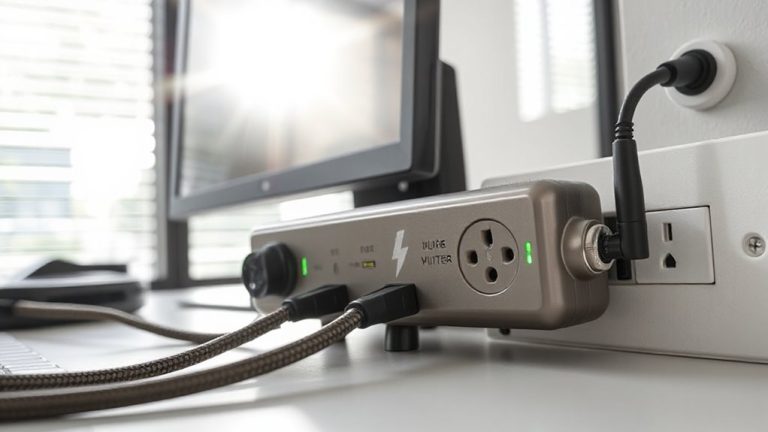
While living off-grid gives you independence from the utility grid, it doesn’t shield your equipment from voltage spikes-and skipping surge protection puts your entire system at risk. Even without grid dependency, your solar charge controllers, inverters, and communication gear face power instability from lightning, wind-driven surges, or sudden load shifts. Voltage spikes above 600V can fry circuitry in seconds, and without layered protection, one strike could cost thousands. You’ll need Type 1 or Type 2 SPDs at key junctions-like generator or solar array inputs-to divert surges safely. Look for units with a minimum 40kA per mode, status indicators, and UL 1449 certification. Most carry 5-year warranties, but proper grounding is non-negotiable. Real-world testing shows SPDs reduce failure rates by up to 85%, yet they won’t fix poor wiring. Budget models may skimp on response time or thermal disconnects-don’t compromise here. For reliable performance, choose from the best surge protectors that meet rigorous safety and durability standards.
Which SPD Type Fits Your Remote Equipment?
You need the right SPD type to match your off-grid setup, not just any model off the shelf. For sensitive remote equipment, Type 2 SPDs are usually your best bet-they handle most voltage spikes from indirect lightning or grid switching. But if you’re near tall terrain or use long cable runs, consider Type 1, even off-grid, since they survive bigger surges. Always check equipment compatibility: mismatched SPDs can clip waveforms or delay response, risking devices like radios or data loggers. Look for units with low let-through voltage-under 600V-and a clamping voltage around 400V for 120V systems. Brands like Eaton and Phoenix Contact test thoroughly, offering warranties up to 5 years. Just remember, no SPD works forever. They wear with each spike, so monitor status indicators or replace every 3–5 years. Performance matters, but only if it fits your real-world conditions. Consider models with high joule ratings for added durability in unpredictable environments, as top picks often feature surge protector ratings that reflect superior energy absorption capacity.
How Heat, Cold, and Moisture Break SPDs
When extreme temperatures or humidity get into the mix, even top-tier surge protective devices can fail before their rated lifespan. Thermal expansion from heat cycles stresses internal components, while cold makes materials brittle and less conductive. Moisture brings condensation buildup inside enclosures, leading to corrosion or short circuits-especially in unheated, remote sites. You need SPDs built for these realities, not just lab ideals.
| Condition | Effect on SPDs | Common Result |
|---|---|---|
| High Heat | Accelerates thermal expansion | Cracked PCBs, failed MOVs |
| Deep Cold | Reduces material flexibility | Connector fractures |
| High Humidity | Promotes condensation buildup | Corrosion, ground faults |
Always check IP ratings and operating ranges. A rugged SPD might handle -40°C to 85°C, but not all do. Don’t assume outdoor-rated means weatherproof. Verify real-world testing data, not just specs.
7 Must-Have Features for Remote-Ready SPDs
What makes an SPD truly ready for remote deployment? You need rugged build quality that guarantees remote durability and long-term uptime without oversight. Look for units with environmental resilience-sealed housings (IP66 or higher), operating ranges from -40°C to +85°C, and corrosion-resistant materials. Metal oxide varistors (MOVs) with low clamping voltage (<1.5 kV) and high surge current capacity (at least 40kA per phase) protect sensitive electronics reliably. Remote monitoring via dry contacts or Modbus helps detect status without on-site checks. However, don’t assume all “rugged” SPDs perform equally-check third-party test reports like IEC 61643-11 and manufacturer warranties (10-year minimum preferred). Even with strong specs, no SPD lasts forever under repeated surges, so factor in replacement costs. Choose wisely-your site’s reliability depends on it, and repairs miles from help aren’t an option.
How to Install & Maintain SPDS Miles From Help
Choosing the right SPD is only the start-installing and maintaining it properly, especially in remote locations, determines long-term protection. You need correct wiring configurations to avoid voltage spikes bypassing the unit; always follow manufacturer specs for conductor length and gauge. Improper grounding techniques drastically reduce effectiveness, so bond the SPD to a low-impedance earth ground using short, straight paths. Check connections annually, since vibration and temperature swings loosen terminals over time. In isolated spots, use SPDs with visual status indicators and remote alarms so you don’t miss failures. While modular designs simplify swaps, keep spares on-site-hours from help mean delays cost uptime. Most units last 5–10 years, but frequent surges shorten lifespan. Warranties often cover connected equipment, but read fine print: some exclude lightning damage. Test monthly if possible, and log results to catch degradation early.
On a final note
You need surge protection for off-grid gear-period. Opt for Type 1 or Type 2 SPDs with at least 40kA per mode, IP65 enclosures, and wide operating temps (–40°C to 85°C). Units with thermal disconnects and status indicators save headaches later. But remember: SPDs wear out, especially in harsh conditions, so check them yearly. No warranty beats real-world durability, so pick brands proven in field tests, not just specs.