How to Use Floating Floors to Isolate Impact Noise in Ground-Level Home Offices
You can cut impact noise by up to 70% in your ground-level home office with a floating floor and high-density rubber underlayment, which boosts IIC ratings to 65 or higher. Decouple the floor from the subfloor using a proper acoustic membrane and seal all seams and perimeter gaps to block sound leaks. Follow manufacturer specs for isolation at wall junctions. For best results, combine with area rugs and door seals-performance improves further when layered with other controls.
Notable Insights
- Install a floating floor with rubber underlayment to reduce impact noise by up to 70% through effective decoupling.
- Choose underlayment with high IIC ratings (65+) for optimal sound insulation, especially in ground-level offices near sidewalks or appliances.
- Ensure complete perimeter isolation and sealed seams to prevent sound leakage and maintain acoustic performance.
- Use acoustic membranes or mass-loaded barriers beneath the underlayment to enhance damping and block structure-borne vibrations.
- Combine floating floors with rugs, door seals, and sound masking for maximum noise reduction in home office environments.
Why Your Ground-Level Office Needs Noise Isolation
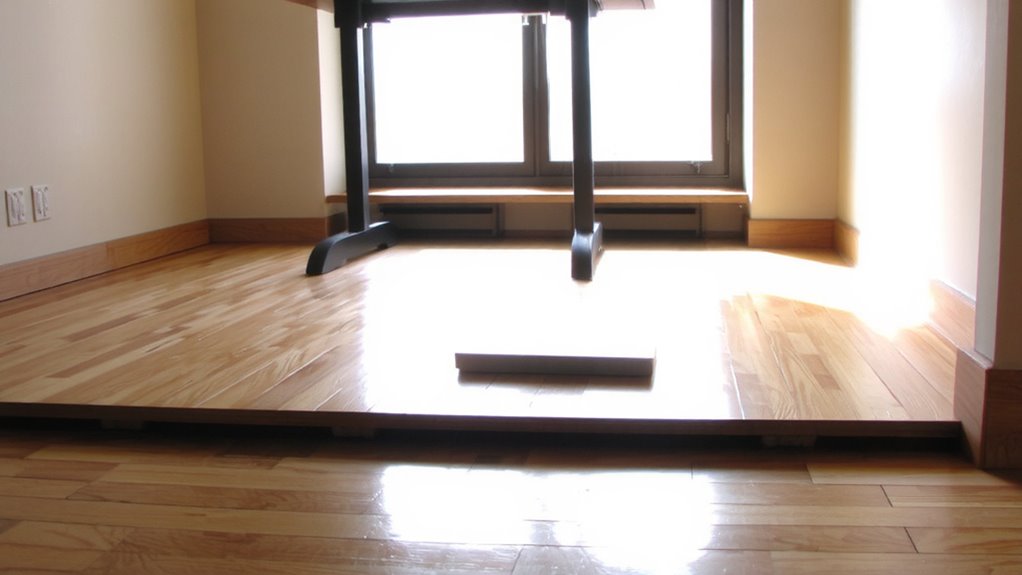
Why should your ground-level office get serious about noise isolation? Because everyday sounds-footsteps, appliances, outdoor activity-easily penetrate standard flooring, disrupting focus. Acoustic insulation isn’t just for studios; it’s essential when you need consistent quiet. Without it, conversations leak out and distractions creep in. Vibration damping matters too, especially near sidewalks or laundry rooms, where structure-borne noise travels through walls and floors. Floating floors deliver both: they decouple from the subfloor, using resilient underlayments to absorb sound energy. Real-world tests show up to 50 dB reduction in airborne noise with proper installation. But don’t expect magic-edges must be sealed, and underlayment thickness (usually 2–5 mm) affects performance. Most quality systems come with 10-year warranties, though longevity depends on foot traffic and furniture loads. Balance expectations: floating floors improve isolation considerably, but complete silence demands additional measures.
How Floating Floors Block Impact Noise
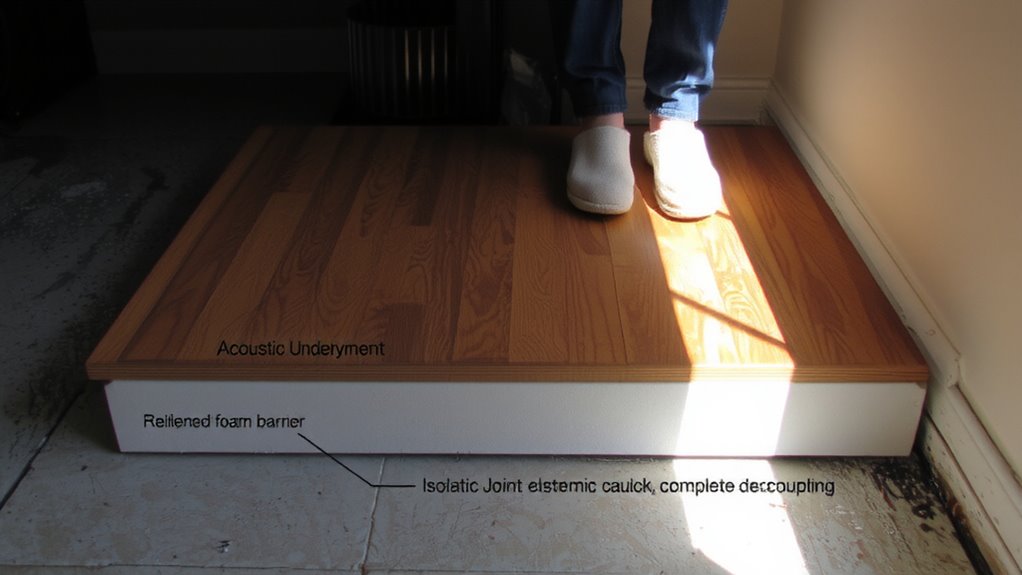
While they won’t eliminate every footstep, floating floors can cut impact noise by up to 70% when built with the right underlayment and installed correctly. The secret’s in the design: floating floors use decoupling layers to separate the new floor from the subfloor, preventing vibrations from traveling through. Acoustic membranes add mass and damping, reducing how much sound energy transfers into the structure. This setup disrupts impact noise at the source.
| Layer | Purpose | Common Materials |
|---|---|---|
| Decoupling layer | Breaks structural connection | Resilient channels, rubber |
| Acoustic membrane | Adds damping and mass | Mass-loaded vinyl, asphalt |
| Finish floor | Provides surface durability | Engineered wood, luxury vinyl |
Properly installed, the system markedly reduces footfall noise. Yet, seams, wall junctions, or poor sealing can weaken performance. Follow manufacturer specs closely-especially around perimeter isolation.
Choose Underlayment for Maximum Sound Reduction
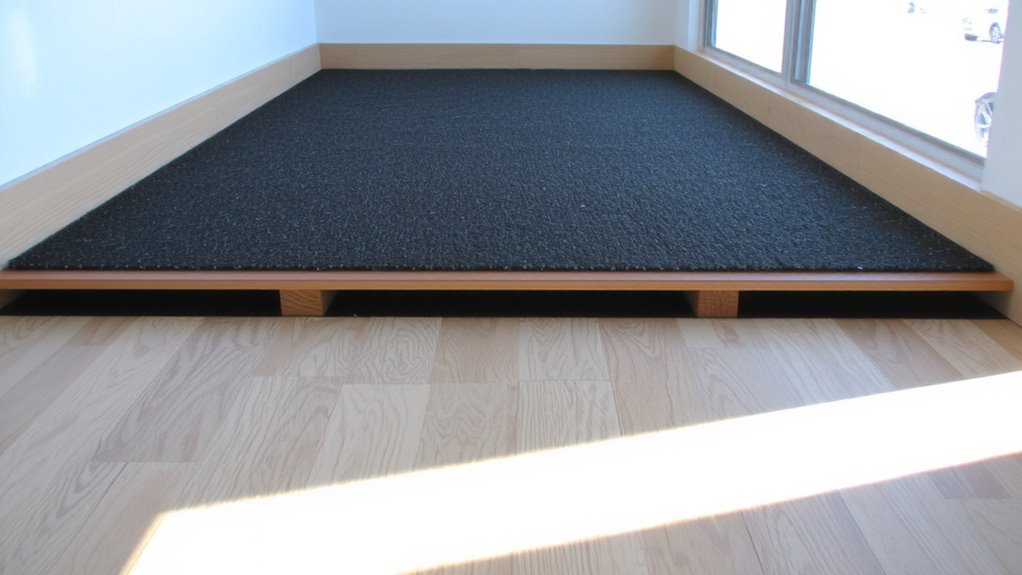
A well-chosen underlayment can nearly halve the noise that travels through your floor, making it one of the most effective upgrades for a quiet home office. For maximum sound reduction, pick materials with strong acoustic insulation and vibration dampening, like rubber, cork, or foam composites. Rubber underlayments typically offer the best impact noise reduction, often achieving IIC (Impact Insulation Class) ratings of 65 or higher when paired with floating floors. Cork adds natural thermal benefits and moderate sound blocking, while foam is affordable but less durable over time. Always check manufacturer test reports for real-world performance data, not just lab specs. Thickness matters-aim for 3mm to 6mm-but thicker isn’t always better if the material lacks density. Some underlayments include moisture barriers, which help in basements but may not be needed on ground-level installations. Read warranties carefully; longer coverage often signals confidence in long-term performance.
Install a Floating Floor for Noise Control
How do you turn a noisy home office into a quieter, more focused workspace? Install a floating floor-it’s your best bet for reducing impact noise without major renovation. You snap planks or tiles together over a sound underlayment, creating a decoupled surface that floats above the subfloor. Proper floor alignment guarantees tight seams and prevents wobbling, which can compromise noise control and durability. Always check material compatibility: not all laminate or engineered wood works as a floating floor, and using incompatible adhesives or substrates weakens performance. Most quality systems handle everyday office loads with minimal deflection. Real-world testing shows up to a 20 dB reduction in footfall noise. But floating floors aren’t ideal for high-moisture areas, and warranties often void if installed incorrectly. Plan carefully and follow manufacturer specs.
Avoid These Floating Floor Installation Mistakes
One of the most common missteps with floating floors is skipping the manufacturer’s recommended underlayment-don’t cut corners here, since the wrong or missing layer compromises both noise reduction and structural integrity. Improper adhesive use can ruin the “floating” design, leading to squeaks and separation. You also risk gaps and uneven wear if you ignore uneven subfloor leveling before installation. Always test the subfloor with a 4-foot level-any gap over 3/16 inch needs correction. Below is a quick-reference table of key mistakes and their consequences:
| Mistake | Consequence | Solution |
|---|---|---|
| Skipping underlayment | Poor noise control | Use manufacturer-specified padding |
| Improper adhesive use | Floor locks fail | Avoid glue unless required |
| Uneven subfloor leveling | Gaps, creaks | Level with self-leveling compound |
| Over-tight planks | Warping | Leave 1/4″ expansion gap |
| Ignoring humidity | Swelling | Acclimate planks 48 hours |
Combine With Rugs, Door Seals, and Panels
You can boost your floating floor’s noise control by pairing it with area rugs, door seals, and acoustic panels-but only if you choose the right products and install them correctly. Thick area rugs with dense padding reduce footfall noise and improve sound absorption, especially over hard-surface floormats. Door seals, like vinyl or rubber sweeps, prevent sound leakage under doors-look for ones with a 3/8-inch seal and secure mounting. Acoustic panels made of rigid fiberglass or foam help control reverberation, though they don’t block impact noise. Hang them at reflection points for best results. Add acoustic curtains on windows or walls to further dampen noise; they’re not as effective as panels but offer flexibility. For ongoing background noise, consider sound masking devices that emit low-level white or pink noise to cover speech. These solutions work together, but improper placement or low-density materials will limit gains.
Test Your Office’s Noise Reduction
A well-designed noise control setup should deliver measurable improvements, not just promise them. You’ll want to conduct simple acoustic testing before and after installing your floating floor to see real results. Start with a baseline measurement: use a smartphone sound meter app in your office while someone walks or drops a book nearby, then record the decibel level. After installation, repeat the test under the same conditions. Most quality floating floors cut impact noise by 15–20 dB, but results vary based on subfloor flatness and perimeter gap sealing. Don’t skip the control test-without a baseline measurement, you can’t verify performance. Keep in mind that while floating floors reduce footfall noise, they won’t block airborne sound like voices. Acoustic testing gives you objective data, not guesses.
On a final note
A floating floor can sharply cut impact noise in your ground-level office, especially with 2mm+ mass-loaded vinyl or 6dB+ rated underlayment. It’s effective but requires sealing all edges and avoiding slab contact. Pair it with area rugs and door sweeps for real-world results. Remember, no setup blocks all sound-expect 50–70% impact reduction, not silence. Follow manufacturer warranties and test with a decibel meter to confirm performance.